
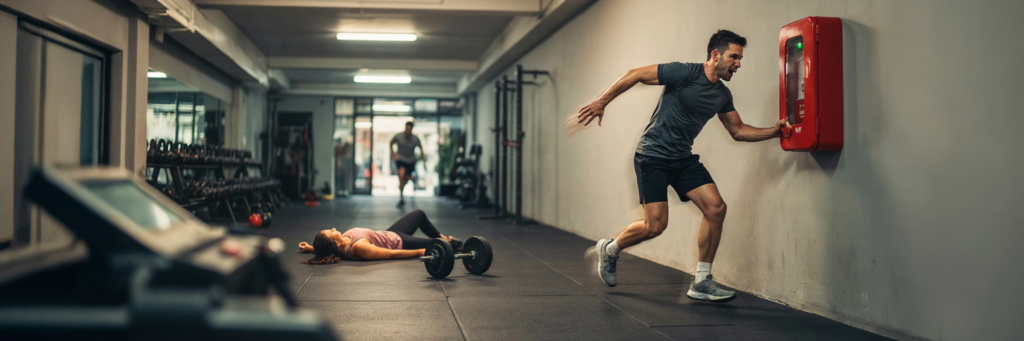
You’re halfway through a Saturday morning session. Client’s on their second set, and then they’re not. They’re on the floor. Not responding. Not breathing right. Every trainer, coach or instructor pictures this moment at some point, usually at 2am when they can’t sleep, and then pushes it out of their head because it’s easier than sitting with it.
Here’s the bit that actually matters though: you don’t need to be a paramedic to handle this. If your gym, pool or studio’s got an AED nearby (most do now), it’s built to walk you through the whole thing out loud. You grab it, you turn it on, it talks. Learning how to use an AED isn’t some separate skill you need years to master, it plugs straight into the CPR training you’ve probably already got.
This guide runs you through when to actually reach for one, the exact steps once it’s in your hands, how it works alongside CPR (not instead of it), whether you need formal training first, and where these things usually live in Brisbane gyms and pools so you’re not hunting for one mid-emergency.
When You Actually Need to Reach for an AED
Not every collapse is a cardiac arrest, and you’re not expected to diagnose anything. But there’s a few signs that should have you moving fast, not standing there second-guessing yourself.
Signs of Sudden Cardiac Arrest
- They're unresponsive, no reaction when you call their name or give them a shake on the shoulder
- They're not breathing normally, this includes that gaspy, irregular sort of breathing (agonal breathing), which people mistake for "they're still breathing, must be fine." It's not fine.
- No pulse, or you genuinely can't find one quickly
If you’re seeing this combo, you’re not waiting around to be more sure. You act.
Collapse Scenarios in Your World
This isn’t abstract for you the way it might be for someone sitting at a desk job. You’re the one standing right there when it happens:
- A client drops mid-set on the gym floor, weights still in hand
- Someone goes under or surfaces wrong poolside during a swim session
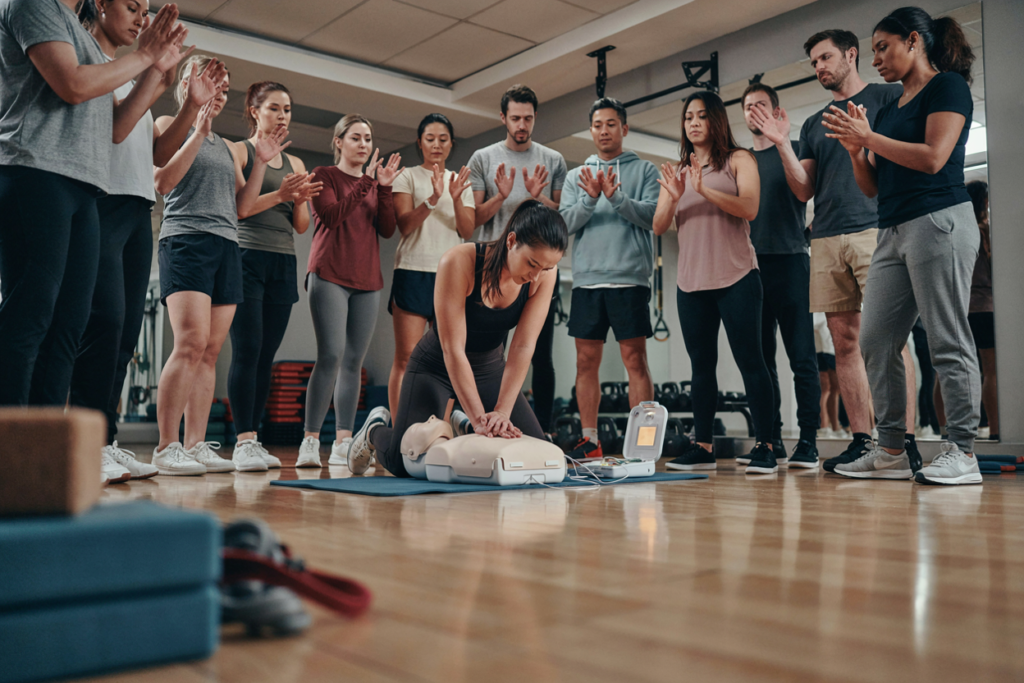
- A participant collapses partway through a group fitness class, and now you've got a room full of people looking at you
Same rules apply in every one of these. Doesn’t matter if it’s a barbell or a pool deck.
AED vs. Just Calling 000 and Waiting
Calling 000 is step one, always. But standing around after that call, waiting for paramedics to arrive, isn’t the move if there’s an AED within reach. Every minute without defibrillation drops the odds of survival. An AED in your hands while you wait for paramedics isn’t optional extra effort, it’s the difference that actually counts in those first few minutes.
Quick decision flow: Unresponsive → not breathing normally → call 000, grab the AED, start CPR. All at once if you’ve got help around you, not one after the other.
If you want the compressions and breathing ratios locked in properly rather than just reading about them, that’s exactly what our HLTAID009 CPR course covers hands-on.
⚡ Quick take: The AED talks you through every step out loud. What follows is just what you'll hear, and do, in order.
How to Use an AED, Step-by-Step
Right, this is the bit you actually came here for. Once you’ve got the AED in hand, here’s exactly what happens.
Steps 1–2: Power On, Expose the Chest
Turn it on first. There’s one button, usually big, usually green or red depending on the brand, and the second you press it the voice prompts kick in. You don’t need to remember a sequence, it tells you.
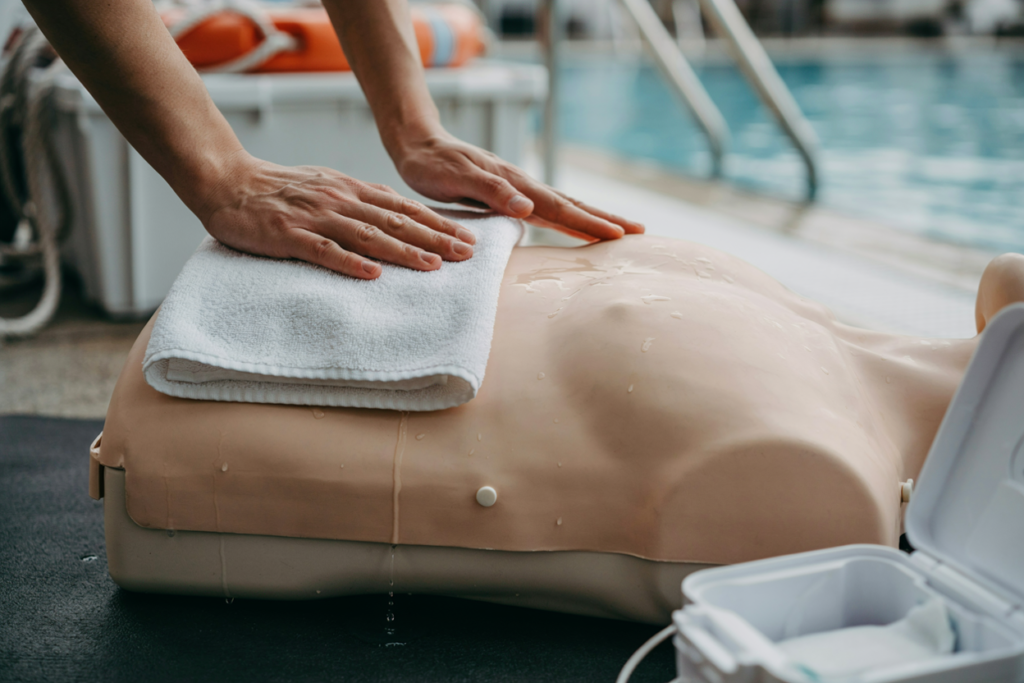
While it’s booting up, get the chest exposed. Rip or cut clothing off if you need to, don’t waste time being polite about it. If the skin’s wet (very likely poolside), dry it off quick with a towel or shirt, whatever’s around. Wet skin messes with pad contact and can weaken the shock delivery.
Step 3: Pad Placement
One pad goes below the right collarbone, the other on the left side, below the armpit. Most pads have a little picture printed on them showing exactly where, so you’re not guessing.
A few variations worth knowing:
Situation | What to do |
Client has a pacemaker or ICD (visible lump under the skin) | Place the pad a few cm away from it, not directly on top |
Hairy chest | Quickly shave the area if a razor’s in the AED kit (most kits have one), or use the pad itself to rip hair off in a pinch |
Patient is wet | Dry the chest thoroughly before applying pads, don’t skip this |
Steps 4–5: Analysing and Shock Delivery
Once the pads are on, the AED tells everyone to stand clear so it can read the heart rhythm. Nobody touches the patient during this bit, not even you.
If a shock’s advised, it’ll say so and the button will flash. Before you press it, do the “clear, clear, clear” call-out, loudly, and actually check nobody’s hands are on the patient. Then press it.
Step 6: Resuming CPR
Shock delivered or not, you go straight back into CPR. Don’t stand around waiting to see what happens, the AED will tell you when it’s ready to reanalyse. Keep going until it prompts you again or paramedics take over.
For the official word on all of this, the ANZCOR defibrillation guideline is the reference point Australian first aid training is built on, not the US-based guidelines you’ll find if you Google around.
🔄 Quick take: An AED without CPR either side of it is only doing half the job. Here's how the two actually fit together.
Using an AED Alongside CPR
Here’s something worth clearing up straight away, an AED doesn’t replace CPR. It’s not one or the other, they work as a pair, and if you’ve already got your HLTAID009 under your belt, this bit should click pretty fast.
The Compression-Analyse-Shock Cycle
The rhythm goes like this:
- 30 compressions, 2 breaths (your standard 30:2 ratio you already know)
- Pause for the AED to analyse when it prompts you
- Resume compressions immediately after the shock (or after "no shock advised")
You’re not sitting back once the AED’s attached. You’re still doing the physical work, the machine’s just reading the rhythm and stepping in with a shock when the heart needs one.
What If It Says “No Shock Advised”?
Keep going. This isn’t the machine telling you to stop, it’s telling you a shock won’t help right now, not that CPR won’t. Compressions are still what’s keeping blood moving to the brain and organs. Don’t take your hands off because the AED went quiet on you.
This is really the whole point of pairing the two skills together, you’re not learning AED use as some separate, standalone thing bolted onto your first aid knowledge. It slots directly into the CPR technique you already practise. One skill, two tools, same emergency.
If it’s been a while since you ran through your compression technique properly, it’s worth a refresher before you’re relying on muscle memory in a real situation.
Do You Need Training to Use an AED?
Short answer, no. Longer answer, still no, but let’s actually get into why.
AEDs Are Built for Untrained Bystanders
These machines are designed from the ground up for someone who’s never touched one before. The voice prompts guide you through every single step, power on, pad placement, standing clear, shocking, resuming CPR. You genuinely could pick one up cold and follow it through. Training just makes you faster and more confident doing it, it’s not a prerequisite to act.
There’s no dramatic risk sitting behind any of this, it’s genuinely just a matter of pressing go and following the voice. That’s it.
One Line on Training Anyway
While you don’t need training to use one, having your CPR knowledge current means the whole process is smoother, you’re not thinking about compressions and the AED steps at the same time, one’s just muscle memory already. Worth keeping in mind next time your HLTAID009 renewal rolls around.
Where to Find an AED in Gyms, Pools & Studios (Brisbane)
Knowing how to use an AED doesn’t count for much if you’ve got no idea where the thing actually is when you need it. This bit trips people up more than the actual steps do.
Typical AED Locations in Fitness & Aquatic Facilities
Most Brisbane gyms, pools and studios keep theirs in one of a few spots:
- Reception or front desk area, often in a bright green or yellow wall-mounted cabinet
- Poolside cabinet, usually near the lifeguard station or first aid room
- Staff room or office, sometimes tucked away where members don't see it day to day
They’re not hidden on purpose, they’re just not always somewhere you’d think to look on a normal day, which is exactly the problem.
Why Every Trainer or Instructor Should Know This Before an Emergency
If you’re mid-class and someone goes down, you don’t have time to be asking around or checking three different rooms. The seconds you spend looking are seconds that AED isn’t attached and doing its job. Knowing the location cold, before you ever need it, is honestly just as important as knowing the steps themselves.
Quick Venue Checklist
Test yourself right now, genuinely, don’t skim past this bit:
- Do you know exactly where the AED is at your main venue?
- Do you know if there's a second one, poolside vs reception, for example?
- Have you actually walked to it and opened the cabinet, or just assumed it's there?
- Does your gym or pool run through this during onboarding, or did you have to ask?
If you hesitated on any of those, that’s worth fixing today, not next time you’re rostered on.
Know the Steps, Pair It With CPR, Book If You’re Due
That’s the whole picture. Spot the signs, grab the AED, follow the voice prompts, keep the compressions going the whole way through, and know where the thing lives at your venue before you’re ever standing over someone needing it.
None of this is complicated once it’s broken down like this, but it’s easy to read through once and file it away as “yeah I get it” without actually locking it in. The gap between knowing the steps in theory and doing them without hesitation when someone’s on the floor in front of you is bigger than most people think. That gap closes with repetition, not with a single read of a guide, however well it’s written.
The AED itself will always talk you through the mechanics. That part’s genuinely foolproof. Where trainers, coaches and instructors tend to freeze isn’t the machine, it’s the moment right before it, the few seconds of deciding whether this is actually happening and whether it’s really on you to act. Having your CPR technique currently takes that hesitation away, because half the sequence is already automatic and you’re not trying to think and act at the same time.
Pairing the two skills is really the whole message here. An AED without CPR either side of it is only doing half the job, and CPR without an AED nearby means you’re working without the one tool that can genuinely restart a heart. Neither replaces the other. They’re not backup options for each other, they’re both required, every time, in that order.
Knowing your venue’s AED location matters just as much as any of the physical steps, arguably more, because it’s the one part of this whole process that has to happen before anything else can. A perfect set of compressions and a perfectly placed pad count for nothing if the AED itself is still sitting in a cabinet three rooms away while someone’s counting seconds.
None of this replaces having your CPR technique current though, the two skills work together, not as substitutes for each other. If it’s lapsed or you’re due for renewal, this is the kind of thing worth sorting before it’s needed rather than after, trainers, coaches, instructors, people who need it done fast and done properly, not bundled into a longer course they don’t need.
Save this AED cheat sheet to your phone so it’s there next time you need a quick refresher, no digging through old bookmarks mid-emergency.
Never let your CPR lapse without noticing, get on the renewal reminder list and it’s one less thing to think about.
✉️ info@firstaidalive.com.au
Book Your First Aid Training Now
Fast, affordable, and nationally accredited training delivered by professionals who care
Frequently Asked Questions
Q.Do I need training to use an AED?
No. AEDs are built for untrained bystanders, the voice prompts guide you through every step from power-on to shock delivery. Training just makes the whole process faster and more automatic, it's not a requirement to act.
Q.Can I hurt someone by using an AED wrong?
No. The AED analyses the heart rhythm itself before it will ever advise a shock, so it won't let you shock someone who doesn't need one. Follow the voice prompts and you genuinely can't get this wrong.
Q.Should I wait for the AED to arrive before starting CPR?
No, start CPR the moment you've confirmed someone's unresponsiveness and not breathing normally. Send someone else to grab the AED while you begin compressions, don't delay compressions waiting on the machine.
Q.What do I do if the AED says "no shock advised"?
Keep going with CPR. That message means a shock won't help right now, not that compressions won't, blood still needs to keep moving to the brain and organs until paramedics take over.
Q.What if the pads won't stick properly because the chest is wet or hairy?
Dry the skin quickly with whatever's on hand before applying pads, and if there's a razor in the AED kit, use it to clear a hairy chest fast. Most AED kits carry one for exactly this reason.
Q.How do I know if my gym, pool or studio actually has an AED?
Check reception, poolside cabinets, and the staff room, these are the most common spots in fitness and aquatic facilities. If you haven't physically walked to it and opened the cabinet yourself, that's worth doing today rather than assuming it's there.
Making first aid training more affordable for
every classroom
We believe every student deserves access to life-saving first aid knowledge. That’s why we offer specially reduced pricing for schools and educational groups. Whether you’re booking for a single class, a year group, or your entire school, our flexible packages make training more accessible and cost-effective — without compromising quality.
