

The principal contractor wants HLTAID014 on your qualifications register before mobilisation. And every page you open about the HLTAID014 prerequisite tells you something different. One says you need HLTAID011 first. Another says nothing’s required. The answer’s a lot simpler than most provider pages make it look. There’s no national prerequisite. The unit listing on training.gov.au has the prerequisite field set to “Not applicable”. Full stop.
But that’s the national rule. An RTO’s entry rules are a different animal, and each provider sets its own. Most will want a USI, decent language, literacy and numeracy (LLN), and the ability to do floor CPR on a manikin to Australian Resuscitation Council guidelines. Under-18 apprentices run into a minimum age and parental consent. Some RTOs want a current HLTAID011 on top of that.
Sort out what each worker needs before you book, and nobody rocks up ineligible and burns a site day you can’t get back. That matters when a principal contractor or a WorkSafe Queensland audit is checking names. Below, we’ll cover the official unit position, why RTO rules differ, a per-worker checklist, where HLTAID011 fits, and what to think about when booking a whole crew. Get it right and it’s simple. Booking confirmed, the whole crew enrolled, and nothing standing between the Statement of Attainment and your contractor management system.
Is There a Prerequisite for HLTAID014?
No. HLTAID014 Provide Advanced First Aid has no formal prerequisite unit. The national unit on training.gov.au lists the prerequisite field as “Not applicable.” Each RTO can still set its own enrolment requirements, which commonly include:
Check your RTO‘s enrolment policy before booking your crew.
Two terms that get mixed up all the time
- Prerequisite unit: A unit of competency you must hold before being assessed in another unit, as set in the national training package.
- Entry requirement: A condition an individual RTO sets for enrolment, such as a USI, minimum age or current CPR certificate. These can differ between providers for the same unit.
One’s a national rule. The other’s a house rule. Most of the confusion online comes from treating them like the same thing.
Prerequisite Units vs RTO Entry Requirements: Why the Answers Online Don’t Match
If you’ve spent a smoke break searching this, you’ve probably walked away more confused than when you started. That’s not because anyone’s trying to trick you. It’s because two different sets of rules are getting lumped in together.
What the National Unit Actually Says
The single source of truth is training.gov.au. That’s the national register for every unit of competency in Australia, and for HLTAID014 the prerequisite field reads “Not applicable”.
Every RTO has to deliver and assess the unit as it’s written there. They don’t get to rewrite it. ASQA, the national VET regulator, keeps them honest on that.
Why RTOs Add Their Own Rules
So where do the extra HLTAID014 entry requirements come from? The same place your site rules do. The WHS legislation sets the baseline, and WorkSafe Queensland’s First Aid in the Workplace Code of Practice is a big part of why sites set first aid requirements at all. Then the principal contractor adds its own induction, PPE and permit rules on top. Nobody thinks that’s dodgy. It’s just how a well-run site operates.
RTOs work the same way. They’ve got a duty of care during physical training, and the assessment conditions mean you’ll be doing CPR on a manikin on the floor. Plenty of providers also run pre-course online learning, and every RTO has its own enrolment and risk policy. Put that together and you get entry rules that are normal and legitimate, even if they vary a bit from one provider to the next.
Why You’ll See Conflicting Claims
Here’s where it gets messy. Search advanced first aid prerequisites and some provider pages say HLTAID011 is required before HLTAID014. Others talk about it like it’s already part of HLTAID014. Neither lines up with the national unit, but you can see how a supervisor reading three different pages ends up scratching his head.
The takeaway is simple. Read the enrolment page of the specific RTO you’re booking with, not a general blog post (and yes, that includes this one).
The question that causes the most confusion, though, is whether HLTAID011 has to come first.
🔗 Heads up: HLTAID011 isn't required nationally before HLTAID014, but some providers ask for it anyway.

Do I Need HLTAID011 Before HLTAID014?
Not nationally. HLTAID014 has no prerequisite unit, so the national rules don’t make you hold HLTAID011 before you enrol. Some RTOs do ask for a current HLTAID009 or HLTAID011 as their own entry requirement though, so check the enrolment policy of whoever you’re booking with.
How HLTAID009, HLTAID011 and HLTAID014 Relate
HLTAID014 is a standalone unit. Its performance criteria include CPR and first aid tasks that overlap with what’s covered in HLTAID009 and HLTAID011, so a lot of the ground will feel familiar if you’ve done those before. Same toolbox, bigger job.
Unit | Formal prerequisite unit | Typical format | What it covers | Who it suits |
HLTAID009 Provide CPR | Not applicable | Online theory plus face-to-face CPR assessment | CPR and defibrillator use | Anyone who needs CPR currency |
HLTAID011 Provide First Aid | Not applicable | Online theory plus face-to-face practical | CPR plus first aid for common injuries and illnesses | Workplace first aiders |
HLTAID014 Provide Advanced First Aid | Not applicable | Pre-course learning plus face-to-face practical | Advanced first aid response for serious incidents | Supervisors and first aid officers on higher-risk sites |
Prerequisites for HLTAID009, HLTAID011 and HLTAID014 compared
⚠️ Compliance check before you book: If a principal contractor's register asks for HLTAID011 by code, confirm with them that they'll accept HLTAID014 in its place. Most registers are built around codes, and a quick email can save a knock-back at upload time.
If you want the broader picture on how these qualifications stack up, our advanced first aid qualification guide covers it.
Where CPR Currency Fits
The Australian Resuscitation Council recommends CPR refreshers more often than full first aid renewals. So even where an RTO doesn’t ask for it at enrollment, keeping a current HLTAID009 on file helps your crew stay on top of CPR currency. It’s one of those things that’s easy to let slide until an auditor asks.
Once you know the rules, the real job is making sure every worker on your list actually meets them before course day.
📋 Supervisor tip: Check every worker before you book, not after. One missing USI can hold up the whole crew.
HLTAID014 Entry Checklist for Every Worker on Your Crew
When you’re booking one person, sorting out the HLTAID014 enrolment requirements is quick. When you’re booking a handful of blokes off different crews, it’s a different story. One missing USI or one bad knee nobody mentioned, and that’s a seat wasted and a worker who’s still not on the register. Run every name through this before you lock anything in.
Unique Student Identifier (USI)
Every worker needs a USI for nationally recognised training. It’s mandatory, no exceptions. And if the USI’s late, the Statement of Attainment is late, which means the contractor management system upload is late too. They’re free and easy to set up at usi.gov.au.
Language, Literacy and Numeracy, Plus Pre-Course Learning
Each worker needs enough LLN to get through the online theory and the knowledge assessment. Make sure every worker has finished the online component before practical day. Chasing it up the night before is a bad time to find out someone hasn’t logged in.
Floor CPR and Physical Requirements
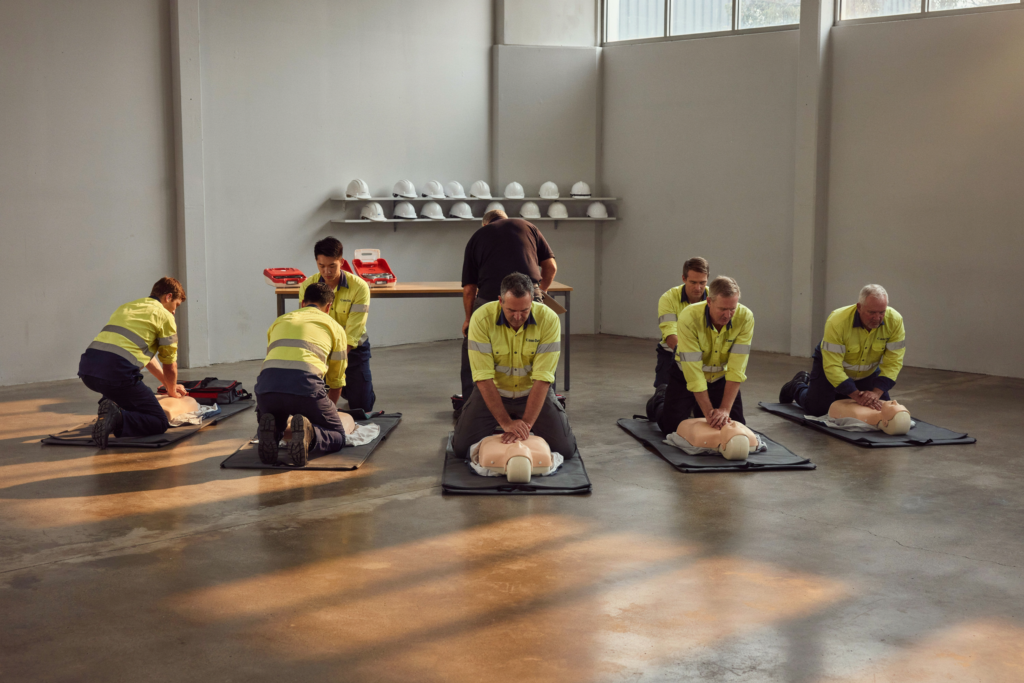
Compressions are done on a manikin, and in practice that’s at floor level. Anyone carrying a knee or back injury should raise it before you book, not on the day.
Age and Apprentices
Younger apprentices can often do the course, but minimum age and parent or guardian consent come into play for anyone under 18. Our HLTAID014 minimum age guide covers the details.
Crew pre-booking checklist
- USI: Set up and shared with the RTO
- Online theory: Knowledge assessment finished before practical day
- Floor CPR: Able to do it, or any injury raised before booking
- Age and consent: Sorted for under-18 apprentices
- Photo ID: Ready for the day
Once every worker meets the HLTAID014 entry requirements, the booking side is the easy bit. For crews, use our group booking option rather than enrolling workers one at a time. If you’re looking at HLTAID014 group booking Brisbane dates, our HLTAID014 Brisbane course page has the rest.
Skip any of those checks, though, and here’s what it can cost you.
What Happens If a Worker Isn’t Ready on Course Day
This is the bit nobody thinks about until it happens. And when it happens, it tends to cost a lot more than one course seat.
Assessment Can’t Be Completed
If a worker can’t do floor CPR, hasn’t finished the online theory, or turns up without a USI, the trainer can’t deem them competent that day. It doesn’t matter how switched on they are or how many incidents they’ve handled on site. The assessment conditions are the assessment conditions.
The Knock-On Effect on Site Access
Here’s how the dominoes fall. No competency means no Statement of Attainment. No Statement of Attainment means nothing to upload to the contractor management system. And nothing uploaded means no site clearance. So a missed login or a forgotten USI can end up with a worker parked in the site shed while the job keeps moving without him.
How to Avoid It
Run the crew checklist above across every name before the booking goes in, not the week of the course. It’s a lot easier to chase a USI from the site office than to rebook a worker who got sent home.
The HLTAID014 prerequisite question has a short answer and a longer one. Nationally, there isn’t one. The longer answer lives in each RTO’s enrolment policy, and that’s the part that trips crews up. Get every worker checked early, sort the USIs and the online theory before anyone’s rostered off, and course day turns into the easy bit. Then it’s just booking confirmed, the whole crew enrolled, and the Statement of Attainment going straight into the contractor management system before the principal contractor comes asking.
Get Your Crew Compliant Before Your Next Audit
When a tender’s about to close or an audit’s on the calendar, the last thing you need is a gap on the qualifications register. You need names on it, each one backed by a Statement of Attainment, before the principal contractor or WorkSafe Queensland comes asking.
Tell us how many workers and your deadline. We’ll lock in dates and get everyone’s Statement of Attainment moving. The quickest way to start is through our group booking form, so you’re not enrolling workers one at a time.
If it’s just you or one leading hand, you can book a single seat instead. Same unit, same Statement of Attainment, just without the crew paperwork.
Before anything goes in, check each worker against the crew checklist, especially their USI and whether they can do floor CPR. Then send through your numbers and deadline on the group booking form, or give us a call.
From there it’s straightforward. Book in, get the online theory finished, and turn up to the practical. Once the Statement of Attainment comes through, upload it to your contractor management system and your crew’s cleared.
Book Your First Aid Training Now
Fast, affordable, and nationally accredited training delivered by professionals who care
HLTAID014 Prerequisite FAQs
Q.Can I do HLTAID014 fully online?
No. HLTAID014 needs a practical assessment, so there's always a face-to-face component. Most RTOs run it blended, with the online theory done first and a hands-on session where you're assessed on floor CPR and other practical skills.
Q.Does HLTAID014 include CPR?
Yes. CPR is assessed within the unit, so you'll be doing compressions on a manikin at floor level as part of the practical. A standalone HLTAID009 still comes in handy for keeping CPR current between full renewals.
Q.Do I need a current first aid certificate to enroll?
Not under the national rules, since HLTAID014 has no prerequisite unit. Some RTOs ask for a current HLTAID009 or HLTAID011 as an entry requirement, so check the enrolment page of the provider you're booking with.
Q.Will HLTAID014 count if the site register asks for HLTAID011?
It can, but check first. Most registers are built around unit codes, so confirm with the principal contractor that they'll accept HLTAID014 in its place before you rely on it.
Q.Do I need a USI for HLTAID014?
Yes. Every worker needs a Unique Student Identifier for nationally recognized training, and the Statement of Attainment can't be issued without one. It's free to set up at usi.gov.au.
Q.Is there a minimum age for HLTAID014?
Minimum age is set by each RTO rather than the national unit, and anyone under 18 will generally need parent or guardian consent. Our HLTAID014 minimum age guide covers the details.
Making first aid training more affordable for
every classroom
We believe every student deserves access to life-saving first aid knowledge. That’s why we offer specially reduced pricing for schools and educational groups. Whether you’re booking for a single class, a year group, or your entire school, our flexible packages make training more accessible and cost-effective — without compromising quality.
