

You’re sitting in the ute between tasks when a tender lands with HLTAID014 listed right there on the pre-qualification checklist, and the principal contractor wants your first aid register updated before mobilisation. That’s usually the moment workplace advanced first aid training stops being a “yeah, we’ll get to it” job and turns into a “we need it now” job. Anyone who’s run a site knows that feeling. One line on a checklist and suddenly it’s the thing holding up the whole job.
But honestly, the pressure isn’t only contractual. Construction recorded 37 worker fatalities in 2024, and falls from height claimed 24 lives nationally, according to Safe Work Australia. Those aren’t just numbers on a toolbox talk slide. On a civil job a long way from the nearest QAS crew, the person holding the advanced certificate is the one managing that injury till paramedics arrive. That wait is the longest stretch of any day on site.
This guide sets out what Queensland WHS law and the First aid in the workplace Code of Practice actually expect, when a site needs an advanced first aider rather than a standard HLTAID011 holder, what HLTAID014 training really covers, and how to get a crew trained and certified without losing valuable site time.
When Does a Workplace Need Advanced First Aid Training Instead of HLTAID011?
A workplace needs advanced first aid training (HLTAID014) rather than standard HLTAID011 when its first aid risk assessment shows a basic response won’t cover the injuries likely on site. In Queensland, the common triggers are:
- Remote or isolated location: Ambulance arrival may be delayed, so a first aider has to manage a casualty for longer
- High-risk work: Working at heights, mobile plant, excavation, electrical or confined space work
- Serious foreseeable injuries: Falls, crush injuries, major bleeding and chest or spinal trauma
- Incident coordination: Someone must manage multiple casualties and direct other first aiders until paramedics take over
- Contract requirements: A principal contractor, tender or client names HLTAID014 for site access
WHS law doesn’t name HLTAID014 directly. The decision comes from your risk assessment under the First aid in the workplace Code of Practice 2021.
Ask yourself two things: what’s the worst injury we could realistically see today, and how long till help actually turns up? If either answer makes your stomach drop a little, you’ve probably got your answer.

What Queensland WHS Law Actually Expects
Those triggers come out of a risk assessment, and the legal framework behind it is shorter than most people expect. There’s no line in the legislation saying high-risk sites must have HLTAID014. The real picture has three layers, stacked like a slab pour: the law is the subgrade, the Code of Practice is the reo, and your contract is the concrete that sets hard.
The duty sits with the PCBU, not the certificate
Under the Work Health and Safety Regulation 2011 (Qld), section 42 puts the duty on the PCBU, which is the person conducting a business or undertaking. In plain terms, that’s the employer or business running the work. The PCBU has to provide first aid equipment, access to facilities, and an adequate number of workers trained to administer first aid.
That word “adequate” does a lot of heavy lifting. It’s set by a risk assessment that looks at the nature of the work, the hazards on site, the size and layout of the workplace, and the number of workers. No clause in the Act or the Regulation names HLTAID014. The law cares whether your first aid cover matches your risk, not which unit code is printed on the certificate.
What the First aid in the workplace Code of Practice 2021 adds
The Code is where things get practical. It gives ratio guidance for how many first aiders a workplace should have, and it speaks to advanced training for remote and high-risk work. Codes are guidance, not legal advice, but they’re the practical benchmark inspectors use when they ask how you decided your cover was adequate.
Where HLTAID014 actually gets written down
If the law doesn’t name it, HLTAID014 usually comes from paperwork further up the chain:
- Principal contractor pre-qualification
- Tender documents
- Client site rules
- Contractor management platforms like RapidGlobal, CM3 and Avetta-style systems
That’s a contractual requirement, not a statutory one. But from where you’re standing, it’s just as hard a deadline. Miss it and you don’t get site access, simple as that. There’s more detail in our full breakdown of Queensland’s advanced first aid requirements.
📋 The law doesn't name HLTAID014. Your contract probably does.
HLTAID011 vs HLTAID014: What Changes on Your Site
Once you know the obligation is risk-based, the next call is which unit each person on your crew actually needs. That’s where the difference between first aid and advanced first aid stops being a training catalogue question and turns into a site planning one.
From first response to extended casualty management
HLTAID011 is built around three jobs: recognise what’s happened, respond to it, and hand over to paramedics. HLTAID014 picks up where that leaves off. It’s about managing a casualty for longer, dealing with more complex injuries, and coordinating the scene and the other first aiders around you. The national unit doesn’t list HLTAID011 as a formal prerequisite, but the two sit on the same ladder, one rung apart. If HLTAID011 teaches you to stop the car skidding, HLTAID014 teaches you to keep driving it through the storm till someone takes the wheel.
HLTAID011 Provide First Aid | HLTAID014 Provide Advanced First Aid | |
Suited to | Low to moderate risk, quick ambulance access | High-risk, remote or multi-crew sites |
Casualty management | Initial response until help arrives | Extended management and incident coordination |
Typical holder | General crew, apprentices | Supervisors, WHS officers, designated site first aider |
Prerequisite | None | None listed on training.gov.au |
Who on the crew needs which
Most sites land on a tiered model, and honestly it’s the setup that makes the most sense in practice:
- General crew: CPR or HLTAID011
- Leading hands: HLTAID011
- Supervisor or designated site first aider: HLTAID014
The catch is that cover has to work per shift and per work front, not just as one name on the register. One name looks fine on paper, until that person is at the far end of the job or on their day off.
Building a tiered first aid register
Set your register up to show the tiers clearly. Keep columns for name, unit held, issue date, expiry, crew or shift, and whether it’s been uploaded to your contractor management system. That last column saves more headaches than people expect. A certificate that isn’t in the system doesn’t get anyone through the gate.
📅 Who needs HLTAID014? Lock in dates before your next mobilization. Book your crew.
What HLTAID014 Advanced First Aid Training Covers
The gap between the two units is clearest when you look at what workplace advanced first aid training makes you do on the day. This isn’t a longer version of the same class. It’s a different job.
Core skills in the HLTAID014 unit
The unit is set out on training.gov.au, and in plain language it breaks down into eight skill areas:
- Scene response: Sizing up an emergency, keeping everyone safe and calling in emergency services
- CPR and defibrillation: Single and two-rescuer CPR, infant CPR and using an AED, all to ANZCOR guidelines
- Major bleeding: Controlling life-threatening bleeding with tourniquets and haemostatic dressings
- Fractures and spinal injuries: Immobilisation, plus head, neck, spinal, crush and abdominal injuries
- Medical emergencies: Anaphylaxis, asthma, shock, chest pain, stroke, seizures and diabetes
- Secondary survey and monitoring: Working out the injury from history, signs and symptoms, and tracking breathing, pulse, temperature and consciousness
- Multiple casualty coordination: Basic triage, running a team, and safely moving and extracting casualties
- Reporting and review: Handing over to paramedics, completing site paperwork and reviewing the response, including its toll on rescuers
How assessment works
Assessment combines a practical demonstration with a written knowledge assessment. You’re showing the trainer, hands on, that you can actually do it.
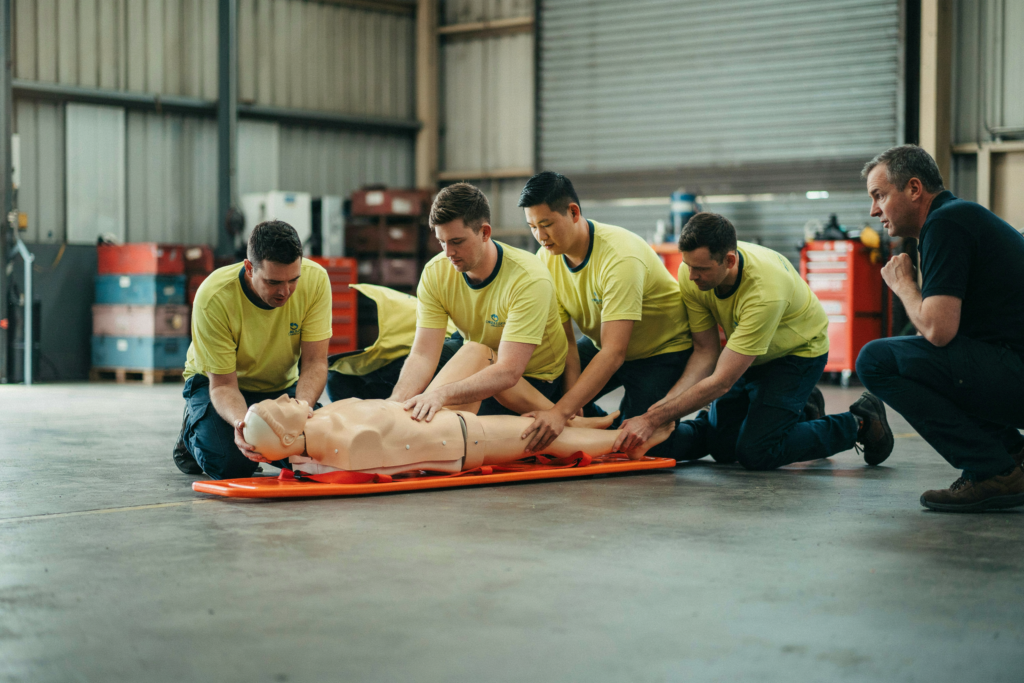
Getting Your Crew Trained Without Losing Site Time
Knowing what workplace advanced first aid training covers is one thing. Getting a crew through it without stalling a live job is harder: the date that clashes with a pour, the approval stuck in procurement, the certificate that arrives after the induction.
Booking a crew, not a seat
You’re rarely booking for one person. A HLTAID014 group booking through one enrolment beats chasing five separate bookings and five separate invoices. One date, one payment, one list of names.
Training at your depot or site shed
On-site training at your depot or site shed means nobody gets pulled off the job to travel, and training in the space where your crew actually works makes the scenarios feel a lot less like a classroom exercise. It’s worth asking whether it’s an option for your site.
Scheduling around pours, deliveries and wet weather
Weekdays on a live site are gold, and nobody wants to burn one sitting in a training room. Ask about Saturday and early-start sessions, and pick your date around the pour schedule and plant deliveries, not the other way round.
From completion to site access
A course isn’t finished for you until the certificate clears the gate. The Statement of Attainment is the nationally recognised document issued when you’re deemed competent in the unit, and it’s what your contractor management system wants to see. Before you upload, check the file has:
- The right file format for your platform
- RTO 31106 visible
- The unit code and title, HLTAID014 Provide Advanced First Aid
- The issue date
Anyone on the principal contractor’s side can verify the RTO on training.gov.au.
Nationally Recognised Training · RTO 31106 · HLTAID014
Keeping Advanced First Aid Current Across Your Crew
Getting everyone certified once isn’t the finish line, because every Statement of Attainment on your register has a clock on it. And those clocks don’t all run on the same schedule, which is exactly how gaps sneak in.
Renewal cycles to track
HLTAID014 renewal and CPR refreshers run on separate cycles, and the First aid in the workplace Code of Practice 2021 sets out the guidance for both. CPR is the one that catches people out, because it comes around faster than the full qualification.
Staying ahead of audits and new starters
The simplest habit that saves the most grief is setting register reminders well before anything expires. That’s enough runway to book around the job instead of scrambling before an audit.
The other gap is new people on site. Check first aid qualifications for new starters and subcontractor crews at induction, not after. Sticking with one provider helps too, because renewals turn into a phone call rather than fresh research.
Site readiness self-check
- Our site is remote, or ambulance arrival could be delayed
- We do high-risk work: heights, mobile plant, excavation, electrical or confined space
- Falls, crush injuries, major bleeding, or chest or spinal trauma are foreseeable
- Someone may need to manage multiple casualties and direct other first aiders
- A principal contractor, tender or client names HLTAID014
- Every shift and work front has a current advanced first aider on the register
If any of the first five apply, your site likely needs HLTAID014 cover. If the last one doesn’t, there’s a gap on your register worth closing before your next audit.
Most supervisors don’t go looking for workplace advanced first aid training because they’ve got time to spare. It starts with a tender checklist or an audit date. But the real story is the wait between an injury and the ambulance, and who on your site is ready to own it.
The law is simpler than people expect. Your risk assessment decides what adequate first aid cover looks like, the Code of Practice fills in the details, and HLTAID014 usually gets written into your contracts.
From there, it’s matching the right unit to the right person. Crew and leading hands carry the first response. Your supervisor carries the extended care and coordination, across every shift and work front.
The training is where the difference shows. Tourniquets, spinal care, multi-casualty scenes and clean handovers stick when the scenarios reflect falls, plant and remote sites.
Getting there doesn’t have to stall the job. Book the crew together, work dates around pours and deliveries, and keep your register honest with reminders well ahead of each expiry.
Do that and the next audit stops being something you dread. And if someone goes down badly on your site, the person kneeling beside them knows exactly what to do next.
Book Your First Aid Training Now
Fast, affordable, and nationally accredited training delivered by professionals who care
Workplace Advanced First Aid Training FAQs
Q.Is advanced first aid a legal requirement in Queensland?
Not by name. The WHS Regulation 2011 (Qld) requires an adequate number of trained first aiders, and your risk assessment decides what adequate means. The First aid in the workplace Code of Practice 2021 guides that call for remote and high-risk work, while principal contractors, tenders and clients are usually where HLTAID014 gets named.
Q.Can a site supervisor be the only advanced first aider on site?
There's no clause stopping it, but one name rarely holds up. Cover has to work across every shift, work front and leave day, and if your only advanced first aider is the one injured, nobody's left to run the response. A backup on HLTAID014 is the safer setup.
Q.Do I need HLTAID011 before doing HLTAID014?
The HLTAID014 unit on training.gov.au doesn't list a formal prerequisite. Training providers can still set their own entry requirements, so check with your provider before you enroll the crew and nobody gets turned away on the day.
Q.Does HLTAID014 cover oxygen therapy?
No. Oxygen therapy sits in a separate unit, HLTAID015 Provide advanced resuscitation and oxygen therapy. HLTAID014 focuses on extended casualty management, major bleeding, fractures, spinal injuries, medical emergencies and coordinating multiple casualties.
Q.What does the Statement of Attainment need to show for site access?
Most contractor management systems want RTO 31106 visible, the unit code and title, HLTAID014 Provide Advanced First Aid, and the issue date, in a file format the platform accepts. Checking those details before you upload saves a rejected file and a crew stuck at the gate.
Q.Does CPR need a separate refresher?
Yes. CPR runs on its own refresher cycle, separate from the full HLTAID014 qualification, and it comes around faster. The First aid in the workplace Code of Practice 2021 sets out the guidance, so give CPR its own column on your register.
Making first aid training more affordable for
every classroom
We believe every student deserves access to life-saving first aid knowledge. That’s why we offer specially reduced pricing for schools and educational groups. Whether you’re booking for a single class, a year group, or your entire school, our flexible packages make training more accessible and cost-effective — without compromising quality.
