

HLTAID014 usually lands on your desk as a line item, not an explanation. Maybe it’s sitting in a principal contractor’s pre-qualification form. Maybe a tender doc named it, or an auditor flagged that your crew’s standard first aid certs don’t match the risk profile of the site.
And you’re reading it in the ute between a concrete pour and a toolbox talk, thinking, righto, what actually is this thing? Because what almost never comes with it is a straight answer on what the unit is.
Put simply, HLTAID014 Provide Advanced First Aid is the nationally recognised unit that takes a first aider past single-casualty care. It’s built for the person expected to take charge when things go bad: serious injuries, multiple casualties, a long wait for an ambulance. Which, let’s be honest, describes a fair few civil and construction sites across Queensland.
This guide breaks HLTAID014 down in plain English, no training-package jargon. You’ll see what the unit covers, how it’s different from the certificate your crew already holds, who on a Queensland worksite is expected to hold it, how the course runs and what you walk away with. Where you need more detail, we’ll point you to the right guide.
HLTAID014 Explained: The Short Answer
HLTAID014 Provide Advanced First Aid is a nationally recognised unit of competency from Australia’s Health Training Package. It trains you to take charge of a serious incident, not just treat one casualty, and to manage injured people until paramedics take over.
HLTAID014 covers:
- Recognising and managing serious injuries and medical emergencies
- Taking control of an incident involving multiple casualties
- CPR, defibrillation (AED) and airway management
- Keeping casualties stable during an extended wait for an ambulance
- Handing over to emergency services and reporting the incident
It sits one level above HLTAID011 Provide First Aid, which is the standard workplace certificate most of your crew will have. It also replaced the older HLTAID006 unit. Most providers issue it alongside HLTAID009, HLTAID010 and HLTAID011 on a single Statement of Attainment.
That’s the quick version. Now here’s what each of those skills actually looks like on a real site.
🧰 Site reality: The skills in this unit line up with what actually goes wrong on civil and industrial sites: falls, mobile plant, excavations and a long wait for help.

What HLTAID014 Actually Covers
The unit in plain terms
“Unit of competency” sounds like something pulled out of a government filing cabinet. All it means is one unit inside the Health (HLT) Training Package. You’re assessed on whether you can actually do the skills, not on how long you sat in a chair. If you’ve done a few compliance-theatre courses over the years, that’s probably the best news in this whole article.
The bigger shift is the job itself. A standard first aider looks after the person in front of them. A HLTAID014 holder takes charge of the whole incident: who’s hurt worst, who’s on the phone to triple zero, who’s keeping everyone else back, and what happens in that long stretch before the paramedics turn up.
The core skills, matched to site risks
Here’s how the unit lines up against the stuff that actually goes wrong on civil and industrial sites.
Skill area | What it looks like on site |
Managing an incident with more than one casualty | A falling-object strike or mobile plant rollover with more than one worker hurt |
Serious injuries: control of major bleeding, fractures, suspected spinal injury, burns, crush injuries | A fall from height or an excavation collapse |
Medical emergencies: cardiac events, stroke, anaphylaxis, asthma, heat illness | A heart attack or stroke on site, or a worker going down from heat stress |
CPR, defibrillation (AED) and airway management | An unconscious worker who isn’t breathing normally |
Extended care until the ambulance arrives | A remote or growth-corridor site a long way from the nearest ambulance |
Handover, reporting and debriefing | Handing over to QAS paramedics, then the WorkSafe QLD notification and your internal incident report |
The clinical language follows ANZCOR, the Australian and New Zealand Committee on Resuscitation. So you’ll hear “control of major bleeding”, not the American terms you might’ve picked up from a YouTube clip.
If I had to point at one row, it’s the extended care one. Holding things together when the ambulance is just around the corner is one thing. Keeping someone stable through a long wait, with a crew watching you and a site that’s still half running, is a different job altogether. That’s the gap this unit is built to fill.
What HLTAID014 doesn’t cover
Oxygen therapy and airway devices aren’t part of this unit. They sit in HLTAID015 Provide Advanced Resuscitation and Oxygen Therapy, which has its own HLTAID015 course.
So that’s what’s inside the unit. The next question most supervisors ask is how it compares to the certificate their crew already holds.
HLTAID014 vs the Certificate Your Crew Already Holds
How the first aid units stack up
Think of the first aid units as a ladder, not a menu:
HLTAID009 (CPR) → HLTAID010 (Basic emergency life support) → HLTAID011 (Provide First Aid, the standard workplace certificate) → HLTAID014 (Advanced First Aid)
They’re levels, not alternatives. Each higher unit includes the skills below it. So your HLTAID014 holder isn’t doing something separate to the crew. They’re doing everything the crew can do, plus running the show. There’s more on how the bottom and top rungs compare in our HLTAID014 vs HLTAID009 guide.
HLTAID011 | HLTAID014 | |
Level | Standard workplace first aid | Advanced first aid |
Scope | Looking after one casualty until help arrives | Running the whole incident until paramedics take over |
Typical holder | Most workers on site | Supervisor, WHS officer, leading hand |
Multi-casualty management | No | Yes |
The difference on a real site
HLTAID011 prepares someone to look after one person until help gets there, and that’s a good thing to have plenty of on any crew. HLTAID014 prepares someone to run the scene. That means directing bystanders, working out who gets treated first and coordinating with QAS when they arrive.
So here’s the honest bit. If your crew all hold HLTAID011 and your site’s risk profile calls for advanced cover, the gap usually isn’t the crew. It’s the supervisor.
Old unit names you’ll still see on registers
Unit codes get updated, but old qualifications registers and tender templates don’t always keep up. Here’s what the older names mean:
- HLTAID006 was the previous advanced first aid unit.
- HLTAID003 was the previous standard first aid unit. "Senior First Aid" is an old informal name for that same level.
So if a register lists someone with “Senior First Aid”, that’s roughly a standard certificate, not advanced cover. Don’t let the word “senior” fool you.
Once you know where HLTAID014 sits, the next question is whether your site actually needs someone holding it.
📋 Heads up: The law rarely names HLTAID014 directly. The requirement usually shows up in a pre-qualification form, a tender or a contractor platform.
Who Needs HLTAID014 on a Queensland Worksite
What Queensland WHS law actually requires
The starting point is the Work Health and Safety Regulation 2011 (Qld). It says a business has to provide first aid equipment and access to trained first aiders. That’s the legal floor.
How much first aid counts as “adequate” is spelled out in the First Aid in the Workplace Code of Practice. It asks you to weigh up four things:
- The nature of the work and the hazards on site
- The size and location of the workplace
- How many workers you've got
- How far you are from medical help
Here’s the bit that trips people up: the law rarely names HLTAID014 directly. It asks for first aid that suits your site’s risks. But on high-risk or remote sites, the Code points pretty clearly toward advanced first aid. Working at heights, mobile plants and open excavations, with the nearest ambulance a fair drive away, is exactly that kind of site.
Where the HLTAID014 requirement usually comes from
In practice, the Regulation isn’t what lands HLTAID014 in your lap. It’s usually a principal contractor’s pre-qualification checklist, a tender document or a contractor management platform that won’t let your crew through the gate until the right certificate’s uploaded.
It’s the same outcome either way. No advanced first aider on the register can mean no site access, or no contract.
Roles that commonly hold it
On most Queensland sites, HLTAID014 ends up with site supervisors, WHS officers, leading hands and foremen, plus anyone running utilities work or remote crews. In other words, whoever the crew looks to when something goes wrong. If you want the full rundown by role and industry, read HLTAID014: Who Needs It and Why It Matters.
Knowing you need it is half the job. The other half is getting through the course without losing more site time than you have to.
How an HLTAID014 Course Runs
Pre-course learning and practical training day
Where a course includes pre-course learning, it covers the theory before you turn up. That way the training day can go on hands-on work rather than someone reading slides at you. You can see the current format and dates on the HLTAID014 course page.
How you’re assessed
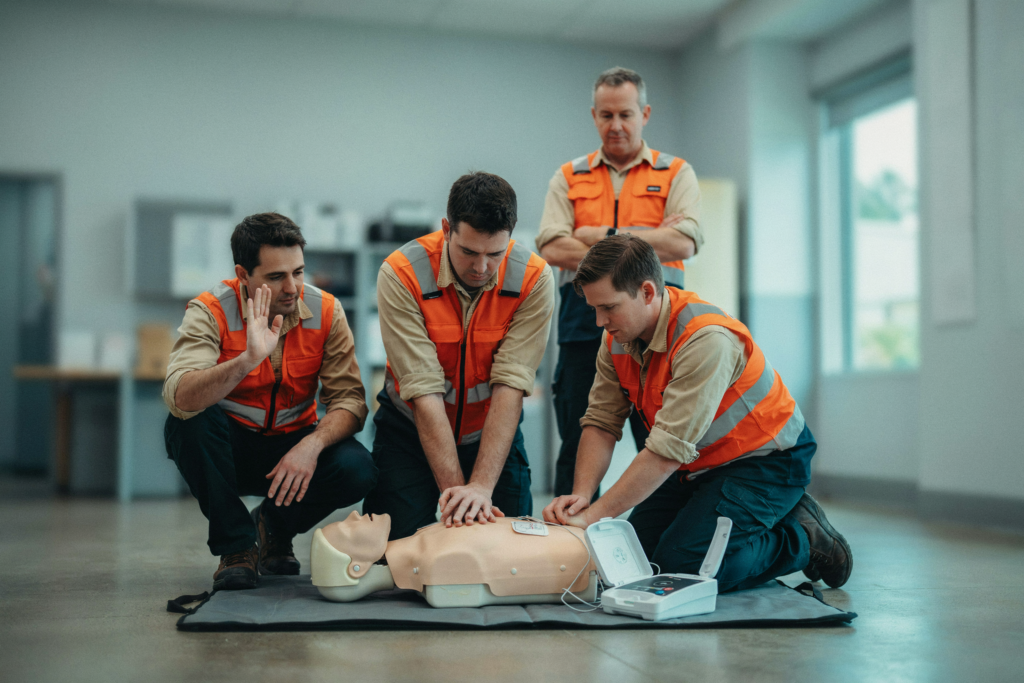
You’re assessed on practical scenarios. You’ll show you can actually manage a casualty, and a scene, rather than just ticking boxes on a quiz.
There’s one physical requirement worth knowing about up front. You’ll need to perform uninterrupted CPR on the floor. If it’s been a few years since your last course, don’t stress. Just know it’s real work on your knees, so go in expecting it.
What You Walk Away With
Your Statement of Attainment
When you pass, you get a Statement of Attainment. It’s the official document from a registered training organisation that shows which nationally recognised units you’ve completed. Because it’s nationally recognised, it’s valid on any site in Australia, not just in Queensland.
The document itself isn’t the tricky part. Timing is. If a contractor management platform won’t grant site access until the certificate’s uploaded, every day you wait is a day your crew’s standing around. For more on what’s on the document and how to use it, read HLTAID014 Statement of Attainment: What It Is and How to Use It.
How long HLTAID014 stays current
The Code of Practice guidance sets out how often first aid qualifications should be renewed, with CPR refreshed more often than the full qualification. That CPR refresher is easy to let slide when a project’s flat out, so it’s worth putting in the calendar the day you get your certificate.
Remember that CPR is the skill you’ll lean on hardest when it counts, and it’s the one that fades fastest if you don’t use it. For renewal timing and options, read HLTAID014 Renewal: When and How to Stay Current.
So that’s HLTAID014 without the jargon. It’s one unit of competency, but it changes the job from looking after one injured worker to running the whole scene until paramedics take over. And on a site with heights, mobile plants and open excavations, that’s a very different kind of responsibility.
The ladder is a bit worth hanging on to. Your crew’s HLTAID011 certificates still matter, and every higher unit builds on the one below it. But if your site’s risk profile calls for advanced cover, the gap usually sits with whoever’s running the site, not the crew.
The law won’t always spell out HLTAID014 by name. What it asks for is first aid that fits your hazards, your workforce and how far you are from medical help. In practice, the requirement is far more likely to turn up in a pre-qualification form, a tender document or a contractor management platform than in the Regulation itself.
When it does turn up, the course is practical and you’re assessed on what you can actually do, not how long you sat in a room. Your Statement of Attainment is what gets you and your crew through the gate, so get everyone booked well before the audit or tender closes. Then keep your CPR refreshed, because it’s the skill that fades fastest.
At the end of the day, the certificate’s the easy part. What really counts is being the person who stays calm and knows exactly what to do when someone goes down badly on your site, with the ambulance still a long way off. That’s what HLTAID014 is really for, and it’s worth getting right.
Book Your First Aid Training Now
Fast, affordable, and nationally accredited training delivered by professionals who care
HLTAID014 FAQs
Q.Is HLTAID014 the same as senior first aid?
No. "Senior First Aid" is an old informal name for the standard first aid level, which is now HLTAID011. HLTAID014 sits a level above that, so a senior first aid certificate won't cover a tender or register that asks for advanced first aid.
Q.How is HLTAID014 different from HLTAID011?
HLTAID011 prepares you to look after one casualty until help arrives. HLTAID014 prepares you to run the whole scene, including multiple casualties, directing bystanders and handing over to paramedics.
Q.Does HLTAID014 include CPR?
Yes. CPR and defibrillation are built into the unit, and you'll be assessed doing uninterrupted CPR on the floor. Most providers also list HLTAID009 on the same Statement of Attainment.
Q.Can you do HLTAID014 online?
Not all of it. Some theory may be done online as pre-course learning, but the practical assessment is face to face with a trainer, because you can't show you can manage a casualty through a screen.
Q.Does HLTAID014 include oxygen therapy?
No. Oxygen therapy and airway devices belong to a separate unit, HLTAID015 Provide Advanced Resuscitation and Oxygen Therapy. If your site keeps oxygen equipment on hand, look at that course as well.
Q.Does Queensland law require HLTAID014 by name?
Rarely. The law asks for first aid that suits your site's risks. The named requirement usually comes from a principal contractor, a tender document or a contractor management platform.
Q.Who usually holds HLTAID014 on a worksite?
Site supervisors, WHS officers, leading hands and foremen, plus anyone running utilities work or remote crews. In short, whoever the crew looks to when something goes wrong.
Q.Is HLTAID014 recognized outside Queensland?
Yes. It's a nationally recognized unit of competency, so your Statement of Attainment holds up on sites across Australia, which helps if your crew moves between projects in different states.
Making first aid training more affordable for
every classroom
We believe every student deserves access to life-saving first aid knowledge. That’s why we offer specially reduced pricing for schools and educational groups. Whether you’re booking for a single class, a year group, or your entire school, our flexible packages make training more accessible and cost-effective — without compromising quality.
