

Your apprentices all got a first aid certificate, and on most sites that’s plenty. But the moment a tender document, a principal contractor or a WorkSafe audit asks for an advanced first aider by name, the difference between basic and advanced first aid stops being some classroom theory. It decides whether your crew mobilises on schedule or sits around waiting.
It nearly always happens the same way. You’re reading the pre-qual checklist on your phone in the ute, and there it is, one line that’s easy to skim past: advanced first aider on the roster. Everyone’s got a ticket, sure. Just not that ticket.
So here’s the short version.
Basic first aid (HLTAID011 Provide First Aid) trains a worker to manage an injury before help turns up.
Advanced first aid (HLTAID014 Provide Advanced First Aid) trains the person in charge to run the whole scene. That means managing more than one casualty, handling serious trauma, and keeping someone stable when the ambulance is a long way out.
One’s a first responder. The other’s who everyone looks at when it goes sideways.
This guide covers what each course actually includes, where Queensland WHS obligations draw the line, which roles on a civil or industrial site need the higher qualification, and how to get your team certified with as little time off the tools as possible. Jump to group booking
What Is the Difference Between Basic and Advanced First Aid?
The difference between basic and advanced first aid is the level of responsibility each course trains you for. Basic first aid (HLTAID011 Provide First Aid) gets you ready to manage a casualty until help arrives. Advanced first aid (HLTAID014 Provide Advanced First Aid) gets you ready to take charge of a complex incident and coordinate the whole first aid response until paramedics take over.
- Basic first aid (HLTAID011): CPR and defibrillation, DRSABCD, bleeding, burns, fractures, asthma and anaphylaxis.
- Advanced first aid (HLTAID014): Builds on basic first aid, adding multiple-casualty management, coordination of other first aiders, resource deployment and scene leadership until medical help arrives.
- Who needs which: Basic first aid suits most workers. Advanced first aid is suited to supervisors, first aid officers, and workers at high-risk or remote worksites.
🧭 Jump to section: At a glance · What basic covers · What advanced covers · Queensland rules · Which roles · Renewal · Book your crew
That’s the short answer. Here’s how the two courses compare line by line.
Basic vs Advanced First Aid at a Glance
What “basic first aid” means in Australia
When most people say basic first aid, they mean HLTAID011 Provide First Aid. If you’ve been on the tools a while you probably still call it Senior First Aid. Same level, new name.
It gets a bit messy here. There’s also a unit called HLTAID010 Provide Basic Emergency Life Support, a shorter unit focused on emergency life support. Despite the title, it’s not what anyone on site means by basic first aid. HLTAID011 already includes HLTAID009 (CPR) and HLTAID010, so when this guide says “basic,” it means HLTAID011.
What makes advanced first aid “advanced”
It isn’t just more hours in a training room. It’s more responsibility.
Basic first aid trains you to treat a casualty. Advanced trains you to run the incident: who’s on compressions, who’s grabbing the gear, who’s on the phone to triple zero.
✅ The plain version: Basic makes you a first aider. Advanced makes you the person the other first aiders report to.
The difference between basic and advanced first aid, side by side
Basic vs advanced first aid: HLTAID011 vs HLTAID014 compared
Basic first aid | Advanced first aid | |
Unit code | HLTAID011 Provide First Aid | HLTAID014 Provide Advanced First Aid |
Role focus | Treat the casualty in front of you | Take charge of the whole incident |
Number of casualties | Built around one casualty | More than one casualty |
Coordination of others | Not the focus | Directs other first aiders |
Resource deployment | Uses the kit and AED on hand | Deploys resources per site procedures |
Typical user | Most workers on site | Supervisors, first aid officers, high-risk or remote sites |
Check the official wording on training.gov.au for HLTAID011 and HLTAID014. Only need CPR? Our HLTAID014 vs HLTAID009 comparison breaks that one down.
Start with the course most of your crew will hold.
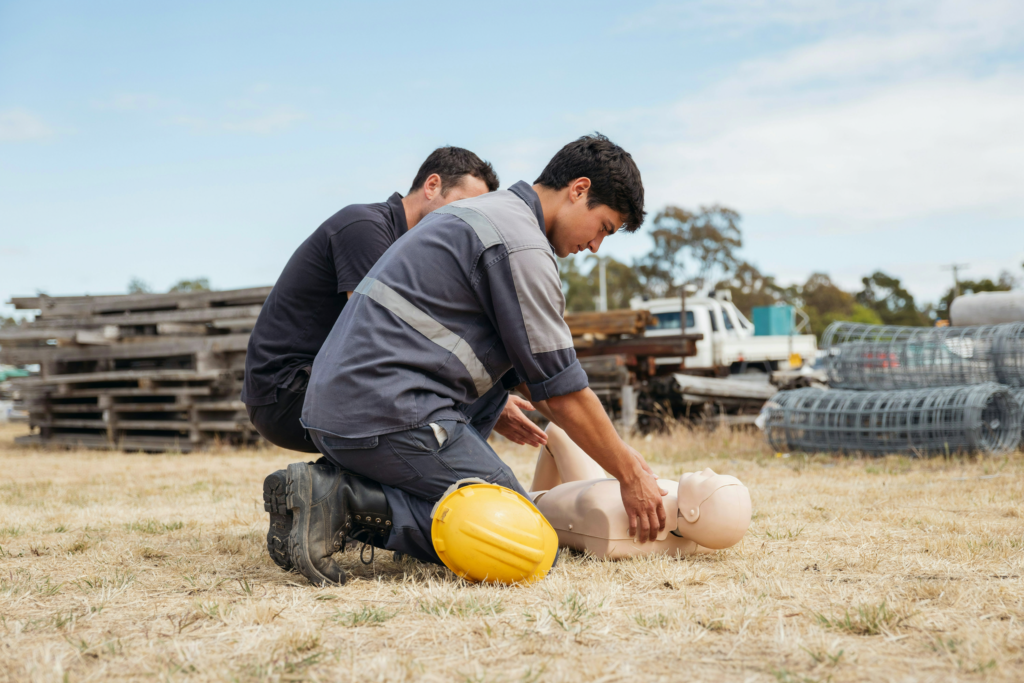
What HLTAID011 Provide First Aid Covers
HLTAID011 Provide First Aid is the workhorse ticket your apprentices turn up with. It covers the injuries you actually see on site.
Core skills
- DRSABCD: The action plan for anyone who's gone down.
- CPR and AED: Compressions and defibrillator use, in line with ANZCOR guidelines.
- Bleeding: Controlling a serious bleed before it gets away from you.
- Burns and fractures: First response when metal, heat and heavy gear are around.
- Asthma and anaphylaxis: Recognising and managing an attack or reaction.
- Shock recognition: Spotting someone going downhill who says they're fine.
The course is built around one casualty: manage them, keep them going, hand over to paramedics.
Where basic first aid is enough on site
For a lot of the crew, it’s exactly the right fit. Think apprentices, labourers and plant operators on metro sites, where the ambulance response is short and there’s already an advanced first aider on the roster.
That’s not a lesser option, it’s the right tool for the job. You need them to be a good pair of hands when the person in charge calls for one.
⚠️ Crew training tip: Most of your crew only need HLTAID011. Save the advanced course for the people who'll be running the scene.
Advanced first aid starts where basic first aid stops: the moment someone has to take charge.
What HLTAID014 Provide Advanced First Aid Covers
On a quiet day, the advanced first aider looks like everyone else on site. The difference shows up the moment something goes wrong and everyone looks for someone to take charge.
Taking charge of the scene
This is the core of HLTAID014: running the response, not just treating the injury.
- Coordinating first aiders: Assigning the right people to the right jobs, rather than having three people assist one casualty while nobody is at the gate.
- Deploying resources: Getting the first aid kit and AED where site procedures say they're needed.
- Managing more than one casualty: Assessing the situation and deciding who needs help first.
- Communicating with emergency services: Giving Triple Zero (000) a clear picture of the situation and providing a clean handover to Queensland Ambulance Service (QAS).
- Post-incident review: Identifying what worked and what didn't once the dust settles.
Scenarios that match real worksites
Training only counts if it looks like your site. The incidents civil and industrial crews actually face look like this:
- Falls from height: Injuries from falling off scaffolding or a ladder.
- Mobile plant injuries: Incidents involving excavators, loaders or rollers.
- Crush injuries: Situations where someone is pinned under heavy equipment or materials.
- Remote-site trauma: Serious injuries at sites where emergency medical assistance may take a long time to arrive.
That last one is where advanced first aid earns its keep.
What advanced first aid is not
HLTAID014 is not HLTAID015 Provide Advanced Resuscitation and Oxygen Therapy. Oxygen and advanced airway equipment belong in HLTAID015 Advanced Resuscitation, not this course, so if your site uses them, that’s the one to look at.
Where each course sits
Step | Unit | What it covers |
1 | HLTAID009 Provide CPR | CPR and defibrillation |
2 | HLTAID010 Provide Basic Emergency Life Support | Emergency life support |
3 | HLTAID011 Provide First Aid | Managing one casualty until help arrives |
4 | HLTAID014 Provide Advanced First Aid | Taking charge of the whole incident |
5 | HLTAID015 Provide Advanced Resuscitation and Oxygen Therapy | Oxygen and advanced airway equipment |
Knowing what the course covers is half the picture. The other half is whether your site actually needs it.
⚖️ Heads up: Queensland law doesn't name HLTAID014, but your contract might.
WorkSafe Queensland Advanced First Aid Requirements
What the law actually says
Here’s the bit a lot of people get wrong. Queensland law doesn’t name HLTAID014 for every construction site.
What the law does say sits in section 42 of the Work Health and Safety Regulation 2011 (Qld). A business has to provide first aid equipment and give workers access to trained first aiders. That’s the legal floor.
How many first aiders you need, and at what level, is guided by the First Aid in the Workplace Code of Practice. The code is risk-based. It asks you to weigh your hazards, your crew, your location and how far away help is, and it suggests ratios of first aiders to workers.
The higher your risk and the further from help, the stronger the case for an advanced first aider.
Site risk factors that point to advanced first aid
If your site ticks a few of these, take it seriously:
- Work at height: Scaffolding, roofs and elevated work platforms (EWPs).
- Mobile plant: Machinery operating and moving around workers.
- Excavation: Trenches, pits and other excavation work.
- Electrical work: Tasks involving potential live electrical or high-voltage exposure.
- Long ambulance response: Sites a considerable distance from the nearest Queensland Ambulance Service (QAS) station.
- Single first aider per shift: One person responsible for coordinating the initial response.
- Large or multi-crew sites: Larger workforces and a greater possibility of multiple casualties.
Does my site need an advanced first aider?
Answer yes or no to each question:
What your answers mean:
- Yes to question 4: HLTAID014 is required by contract. Book a group course.
- Two or more yes answers across questions 1, 2, 3 or 5: Advanced first aid is strongly recommended. See the HLTAID014 Advanced First Aid course.
- Anything else: HLTAID011 is likely sufficient, but confirm it with your risk assessment. Book HLTAID011.
This is a guide, not a legal assessment.
When contracts ask for more than the law
This is usually the real reason you’re here. The law sets the minimum, but your contract can set the bar higher.
Principal contractors often name HLTAID014 in pre-qualification requirements, and so do tenders and platforms like RapidGlobal, Cm3 and Avetta. If the paperwork asks for it, you either have it on the register or you don’t get site access.
The WorkSafe Queensland first aid page is the official place to start.
⚠️ Contract requirements: Your contract may ask for more than the law. Always check the pre-qualification and tender documents, not just the regulation.
Once you know your site’s risk level, the next question is who on the roster needs which qualification.

Who Needs Advanced First Aid on a Civil or Industrial Site?
Not everyone, which is the good news. Most sites run fine with the bulk of the crew on HLTAID011 and a few key people on HLTAID014, as long as one of them is on every shift.
Role-by-role guide
Role | Typical requirement |
Apprentice / labourer | HLTAID011 |
Plant operator / leading hand | HLTAID011, or HLTAID014 if they’re the rostered first aider |
Site supervisor / foreman | HLTAID014 |
WHS officer / first aid officer | HLTAID014 |
Remote crew, designated first aider | HLTAID014 |
Roles using oxygen or advanced airways | HLTAID015 |
The one that catches people out is the leading hand. If the supervisor’s off site and the leading hand becomes the rostered first aider, your advanced cover is gone. A second advanced first aider stops the roster falling over when someone’s on leave.
The career case
There’s a personal upside too. Senior HSE and WHS job ads often list advanced first aid as a requirement.
It shows you’ve been the one running the scene, not just holding the bandage.
With the roles sorted, here’s how long the qualifications last.
How Long Advanced First Aid Is Valid
There are two different clocks running here, and it’s easy to lose track of both.
- CPR: Refresh it every 12 months, as recommended by the Australian Resuscitation Council.
- First aid: Renew it every 3 years, in line with the relevant code of practice.
The CPR refresh is the one that slips, and nobody notices until it shows up as a gap on the qualifications register. Pop both dates in your calendar the day the certificate lands.
If an audit or tender date is already on the calendar, this is the part that matters most.
How to Get Your Crew Certified Before the Next Audit
The training is the easy bit. What slows things down is booking everyone and getting certificates into the contractor portal before the site access deadline. A HLTAID014 group booking fixes most of that. All training is regulated by ASQA, and you’ll find full details on the HLTAID014 Advanced First Aid course page.
Get Your Crew Compliant Before the Next Audit
When an audit or tender close is on the calendar, you don’t have time to chase quotes from a pile of providers. You need the crew booked, trained and on the register without the job grinding to a halt.
So the whole crew goes in one enquiry: HLTAID014 for supervisors, HLTAID011 for everyone else. One booking, one invoice.
It keeps the paperwork simple too. One RTO, one tidy qualifications register.
Every course is nationally recognised training delivered by First Aid Alive, RTO 31106. When the principal contractor or pre-qual platform checks the Statement of Attainment, it holds up, and it doesn’t get knocked back at the gate.
Statements of Attainment are ready to upload into RapidGlobal, Cm3 or whatever contractor management platform your site uses, so nobody’s stuck in the site shed waiting for access.
And once you’ve booked with us, you don’t have to search again. When renewals come round or new starters need their ticket, you just make one call.
Prefer to talk it through? Give us a call.
Your Next Step
Strip away the unit codes and the paperwork, and the difference between basic and advanced first aid comes down to one thing: who’s running the scene when something goes wrong. Most of the crew need to be a steady pair of hands. A few need to be the person everyone else looks to.
The certificate gets you through the audit. The training is what counts on the day something goes wrong.
Book Your First Aid Training Now
Fast, affordable, and nationally accredited training delivered by professionals who care
Frequently Asked Questions
Q.Is advanced first aid the same as senior first aid?
No. Senior First Aid is the old name for HLTAID011, the basic level most workers hold. Advanced first aid is HLTAID014, which trains you to take charge of the incident and coordinate other first aiders until paramedics arrive.
Q.Does HLTAID014 include CPR?
HLTAID014 builds on basic first aid skills, and CPR sits in that foundation. Just remember CPR runs on its own clock, so it still needs a refresh every 12 months even if your advanced certificate has time left on it.
Q.Do I need HLTAID011 before HLTAID014?
Check the current unit requirements on training.gov.au before you book. If you're not sure where you stand, give us a call with your current certificate details and we'll point you to the right course.
Q.How long is an advanced first aid certificate valid?
First aid is generally renewed every 3 years in line with the code of practice, and CPR every 12 months as recommended by the Australian Resuscitation Council. Track both dates, because the CPR one is the one that usually slips.
Q.Is HLTAID014 enough for a remote Queensland worksite?
For most remote civil and industrial sites, yes. When you're weighing up basic vs advanced first aid for a site with a long ambulance wait, advanced is built for exactly that. If your site uses oxygen or advanced airway equipment, you'll need HLTAID015 too.
Making first aid training more affordable for
every classroom
We believe every student deserves access to life-saving first aid knowledge. That’s why we offer specially reduced pricing for schools and educational groups. Whether you’re booking for a single class, a year group, or your entire school, our flexible packages make training more accessible and cost-effective — without compromising quality.
