

Here’s a hypothetical, but one that plays out on sites more than anyone likes to admit. Tuesday arvo, busy civil job. An angle grinder kicks back and opens up your leading hand’s forearm, and in that moment bleeding control first aid is the only thing between him and a very bad outcome. Blood’s coming fast. QAS is still a long way out. And a certificate doesn’t stop a haemorrhage. Trained hands pressing down on that wound do.
This guide walks you through the 5 steps of bleeding control first aid, all lined up with ANZCOR guidelines, so you know exactly how to stop severe bleeding when it counts. You’ll learn how to tell if a bleed is actually life-threatening, and when a tourniquet is the right call.
We’ll cover recognising a serious bleed, the 5 steps, tourniquets and haemostatic dressings, site kits, and why hands-on training makes the difference.
What Are the Steps for Bleeding Control First Aid?
Bleeding control first aid is about stopping blood loss fast with firm direct pressure first, a tourniquet only for life-threatening limb bleeding, and keeping at it until paramedics take over.
If something’s stuck in the wound, leave it in and press around it, not on it.
🩸 Read it fast: How much blood is coming out, and how fast, matters more than what colour it is.
How to Recognise Life-Threatening Bleeding
Not every bleed that looks bad actually is. The trick is reading it quickly.
Arterial, Venous and Capillary Bleeding
- Arterial: Bright red blood that spurts, often in time with the heartbeat. This type of bleeding can become life-threatening very quickly.
- Venous: Darker red blood that flows steadily. Bleeding can still be heavy, especially from a deep wound.
- Capillary: Blood that oozes from grazes and small cuts. It usually stops with direct pressure.
On a real site you won’t be checking what color the blood is. What matters is how much and how fast. A big venous bleed can kill just as surely as an arterial one.
Signs Bleeding Is Life-Threatening
Treat it as life-threatening if you see any of these:
- Blood spurting or pumping out of the wound.
- Blood pooling on the ground around the injured person.
- A pad or dressing soaking through quickly.
- A partial or full amputation.
- Signs of shock, even if you can't see much blood.
If you’re torn between minor or serious, go with serious. Over-reacting costs you a bit of time. Under-reacting can cost a life.
Don’t Miss Internal Bleeding
Some of the worst bleeds on site you won’t see at all. A worker who’s fallen from height or been crushed by a plant can be bleeding inside with barely a mark on them. If someone’s showing signs of shock after an incident like that, suspect internal bleeding and get QAS on the way. ANZCOR‘s shock guideline (9.2.3) has the full picture.
Bleeding Control First Aid: The 5 Steps in Detail
Step 1: Check for Danger and Call Triple Zero (000)
Before you go charging in, look at what caused the injury, because whatever got them can get you too. Plant still running? Get it isolated. Live electrical, falling objects, traffic? It stops one casualty turning into two.
Grab gloves if they’re within reach, but don’t let hunting for them cost the person blood. And don’t forget DRSABCD: if they’re unresponsive and not breathing normally, CPR comes first.
Hand the 000 call off to someone else so your hands stay on the wound. Then send another worker down to the site gate to meet QAS.
Step 2: Expose the Wound and Apply Firm Direct Pressure
You can’t press on what you can’t see. Cut or pull back the hi-vis, sleeves, whatever’s in the way, then get a pad over the wound and press down hard with the heel of your hand. Keep it firm and keep it going.
If there’s something embedded, like a shard of glazing or a bit of rebar, leave it where it is. Pulling it out can make the bleed worse. Press firmly around it instead.
⚠️ Common mistake: Lifting the pad to check if the bleeding's stopped. Every time you peek, you disturb the clot that's trying to form and you're basically starting over. Put it on, press, and leave it.
Step 3: Secure the Pad With a Firm Bandage
Once the pressure’s on, wrap a firm bandage over the pad to hold it in place. That keeps the pressure on, so you’re not relying on your hand alone.
Step 4: Use a Tourniquet if Pressure Fails on a Limb
If it’s a limb, the bleeding’s life-threatening, and firm direct pressure just isn’t holding it, that’s when a tourniquet comes out. More on that in the next section.
Step 5: Manage Shock and Monitor Until QAS Arrives
Lie them down and keep them warm with a blanket, a jacket, whatever you’ve got, even on a hot arvo. Talk to them and tell them help’s on the way. A panicking patient is harder to keep still.
Keep watching their breathing, colour and how responsive they are.
When the paramedics arrive, have your handover ready:
- What time the injury happened.
- What time the tourniquet was applied, if one was used.
- What first aid you provided and how the person's condition changed.
🔧 The tourniquet test: It's a limb, it's life-threatening, and pressure isn't working. All three, then it goes on.
When to Use a Tourniquet in First Aid
Use a tourniquet in first aid when bleeding from an arm or leg is life-threatening and firm direct pressure hasn’t controlled it. Apply it above the wound, not over a joint, leave it uncovered, note the time and tell QAS when they arrive.
What ANZCOR Says About Tourniquets
ANZCOR is pretty clear. A tourniquet is for life-threatening limb bleeding that direct pressure isn’t controlling. It goes above the wound, never over a joint or the wound itself, and it stays uncovered so nobody misses it.
ANZCOR doesn’t pretend tourniquets are risk-free. But when someone’s bleeding out from a limb, the risk of not using one is far bigger than the risk of using it.
Commercial vs Improvised Tourniquets
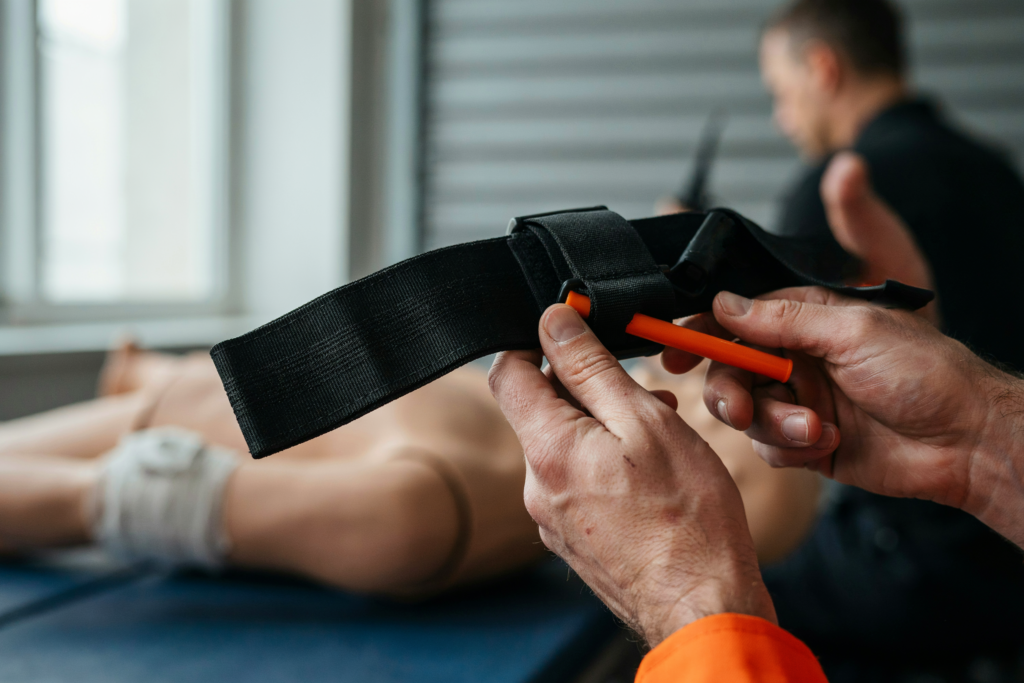
A commercial windlass tourniquet does the job far better than anything you’ll rig up on the spot. But it only counts if someone’s practiced with it. Fumbling with the strap for the first time while a mate’s bleeding is not where you want to be.
And the belt thing? Mostly a myth. A belt usually can’t be pulled tight enough, or kept tight enough, to stop serious limb bleeding.
How to Apply a Commercial Tourniquet
The general sequence goes like this: band around the limb above the wound, pull it tight, twist the windlass until the bleeding stops, lock it off, and note the time. That’s the outline, not the skill. Getting it right under pressure takes hands-on practice.
Tourniquet Myths That Cost Time
Myth | Fact |
A tourniquet means they’ll lose the limb | ANZCOR supports tourniquets for life-threatening limb bleeding because bleeding to death is the bigger risk |
You should loosen it every so often | Once it’s on, leave it on and let QAS or the hospital take it from there |
Only paramedics can use them | Trained first aiders can apply tourniquets in line with ANZCOR guidance |
Haemostatic Dressings and Wound Packing
When First Aiders Use Them
ANZCOR recognises haemostatic dressings for severe bleeding where direct pressure on its own isn’t getting on top of it. They matter most in junctional wounds, where a limb meets the body and there’s nothing to wrap a tourniquet around.
Think of one as a holding pattern, not a fix. Even when the bleeding slows, that person still needs hospital fast.
🏗️ On site: Everyday gear causes most serious bleeds, so the response has to be everyday knowledge too.
Severe Bleeding on Construction and Civil Sites
How Severe Bleeding Happens on Site
Most serious bleeds on site come from the same handful of sources:
- Angle grinders and saws kicking back or losing a disc.
- Sharp sheet metal edges and offcuts.
- Glazing that shatters or slips during handling or installation.
- Rebar injuries, whether from a fall onto it or a snag while handling it.
- Mobile plant incidents, where crush injuries and serious bleeding can occur together.
It’s everyday gear on everyday jobs, so the response needs to be everyday knowledge for whoever’s running the crew.
The Gap Between the Injury and the Ambulance
A lot of SEQ’s growth is happening out on the edges: new estates, roads and industrial parks. Those sites can be a long way from the nearest ambulance, and half-built roads aren’t easy to find. That stretch between the injury and QAS walking through the gate is on you and your crew.
Crush Injuries and Trapped Workers
If someone’s pinned under plants or materials, it’s not just a bleeding problem anymore. Crush injuries come with their own risks and rules, and they’re the kind of scenario worth training for hands-on in HLTAID014 Advanced First Aid, not reading about for the first time on the day.
Your Legal Obligations Under WorkSafe QLD
Under Queensland’s WHS framework, the business running the site has to provide first aid equipment, facilities and trained first aiders that match the site’s risks. WorkSafe Queensland’s First Aid in the Workplace Code of Practice spells out how. When an auditor comes through, it’s your name they’re looking for on the qualifications register.
What Your Site Bleeding Kit Should Contain
A lot of site kits are built for splinters and grazes, not someone losing blood fast off a grinder.
The Code of Practice Baseline
WorkSafe Queensland’s First Aid in the Workplace Code of Practice sets out what a standard workplace first aid kit should contain. Treat that as your floor, not the finish line.
High-Risk Site Additions
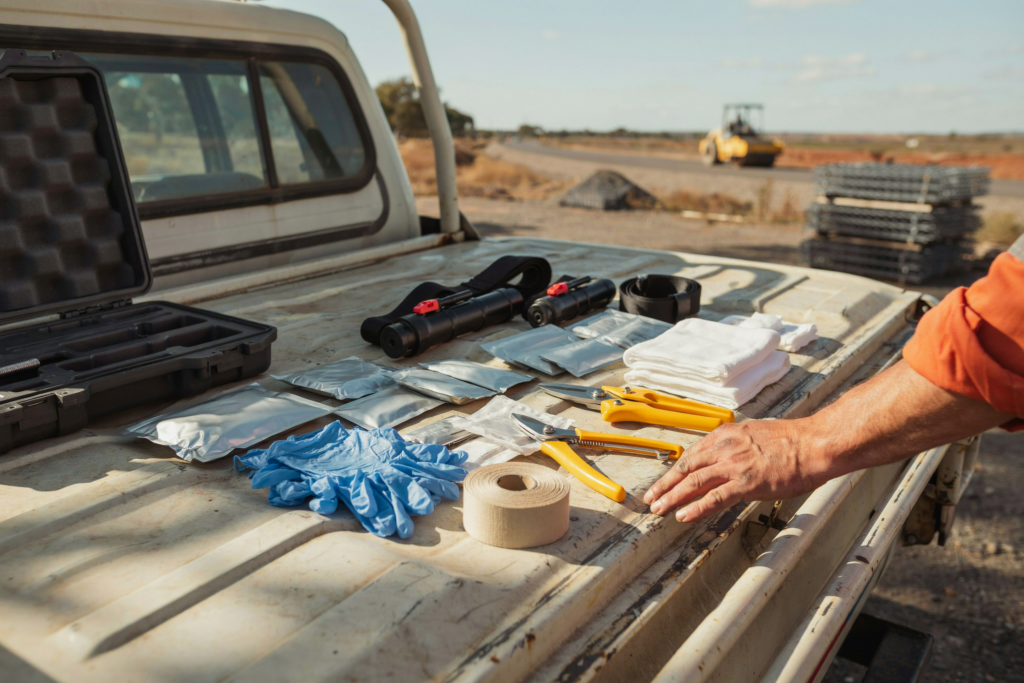
For high-risk sites, consider adding these based on your risk assessment:
- Commercial windlass tourniquets.
- Haemostatic dressings.
- Large trauma dressings.
- Trauma shears for cutting through PPE and clothing.
- Extra gloves in more than one size.
None of it helps if nobody on site knows how to use it.
Keep It Where the Risk Is
A kit locked in the site office isn’t much use when someone’s bleeding at the work face. Put your bleeding control gear where the risk is: near the cutting, in the utes, on or near the plant.
Check it regularly. Restock after use, watch use-by dates, and make sure the tourniquets haven’t wandered off.
Why Hands-On Advanced First Aid Training Matters for Bleeding Control
Knowing the Steps vs Doing Them Under Pressure
Reading five steps on a screen is one thing. Doing them with blood on your hands, someone yelling for help, plants still ticking over and your heart going like a jackhammer is something else. Under that kind of pressure, people don’t rise to the occasion. They fall back on whatever their hands have actually practised.
When you’ve packed a wound, pushed down hard on a pad and cranked a tourniquet windlass in a realistic scenario, your hands already know the moves when it’s real. When you’ve only read about it, you’re working it out on the spot.
What HLTAID014 Covers That a Standard Certificate Doesn’t
HLTAID011 Provide First Aid suits workers who need a general first aid certificate. HLTAID014 Provide Advanced First Aid is built for supervisors and designated first aiders on higher-risk sites.
Training Options for Brisbane and SEQ Crews
Most supervisors aren’t booking one seat, they’re booking a crew. Group bookings keep it simple, and individual places are there if it’s just you.
Bleeding control first aid comes down to five things: check for danger and call 000, get firm pressure on the wound, bandage it in place, use a tourniquet if limb bleeding won’t stop, and manage shock until QAS arrives. Go back to that civil site for a second. Grinder kicks back, the leading hand’s forearm opens up, and the ambulance is still a long way off. At that moment nobody needs a certificate sitting in a drawer. They need someone who’s done this with their hands before, who doesn’t freeze, and who knows exactly what comes next. Be that person.
Book Your First Aid Training Now
Fast, affordable, and nationally accredited training delivered by professionals who care
Bleeding Control First Aid FAQs
Q.How can you tell if bleeding is life-threatening?
Look for blood spurting or pooling, a pad soaking through fast, a partial or full amputation, or signs of shock even when you can't see much blood. If you're not sure, treat it as serious and get Triple Zero (000) called straight away.
Q.Can you use a belt as a tourniquet?
A belt is a last resort, and a poor one. It usually can't be pulled tight enough, or held tight enough, to stop serious limb bleeding. A commercial windlass tourniquet does the job far better, so keep one in every high-risk site kit.
Q.Should you loosen a tourniquet once it's on?
No. Once it's on, leave it on and let QAS or the hospital take it from there. Leave it uncovered, write down the time it went on and tell the paramedics at handover.
Q.Should you lift the pad to check if the bleeding has stopped?
No. Every time you lift the pad you disturb the clot that's trying to form, and you're basically starting over. Put it on, press hard, secure it with a firm bandage and leave it.
Q.Should you pull out an object stuck in a wound?
Leave it where it is. Pulling out glass, rebar or anything else embedded can make the bleeding worse. Press firmly around the object instead of on it, and let the paramedics deal with removing it.
Q.What's the difference between HLTAID011 and HLTAID014?
HLTAID011 Provide First Aid suits workers who need a general first aid certificate. HLTAID014 Provide Advanced First Aid is built for supervisors and designated first aiders on higher-risk sites like construction, civil and industrial work.
Making first aid training more affordable for
every classroom
We believe every student deserves access to life-saving first aid knowledge. That’s why we offer specially reduced pricing for schools and educational groups. Whether you’re booking for a single class, a year group, or your entire school, our flexible packages make training more accessible and cost-effective — without compromising quality.
