

The casualty was grey and short of breath, the cylinder was in your hand, and the regulator went on first time. Then someone asked what flow rate you’d set, and you weren’t sure. The five rights of oxygen administration exist for exactly that moment. And five rights oxygen administration isn’t just something for the nurses on a ward.
Oxygen’s a medication. It’s got times when it helps, it’s got risks, and it’s got a right dose. The five rights started in nursing, but they fit a warehouse first aid room just as well as a hospital bed.
What follows is an oxygen administration checklist adapted for workplace first aiders and built on ANZCOR guidance. There’s no doctor’s order on site. It’s your assessment, your training, your call.
If you’re an ERT leader, a senior first aid officer, an event first aider or the person who looks after the oxygen kit at a Brisbane workplace, this one’s for you.
We’ll cover why oxygen counts as a medication, each of the five rights, a printable checklist, the checks that get skipped, whether you need HLTAID015, and keeping it all sharp.
What Are the Five Rights of Oxygen Administration?
The five rights of oxygen administration are a safety check that treats oxygen as a medication. In workplace first aid, they are:
Why Oxygen Counts as a Medication in Workplace First Aid
Walk into most first aid rooms and the oxygen kit is sitting on the shelf next to the stretcher and the spill kit. It gets tagged and checked like any other bit of equipment. Fair enough, it is equipment. But the gas inside that cylinder is a medication, and oxygen therapy in first aid works the same way any medication does. It has indications. It has risks. And it has the correct dose.
The five rights came out of nursing, where they’re used to stop medication errors before they reach the patient.
Here’s the big difference though. On a ward, a nurse gives oxygen against a doctor’s order. On site there’s no order. There’s you, your assessment, your training and the ANZCOR guidelines.
And more isn’t always better. It’s easy to think oxygen can’t hurt, so if someone looks crook you turn it on and walk away. ANZCOR doesn’t see it that way. Its guidance in ANZCOR Guideline 9.2.10 advises against giving oxygen routinely, and says to give it when it’s actually indicated. Too much oxygen isn’t harmless, and that’s exactly why the decision and the dose matter.
Our article on the HLTAID015 unit of competency shows where oxygen sits in your training.
That’s why the five rights translate so well to a first aid room. Here’s what each one looks like when there’s no doctor’s order to rely on.
🔍 How to read this part: Each right covers what it means, what to check, where it goes wrong, and one line to remember.
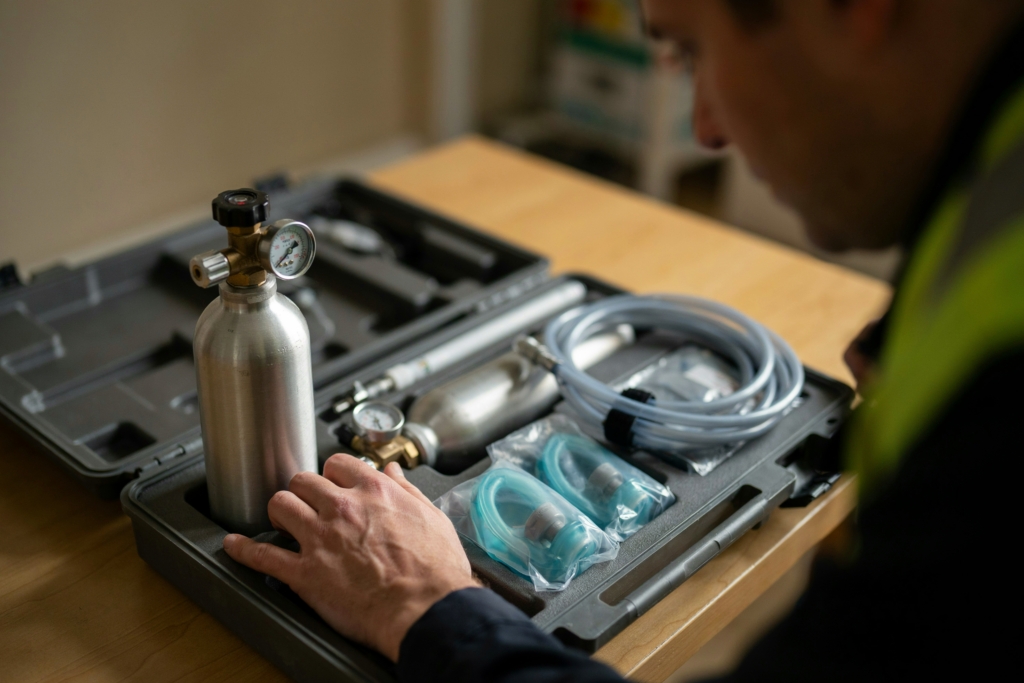
The Five Rights of Oxygen Administration, Explained for First Aiders
Right Person: Is Oxygen Actually Indicated?
This one is about the casualty, not the cylinder. Before the oxygen comes out you need a reason for it, and that reason comes from your assessment.
Check their breathing, their pulse and their level of consciousness. If there’s a pulse oximeter in the kit, use it and check their SpO₂ as well. Then match it against the signs your training taught you.
It shouldn’t come from the noise of the scene. Bystanders yelling or a rattled casualty isn’t the same as a sign that oxygen is indicated.
Where it goes wrong is reflex. Someone goes down, the oxygen goes on, and nobody stops to ask if it was the right call. It feels like doing something, but not always the right thing.
Check: Your assessment is done and the casualty’s signs point to oxygen, not just the mood in the room.
Right Oxygen: Cylinder, Contents and Regulator
Go back to that moment at the top of this article. The regulator went on the first time, and that’s this right working the way it should. On site it matters most, because if the gas or gear isn’t right, nothing after it is.
Check it’s labelled medical oxygen, in date and tagged, with enough in the cylinder for the job. The regulator is seated firmly and there are no leaks when you open it up.
Where it goes wrong is boring stuff: a cylinder nobody swapped out, a tag nobody looked at, a regulator forced on in a rush. If the set-up’s a bit rusty for you, our oxygen regulator set-up guide is a quick refresher.
Check: Medical oxygen, in date, enough contents, regulator secure, no leaks.
⚠️ Worth knowing: "Most oxygen errors on site aren't clinical. They're a cylinder nobody checked."
Right Dose: Flow Rate Matched to the Casualty
With oxygen, the dose is the flow rate. You set it for the casualty’s condition and for the device you’re using, and you follow what your training and ARC guidance support. You won’t find numbers here. They belong in your training.
It goes wrong in two ways. Cranking it to max and never adjusting it as the casualty changes, or setting it too low for the device to do its job.
Check: The flow rate is what your training supports for this casualty, on this device.
Right Route: Matching the Device to the Breathing
Route is how the oxygen actually gets in, and it all comes down to breathing. If the casualty is breathing adequately on their own, it’s a mask or nasal cannula. If they’re not breathing adequately, you’re using a bag-valve-mask with oxygen attached and doing the breathing for them.
The device and the flow have to match. If they don’t go together, the casualty isn’t getting what you think they’re getting.
Check: The device suits how the casualty is breathing, and the flow suits the device.
Right Time: When to Start, Reassess and Hand Over
Oxygen never comes before CPR or the AED. If the casualty needs compressions and a shock, that starts straight away. The oxygen joins in once someone has it set up, not before.
Once it’s on, it’s not set and forgotten. Reassess regularly. If the casualty gets worse, run through the five rights again from the top, because the right dose or the right device can change as they change. That’s five rights: the oxygen administration doing its job.
Keep going until paramedics take over. When they arrive, hand over what you gave, when you started it, what flow and what device.
Check: CPR and the AED weren’t delayed, reassessment is happening, and the handover details are ready.
Knowing the five rights is one thing. Running through them while a casualty is in front of you is another, and that’s what the checklist is for.
🖨️ Print it: A checklist on the kit lid beats a list in your head when the radio goes.
Your Workplace Oxygen Administration Checklist
Under pressure nobody remembers a long list, so this oxygen administration checklist is built to be printed and stuck where you’ll actually see it: on the wall of the first aid room, or taped inside the lid of the oxygen kit.
Work down it before the oxygen goes on.
Right | Check before oxygen goes on | ✓ |
Person | Signs indicate oxygen, assessment done | ☐ |
Oxygen | Medical O₂, in date, contents sufficient, regulator secure | ☐ |
Dose | Flow rate set per training for this casualty and device | ☐ |
Route | Device matches breathing status and flow | ☐ |
Time | Started without delaying CPR or AED, reassessment scheduled | ☐ |
The checklist only works if the kit is ready before anyone needs it. Do a quick readiness check whenever you’re in the first aid room:
- Cylinder contents are enough for a real job, not just a quick test
- Regulator is with the kit and in working order
- Masks and tubing are in date and still sealed
- A spare cylinder is on hand
If the checklist turns up a gap in your own skills, our HLTAID015 course is where you practise all five rights on real equipment.
The checklist covers the five rights. Experienced responders know there are a few more checks that tend to get dropped when the pressure is on.
The Checks That Get Skipped Under Pressure
Right Environment: Ventilation and Ignition Sources
Oxygen doesn’t burn on its own, but it makes everything around it burn faster and hotter. So before you open the cylinder, look at where you are. Open flames, sparks from grinding or welding, oil and grease on hands, gloves or fittings, and anyone smoking nearby all need to be dealt with first. Warehouses, workshops and plant rooms have plenty of them.
Ventilation matters too. A casualty in a small, closed-in space with oxygen running is a different job from one out on an open loading dock. Checking the environment is part of the HLTAID015 assessment requirements, so expect to show it.
Right Documentation: The “Sixth Right”
Plenty of responders call this the sixth right. Write down what you gave, when you started it, the flow, the device and how the casualty responded. Those notes become your handover to paramedics, and later they feed straight into the incident report.
You’ll see longer lists out there with six, seven or more rights. They’re not wrong, but five is what people remember on a bad day, so treat documentation as the habit behind them.
When the Equipment Fails Mid-Response
Sooner or later the cylinder runs empty, the regulator leaks or the tubing kinks under the casualty’s shoulder. Have a plan B ready, whether that’s a spare cylinder, a second regulator or a different device, and don’t let basic life support stop while you sort it out. Compressions and breaths keep going.
Managing an equipment failure is an assessed skill in HLTAID015, and our unit of competency article covers it in more detail.
All of this assumes the person holding the cylinder has been trained to use it. So the next thing to work out is what training your workplace actually needs.
🎓 Short answer: If your site holds oxygen, the people using it need training that covers it.
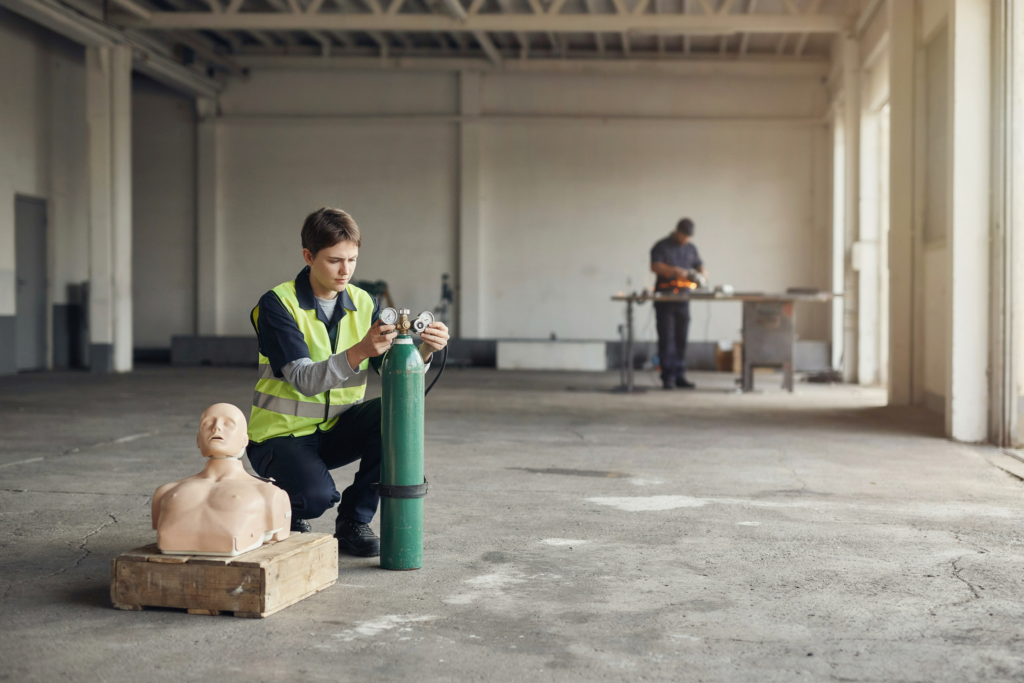
Do You Need HLTAID015 to Give Oxygen at Work?
The full title is HLTAID015 Provide Advanced Resuscitation and Oxygen Therapy. It’s the unit that covers oxygen, airway adjuncts, bag-valve-mask ventilation and advanced resuscitation as a team.
The equipment and the training go together. If your first aid room has oxygen, airways and a bag-valve-mask, the people expected to use them need training that covers that gear.
What your particular site needs comes down to two documents: Queensland’s First Aid in the Workplace Code of Practice from WorkSafe Queensland, and your own site risk assessment. Check both, and talk to whoever owns your site’s first aid procedures. A facility with heavy plant and shift work is going to land somewhere different from a small office.
If you’re not sure whether you need HLTAID015 or HLTAID014 Provide Advanced First Aid, or both, our article comparing the two explains the difference. The unit’s official details are listed on training.gov.au.
Being trained once isn’t the end of it. Oxygen skills fade faster than most.
Keeping the Five Rights Sharp Between Renewals
Skills you don’t use go stale, and advanced resus skills seem to go faster than most. Most first aiders run through CPR in their head all the time, but can go a long while without touching an oxygen regulator. Then the day comes and their hands have forgotten what their head still knows.
The good news is it doesn’t take much to keep the five rights fresh:
- Regular kit check. Open the kit, check the cylinder and regulator, and put your hands on the gear.
- Toolbox talk walkthrough. Run the five rights out loud with the crew at a toolbox talk.
- Cylinder swap drill. Practise swapping an empty cylinder for a full one against the clock, so plan B is muscle memory.
On renewals, check what your employer, your insurer and your principal client expect, because they don’t always want the same thing.
If your certificate is close to expiry, or the team hasn’t had hands-on practice in a while, an HLTAID015 refresher in Brisbane is the easiest way to get everyone back to the same standard.
Conclusion
Back to that first aid room. The regulator went on the first time, then came the question about flow and you weren’t sure. That gap isn’t in your hands. It’s the gap between knowing and being certain under pressure, and the five rights are there to close it.
Oxygen is a medication, even sitting on a shelf. Five rights oxygen administration lets you treat it like one with no doctor’s order to fall back on. Your assessment, your training and ANZCOR guidance do the rest.
The skipped checks matter just as much. Clear the ignition sources, write it all down, and have a plan B ready while compressions and breaths keep going.
None of it works without training on that gear. Your code of practice and site risk assessment will tell you what your workplace needs.
Then keep it fresh, so your hands stay as sharp as your head between renewals.
Print the checklist, stick it inside the kit lid and run it with your crew. Next time the radio goes, you’ll know what to do before you pick up the cylinder.
Book Your First Aid Training Now
Fast, affordable, and nationally accredited training delivered by professionals who care
Frequently Asked Questions
Q.What are the five rights of oxygen administration?
The five rights of oxygen administration are a safety check that treats oxygen as a medication: right person, right oxygen, right dose, right route and right time. You confirm oxygen is indicated, check the cylinder and regulator, set the flow your training supports, match the device to the person's breathing, and reassess until paramedics take over.
Q.Is oxygen considered a medication in first aid?
Yes. Oxygen has indications, risks and a correct dose like any other medication. On site, there is no doctor's order, so the first aider makes decisions based on their assessment, training and ANZCOR guidance, which advises against giving oxygen routinely.
Q.Can a first aider give oxygen in a Queensland workplace?
A first aider trained to use oxygen can administer it in accordance with the site's first aid procedures. What each workplace needs is determined by the First Aid in the Workplace Code of Practice and the site's risk assessment, so check both.
Q.How often should workplace oxygen equipment be checked?
Perform quick readiness checks routinely as part of maintaining the first aid room. Check cylinder contents, the regulator, masks, tubing and the availability of a spare cylinder. Follow your oxygen supplier's servicing schedule and your site's own procedures.
Q.What is the sixth right of oxygen administration?
Many responders call documentation the sixth right. It means recording what oxygen was given, when it was administered, the flow rate, the device used and how the casualty responded. This helps ensure the paramedic handover and incident report are accurate.
Q.Does the checklist replace training?
No. The checklist supports accredited training and your site's procedures, but it does not replace them. It is a prompt for people who already know how to use the equipment.
Making first aid training more affordable for
every classroom
We believe every student deserves access to life-saving first aid knowledge. That’s why we offer specially reduced pricing for schools and educational groups. Whether you’re booking for a single class, a year group, or your entire school, our flexible packages make training more accessible and cost-effective — without compromising quality.
