
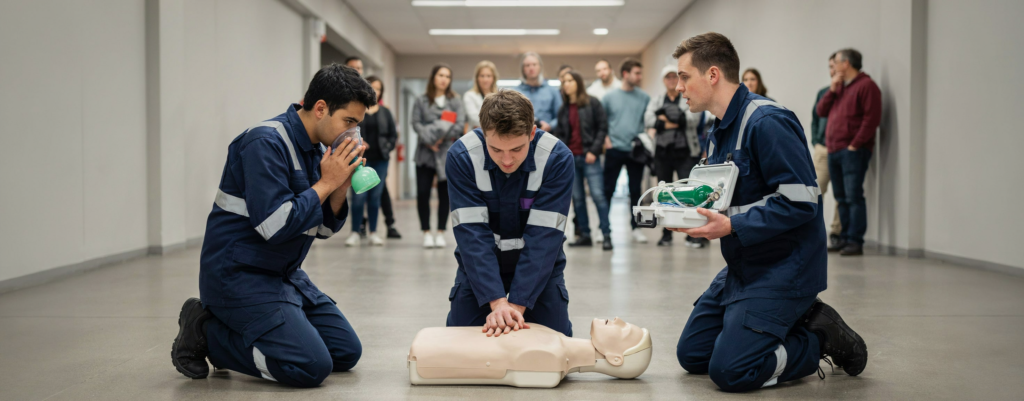
The radio crackles, someone’s down on the concourse, and your hands already know the drill. Until the crowd presses in and the oxygen bag snags on a handrail. High stakes emergency response is less about what you know and more about what still works when everything around you gets loud.
That’s the point of high stakes emergency response training in Brisbane. You’re the ERT leader, the senior first aid officer, the event first aider or the FIFO crew member with oxygen and airway kit on site. The one they call. Here’s the problem though. Advanced skills fade fastest on the gear you rarely touch, and a calm classroom assessment on a clean floor hides that fade. Nobody notices till a real incident shows it up.
So what makes HLTAID015 Provide Advanced Resuscitation and Oxygen Therapy training actually hold under pressure? Real equipment, team scenarios, troubleshooting when kit fails, and onsite delivery so whole crews train together. We’ll work through why skills break down, what pressure-ready training looks like, the HLTAID015 skills that matter most, training your ERT, and choosing a Brisbane provider.
First though, a straight definition, cause the phrase gets used pretty loosely.
What Is High Stakes Emergency Response Training?
High stakes emergency response training prepares experienced first aiders to perform advanced resuscitation when conditions are noisy, crowded or unpredictable, not just on a clean training floor. In Australia, it usually centres on HLTAID015 Provide Advanced Resuscitation and Oxygen Therapy, delivered through realistic, scenario-based practice on real equipment. Training typically covers:
- Oxygen therapy, including cylinder and regulator set-up
- Airway management with adjuncts and suction
- Bag-valve-mask ventilation during two-rescuer CPR
- AED use within a team resuscitation sequence
- Managing equipment malfunctions mid-scenario
- Team roles, communication and handover to paramedics
It suits ERT members, senior first aid officers, event first aiders and FIFO workers who have oxygen and airway equipment on site.
Why Advanced Resus Skills Break Down Under Pressure
Ask anyone who’s done a real call. It wasn’t the knowledge that let them down. It was the hands, the noise, the gear that didn’t behave like it did in the training room. Emergency response under pressure exposes gaps a clean assessment never touches.
Equipment You Rarely Touch Fades First
Think about how often you actually open the oxygen kit, size an airway or switch on the suction unit. For most ERTs, maybe only at renewal. That’s where advanced resuscitation skill fades hardest. CPR you could probably do in your sleep. The hesitation comes from the bag snagging, the mask that won’t seal, the kit you haven’t handled since your last course.
Stress Narrows Attention and Fine Motor Control
Anyone who’s been there knows the feeling. Your vision tunnels in on the casualty. Your fingers go thick and clumsy on a valve you’d open without thinking in the training room. You lose your place in the sequence, start something, stop, start again. It’s what stress does to people, and good training plans for it.
Calm Classroom Assessments Hide the Gap
This is a pattern right across the industry. Plenty of assessments happen on a clean floor, in a quiet room, with no interruptions. You pass and walk out feeling ready. But passing in those conditions isn’t the same as being ready on a loading dock with a forklift reversing behind you. The gap was there the whole time, just hidden.
Teams Fail Without Assigned Roles
On a real call the problem often isn’t what to do. It’s who does what. Three solid first aiders can all reach for the AED while nobody’s looking after the airway. Without roles sorted, good individual skills don’t add up to a good response.
For how often these skills should be refreshed, the Australian Resuscitation Council and ANZCOR guidelines are the reference point.
So that’s why skills break. The other half of the job is training in a way that stops them breaking.
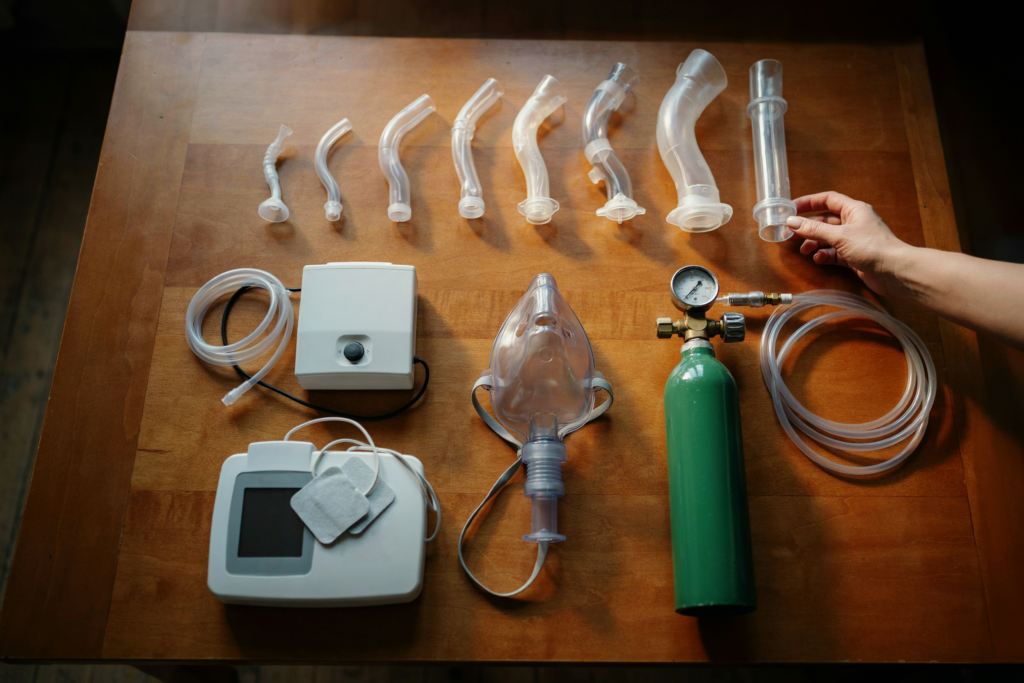
🧰 Trainer tip: Look at the equipment table before you look at anything else. It tells you most of what the day will be like.
What Pressure-Ready Emergency Response Training Looks Like
You can usually tell early whether a training day’s going to be worth it. Is the oxygen cylinder charged? Are the airways laid out in a full size range, or is there one lonely OPA rattling around in a zip-lock bag? Realistic emergency response training starts with what’s on the table.
Real Equipment, Not Props
Pressure-ready training means charged training cylinders, a full range of airway sizes, working suction, bag-valve-masks, and AED trainers that look like the units on the wall at work. If the gear in the room doesn’t match the gear on your site, you’re practising on something you’ll never use for real.
Scenarios That Look Like Your Workplace
A casualty on a warehouse floor is a different job to one on a stadium concourse. A mine site crib room is different again, and so is a loading dock with trucks backing in. Good scenario-based first aid training in Brisbane puts you somewhere that feels like where you actually work.
Planned Interruptions and Equipment Malfunctions
Halfway through a scenario the trainer throws in a problem. The oxygen stops flowing, or something doesn’t do what it’s meant to. Managing an oxygen equipment malfunction is part of what HLTAID015 assesses, so practising it under pressure is part of doing the unit properly.
Team-Based Practice Instead of Solo Demonstrations
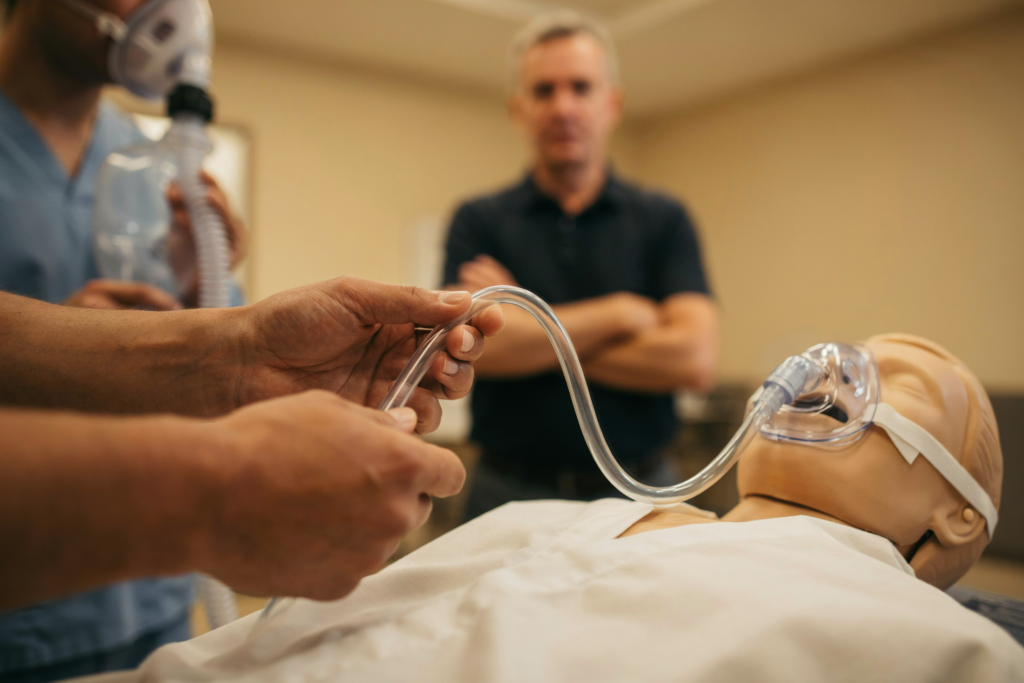
Doing it alone on a mannequin is one thing. Real calls are team calls. That means two-rescuer CPR with a BVM, rotating operators so nobody burns out on compressions, and one person leading and calling the sequence out loud.
More Hands-On Time, Less Re-Teaching the Basics
If you already hold your CPR and first aid tickets, you don’t need to re-learn them. You need time on the oxygen, the airways and the BVM. Pressure-ready training respects what you already know and spends the day on the parts that fade.
Tick-box course | Pressure-ready training | |
Equipment | Props, empty cylinders, limited airway sizes | Charged cylinders, full airway range, working suction |
Scenarios | Mannequin on a clean floor | Settings that look like your workplace |
Equipment failures | None | Planned malfunctions mid-scenario |
Team roles | Solo demonstrations | Two-rescuer CPR with a leader calling it |
Hands-on time | Heavy on slides and theory | Most of the day on the equipment |
🫁 Remember: Four skills tend to wobble first on a real call. Oxygen, airways, BVM and the AED inside a team.
All that realism won’t help much, though, unless it’s built around the right skills.
The HLTAID015 Skills That Matter Most When It’s Real
Every HLTAID015 course in Brisbane works from the same unit, set nationally on training.gov.au. What changes from one advanced resuscitation course in Brisbane to the next is how hard those skills get tested. These four tend to wobble first.
Oxygen Set-Up and Delivery
Where it breaks: You fumble the cylinder and regulator with people watching, or freeze when the gauge doesn’t read the way you expect.
What good training does: It gets the kit in your hands until the set-up is boring, then adds noise and interruptions. For clinical detail, go by the ARC guidelines and what you’re taught on the day.
Airway Adjuncts and Suction
Where it breaks: Sizing. It’s the skill people lose quickest, because you rarely measure an airway on a real person. Suction gets forgotten too, until you need it.
What good training does: It has you size and insert across the full range, and run suction inside the scenario instead of as a separate demo.
Bag-Valve-Mask Ventilation in a Two-Person Team
Where it breaks: The mask seal. It looks simple until your hands are tired and your partner is mid-compression beside you.
What good training does: It drills the seal in two-person teams, swapping roles, with a trainer watching for leaks.
AED Use Inside a Team Sequence
Where it breaks: The AED on its own is easy. Fitting it in while oxygen is running and someone’s on the BVM is where pauses blow out.
What good training does: It runs the AED as one part of the team response, with a leader keeping interruptions to compressions as short as possible.
🟧 Want the detail? This is the short version. Our full skill-by-skill breakdown of HLTAID015 covers what's included and how it's assessed.
That’s you sorted. Getting a whole response team to the same standard is a bigger job.
Training Your Whole ERT Without Leaving the Site Exposed
If you run an ERT, you know the catch. You can’t pull every responder off the floor at once and leave nobody on the radio. Good emergency response team training in Brisbane works around your roster, not the other way round.
Onsite Training on Your Own Equipment
Training on the kit your team will actually grab is hard to beat. Onsite advanced resuscitation training in Brisbane means practising with your cylinders, your regulator and your AEDs, in the spaces where an incident would really happen.
Split Sessions So the Site Stays Covered
Split the ERT into two groups across different days or shifts. Half trains while half stays on the radio, then they swap. Nobody’s left exposed.
Tracking Renewals Across the Team
This is the admin side nobody enjoys. One responder’s HLTAID009 is coming due, another’s HLTAID011 has lapsed, and the HLTAID014 and HLTAID015 dates don’t line up with anyone’s. A simple tracker with every name, role and expiry date in one place fixes that.
Certificates That Satisfy Insurers, Clients and Contractor Portals
Your insurer wants proof. Your principal contractor wants proof. Then someone has to upload it all to Cm3, Rapid Global or Avetta. Each Statement of Attainment should show the unit code and full title, the RTO number and the NRT logo, in a format that uploads cleanly for the first time.
WorkSafe Queensland’s First Aid in the Workplace Code of Practice works on the principle that training should match the equipment and risks on your site. Oxygen and airway kit on the shelf means training that covers it.
Not every high-pressure call happens with a first aid room down the corridor, though.
Event First Aid and FIFO: Different Settings, Same Pressure
Event first aiders work in the middle of the crowd. FIFO crews might be a long way from the nearest hospital. Same HLTAID015 skills, different pressure.
Event First Aiders: Crowds, Noise and Handover
Concourses are narrow, loud and full of people who stop to watch. You might carry your kit through a crowd just to reach the casualty. Keeping the ambulance access route clear is half the job at a big venue.
Then there’s the handover. Whether it’s the event medical lead or QAS paramedics, you’ve got very little time to pass on what happened and what you’ve done. Event first aid training in Brisbane that’s worth it practises handover out loud, in the noise.
FIFO and Mine Site Workers: Longer Waits and Tight Training Windows
On a remote site, an ambulance can take a lot longer to arrive than it does in the city. The first aider could be managing the casualty for an extended stretch, keeping oxygen running, watching the airway and rotating CPR operators as people tire. Out there, stamina and teamwork count as much as technique.
Then there’s the calendar. FIFO advanced resuscitation in Brisbane has to fit into your break between swings, ideally on a weekend or at short notice, so your ticket’s current before you fly back out.
Wherever you work, the provider you pick decides how close training gets to the real thing.
How to Choose a High-Stakes Emergency Response Training Provider in Brisbane
A lot of course pages look the same. Same unit code, same stock photo of smiling people in a classroom. When you’re hunting for the best advanced resuscitation course in Brisbane, the difference between a tick-box day and proper high stakes emergency response training is in the detail.
What to Check Before You Book
- RTO number you can verify on training.gov.au (First Aid Alive is RTO 31106)
- Equipment listed and shown in real photos, not stock images
- Scenario-based assessment explained clearly
- Trainer background that's verified, not padded out
- Onsite and group options for training a whole ERT
- Certificate format that uploads cleanly to contractor portals
- Venue access and parking that suits a work ute
Get Ready Before the Next Call
That concourse scene from the start doesn’t have to end with a snagged bag and a lost sequence. It can end with a calm handover and a team that knew who was doing what.
That’s the difference high stakes emergency response training makes. More time on the gear, in conditions that feel like the real thing.
The first step’s simple. Check your HLTAID015 expiry date, then check your team’s, and get every date into one place.
Next, work out how you want to train. A public course suits you if you’re renewing on your own. A team booking keeps a whole ERT at the same standard.
If you’re not sure what you’ll be doing on the day, ring and ask. A good provider will be glad you did.
The skills that fade between renewals are the ones you’ll need most. Closing that gap now beats finding it on the floor.
You’re the one people call on the radio. Be ready when they do.
Book Your First Aid Training Now
Fast, affordable, and nationally accredited training delivered by professionals who care
High Stakes Emergency Response Training FAQs
Q.Who needs high stakes emergency response training?
It suits anyone who's expected to respond with oxygen and airway equipment on site, like ERT members, senior first aid officers, event first aiders and FIFO workers. If people call you on the radio when someone goes down, high stakes emergency response training is built for you.
Q.How often should I renew HLTAID015?
The Australian Resuscitation Council and ANZCOR guidelines are the reference point for refresher training, and your employer, insurer or principal client may set their own requirements too. Because advanced skills fade quietly between renewals, plenty of ERT leaders book their refresher before the expiry date comes round.
Q.What is the difference between HLTAID014 and HLTAID015?
HLTAID014 Provide Advanced First Aid covers broader advanced first aid and incident management, while HLTAID015 focuses on advanced resuscitation with oxygen, airway adjuncts, suction and bag-valve-mask ventilation. Plenty of ERT members end up needing both.
Q.Do I need a prerequisite to enroll in HLTAID015?
Entry requirements are worth checking before you book, so have a look at our guide to HLTAID015 prerequisites or ask when you call.
Q.Can you train our team on our own equipment?
Onsite training on your site's own oxygen, airway kit and AEDs is worth asking about when you call, because practicing with the exact gear your team will grab on the day makes the training stick.
Making first aid training more affordable for
every classroom
We believe every student deserves access to life-saving first aid knowledge. That’s why we offer specially reduced pricing for schools and educational groups. Whether you’re booking for a single class, a year group, or your entire school, our flexible packages make training more accessible and cost-effective — without compromising quality.
