
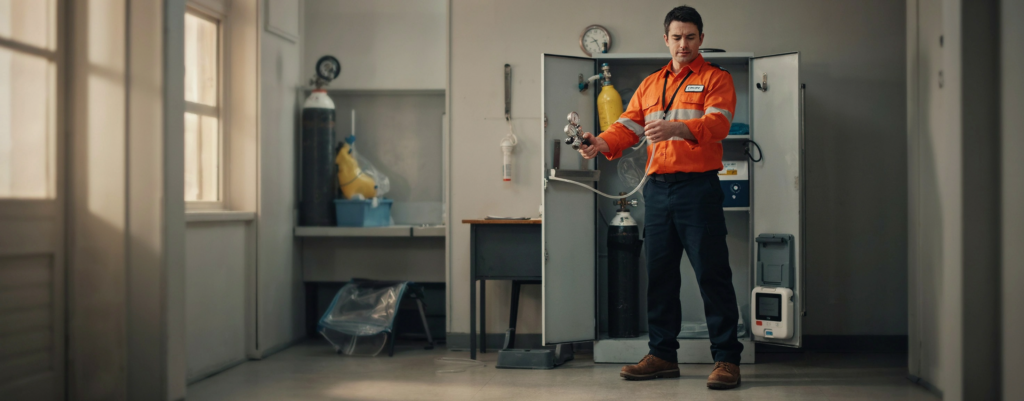
Resuscitation skills maintenance is the work that happens between courses, and for most Brisbane ERT leads it barely happens at all. You finish your HLTAID015, the certificate gets uploaded to Cm3 or Avetta, and the oxygen goes back to the first aid room. Then months go by. When someone finally does go down, that regulator in your hands can feel like somebody else’s gear.
That skill fades. It doesn’t hit everything evenly either. It hits the stuff you touch least: oxygen set-up, airway sizing, holding a good BVM seal, suction, and how the team works together when it’s all happening at once. Renewal keeps your site compliant. Practice in between keeps you ready. Those aren’t the same thing, and most of us only find out the difference on a real callout.
This guide is for ERT leaders, senior first aid officers, event first aiders and FIFO crews who want a practice rhythm they can run with their own team. It covers which skills fade first, how often to drill each one, how to run short sessions on your site’s own equipment, and when a formal refresher beats another drill.
How Often Should You Practise Resuscitation Skills?
ANZCOR guidance says retraining every 12 to 24 months is not enough to keep resuscitation skills sharp. Skills start to fade within one to six months, so ANZCOR prefers short practice sessions of 5 to 15 minutes, ideally monthly. Formal HLTAID015 renewal timing still follows your employer’s requirements.
- Short skill drills covering CPR, AED, oxygen, airways and BVM for 5 to 15 minutes, ideally monthly
- Quarterly workplace scenario practice sessions lasting 15 to 30 minutes
- Debrief after every real callout, then practise any skill that felt shaky
- Full course re-completion based on employer, insurer and principal client requirements, as ANZCOR has not set an ideal interval
Lorem ipsum dolor sit amet, consectetur adipiscing elit. Ut elit tellus, luctus nec ullamcorper mattis, pulvinar dapibus leo.
⚠️ What ANZCOR actually says: A retraining cycle of one to two years isn't enough on its own to hold resuscitation skills. ANZCOR leans towards little and often instead. (ANZCOR Guideline 10.1, ANZCOR Guideline 10.2)
Equipment skills need more frequent practice than CPR because of how quickly each one fades when it sits in a cupboard.
Which Advanced Resuscitation Skills Fade First
ANZCOR’s training guidelines are pretty blunt about it. Resuscitation skills start slipping within weeks to months of a course, and ANZCOR flags that quick drop-off after standard training as a real concern for patient care. It isn’t a reflection on you. It’s just how skills behave when you don’t use them.
The pattern is simple enough. The skills you use least fade fastest. CPR gets a bit of airtime at most sites. The equipment side of what HLTAID015 covers mostly doesn’t.
Oxygen cylinder and regulator set-up
You don’t use it often, it’s several steps in a row, and when you do need it, it’s under pressure with someone on the floor. That’s the perfect recipe for skill fade. Most people who’ve fumbled a regulator on a real job knew how to do it on course day.
Airway adjunct sizing and insertion
Sizing an OPA is a judgement call, and judgement drops off without repetition. You might remember the method but lose the feel for it.
Bag-valve-mask seal and ventilation
Holding a good single-person seal is hard without regular practice. Honestly, it’s hard with practice too. That’s why two-person technique is the one worth drilling, with one person on the seal and one on the bag.
Suction
Plenty of people never touch the suction unit outside the course. It sits in the first aid room looking ready, and so does the person who’s meant to use it.
Team roles and communication
This one gets missed because it’s not a piece of kit. ANZCOR 10.2 found no evidence that improvements from team training hold beyond a year, so who does what, and how you talk to each other during a callout, needs practice too.
None of this shows up on your Statement of Attainment, and that’s the gap between being compliant and being ready.
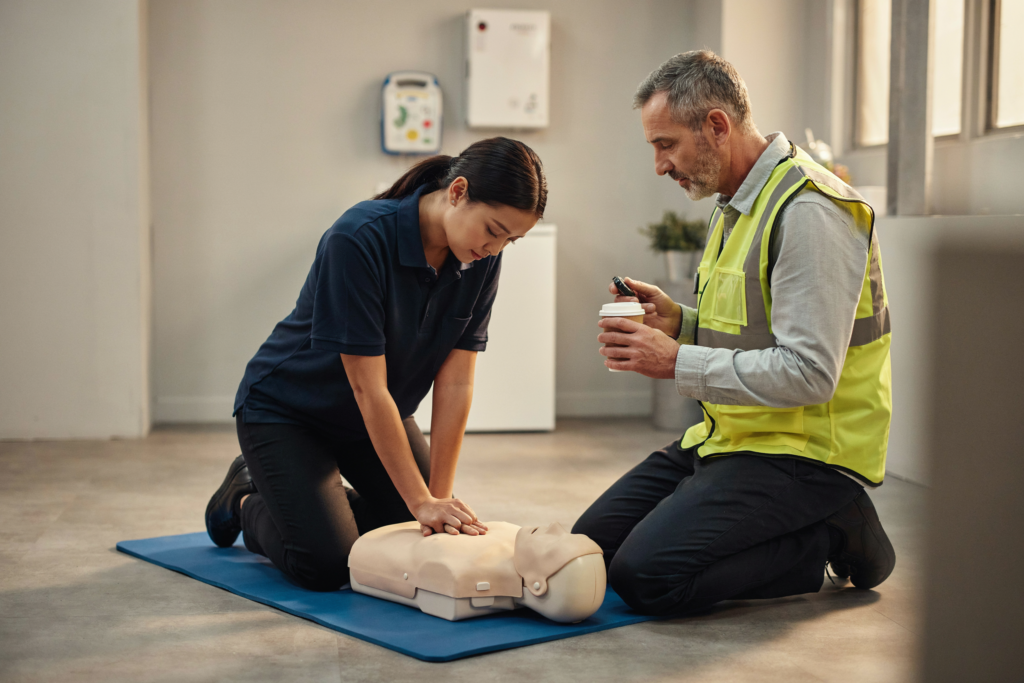
Certificate Currency vs Skill Currency
These two get lumped together a lot, but they answer different questions. One tells an auditor you’re trained. The other tells you whether your hands still know what to do.
What your Statement of Attainment proves
Your HLTAID015 Statement of Attainment shows you were competent on assessment day. That’s what insurers, principal clients and contractor portals check, and it matters. Without it, you’re not on the ERT roster, simple as that. For how long it stays current, check our guide on HLTAID015 renewal requirements.
What ANZCOR says about 12 to 24 month cycles
ANZCOR’s view is that retraining every one to two years isn’t enough on its own to hold the skills. They also haven’t set an ideal interval for redoing a full course. So the certificate isn’t pointless. It’s just not the whole job. Skill fade happens in the months between, whether your paperwork is current or not.
Certificate currency | Skill currency |
Proves competence on assessment day | Shows what you can do right now |
Checked by insurers, principal clients and portals | Checked by the next real callout |
Kept current through formal renewal | Kept current through regular short practice |
Sits in Cm3 or Avetta | Sits in your hands |
Closing that gap doesn’t need another full day off site. It needs a rhythm.
A Practical Skills Maintenance Rhythm for Brisbane ERTs
So how often should you actually be practising? Here’s a rhythm you can put straight on the site calendar. It’s a suggestion built on ANZCOR guidance, not a schedule ANZCOR has mandated, so adjust it to your site, your kit and your crew.
Monthly, 5 to 15 minutes
One skill per session, on your site’s own kit. Rotate through oxygen, airway, BVM, suction and AED so nothing sits untouched for long. This is ANZCOR’s low-dose, high-frequency approach in practice. It’s short enough to run at the start of a shift, and that’s half the reason it actually gets done.
Quarterly, 15 to 30 minutes
Run a full scenario somewhere realistic. The warehouse floor, the loading dock, the event concourse. Wherever your next callout is most likely to happen. A manikin on a clean training room floor doesn’t teach you much about working between pallet racking.
After every real callout
Do a structured debrief while it’s fresh. What went well, what slowed us down, and what do we drill next. The skill that felt shaky becomes next month’s session.
Before a swing or event season
For FIFO crews and casual event first aiders, do a quick equipment check and drill before you deploy. You don’t want your first look at the gear in months to be on the job.
Month | Monthly drill | Quarterly scenario |
1 | Oxygen set-up | |
2 | Airway sizing | |
3 | BVM ventilation | Full scenario |
4 | Suction | |
5 | AED | |
6 | Oxygen set-up | Full scenario |
7 | Airway sizing | |
8 | BVM ventilation | |
9 | Suction | Full scenario |
10 | AED | |
11 | Oxygen set-up | |
12 | Airway sizing | Full scenario |
Any time | Debrief after every real callout, then drill the shaky skill |
The monthly session is where most of the work happens, so here’s what ten minutes on your own kit can look like.
🛑 Safety first: Drills back up accredited training. They don't stand in for it.
Running a 10-Minute Equipment Drill on Your Own Site
Quick word before the drills. These reinforce what you learned in accredited training. They don’t replace it. Follow the manufacturer’s instructions and your site procedures every time, and use training devices wherever your site requires them.
Oxygen set-up drill
This is the one most people need, so start here. Run through it in order, out loud if it helps, until it feels automatic again.
- Cylinder check
- Regulator fitting
- Leak check
- Flow selection
- Mask choice
Airway sizing drill
Lay out the OPA set and size on a manikin, then size on each other. Sizing only. No insertion on live people, ever. The point is to get your eye back for picking the right one fast, because that’s the bit that goes rusty.
BVM seal drill
Two-person technique on a manikin. One person holds the seal, the other works the bag, then swap. Rotate roles until everyone’s had a turn on both. You’ll find out pretty quickly who’s been doing this lately and who hasn’t, and that’s useful information for an ERT lead.
AED familiarisation
Use a trainer unit set up for your site’s actual AED model. Go over pad placement and listen to the prompts. Different brands talk differently, and you don’t want to hear a prompt for the first time mid-callout.
Log it
Write down the date, who attended and which skill you covered. Takes thirty seconds. That little log ends up doing more work than you’d think, which is where the next section picks up.
📋 Grab the 10-Minute Drill Card: A printable drill card with monthly rotating prompts for oxygen, airway sizing, BVM, suction and AED, plus a 12-month resuscitation skills maintenance calendar and a log line for every session.
Running drills for yourself is one thing. Keeping a whole response team current is where it gets harder.
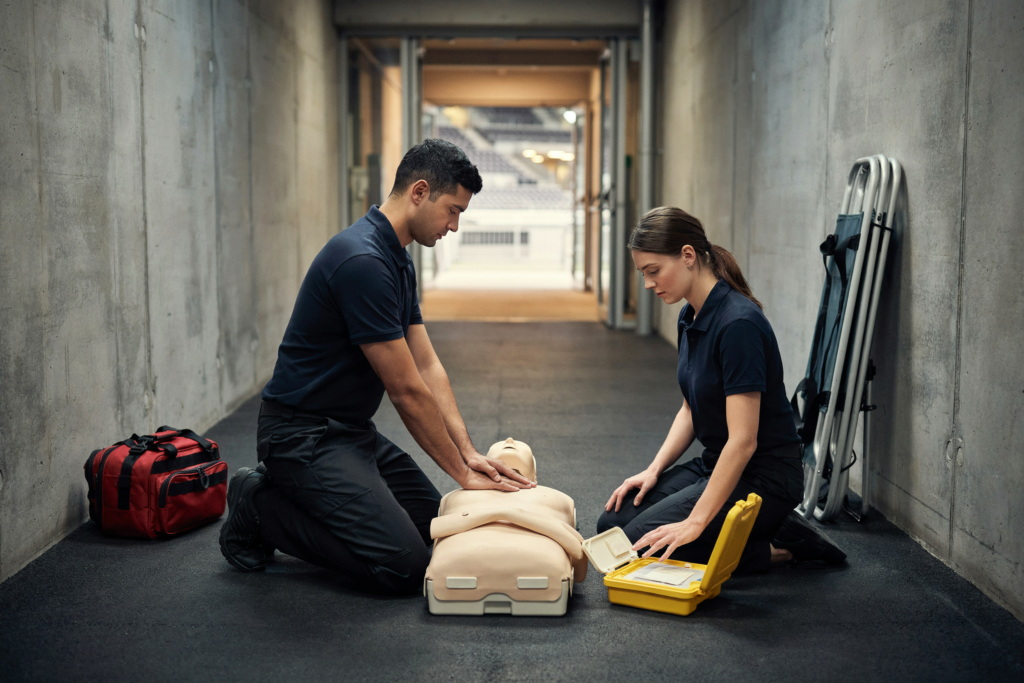
Keeping a Whole ERT Current
Looking after your own skills is manageable. Looking after six or ten people across different shifts, with different certificates expiring at different times, is a different job. Here’s how to keep it from getting away from you.
Drill records as audit evidence
That drill log from the last section is worth keeping properly. Logged drills can support your evidence of ongoing competence when insurers or principal clients come asking. They don’t replace current certificates, but they show the team isn’t just renewing tickets and forgetting about it.
Tracking expiry dates across units
Most ERTs have a mix of HLTAID009, HLTAID011, HLTAID014 and HLTAID015 on the go, and nobody’s expiring on the same date. One shared tracker with every name, every unit and every expiry date saves you finding out about a lapsed ticket during an audit.
Keeping the site covered
You can’t pull the whole response team off the floor at once. Stagger your monthly drills across shifts so there’s always someone on with a recent session under their belt. Do the same with formal training: split it so responders stay on shift while others are being assessed.
For the bigger picture, check the WorkSafe Queensland First Aid Code of Practice alongside your site risk assessment. It’ll help you match your first aid arrangements, and your training, to the equipment you actually hold on site.
🏭 Training your whole team? First Aid Alive runs emergency response training in Brisbane for ERTs, including onsite sessions on your own equipment.
Drills keep skills from fading, but sometimes the signs point to something more.
When a Drill Isn’t Enough: Signs You Need a Formal Refresher
Monthly drills do a lot of heavy lifting, but they’ve got limits. There’s no assessor, no outside feedback and no new Statement of Attainment at the end. Sometimes that’s exactly what you need.
Signs it’s time for a formal refresher
- ✅ You fumbled or hesitated during a real incident
- ✅ Your site equipment has changed (new regulator, new AED model, different airway kit)
- ✅ You've got new members joining the ERT
- ✅ Guidelines have been updated (see what's changed in the 2026 guidelines)
- ✅ Your certificate is getting close to expiry
If you ticked the first one, don’t sit on it. That feeling after a shaky callout fades too, and so does the motivation to fix the gap.
What a formal HLTAID015 refresher adds
A proper HLTAID015 refresher in Brisbane gives you things a site drill can’t. You’re assessed against the unit. A trainer watches what you’re doing and tells you what to tighten up. You work through scenarios with someone running them who isn’t also your mate on the next shift. And you walk out with a current Statement of Attainment for the insurer and the portals.
Onsite training on your own equipment
Onsite advanced resuscitation training means your team trains on the same regulator, airways and AED they’ll grab on a real callout, and your site stays covered while it happens.
Your certificate and your skills run on two different clocks. The Statement of Attainment keeps your site compliant and keeps the insurer and principal client happy. Your hands only stay ready if they keep getting time on the gear, and ANZCOR is pretty clear that waiting one or two years between courses won’t cut it.
The good news is it doesn’t take much. Ten minutes a month on one skill, a proper scenario every quarter, a debrief after every real callout, and a quick check before a swing or event season. That’s a rhythm most ERTs can fit around shifts without losing site cover.
So start this month. Pick one skill, probably oxygen set-up if you’re honest with yourself, and run a 10-minute drill on your own kit. While you’re at it, book the quarterly scenario into the site calendar so it actually happens instead of getting pushed back every time things get busy.
Then check your team’s expiry dates across every unit. Anyone due, or anyone who hesitated on a recent callout, is a good reason to book an HLTAID015 refresher in Brisbane or organise an onsite session on your own equipment.
Resuscitation skills maintenance isn’t glamorous work. It’s the small, regular stuff nobody sees until the radio goes off. But when someone does go down on your watch, those quiet ten minutes are what you’ll be glad you put in.
Book Your First Aid Training Now
Fast, affordable, and nationally accredited training delivered by professionals who care
Frequently Asked Questions
Q.How often should you practice resuscitation skills?
ANZCOR guidance says retraining every 12 to 24 months is not enough to keep resuscitation skills sharp. Skills start to fade within one to six months, so ANZCOR prefers short practice sessions of 5 to 15 minutes, ideally monthly. Formal HLTAID015 renewal timing still follows your employer's requirements.
Q.How quickly do resuscitation skills fade?
ANZCOR guidelines note that resuscitation skills and knowledge can deteriorate within one to six months without ongoing practice. Equipment skills you rarely use, such as oxygen set-up and airway adjunct sizing, are often the first to feel unfamiliar.
Q.Is renewing my HLTAID015 enough to stay current?
Renewal keeps your Statement of Attainment current for employers, insurers and principal clients. ANZCOR guidance suggests skills also need regular short practice between courses to stay sharp.
Q.How long should a resuscitation practice session be?
ANZCOR describes brief refresher sessions of 5 to 15 minutes, scheduled frequently, as a practical way to maintain resuscitation skills.
Q.Can we run resuscitation drills at our workplace?
Yes. Short drills on your site's own equipment, using manikins and training devices, help maintain skills between courses. Drills support accredited training but do not replace formal assessment. Follow manufacturer instructions and site procedures.
Making first aid training more affordable for
every classroom
We believe every student deserves access to life-saving first aid knowledge. That’s why we offer specially reduced pricing for schools and educational groups. Whether you’re booking for a single class, a year group, or your entire school, our flexible packages make training more accessible and cost-effective — without compromising quality.
