

It’s a Thursday afternoon and the director pokes her head into the pre-kindy room holding a new enrolment form. Little girl, starts soon, peanut allergy, ASCIA Action Plan and an EpiPen in a labelled pouch. You nod and smile, and then later that night you’re on the couch typing where to inject an EpiPen into your phone, because honestly you can’t remember the last time you held one.
Here’s the short version. ASCIA says the outer mid-thigh, with or without clothing. That’s it. Easy to say, mind you, but a lot harder to find on a small, moving child who really doesn’t want to be held. And it’s not a rare situation either. About 1 in 10 Australian infants has a food allergy, so most rooms will meet an action plan sooner or later.
This guide walks you through finding the thigh on babies and toddlers, whether clothes need to come off, how to hold a child still, the spots to stay away from and what to do if it goes in the wrong place. Reading it helps. But it’s practising with your own hands, on a real trainer device, that turns knowledge into reflex.
Where to Inject an EpiPen: The Short Answer
Inject an EpiPen into the outer mid-thigh, with or without clothing. It’s the same site for babies, children and adults, and it’s the only site shown on the ASCIA Action Plan.
- Hold leg still and place orange end against outer mid-thigh (with or without clothing).
- Push down hard until a click is heard or felt.
- Hold in place for 3 seconds.
Never inject into:
- The buttocks
- Hands, fingers or thumb
- Feet or toes
- A vein
If the injector goes into your own thumb or finger by accident, use a second injector on the child. If there’s one available, call 000 and get medical help for yourself too.
Finding the Outer Mid-Thigh on Babies, Toddlers and Preschoolers
When people ask where to inject an EpiPen on a child, the answer is the same as it is for adults. The tricky bit is the size. A two-year-old’s thigh isn’t much bigger than your forearm, so the EpiPen injection site gets small pretty quick.
What “Outer Mid-Thigh” Actually Means
Find the hip, find the knee, and go halfway between them. Then look to the outside of the leg, roughly where the side seam on a pair of shorts or leggings would sit. That’s your spot.
On a toddler, that whole area might only be about a hand’s width. Don’t stress about getting it down to the centimetre. Aim for the middle of the outside of the thigh and you’re right where you need to be. And either leg is fine, use whichever one is closest or easiest to hold.
Why the Thigh and Not the Arm or Bottom
The thigh is a big muscle and it’s quick to get to, even if a child is strapped in a highchair or curled up on the mat. It’s also the only site shown on ASCIA Action Plans.
You’ll probably come across claims online about how fast adrenaline gets absorbed from different spots. We’re leaving the numbers out of this one. Outer mid-thigh, every time.
EpiPen or EpiPen Jr: The Action Plan Decides
Younger kids are often prescribed an EpiPen Jr rather than the standard EpiPen. The site doesn’t change. What changes is the dose, which goes by the child’s weight, and the right device is named on their action plan.
That’s why it pays to check the plan and the device together at enrollment. Name on the plan, name on the injector, do they match, and what’s the expiry date. Much easier at sign-up than when your heart’s pounding.
You can view and download the current plans on the ASCIA Action Plans page.
👖 Good to know: You don't need to take clothes off. Just aim for plain fabric.
Can You Inject an EpiPen Through Clothing?
Short answer, yes. Giving an EpiPen through clothing is exactly what the device is made for.
Yes, and You Shouldn’t Waste Time Removing It
ASCIA Action Plans say to inject into the outer mid-thigh “with or without clothing.” That covers what most kids turn up in on a normal day. Leggings, shorts, tights, trackies, even an EpiPen through jeans is fine.
Think about what pulling clothes off actually looks like at the moment. A scared, wriggly toddler, tight leggings, maybe a nappy underneath, and you tugging it all down with shaky hands. That precious time gone for nothing. Leave the clothes on and get to the thigh.
What to Aim Around
The one thing you do want is plain fabric. Glance at the spot before you press and steer clear of:
- Thick seams
- Zips
- Buttons
- Pockets with hard things in them, like a toy car or a hair clip
If one of those is sitting right on the outer mid-thigh, just shift a little higher or lower on the outside of the leg.
The leggings are fine. Don’t pull clothes off. Find the outside of the thigh and go.
How to Hold a Child’s Leg Still During an EpiPen Injection
Knowing where to inject is one thing. Getting the injector onto that spot while a frightened child is kicking, crying or trying to climb into your arms is another thing altogether.
Lay Them Flat First
ASCIA advises laying the person flat and not letting them stand or walk, and holding young children flat rather than upright. If breathing is hard, they can sit with their legs stretched out in front of them. Either way, a flat or outstretched leg is far easier to hold still than one bent up under them.
With a Second Educator
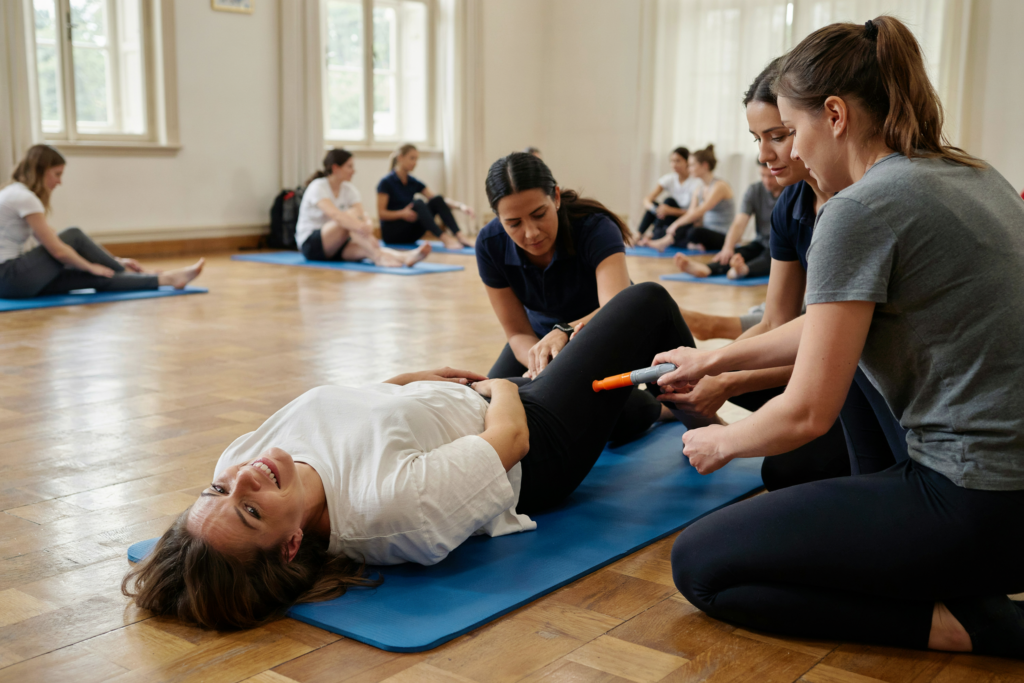
If there’s another adult nearby, use them. One educator holds the leg, with one hand just above the knee and the other at the hip. The other gives the injection. Once it’s done, the second educator can call 000 while you stay with the child.
On Your Own, With a Baby or Toddler
Sometimes it’s just you. For giving an EpiPen to a baby or an EpiPen on a toddler, try one of these:
- Lap hold: sit the child on your lap facing away from you, legs out in front.
- Floor hold: lay them on the floor and kneel beside them.
In both, rest your forearm across their thighs to keep the leg still while your other hand uses the injector. This isn’t something ASCIA spells out, it’s just a practical tip that tends to work with little ones.
If the Child Kicks or Pulls Away
Get a firm hold before the device ever touches the leg. Not halfway through. Not once they start kicking. Hold leg still, EpiPen comes second. Scared little kids are surprisingly strong.
If you’d rather feel these holds before you ever need them, our hands-on asthma and anaphylaxis training lets you practise with trainer devices.
🚫 No-go zones: Buttocks, hands, feet, veins and the upper arm. Outer mid-thigh only.
Where Not to Inject an EpiPen (And Why)
Knowing where not to inject an EpiPen is just as handy as knowing where to put it.
The Buttocks, Hands, Feet and Veins
The EpiPen product information lists these as places to avoid:
Avoid | Why |
Buttocks | The injection may not work as well as it should |
Hands, fingers or thumb | Can cut off blood flow to the area |
Feet or toes | Can cut off blood flow to the area |
A vein | Not where the device is designed to go |
On a little one in a nappy, the bottom can look like the obvious soft target. It isn’t. Outer mid-thigh.
The Upper Arm and Hip: A Common Myth
So, can you inject an EpiPen in the arm? Not according to the action plan. Some people mix it up with vaccinations, which often go in the upper arm, or they aim for the hip because it feels close enough. The outer mid-thigh is the only site shown on ASCIA Action Plans. Even overseas, Food Allergy Canada (a Canadian resource) points to the outer thigh too.
How Thumb Injections Happen
Most thumb injections come from one simple mistake. Grabbing the device upside down and putting a thumb over the orange end, which is where the needle comes out. In a panic, the shapes and colours blur together.
Say this to yourself every time you pick one up: “Orange end to the outer thigh, blue end to the sky.” It sounds a bit silly. It works.
📌 Free room poster: Asthma and anaphylaxis first aid steps for children, ready to print and stick on your room wall.
What to Do If an EpiPen Goes in the Wrong Place
Nobody wants to think about this part, but an accidental EpiPen injection does happen, even to calm, well-trained people. The good news is there’s always a clear next step.
Wrong spot? There’s still a next step.
If You Inject Your Own Thumb or Finger
If you’ve injected an EpiPen into your thumb or finger, the child still hasn’t had their adrenaline. So the child comes first. Grab the second injector if there’s one available and give it into their outer mid-thigh. Call 000. Then get medical attention for yourself as well.
If the Child Moved During the Injection
Sometimes a child jerks their leg at the exact second you press, and you’re left wondering if it went in properly. Don’t guess. Call 000, tell them exactly what happened, and follow what they say.
What to Tell Paramedics
When the ambulance arrives, hand over the used device and tell them the time it was given, as ASCIA advises. If something went wrong, tell them that too. Jotting the time on your hand the second you inject makes this part a lot easier.
🔄 Two devices, one site: EpiPen and Anapen both go into the outer mid-thigh and both hold for 3 seconds.

EpiPen vs Anapen: Same Site, Different Technique
Plenty of educators learn on one device and then meet the other at a new centre. The good news is the site doesn’t change. Both go into the outer mid-thigh, both can go through clothing and both are held in place for 3 seconds.
With an Anapen, you take off the black needle shield, then the grey safety cap. Place it against the outer mid-thigh at 90 degrees and press the red button. That’s the bit that catches EpiPen users out.
EpiPen | Anapen | |
Injection site | Outer mid-thigh | Outer mid-thigh |
Through clothing | Yes | Yes |
Getting it ready | Orange end down, blue end up | Remove black needle shield, then grey safety cap |
How you give it | Push hard until it clicks | Hold at 90 degrees and press the red button |
Hold time | 3 seconds | 3 seconds |
If your centre has both, practise both.
After the Injection: The First Five Minutes
The click happens, you count to three, you pull the device away. And then there’s this strange moment where your hands are empty and your heart’s going a million miles an hour. Here’s what comes next, following ASCIA guidance.
- 1. Call 000 (if someone hasn't already). Ask for an ambulance and say the word anaphylaxis.
- 2. Keep the child lying flat. Don't let them stand up or walk around, even if they seem to perk up.
- 3. Note the time the adrenaline was given. Write it down anywhere you can.
- 4. Watch closely. If there's no response after 5 minutes, further adrenaline may be given if another injector is available.
- 5. Contact the family as set out in the child's action plan and your service's medical conditions policy.
It’s normal to feel shaky once it’s over. Stay with the child, keep talking to them calmly and let the paramedics take it from there.
Practising the Injection Site Before It’s Real
You can read this whole guide twice and still feel your stomach drop the first time you hold an injector. That’s normal. Reading tells your brain where the outer mid-thigh is. Practice teaches your hands to find it when your brain is busy panicking.
That’s what good anaphylaxis training Brisbane educators can rely on should feel like. Hands on, not just slides. In our ACECQA approved anaphylaxis training, you’ll practise with both EpiPen and Anapen trainer devices, so whichever one turns up in a child’s pouch, it won’t be your first time holding it. And we work through child scenarios, not adult ones. The toddler on the mat. The baby on your lap. The kid who won’t stop kicking.
For centres wanting EpiPen training childcare Brisbane teams can do together, we can come to you with on-site training for your whole centre. Not sure if your current certificate already covers you? Our Am I covered? The checker will tell you.
Next Steps
If a child with an ASCIA Action Plan is about to start in your room, or already has, you don’t need to fix everything tonight. You just need to start. And honestly, it comes down to three small jobs.
The first is to check the plan. Sit down with it properly, not a quick skim while you’re signing off the morning paperwork. Look at which device is named and who you need to call. If something doesn’t make sense, ask your director or the family now, while everything’s calm.
The second is to check the device. Pull the injector out of the child’s pouch and hold it next to the plan. Do the names match? Is it on a date? Where is it kept during the day, and does it go out to the yard with the child? While it’s in your hand, notice which end is orange and which is blue, so your eyes know it before your nerves get involved.
The third is to practise it. This is the one people put off, and it’s the one that matters most when the moment comes. Practice is what gets your hands to the outer mid-thigh without thinking, through leggings, on a wriggly toddler, with your heart pounding.
It’s also worth bringing the rest of your team along. The child won’t only be with you. Casuals, new starters and whoever’s on the late shift all need to know where that injector goes.
None of this is about being perfect. It’s about being ready enough to act, fast and calm, instead of freezing.
You chose this work because you care about these kids. Being the steady adult who knows exactly where that injector goes is just another way of looking after them, and it’s well within your reach.
Book Your First Aid Training Now
Fast, affordable, and nationally accredited training delivered by professionals who care
Frequently Asked Questions
Q.Which thigh do you inject an EpiPen into?
Either thigh is fine. Use the outer mid-thigh of whichever leg is closest to you or easiest to hold still.
Q.Can you inject an EpiPen through jeans?
Yes. ASCIA Action Plans say with or without clothing, so jeans are fine, just steer clear of seams, zips, buttons and full pockets.
Q.Can you give an EpiPen to a child who is sitting up?
If breathing is hard they can sit with legs stretched out, otherwise ASCIA advises holding young children flat rather than upright.
Q.Does an EpiPen hurt a child?
They'll usually feel a quick sting and a bit of soreness, but it's over in seconds and nothing compared to what anaphylaxis can do.
Q.What if I'm not sure it's anaphylaxis?
ASCIA's advice is if in doubt, give the adrenaline injector, then follow the child's action plan and call 000.
Q.Where can educators practice using an EpiPen in Brisbane?
Our ACECQA-approved asthma and anaphylaxis training gives you hands-on practice with EpiPen and Anapen trainers, and we can run it on-site at your centre.
Making first aid training more affordable for
every classroom
We believe every student deserves access to life-saving first aid knowledge. That’s why we offer specially reduced pricing for schools and educational groups. Whether you’re booking for a single class, a year group, or your entire school, our flexible packages make training more accessible and cost-effective — without compromising quality.
