

It’s 10:15am. Morning tea’s just finished, and a three-year-old in your room starts rubbing at his mouth. His lips are swelling. His voice sounds hoarse and scratchy, not like him at all. And the plan with his photo on it is hanging on the wall above the sink, right where it’s been every single day. This is the moment an anaphylaxis emergency response either runs on training, or stalls on doubt.
The order matters. ASCIA’s first aid steps go like this: lay the child flat, give the adrenaline device, call 000, then phone the family. The thing is, most educators who freeze don’t actually lack the knowledge. They hesitate because they aren’t sure it’s “bad enough” yet. That little voice saying maybe just wait a minute is the most dangerous thing in the room.
This guide covers recognising anaphylaxis in babies and toddlers, using EpiPen and Anapen devices when your hands won’t stop shaking, when to give a second dose, what to do while you wait for the ambulance, and why ASCIA’s advice is to give adrenaline if you’re in doubt.
By the end, you’ll have a sequence you can run without stopping to think, like a fire drill your body knows before your brain catches up. And you’ll know where hands-on, ACECQA-approved training fits in.
What to Do First in an Anaphylaxis Emergency
In an anaphylaxis emergency, act straight away and follow the child’s ASCIA Action Plan in this order:
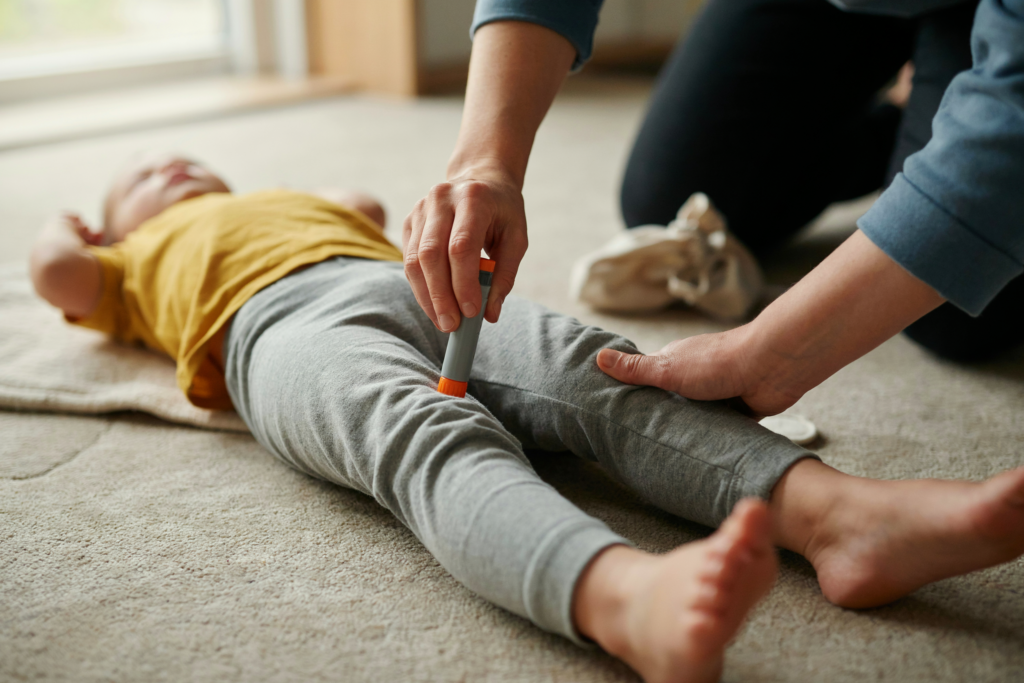
- 1. Lay the child flat. Don't let them stand or walk. Hold babies and toddlers flat, not upright. If breathing is difficult, let them sit with legs outstretched.
- 2. Give the adrenaline device (EpiPen, Anapen or other prescribed device) following the instructions on the plan.
- 3. Call 000 and say "anaphylaxis".
- 4. Phone the family or emergency contact.
- 5. Give a further dose after 5 minutes if there's no response and another device is available.
- 6. Start CPR at any time if the child is unresponsive and not breathing normally.
If in doubt, give adrenaline. The child needs hospital observation even if they recover.
Those steps only work if you recognise anaphylaxis early, and in young children the signs don’t always look the way you expect.
How to Recognise Anaphylaxis in Babies, Toddlers and Young Children
The signs of anaphylaxis that matter most are often quiet ones, and with little ones who can’t tell you their throat feels tight, you’re reading the child rather than listening to them.
Mild to Moderate Signs vs Anaphylaxis
ASCIA splits allergic reactions into two groups. Mild to moderate signs sit on the skin and face. Anaphylaxis is the severe end, where breathing and circulation are affected.
Here’s the catch. ASCIA notes the mild to moderate signs may not come first, so a child can go straight to breathing trouble with no hives at all. Waiting for the rash is like waiting to see smoke before you believe the alarm.
Signs That Are Easy to Miss in Babies and Toddlers
Toddlers don’t announce symptoms. They change. A cry that sounds wrong. A chatty kid who goes suddenly quiet. A child who won’t let go of you. A little body that feels floppy in your arms. You know these kids, so if something feels off, trust that.
What ASCIA lists | What it can look like in a young child | |
Mild to moderate | Swelling of face, lips or eyes | Puffy face or eyes, rubbing at the face |
Hives or welts | Raised patches, scratching | |
Tingling mouth | Rubbing or pulling at the mouth | |
Anaphylaxis | Difficult or noisy breathing, wheeze or persistent cough | Effortful breathing, coughing that won’t settle |
Tongue or throat swelling or tightness, hoarse voice or cry | A changed voice or cry | |
Persistent dizziness or collapse | Sudden quietness, clinginess | |
Pale and floppy | Floppy when held, unusually pale |
For a visual version, see ASCIA’s anaphylaxis infographic on allergy.org.au.
When There’s No Action Plan: First Reactions at the Centre
Some children have their very first exposure to food while they’re in care, so there’s no personalised plan on the wall. That’s what the orange ASCIA First Aid Plan for Anaphylaxis is for. The policy side sits in our asthma and anaphylaxis emergency plan guide.
Stings, Bites and Ticks in Outdoor Play
Outdoor play brings bees and wasps, so stings belong on your radar alongside food. Ticks too. The ASCIA advice for ticks is “freeze it, don’t squeeze it”.
Spotting the signs is one thing. Acting on them while part of you is still unsure is where most educators get stuck.
Why Educators Hesitate, and Why ASCIA Says Give Adrenaline If in Doubt
The “Is It Bad Enough Yet?” Trap
Most educators who freeze aren’t missing knowledge. They’re stuck in doubt. Is that cough just a cough. What if I give it and I was wrong, and now I’ve got to explain myself to the parents.
It’s the doubt that burns the time, not the decision.
💬 Remember: "If in doubt, give adrenaline. The ASCIA Action Plan tells you to."
What Adrenaline Does, and Why Delay Is the Bigger Risk
Adrenaline is the first-line treatment for anaphylaxis. Not antihistamine, not waiting to see. Allergy & Anaphylaxis Australia is clear that antihistamines don’t treat anaphylaxis, and ASCIA’s guidelines on the acute management of anaphylaxis put adrenaline first. It’s a real medicine, not a nothing drug, but the guidance comes back to one plain idea: delaying it is the bigger risk.
Here’s the reframe that helps. The action plan on the wall isn’t asking for your personal judgement. It’s giving you permission. Somebody qualified already made that decision when they wrote it. It’s not a test you might fail, it’s a script you’ve been handed. You don’t have to be sure. You just have to act.
Once you’ve decided to act, the order matters more than speed. Here’s how each step plays out in a real room.
The Anaphylaxis Emergency Response, Step by Step in Your Room
Here’s how the anaphylaxis first aid steps for childcare play out with a room full of kids watching.
- 1. Lay the Child Flat (and Why Standing Is Dangerous): Lay the child down straight away. No standing or walking, not even to the couch. Allergy & Anaphylaxis Australia warns that standing can cause a sudden drop in blood pressure and collapse. Hold babies flat, not upright. If breathing is hard, let them sit with legs out straight. If they're unconscious, use the recovery position.
- 2. Give the Adrenaline Device and Note the Time: Follow the instructions on the child's plan and give the adrenaline device. Then note the time, or say it out loud so someone else hears it. Keep the used device for the paramedics. If the child has asthma and a known allergy and suddenly can't breathe, give adrenaline first, then their reliever puffer.
- 3. Call 000: What to Tell the Ambulance Service: Call 000 and say "anaphylaxis" early. Tell them the child's age, and that adrenaline has already been given. Stay on the line.
- 4. Phone the Family or Emergency Contact: Once the ambulance is on the way, phone the family or the emergency contact on the plan. Keep it calm: what happened, adrenaline given, ambulance coming.
- 5. A Second Dose After 5 Minutes: If there's no response after 5 minutes, and another adrenaline device is available, give a further dose. Five minutes feels like forever on the floor, so that noted time matters.
- 6. Start CPR If the Child Stops Breathing Normally: If at any point the child becomes unresponsive and isn't breathing normally, start CPR. Don't wait for the second dose or the ambulance.
- 7. Who Does What: The Second Educator and the Rest of the Room: An anaphylaxis emergency response goes smoother with clear roles. One educator stays with the child. One fetches the device and the plan. One calls 000 and supervises the rest of the room. A calm voice from that third person helps the other kids too.
Step two is where hands tend to shake, so it’s worth knowing exactly how your child’s device works.
EpiPen vs Anapen (and Jext and neffy): Using the Device Under Pressure
The real device, in a pouch with a child’s name on it, feels nothing like the trainer you held years ago. The fix isn’t memorising every brand. It’s knowing the device your child has, and that the plan tells you how to use it.
EpiPen Technique: Blue to the Sky, Orange to the Thigh
Blue end points up, orange end goes to the outer mid-thigh, through clothing if needed. Hold the child’s leg still, because a wriggling toddler is a moving target. Current ASCIA plans say to hold for 3 seconds. If you remember a longer hold from older training, that’s now outdated.
Anapen Technique: What’s Different
Anapen goes into the same spot. The difference is at the start: remove the black needle shield first, then the grey safety cap. Read the plan rather than trusting memory.
Jext and neffy: Newer Devices on 2026 Action Plans
ASCIA’s 2026 plans list four device versions: EpiPen, Anapen, Jext and neffy. neffy is a nasal adrenaline spray, 1 mg for children 15 to 30 kg, and the device-specific plan on allergy.org.au shows how to give it.
Device | How it’s given | Key step difference | Hold time |
EpiPen | Injection, outer mid-thigh | Blue to the sky, orange to the thigh | 3 seconds |
Anapen | Injection, outer mid-thigh | Remove black needle shield, then grey safety cap | 3 seconds |
Jext | Injection, outer mid-thigh | Follow the device-specific plan | As per the plan |
neffy | Nasal spray | Not an injection | Not applicable |
Junior vs Adult Doses: Why the Plan, Not the Educator, Decides
Some children have a junior device and others don’t. That’s not your call. The prescriber decides the dose, and you follow the plan. One less thing to carry, honestly.
Storing Devices in Summer Heat
Hot summers are hard on adrenaline devices. Keep them below 25°C, out of the sun, and not in the fridge. Check the viewing window and expiry date regularly, so the device you grab on the worst day is actually ready.
Once the adrenaline is in and the ambulance is on its way, your job isn’t quite finished.

While You Wait and After the Ambulance Arrives
Stay With the Child and Keep Them Lying Down
The adrenaline’s in, the call’s made, and there’s this strange quiet stretch. Stay with the child. Keep them lying down, even if they perk up and want to get off the mat. Keep watching their breathing.
Why Hospital Is Non-Negotiable, Even If They Seem Fine
The child looks better, the colour’s coming back, and it feels like maybe you overreacted. You didn’t. ASCIA advises hospital observation for at least 4 hours after anaphylaxis, because symptoms can come back. That’s called a biphasic reaction.
Handover, Documentation and Notifications
✅ Handover checklist
- Time of each adrenaline dose
- Used devices
- A copy of the child’s ASCIA Action Plan
- The signs you saw and when they started
- Whether the family has been contacted
Afterwards, the incident goes into your service’s Regulation 87 incident, injury, trauma and illness record. Where emergency services attend, it’s also a serious incident that needs notifying within 24 hours. Your director usually leads this; the detail is in our asthma and anaphylaxis emergency plan guide.
Then, please, debrief with your team and your director. Feeling shaky or guilty afterwards is normal, even when you did everything right. Ask for support. You’ve earned it.
⚠️ Please note: This article is general information only. Always follow the child's ASCIA Action Plan and your service's medical conditions policy. In an emergency, call 000.
Reading the steps helps, but practising them on trainer devices is what makes them automatic.
Where ACECQA-Approved Anaphylaxis Training Fits
What the National Regulations Require on the Premises
Under Regulation 136 of the Education and Care Services National Regulations, a service needs an educator with approved anaphylaxis management and emergency asthma management training on the premises and immediately available whenever children are being cared for. That’s the compliance side. The real reason most educators book is a new enrollment, and that knot in the stomach.
HLTAID012 vs 22300VIC and 22556VIC: Which One Counts
HLTAID012 on its own doesn’t meet the requirement. 22300VIC covers anaphylaxis, and 22556VIC covers asthma. If you’re not sure what you’ve got, check your certificate against ACECQA’s approved training list.
What Hands-On Training Actually Feels Like
Good ACECQA approved anaphylaxis training shouldn’t feel like an exam. You practise your anaphylaxis emergency response on EpiPen and Anapen trainer devices until the steps stop feeling foreign in your hands. The scenarios are about children. Nobody’s judging you for fumbling the cap the first time, and your certificate comes through the same day. For centres, sessions can run on-site.
Your Next Three Steps
Back in that room at 10:15am, the difference between freezing and acting comes down to what you did on a quiet day beforehand.
So start today. Find where each child’s adrenaline device and ASCIA Action Plan are kept in your room, and check the expiry dates while you’re there.
This week, download the room poster and put it up somewhere you’ll actually see it. When your heart’s pounding, you’ll want them at eye level.
This month, book a hands-on 22300VIC and 22556VIC session, or ask your director about on-site training for the whole team. Practice on a trainer device is what makes it stick.
You don’t need to feel fearless. Most educators who handle it calmly were scared too. They’d just practised the order until their hands knew what to do before their head caught up.
A good anaphylaxis emergency response doesn’t start with the reaction. It starts with you, getting ready now, so you already know your first move.
Book Your First Aid Training Now
Fast, affordable, and nationally accredited training delivered by professionals who care
Anaphylaxis Emergency Response FAQs
Q.Can you give an EpiPen through clothing?
Yes. Adrenaline devices can go into the outer mid-thigh through clothing, so don't waste time removing shorts or leggings. Hold the leg still and follow the child's ASCIA Action Plan.
Q.What if a child has never had a reaction before and has no action plan?
Follow the orange ASCIA First Aid Plan for Anaphylaxis. Lay the child flat, call 000, and give a general use adrenaline device if your service holds one under its medical conditions policy.
Q.Should I give an antihistamine first?
No. Adrenaline is the first treatment for anaphylaxis. Antihistamines only help mild symptoms like itching or hives and don't treat anaphylaxis.
Q.Do I still call 000 if the child improves after the EpiPen?
Yes. ASCIA advises hospital observation for at least 4 hours after anaphylaxis because symptoms can come back, even when the child looks fine.
Q.When do I give a second adrenaline dose?
Give a further dose after 5 minutes if there's no response and another adrenaline device is available. Noting the time of the first dose makes this much easier.
Q.Does HLTAID012 cover anaphylaxis training for childcare?
No. HLTAID012 on its own doesn't meet the approved anaphylaxis and emergency asthma management requirement. Courses such as 22300VIC and 22556VIC cover it, so check ACECQA's approved training list.
Making first aid training more affordable for
every classroom
We believe every student deserves access to life-saving first aid knowledge. That’s why we offer specially reduced pricing for schools and educational groups. Whether you’re booking for a single class, a year group, or your entire school, our flexible packages make training more accessible and cost-effective — without compromising quality.
