

Think about the next time a child in your room starts to wheeze after outdoor play. It’s a sticky afternoon, the sandpit’s just been packed away, and one of your four-year-olds is sitting off to the side, quieter than usual. You sit them upright, shake the blue puffer, fit the spacer mask over their nose and mouth and count four slow breaths. Your voice stays calm. You’re still worried, but you know the spacer and puffer technique by heart.
That kind of calm doesn’t come from skimming an action plan once at induction. Most of us have done exactly that: signed the bottom of the page and gone straight back to the room. Real calm comes from practising each step until your hands just know what to do, like tying your shoelaces. Summer is when it counts most, when storms roll in, afternoons go heavy and humid, and asthma symptoms can flare.
This guide breaks the technique into simple steps for babies, toddlers and school-age kids. It explains the 4x4x4 asthma first aid method, the situations where it doesn’t apply, and the small mistakes that stop medicine reaching a child’s lungs. You’ll also see where this skill sits within your ACECQA-approved emergency asthma management training, so you know exactly what’s expected of you, and when.
How to Use a Puffer with a Spacer: Step by Step
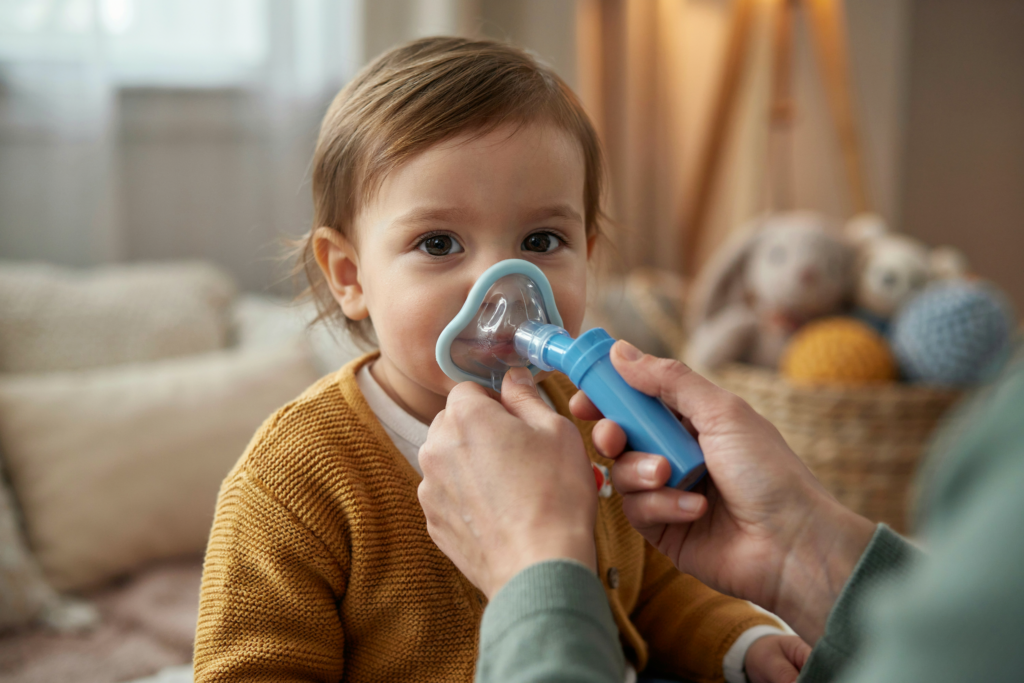
A spacer is a clear plastic chamber that attaches to a puffer and holds the medicine so a child can breathe it in slowly, getting more of it into the lungs. To use a puffer with a spacer:
- 1. Remove the puffer cap and shake the puffer well.
- 2. Fit the puffer upright into the end of the spacer.
- 3. Seal the child's lips around the mouthpiece, or fit the mask firmly over their nose and mouth.
- 4. Press the puffer once to release one puff into the spacer.
- 5. Have the child take 4 normal breaths in and out through the spacer.
- 6. Remove the spacer, shake the puffer again and repeat for each extra puff.
- 7. Replace the cap when finished.
Only put one puff into the spacer at a time.
For the full official guide, see Asthma Australia’s puffer and spacer page.
Mask | Mouthpiece | |
Who | Babies, toddlers, any child who can’t seal their lips | Older children who can seal their lips |
Seal | Over nose and mouth, no gaps | Lips around it, teeth outside |
Breathing | 4 normal breaths | 4 normal breaths, or as the child’s plan says |
Using a Spacer with a Mask (Babies and Toddlers)
Toddlers don’t usually love something pushed onto their face. That’s fine. You don’t need them to love it, you just need the seal.
- The mask covers the nose and mouth with no gaps.
- Keep the mask sealed for all 4 breaths. Watch the valve move or the mask fog up, that's how you know they're breathing through it.
- Sit the child upright on your lap and keep your voice calm and low.
- If they cry, keep going. Crying children still breathe in the medicine.
- Use the correct mask size for the child's face, and never share masks between children.
Using a Spacer with a Mouthpiece (Older Children)
Older kids can usually manage the mouthpiece with a bit of coaching. Lips sealed around the mouthpiece, teeth outside it. The default is 4 normal breaths after each puff. Some children’s plans say one slow breath held for 5 to 10 seconds instead, as described by the Lung Foundation. If the plan says that, follow the plan.
This one matters a lot for OSHC and vacation care staff, since most of your kids will be mouthpiece age.
When to Move from a Mask to a Mouthpiece
Children’s Health Queensland puts it simply: use a mask if the child can’t seal the spacer with their lips. Guidance does vary between states though. WA Health says children under 3 need a mask, while Canberra Health Services uses a no-mask method from age 4.
The practical rule is to follow the child’s asthma action plan, and confirm the mask or mouthpiece at enrollment so nobody is guessing on the day.
What to Do If There’s No Spacer
The 2026 Asthma Australia chart covers this. Give 1 puff as the person takes 1 slow, deep breath, and have them hold that breath as long as comfortable. Repeat until all the puffs are given.
This is a last resort, not a plan. Every kit in your service should hold a spacer, which we come back to in spacer care.
👀 Watch behavior, not words: Toddlers can't tell you their chest feels tight. A quiet, still child after play is your clue.
Signs a Child Needs Asthma First Aid
Knowing how to use the spacer is half the job. The other half is knowing when. Little kids rarely announce they’re struggling. That’s why spotting them early is the first of the asthma first aid steps for children.
Early Signs in Young Children
- A cough, especially at night or after running around.
- Wheeze, that whistly sound when they breathe out.
- Breathing faster than usual.
- Tummy breathing, with the belly pumping in and out.
- Being unusually quiet.
- Playing less, or sitting out of games they normally love.
A three-year-old can’t tell you their chest feels tight. What they can show you is a change in behaviour, like the kid who’s normally first on the climbing frame suddenly sitting in the corner of the cubby. Trust that gut feeling, you know these children better than almost anyone.
Signs It’s Getting Serious
- Trouble speaking in full sentences, or trouble feeding for babies.
- Skin sucking in at the base of the throat or between the ribs.
- Blue or pale lips.
- Drowsiness.
- Distress.
If You’re Not Sure, Act
You don’t have to be certain before you act. Hesitating while you try to diagnose a child is far riskier than giving a reliever and calling for help.
🛑 Allergy changes the order: Known allergy plus sudden breathing trouble means adrenaline before the reliever.
The 4x4x4 Asthma First Aid Method Explained
When the signs are there, you follow one sequence. 4x4x4 asthma first aid is the Australian emergency protocol for an asthma attack: 4 separate puffs of blue reliever, 4 breaths after each puff, then a 4-minute wait. Each puff uses the same spacer and puffer technique you just learned.
- 1. Sit the child upright. Stay calm and reassuring. Don't leave them alone.
- 2. Give 4 separate puffs of blue reliever. Shake, 1 puff into the spacer, 4 breaths, then repeat until 4 puffs are given.
- 3. Wait 4 minutes. If breathing hasn't returned to normal, give 4 more separate puffs.
- 4. Call 000. Say "ambulance" and that someone is having an asthma attack. Keep giving 4 separate puffs every 4 minutes until help arrives.
These steps come straight from the Asthma Australia first aid chart (2026), which matches the National Asthma Council Australia’s First Aid for Asthma guidance.
Why “4x4x4” Is Easy to Remember
It’s 4 puffs, 4 breaths each and 4 minutes. That’s the whole thing. Every puff is one full cycle of the spacer technique: shake, puff, seal, four breaths. When your adrenaline’s going, a rule built on one number is much easier to hold onto than a page of instructions.
Which Puffers Are Relievers?
The 2026 chart lists these as blue relievers:
- Airomir
- Asmol
- Ventolin
- Zempreon
- Bricanyl
You might remember older training calling them “blue/grey” puffers. The current chart just says “blue reliever”, so that’s the wording to use in your room and your plans.
When to Call 000 Straight Away
Don’t wait for 4 minutes. Call 000 immediately if the child:
- Is not breathing.
- Suddenly gets worse or isn't improving.
- Is having an asthma attack and there's no reliever available.
- May not be having asthma, and you're unsure.
Keep giving first aid while you wait. It’s okay to ring early.
When 4x4x4 Isn’t the Whole Answer
4x4x4 covers most asthma attacks, but a few situations change the order of things.
Allergy Plus Sudden Breathing Difficulty: Adrenaline First
🛑 Adrenaline first: The 2026 Asthma Australia chart says that if someone with a known food, insect or medication allergy suddenly has trouble breathing, you give adrenaline first, if it's available. Then follow with asthma first aid.
Think about the new child in your room with the peanut allergy and the EpiPen in their bag. If they start wheezing after morning tea, it’s not just an asthma moment anymore. It could be anaphylaxis, and their ASCIA Action Plan for Anaphylaxis takes priority. Adrenaline injector first, then the reliever.
Bricanyl Is Different
Bricanyl is on the reliever list, but it isn’t a puffer. It’s a breath-activated dry powder device, so it doesn’t go in a spacer and you don’t shake it.
- For children 5 years or older.
- Open it, twist it around and back, then have the child take a deep breath in.
- Give 2 separate inhalations, then 1 more after 4 minutes if needed.
Dual-Purpose Relievers
Some children use dual-purpose relievers, such as DuoResp Spiromax, Symbicort Turbuhaler, Symbicort Rapihaler or Fostair. Asthma Australia publishes separate first aid charts for these, so don’t apply 4x4x4 to them. Check the child’s plan and the matching chart.
The Child’s Own Action Plan Comes First
Where a child’s asthma action plan says something different, follow the plan. Use the general 4x4x4 method when there’s no plan, or when the plan tells you to. If something in a plan doesn’t make sense, raise it with the family at enrolment, not halfway through an attack.
Common Spacer Mistakes (and How to Fix Them)
Small slips in your spacer and puffer technique can stop the medicine reaching the lungs. Without a spacer, Asthma Australia says up to three quarters of the medicine can stay in the mouth and throat, and a spacer used badly loses a lot of that benefit too.
Mistake | Fix |
Several puffs into the spacer at once | One puff, 4 breaths, then the next puff |
Not shaking between puffs | Shake before every puff |
Gaps around the mask | Correct mask size, gentle but firm seal |
Lifting the mask after the puff | Keep the seal through all 4 breaths |
New spacer straight from the packet | Wash before first use (Children’s Health Queensland) |
Empty or expired puffer | Check expiry, dose counter, spacer and mask condition |
Waiting too long to call 000 | Follow the “call immediately” triggers in the 4x4x4 section |
The Mistake Training Fixes Best
The trickiest mistake isn’t on that table. It’s coordination under stress: holding a wriggling toddler, keeping the seal, counting breaths, all while your heart’s thumping. Reading can’t fix that, but practising with trainer devices in hands-on asthma training does.
Spacer Care, Storage and Checks in Your Service
A lot of slips actually start with the equipment. This bit is for room leaders and for directors who look after the kits.
Cleaning Puffers and Spacers
- Puffers: Clean weekly so they don't block up (Asthma Australia).
- Spacers: Wash in warm soapy water before first use, then monthly (Children's Health Queensland).
- Spacers: Check every 6 to 12 months for cracks or damage (Lung Foundation).
First Aid Kit Essentials
A spare reliever and spacer are recommended in both your service kit and your excursion kits. Disposable cardboard spacers suit kits well, but they only last a limited number of uses (Asthma Australia), so treat them as backup, not the long-term plan.
A Simple Weekly Check
✅ Weekly check:
☐ Puffer expiry dates
☐ Dose counters
☐ Spacer condition
☐ Mask sizes on hand
☐ Action plans current and displayed
Pair it with a director’s compliance register so everything’s tracked in one place.
Where This Skill Fits in Your Approved Asthma Training
Reading the steps is a start. Practising them is what makes them automatic, and in a childcare service, it’s also part of compliance.
What ACECQA Requires
Under the National Quality Framework, a service needs an educator with approved emergency asthma management and anaphylaxis management training on the premises and immediately available whenever children are in care.
Does HLTAID012 Cover This?
One of the most common questions we hear. HLTAID012 on its own doesn’t meet the ACECQA approved asthma and anaphylaxis requirements. Those are covered by standalone units: 22556VIC for asthma and 22300VIC for anaphylaxis. If you’re unsure, a bundle of HLTAID012 plus asthma and anaphylaxis covers it all in one go.
How Often to Renew
Your ACECQA approved asthma training needs renewing on a regular cycle, so check the current period on the ACECQA website. CPR is a separate cycle and is typically refreshed every year. Put both dates in your calendar now.
What You’ll Practise on the Day
- Trainer puffers.
- Spacers with masks and with mouthpieces.
- A full 4x4x4 scenario.
- Child-specific role plays.
Practise this with real trainer devices
Hands-on asthma and anaphylaxis training for educators. ACECQA-approved and nationally recognised, with your certificate the same day.
Making the Spacer and Puffer Technique Second Nature
Think back to that wheezy four-year-old by the sandpit. The steps you’d follow are the ones in this guide: sit them upright, shake the blue puffer, seal the mask, give one puff and count four breaths.
The order is where people come unstuck. Spot the signs early, especially in toddlers who can’t tell you their chest feels tight. If you’re not sure it’s asthma, call 000 and give the reliever anyway. If there’s a known allergy and sudden breathing trouble, reach for the adrenaline first.
From there, 4x4x4 does the heavy lifting. Four separate puffs, four breaths after each, then wait 4 minutes. One puff at a time, even when you want to hurry.
The child’s own action plan always comes first. If it says mouthpiece instead of mask, or a different device altogether, follow it.
Your equipment matters as much as your hands. Clean puffers weekly, wash spacers and keep a spare in your excursion bag.
Then there’s the part reading can’t fix. Holding a wriggling toddler, keeping the seal and counting breaths while your hands shake is a skill you build by doing it, not by skimming a chart.
So keep it simple this week. Print the poster for your medication area. Run a quick practice drill with your team. Then book hands-on training, so shake, seal, puff and four breaths become second nature, and on the day it matters, your hands just do it.
Book Your First Aid Training Now
Fast, affordable, and nationally accredited training delivered by professionals who care
Spacer and Puffer FAQs
Q.How many breaths should a child take after each puff?
Four normal breaths in and out through the spacer, with the seal held the whole time. If the child's action plan says one slow breath held for 5 to 10 seconds instead, follow the plan.
Q.Can I put all 4 puffs into the spacer at once?
No. One puff at a time, then 4 breaths, then shake and do the next one. Puffs sprayed in together mostly stick to the inside of the spacer.
Q.Can a reliever puffer harm a child who doesn't have asthma?
Asthma Australia says blue relievers are unlikely to harm someone in an emergency, even without asthma. If you're unsure it's asthma, give the reliever and call 000.
Q.Can I use another child's puffer in an emergency?
St John Ambulance says you can use another person's reliever in an emergency if local rules allow it. Check your service's medical conditions policy now so you know before it happens.
Q.What if a toddler cries or pulls away from the mask?
Keep them upright on your lap, stay calm and hold the seal. Crying children still breathe in the medicine, so the puff isn't wasted.
Q.How often should spacers be cleaned?
Wash spacers before first use and then monthly, and clean puffers weekly. Check spacers every 6 to 12 months for cracks or damage.
Q.Does HLTAID012 include asthma training?
HLTAID012 on its own doesn't meet the ACECQA approved asthma and anaphylaxis requirements. You'll need 22556VIC for asthma and 22300VIC for anaphylaxis.
Q.How long is asthma training valid for childcare?
It runs on a regular renewal cycle, so check the current period on the ACECQA website and pop the date in your calendar. CPR is usually refreshed every year.
Making first aid training more affordable for
every classroom
We believe every student deserves access to life-saving first aid knowledge. That’s why we offer specially reduced pricing for schools and educational groups. Whether you’re booking for a single class, a year group, or your entire school, our flexible packages make training more accessible and cost-effective — without compromising quality.
