

It’s Thursday arvo and your director pops her head into the room. A new little one starts in a fortnight with a peanut allergy, an ASCIA (Australasian Society of Clinical Immunology and Allergy) Action Plan, and an EpiPen tucked in the front pocket of their bag. She wants your training on file before then. Right there, you feel a little knot in your stomach. If your certificate is getting close to three years old, asthma and anaphylaxis certificate renewal just jumped straight to the top of your list.
Here’s the bit that matters. Under the National Quality Framework, ACECQA treats approved anaphylaxis management training and approved emergency asthma management training as current for three years from the day you complete them. Once that date ticks past, your service can’t count you as its trained educator for those requirements anymore. And honestly, that’s a gap no director wants to find at an assessment and rating visit.
The good news is renewing is pretty simple once you know which course counts. This guide walks you through how long your training stays current, whether your HLTAID012 already covers you, how renewal works here in Brisbane, what actually happens on the day, and how to stop your renewal date from ever sneaking up on you again.
How Do I Renew My Asthma and Anaphylaxis Certificate?
To renew your asthma and anaphylaxis certificate, complete approved training again before three years have passed since your last course. Follow these steps:
- 1. Check your completion date. ACECQA treats approved anaphylaxis and emergency asthma management training as current for three years.
- 2. Confirm the course is ACECQA approved. Check the NQF approved qualifications list, as not every first aid course covers both.
- 3. Book four to eight weeks ahead. Choose a face-to-face or blended course with a practical assessment.
- 4. Have your USI ready. You need a Unique Student Identifier to enrol with an RTO (Registered Training Organisation).
- 5. Complete the hands-on assessment. Practise with adrenaline injector trainers and a puffer and spacer.
- 6. Give your director the new certificate. Add it to the staff register and set a reminder for three years.
📅 Remember: Your three years start from the completion date printed on your certificate, not the booking date.
How Long Is Asthma and Anaphylaxis Training Current?
The three-year rule under the National Quality Framework
Here’s the short answer to how long is anaphylaxis training valid. ACECQA treats approved anaphylaxis management training and approved emergency asthma management training as current if you completed it within the previous three years.
Those three years start from the completion date printed on your certificate.
Most certificates don’t actually print an end date, so plenty of educators go hunting for their asthma and anaphylaxis certificate expiry and come up empty. So do the maths yourself:
Completion date + three years = the date you’re current until.
So if you finished your course on 14 March 2024, you’re current until 14 March 2027.
Why CPR runs on a different cycle
This is where most of the confusion comes from. The industry standard is a CPR refresher every year, while first aid, anaphylaxis and asthma training sit on a three-year cycle. That’s why forum threads swear you need anaphylaxis training every year. You don’t. It’s your CPR that needs the yearly top-up.
When your centre may ask for more
So, how often do childcare workers need anaphylaxis training? The regulatory benchmark is three years. But your service’s medical conditions policy can set a shorter cycle than ACECQA does, and if it does, that’s the one you follow at work.
ASCIA also recommends regular refreshers of its free anaphylaxis e-training for schools and childcare.
If you want the full picture on what’s printed on your paperwork, our page on the asthma and anaphylaxis certificate covers it.
Knowing your date is half the job. The other half is making sure the course you book is one ACECQA will actually accept.
Which Courses Count for ACECQA Renewal?
The three requirements in Regulation 136
Under Regulation 136 of the Education and Care Services National Regulations, a centre-based service needs at least one educator in attendance and immediately available who holds each of these:
- a current approved first aid qualification
- current approved anaphylaxis management training
- current approved emergency asthma management training
The ACECQA summary page sets it out the same way.
🟧 Good to know: One person can hold all three. And if you work in family day care, every educator must hold all three, not just one person on site.
Does HLTAID012 cover asthma and anaphylaxis?
This is the big one. Ask any room of educators “does HLTAID012 include asthma and anaphylaxis” and you’ll get about five different answers.
The HLTAID012 unit on its own does not satisfy the anaphylaxis and asthma requirements. It covers first aid only.
Where people get tripped up is that some providers deliver HLTAID012 together with approved anaphylaxis and asthma units as one combined course, and ACECQA lists that combined course as meeting all three requirements.
So the test isn’t “did I do HLTAID012?” The test is this: does the exact course name and provider on your certificate appear on the ACECQA list for anaphylaxis and asthma?
How to check your course is on the ACECQA approved list
- 1. Open the NQF approved qualifications list on the ACECQA website.
- 2. Filter to anaphylaxis or asthma.
- 3. Match the course name and provider to your certificate.
If your current certificate already covers you, you don’t need to book yet.
Why online-only renewal won’t count
If you’re searching for acecqa approved anaphylaxis training brisbane and you find a cheap, fully online option, be a bit wary. Approved training includes a practical assessment with the devices.
Blended delivery is the accepted format for approved emergency asthma management training in QLD and everywhere else. That means online pre-learning at home, then a face-to-face practical assessment.
For more on exactly what your service needs, see our guides on the asthma and anaphylaxis training requirement and training for childcare staff.
Once you know your course counts, the next question is timing, and in Brisbane, timing matters more than most people expect.
When Should You Book Your Renewal?
The four to eight week window
The sweet spot is booking four to eight weeks before your three-year mark. Book that far out and you get to pick a date that suits you, instead of grabbing whatever’s left.
Leave it until the last week and you’re suddenly typing “anaphylaxis course this weekend brisbane” into your phone late on a Sunday night, hoping something pops up.
Brisbane’s busy periods
These times fill up fast:
- January. New enrolments and new staff start, and centres scramble to get everyone current.
- Before assessment and rating visits. Directors audit the training register and suddenly a few names need renewing.
- School term starts. OSHC and vacation care teams tend to book together.
- Storm season, November to March. Asthma skills really matter in a Brisbane summer. Asthma Australia explains how thunderstorm asthma can affect people during spring and early summer.
If your date falls anywhere around the new year, now’s honestly the time to lock it in. Late October is quiet compared to January.
Fitting renewal around your roster
Centres run long days, and getting out of ratios isn’t always easy. Check which session times are on offer and pick one that works around your shifts, not the other way round. If you’re searching for asthma anaphylaxis training near me, a short drive after a long shift makes a real difference.
One more thing before you book. Have your USI handy. If you can’t find it, you can look it up or create one at usi.gov.au.
For shorter refresher options, see our asthma and anaphylaxis refresher Brisbane page.
If the thought of the practical part is what’s really holding you back, here’s exactly what happens on the day.
What Happens at a Renewal Course in Brisbane
Before the day
If your course is blended, you’ll have some online pre-learning to finish first. Do it a few days early.
- Bring: Your USI and anything listed in your confirmation email.
- Wear: Something comfortable that you can kneel down in.
- Parking: Check the details before you leave home.
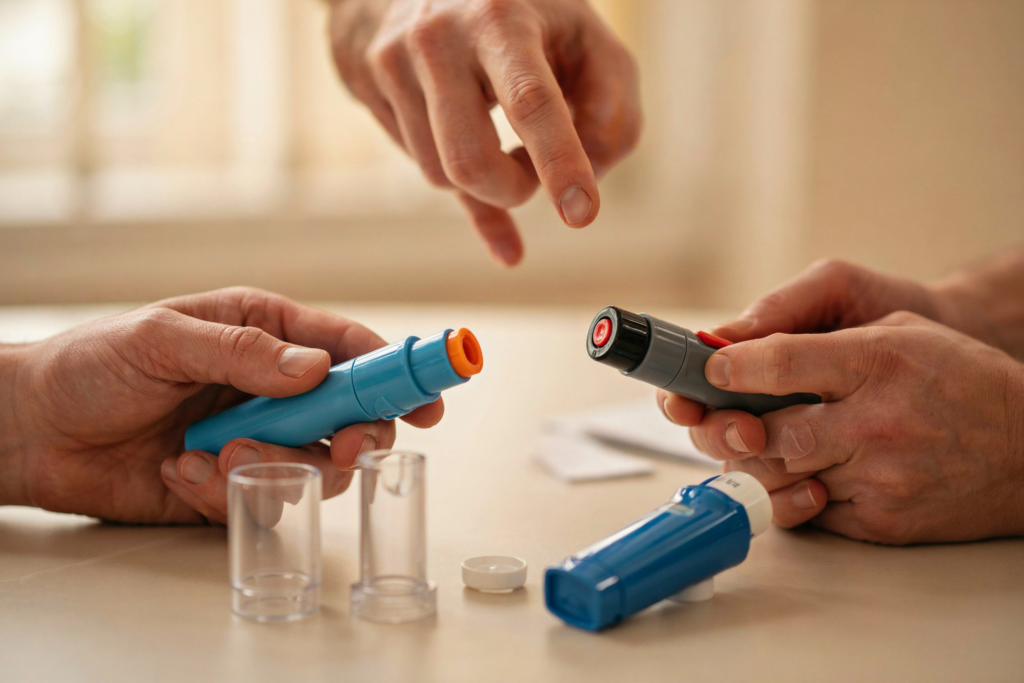
Hands-on practice with EpiPen and Anapen trainers
This is the part most educators are nervous about. Good epipen training childcare brisbane educators can rely on is all about getting the device in your hands, again and again, until it stops feeling foreign.
The trainer devices have no needle and no medication in them. Practise as many times as you need.
Both devices go into the outer mid-thigh, but the steps for each one are a little different, which is exactly why practising matters. You can check ASCIA’s device instructions any time. The right dose depends on the child’s weight and the device prescribed, and that’s all set out on the child’s ASCIA Action Plan.
Asthma first aid with a puffer and spacer
You’ll work through the steps on the official Asthma Australia first aid chart using a puffer and spacer. For younger children you’ll use a spacer with a mask, because toddlers just can’t seal their lips around a mouthpiece properly.
Child scenarios, not adult examples
A good asthma and anaphylaxis course Brisbane educators actually remember is built around the room you work in. You’ll run through things like:
- A reaction after morning tea.
- Wheezing during outdoor play.
- A first reaction in a child with no known allergy.
🟧 If you're unsure: ASCIA's advice is that if you can't tell whether it's anaphylaxis or asthma, give the adrenaline injector first, then the asthma reliever.
The assessment is practical and supportive. You show what you’ve practised, and the trainer helps you get there. That’s real hands-on anaphylaxis training.
Getting your certificate
When your certificate lands, forward it straight to your director and save a copy to your phone.
For more detail, see our asthma and anaphylaxis workshop in Brisbane and our guide to asthma and anaphylaxis management.
Renewing one educator is simple. Keeping a whole roster current takes a system.

Renewing a Whole Team: On-Site Training for Centres
Why centres renew staff together
If you’re a director, you already know the juggle. One educator’s due in March, another in June, a casual started last week and nobody’s checked her paperwork yet. Booking group asthma and anaphylaxis training brisbane centres can run in one go takes a lot of that juggling off your desk.
- One booking instead of chasing separate enrolments.
- Consistent training, so everyone follows the same steps in a real emergency.
- Casuals and new starters covered at the same time.
- Ratios kept, because nobody's driving across town.
How on-site sessions work
With onsite anaphylaxis training childcare centre brisbane teams can fit around the day, the trainer comes to you and brings all the devices. Most centres run it before opening, after close, or on a staff development day, so the kids aren’t affected at all.
Keeping your training register current
The renewal itself is the easy part. Track every staff member’s completion date and their three-year date in one place.
Then stagger renewals. If everyone renews in the same month, everyone’s due in the same month three years later, and that’s when a service ends up down to one trained educator. Spread them out and there’s always cover.
Example register
Name | Role | Course | Completed | Current until |
Sarah | Room leader | Approved anaphylaxis and asthma | 14 Mar 2024 | 14 Mar 2027 |
Priya | Educator | Approved anaphylaxis and asthma | 2 Aug 2025 | 2 Aug 2028 |
Jess | Casual educator | Approved anaphylaxis and asthma | 20 Jan 2026 | 20 Jan 2029 |
And if you’ve read this far and realised your date has already passed, here’s what to do next.
What Happens If Your Training Has Already Lapsed
First up, take a breath. Finding out your date has slipped by feels awful, especially when there’s a child with an action plan in your room. It happens, and it’s fixable.
If you’ve landed here searching for “expired anaphylaxis certificate” late at night, this section is for you.
Is there a grace period?
No, there isn’t a formal one. ACECQA counts training completed within the previous three years, and once you’re past that date, your training no longer counts towards your service’s requirements.
The obligation to have a trained educator on the premises belongs to the service. So when anaphylaxis training has lapsed in childcare, the main job is making sure your centre knows straight away and can plan around it.
Renew Once, Then Stop Worrying About It
Asthma and anaphylaxis certificate renewal really comes down to one simple rule. Your training is current for three years from the completion date on your certificate, so add three years to that date and pop it in your phone calendar today.
Before you book anything, check that your course is on the ACECQA approved list for both anaphylaxis and asthma.
Then book four to eight weeks ahead. You’ll get a date that suits your roster.
If your date is close or already passed, tell your director and book in this week.
If you’re the one keeping a whole team current, on-site training is the easiest way to get everyone renewed in one go. And if you’re not due for a while yet, set a reminder now so the date never sneaks up on you again.
Because the real goal was never just the piece of paper. It’s that one afternoon when a child’s action plan suddenly becomes real, you’ll be the calm adult in the room who knows exactly what to do, because you’ve already practised it with your own hands.
Book Your First Aid Training Now
Fast, affordable, and nationally accredited training delivered by professionals who care
Asthma and Anaphylaxis Renewal FAQs
Q.How long is an asthma and anaphylaxis certificate valid?
It's current for three years from the completion date on your certificate. ACECQA treats approved anaphylaxis management and emergency asthma management training as current within that window, while CPR needs a refresher every year.
Q.Is there a grace period after it lapses?
No. ACECQA only counts training completed within the previous three years, so tell your director straight away and book the next available approved course.
Q.Can I renew asthma and anaphylaxis training online?
Not fully. Approved training includes a hands-on practical assessment with the devices, so a blended course with online pre-learning and a face-to-face assessment is the way to go.
Q.Does HLTAID012 cover asthma and anaphylaxis?
Only if that exact course is on the ACECQA list for both. The HLTAID012 unit on its own covers first aid only, so check the course name and provider on your certificate against the list.
Q.When should I book my renewal?
Aim for four to eight weeks before your three-year mark. In Brisbane, January and the weeks before assessment and rating visits fill quickly, so booking early gives you more choice.
Q.Do I need a USI to renew?
Yes. You need a Unique Student Identifier to enroll with any RTO, and you can look yours up or create one at usi.gov.au.
Q.Can my center book training on-site?
Yes. A trainer can come to your center with all the devices, usually before opening, after close or on a staff development day, so ratios stay in place.
Q.What if I can't tell whether it's anaphylaxis or asthma?
ASCIA's advice is to give the adrenaline injector first, then the asthma reliever. You'll practice this in the child scenarios during your course.
Making first aid training more affordable for
every classroom
We believe every student deserves access to life-saving first aid knowledge. That’s why we offer specially reduced pricing for schools and educational groups. Whether you’re booking for a single class, a year group, or your entire school, our flexible packages make training more accessible and cost-effective — without compromising quality.
