
Imagine this: You’re at work when a colleague suddenly collapses. Everyone turns to you, expecting action. Your heart races. Do you remember the steps? Where do you place your hands? How fast should compressions be?
This moment of panic is exactly why knowing how to provide cardiopulmonary resuscitation confidently matters. Whether you’re a Brisbane fitness instructor, teacher, aged care worker, or parent, CPR skills transform you from a bystander into a potential lifesaver.
In this guide, you’ll learn the 5 steps to provide cardiopulmonary resuscitation, backed by current Australian Resuscitation Council guidelines. We’ll break down each technique in practical terms, address common concerns, and show you exactly what to do in those critical first minutes.
What Are the 5 Steps of CPR?
To provide cardiopulmonary resuscitation effectively, follow these 5 steps:
- Check for Danger – Ensure the scene is safe for you and the casualty before approaching. Look for hazards like traffic, electricity, or fire.
- Check for Response – Tap the person’s shoulders firmly and ask loudly “Can you hear me?” If they’re unresponsive, call 000 immediately or get someone else to call.
- Open the Airway – Tilt the head back gently and lift the chin to open the airway. Check for normal breathing for no more than 10 seconds.
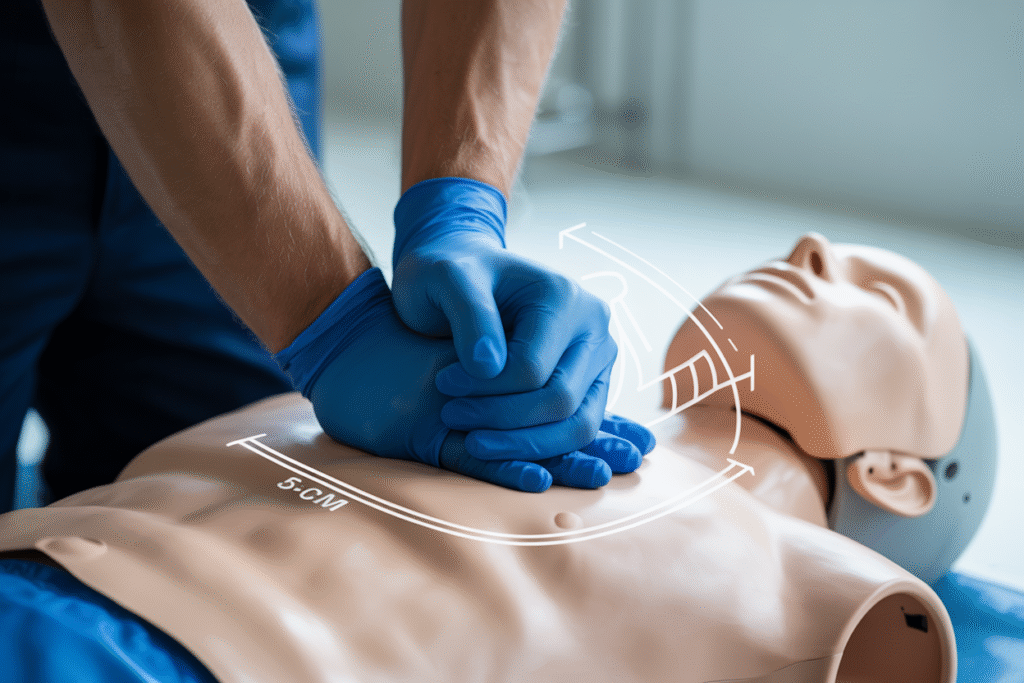
- Start Chest Compressions – Place the heel of one hand on the centre of the chest, interlock your fingers, and compress hard and fast at a rate of 100-120 compressions per minute. Push down 5-6 cm deep.
- Give Rescue Breaths – After every 30 compressions, give 2 rescue breaths. Pinch the nose closed, seal your mouth over theirs, and blow steadily for 1 second each.
Continue this 30:2 cycle until emergency services arrive or the person shows signs of recovery.
Understanding Cardiopulmonary Resuscitation (CPR) Basics
What Is Cardiopulmonary Resuscitation?
Cardiopulmonary resuscitation—CPR—is you becoming someone’s temporary heart and lungs when theirs have stopped working. When someone goes into cardiac arrest, their heart stops pumping blood. That means oxygen isn’t getting to the brain, and brain cells start dying within minutes. CPR keeps blood flowing until professional help arrives.
According to the Australian Resuscitation Council, immediate CPR can double or triple someone’s chance of survival. Every minute without CPR decreases survival chances by 7-10%. In Australia, around 25,000 cardiac arrests happen outside hospitals each year. Only about 1 in 10 people survive—but when CPR starts immediately, those odds improve dramatically.
When Should You Provide Cardiopulmonary Resuscitation?
A heart attack happens when blood flow to the heart gets blocked. The person is usually conscious, complaining of chest pain. A cardiac arrest is when the heart suddenly stops beating altogether. The person collapses, becomes unresponsive, and stops breathing normally. This is when you provide cardiopulmonary resuscitation.
The signs are clear:
- Person is completely unresponsive
- Not breathing normally (no breathing at all, or just occasional gasps)
- No signs of life
If someone’s unresponsive and not breathing normally, they need CPR. Don’t waste time trying to figure out what caused it. Start compressions and get help coming.
Before You Start: Critical Safety Checks
The DRS ABCD Action Plan
Before starting CPR, make sure you’re not about to become a casualty yourself.
D – Danger: Look around before you approach. Electricity? Traffic? Chemical spills or fire? Don’t be a hero if the scene isn’t safe.
R – Response: Tap their shoulders firmly and shout “Can you hear me?” If there’s no response, they need immediate help.
S – Send for Help: Call 000 straight away. If others are around, point to someone specific: “You in the blue shirt—call 000 now!” If you’re alone, put your phone on speaker.
This sequence matters because protecting yourself comes first. And calling for help early means paramedics are already on their way before you start compressions.
What to Tell Emergency Services
When you’re on the phone with 000, tell them:
- Your exact location (street address or landmarks)
- “Someone’s collapsed and not breathing”
- That you’re starting CPR
- Follow their guidance—they’ll walk you through the steps if needed
Don’t waste time speculating about what caused the collapse. Brisbane paramedics just need the basics to get to you fast.
Step-by-Step Guide to Provide Cardiopulmonary Resuscitation
Step 1 – Positioning the Casualty
Get the person flat on their back on a firm surface—the floor is perfect. Soft surfaces like beds absorb the force of your compressions. You’ll be pushing the mattress down instead of compressing their chest.
If the person is face down, roll them over. Support their head and neck. Make sure their head and neck are in line with their body.
Step 2 – Hand Placement for Chest Compressions
Find the centre of the chest—roughly between the nipples. Place the heel of one hand there, then interlock your other hand on top.
Lock your elbows straight. Get your shoulders directly over your hands. You’re using your body weight to compress the chest, not your arm muscles.
Step 3 – Performing Effective Chest Compressions
Depth: Push down 5-6 centimeters. That’s pretty firm pressure.
Rate: 100-120 compressions per minute. If you know “Stayin’ Alive” by the Bee Gees, that’s the perfect tempo.
Full recoil: Let the chest come all the way back up between compressions.
Don’t stop: Minimize interruptions. Every time you stop, blood flow stops.
Effective CPR is physically demanding. You might feel like you’re being too rough. You’re not. You’re keeping someone alive.
| Age Group | Compression Depth | Compression Rate |
|---|---|---|
| Adult (8+ years) | 5-6 cm | 100-120 per minute |
| Child (1-8 years) | 5 cm | 100-120 per minute |
| Infant (under 1 year) | 4 cm | 100-120 per minute |
Step 4 – Opening the Airway Correctly
After 30 compressions, open the airway. Put one hand on their forehead and gently tilt the head back. Take two fingers of your other hand and lift the chin up.
Take a quick look, listen, and feel for breathing—no more than 10 seconds. “Normal breathing” doesn’t include occasional gasps. If you see agonal breaths (weird gasping sounds), they still need CPR.
Step 5 – Delivering Rescue Breaths
Pinch the nose closed. Seal your mouth completely over theirs. Blow steadily for about 1 second. You should see the chest rise.
If the chest doesn’t rise, reposition the head. Give the second breath the same way.
If you don’t want to give rescue breaths, you don’t have to. Compression-only CPR is absolutely an option.
The 30:2 Ratio Explained
30 compressions, 2 breaths. Then repeat.
This ratio provides the best balance between keeping blood pumping and getting oxygen into the lungs. Count out loud if it helps.
Continue until:
- The person shows signs of life
- A defibrillator arrives
- Paramedics take over
- You’re physically too exhausted to continue
CPR is exhausting. If there are other people around who know CPR, swap out every 2 minutes.
Using an Automated External Defibrillator (AED)
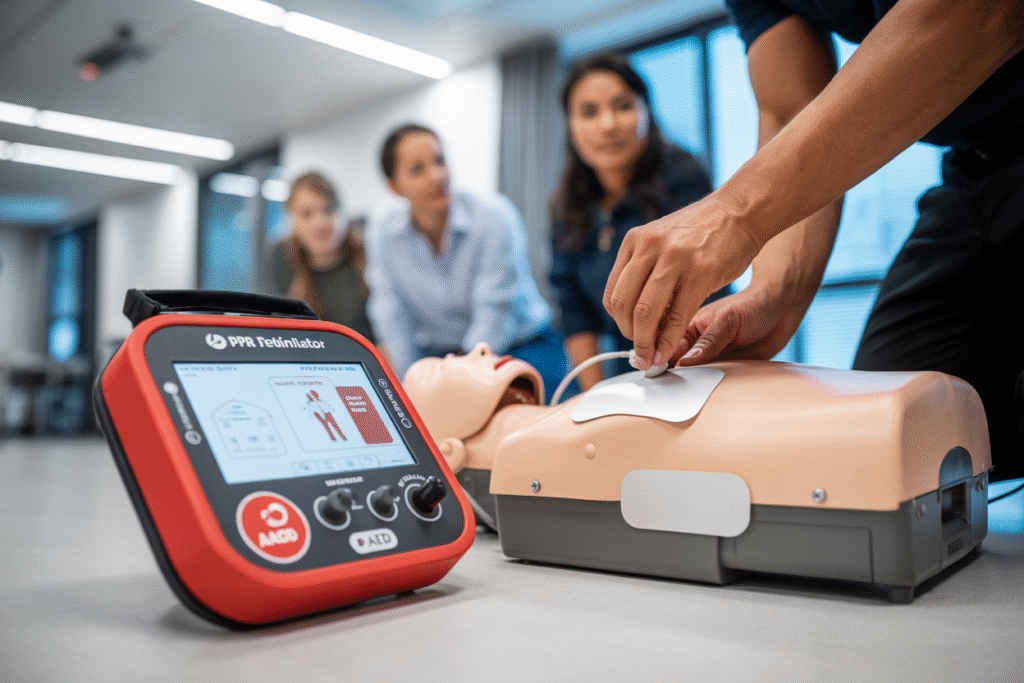
AEDs are designed to be used by anyone. The device talks to you and tells you exactly what to do.
Where to Find AEDs in Brisbane
You’ll find them in shopping centres (Carindale, Chermside, Westfield Garden City), gyms, schools, office buildings, sports facilities, and public spaces like Brisbane Airport and train stations.
The “AED Locations” app shows registered defibrillators across Australia.
How to Use an AED
- Turn it on—it starts giving voice instructions
- Expose the chest and attach the pads as shown
- Don’t touch the patient while it analyzes
- Press the shock button if advised
- Get straight back to CPR
The machine won’t let you shock someone who doesn’t need it. You can’t accidentally harm someone with an AED. Once it’s on, leave it on until paramedics arrive.
CPR Training and Certification in Brisbane
Reading about how to provide cardiopulmonary resuscitation is one thing. Actually doing it is completely different.
Why Hands-On Training Matters
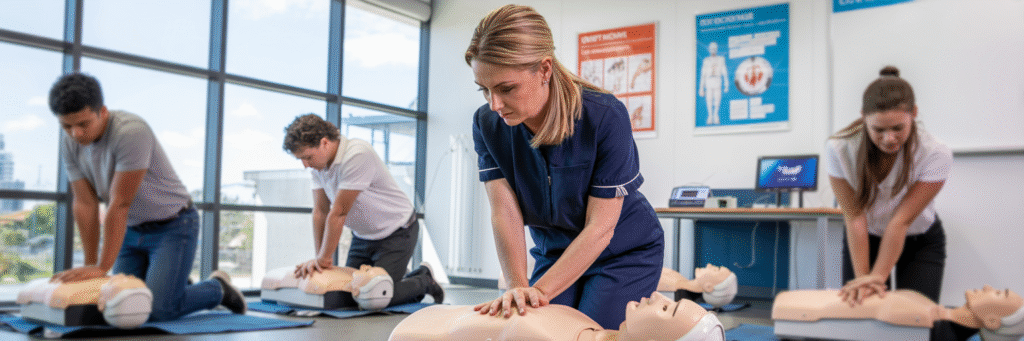
Until you’ve pushed down on a training manikin’s chest, felt how much force you need, and gotten the rhythm sorted—you don’t really know it. Hands-on training gives you muscle memory, confidence, feedback, and real scenarios.
Types of CPR Courses Available
HLTAID009 – Provide Cardiopulmonary Resuscitation: Covers CPR for adults, children, and infants, plus AED use.
HLTAID011 – Provide First Aid: Full first aid course including CPR.
HLTAID012 – Provide First Aid in Education and Care Setting: Specialized for people working with kids.
Don’t wait until the last minute. Courses get booked out, especially weekends. Give yourself at least 2-3 weeks buffer before expiry.
CPR in the Workplace
Who Needs CPR Certification for Work?
Many Brisbane industries require CPR certification:
- Fitness: Personal trainers, gym instructors, sports coaches
- Education: Teachers, teacher aides, childcare educators
- Healthcare: Aged care workers, support workers, disability support staff
- Hospitality: Venue managers, function coordinators
- Construction: Site supervisors, safety officers
Under Queensland’s Work Health and Safety laws, employers must provide first aid in the workplace. If CPR is required for your role, it’s your responsibility to keep it current.
Setting Up Workplace CPR Response
- Know where the AED is located
- Have an emergency action plan (who calls 000, who gets the AED, who starts CPR)
- Keep first aider certifications visible
- Practice drills periodically
If multiple people know CPR, designate tasks: one performs CPR, one calls 000, one gets the AED, one directs paramedics when they arrive.
Quick Reference Guide: CPR At-a-Glance
The 30-Second CPR Checklist
✅ Check for danger → ✅ Check response → ✅ Call 000 → ✅ Position flat on firm surface → ✅ Compressions (centre of chest, 5-6cm deep, 100-120/min) → ✅ Open airway → ✅ 2 breaths after 30 compressions → ✅ Continue until help arrives
CPR Numbers to Remember
| What | Number |
|---|---|
| Compression depth | 5-6 cm |
| Compression rate | 100-120 per minute |
| Compression ratio | 30:2 |
| Breath duration | 1 second each |
| Emergency number | 000 |
When to Stop CPR
- The person shows signs of life
- Professional help takes over
- An AED is ready to analyze
- You’re physically unable to continue
- The scene becomes unsafe
Conclusion: You’re Ready to Save a Life
Learning how to provide cardiopulmonary resuscitation isn’t about memorizing perfect technique. It’s about being able to act when someone needs you most.
The 5 steps are straightforward:
- Check for danger and response
- Call 000 and send for help
- Start chest compressions—hard and fast, 5-6cm deep
- Open the airway and check breathing
- Give rescue breaths in a 30:2 ratio with compressions
Imperfect CPR saves lives. Hesitation doesn’t.
The difference between reading this article and actually being able to help comes down to hands-on training. Three hours of proper CPR certification could mean the difference between watching someone die and watching them recover.
Ready to Learn CPR With Confidence?
Whether you need CPR for work, want the skills for peace of mind, or your certificate’s about to expire—don’t put it off. The life you save might be someone you love.
Book your CPR training today. Because knowing how to provide cardiopulmonary resuscitation isn’t just a workplace requirement—it’s one of the most valuable skills you’ll ever have.
Book Your First Aid Training Now
Fast, affordable, and nationally accredited training delivered by professionals who care
Frequently Asked Questions About CPR
Q.Can I hurt someone by performing CPR if they don't actually need it?
If someone is responsive and breathing normally, they don't need CPR. The key checks protect against this—if they respond when you tap their shoulders or if they're breathing normally, you won't start CPR. However, if someone is truly unresponsive and not breathing normally, performing CPR won't make things worse. Their heart has already stopped, so you're only helping. The bigger risk is not performing CPR when someone needs it.
Q.How long can I perform CPR before I need to stop?
Continue CPR until one of four things happens: the person shows signs of life (starts breathing normally, moving, or responding), paramedics arrive and take over, you have access to an AED that needs to analyze the heart rhythm, or you're physically too exhausted to continue safely. In Brisbane, average ambulance response times are around 8-12 minutes in metro areas, though this can vary. If others are present and know CPR, swap out every 2 minutes to maintain effective compression quality. Don't feel guilty if you become too exhausted—doing CPR for even a few minutes is better than nothing.
Q.Do I have to give rescue breaths, or can I just do compressions?
Compression-only CPR is absolutely acceptable and still saves lives. If you're uncomfortable with rescue breaths, not trained in them, or concerned about disease transmission, just do continuous chest compressions at 100-120 per minute without stopping for breaths. While the combination of compressions and breaths is ideal, compressions alone are far better than doing nothing. Many bystanders choose compression-only CPR, and studies show it's still highly effective, especially in the first few minutes of cardiac arrest.
Q.What if the person vomits during CPR?
Vomiting can occur during CPR, especially if the person has recently eaten. If this happens, turn the person's head to the side (or roll them onto their side if necessary) to allow the vomit to drain and prevent choking. Quickly clear the mouth if possible, then reposition them on their back and continue CPR immediately. Don't let this interrupt compressions for more than a few seconds. If you're concerned about hygiene, focus on compression-only CPR rather than stopping altogether. Time is critical, and brief interruptions are acceptable when necessary.
Q.Can I be sued for performing CPR in Queensland?
No. Queensland's Civil Liability Act 2003 protects Good Samaritans who provide emergency assistance in good faith. As long as you're acting without reckless disregard for the person's safety and not expecting payment, you're protected from civil liability. This means you cannot be sued for broken ribs, bruising, or other injuries that result from properly performed CPR. The law recognizes that bystander CPR saves lives and protects people who step up to help in emergencies. This protection applies across all Australian states and territories.
Q.Is CPR different for children and infants?
Yes, there are modifications for different age groups. For infants (under 1 year), use two fingers for compressions and compress about 4cm deep. For children (1-8 years), use one or two hands and compress about 5cm deep. For anyone 8 years and older, use the adult technique with 5-6cm compressions. The compression rate remains 100-120 per minute for all ages. For infants and children, the ratio is 30 compressions to 2 breaths if you're alone, or 15:2 if there are two trained rescuers present. Proper CPR training covers these age-specific techniques with hands-on practice.
Q.What if I'm pregnant—can I still perform CPR?
If you're physically able to, yes. CPR is demanding work, so consider your own capabilities and your stage of pregnancy. You might find it easier to kneel at the person's side rather than leaning over them. If you're in later pregnancy and concerned about the physical strain, you can coordinate with others—call 000, get the AED, direct other helpers, or swap out with another rescuer after a cycle or two. If you're unable to perform compressions effectively, doing something (even just calling for help and getting an AED) is better than nothing. Your safety matters too.
Q.Do I need to recertify my CPR every year even if I'm confident in my skills?
Yes. CPR certification is valid for only 12 months under Australian standards, and there's good reason for this. Guidelines are updated periodically based on new research, compression depths and techniques are refined, and muscle memory fades quickly without practice. Annual recertification ensures you're up-to-date with current Australian Resuscitation Council protocols and gives you hands-on practice to maintain confidence and competence. Many workplaces require current certification as part of compliance obligations. Even if you feel confident, the annual refresher catches technique drift, reinforces proper form, and keeps you legally covered for workplace requirements.
Q.What's the difference between a heart attack and cardiac arrest?
A heart attack is a "plumbing problem"—a blocked artery reduces blood flow to part of the heart muscle. The person is usually awake, may have chest pain or discomfort, and their heart is still beating. They need urgent medical care but typically don't need CPR. Cardiac arrest is an "electrical problem"—the heart's electrical system malfunctions and the heart stops beating altogether. The person collapses, becomes unresponsive, and stops breathing normally. This is when CPR is needed immediately. A heart attack can lead to cardiac arrest, but they're not the same thing. If someone's unresponsive and not breathing, treat it as cardiac arrest and start CPR regardless of what caused it.
Making first aid training more affordable for
every classroom
We believe every student deserves access to life-saving first aid knowledge. That’s why we offer specially reduced pricing for schools and educational groups. Whether you’re booking for a single class, a year group, or your entire school, our flexible packages make training more accessible and cost-effective — without compromising quality.
