
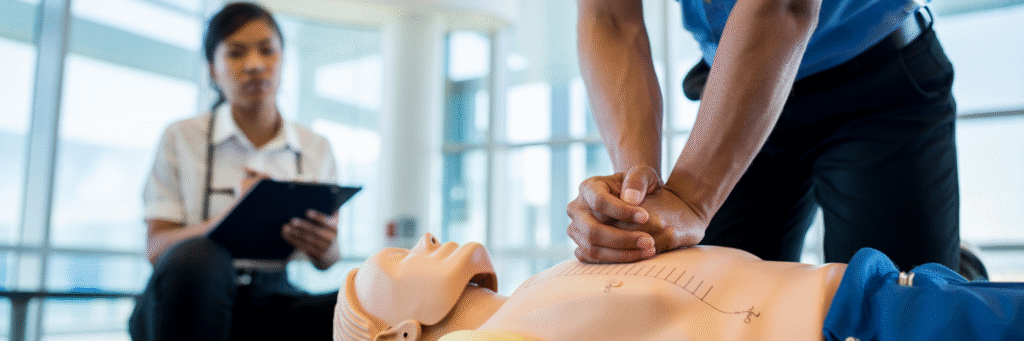
Here’s the thing most people don’t tell you about CPR skills tests—they’re designed for you to pass, not fail. You’ve practiced the key techniques during your course. You understand what assessors are checking for. When assessment time comes, your hands know what to do—no panic, no freezing, just confident execution.
The CPR skills test is the practical component of your CPR certification course, where you demonstrate life-saving techniques on a training manikin. While it might sound intimidating, understanding the assessment criteria and what trainers are actually looking for transforms this from a stressful unknown into a straightforward, passable evaluation.
This guide breaks down the entire CPR skills test process—from what happens in the assessment room to the specific techniques assessors check, common mistakes that trip up first-timers, and practical preparation tips from experienced Brisbane CPR instructors.
You’ll learn exactly what’s tested, how assessors score your performance, step-by-step technique breakdowns, and how to practice effectively before your course. By the end, you’ll feel prepared rather than anxious about your upcoming CPR assessment.
What Is Tested in a CPR Skills Test?
A CPR skills test assesses your ability to perform cardiopulmonary resuscitation correctly on a training manikin. The practical assessment evaluates:
- Compression technique – Correct hand placement on the chest, appropriate depth (5-6cm), and rate (100-120 compressions per minute)
- Rescue breaths – Proper head tilt-chin lift, effective breath delivery with visible chest rise
- Compression-to-breath ratio – Maintaining the correct 30:2 cycle (30 compressions, 2 breaths)
- Response protocol – Checking for danger, responsiveness, and calling for help (DRSABCD)
- Assessment timing – Completing a full 2-minute CPR cycle with consistent technique
- Scene safety – Demonstrating awareness of hazards before starting CPR
Most CPR courses in Brisbane conduct the skills test after hands-on practice sessions, allowing you to demonstrate these techniques under instructor observation. The assessment focuses on correct technique rather than perfection, with trainers providing guidance throughout.
Understanding the CPR Skills Test Format
What Happens During the Assessment
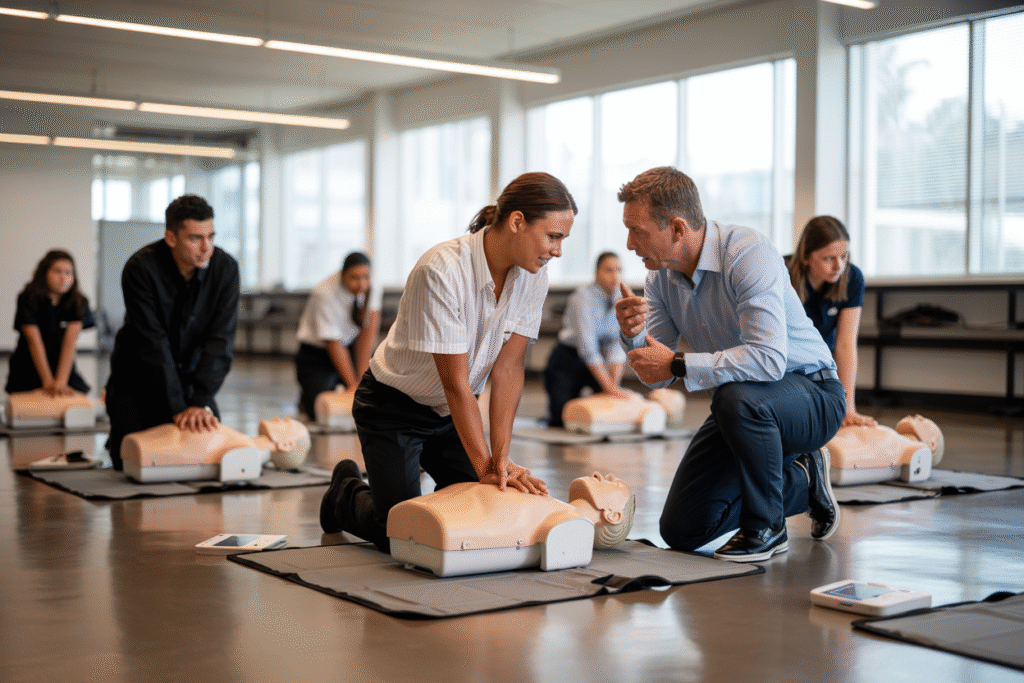
The skills test typically takes about 5-10 minutes per student. You’re not thrown into some high-pressure examination room with stern-faced assessors staring you down. Most Brisbane CPR courses run assessments in small groups or one-on-one with your instructor, using the same training room where you’ve been practicing all day.
You’ll be working with adult manikins, training AEDs (defibrillators), and face shields for hygiene during rescue breaths. The pass/fail criteria is straightforward—your assessor is checking that you can perform CPR safely and effectively, not that you’re perfect.
“Most students are surprised at how supportive the assessment environment is. We’re not trying to catch you out—we want you to succeed.” — Brisbane CPR Instructor
Assessment vs. Practice Sessions
During practice sessions, your instructor is constantly correcting your hand position, adjusting your compression depth, and answering your questions. The formal assessment happens after you’ve had plenty of practice. Most accredited courses in Brisbane give you 90-120 minutes of hands-on practice before anyone assesses you.
Here’s a statistic that should calm your nerves: 94% of students pass on their first attempt in accredited courses. That’s because by the time you get to the assessment, you’ve already practiced the skills dozens of times. If you don’t pass on your first attempt, you can absolutely retry—often on the same day.
Who Assesses You and How
Your assessor holds current TAE40116 and HLTAID009 certifications, registered with Australian training authorities. They’re not looking for perfection—they’re checking that your technique is effective enough to save someone’s life. The assessment approach is constructive, not critical. Your assessment is also confidential—it’s just you, the instructor, and the manikin.
The Complete DRSABCD Assessment Protocol
Why DRSABCD Matters in Your Test
DRSABCD is the Australian emergency response protocol, and it’s the backbone of your CPR skills test. The most common mistake first-timers make? Jumping straight to chest compressions. But if you skip the danger check and there’s a live electrical wire near the collapsed person, you’ve just become the second casualty.
Assessors specifically check that you follow this sequence because missing steps can mean failing the assessment—even if your compression technique is perfect.
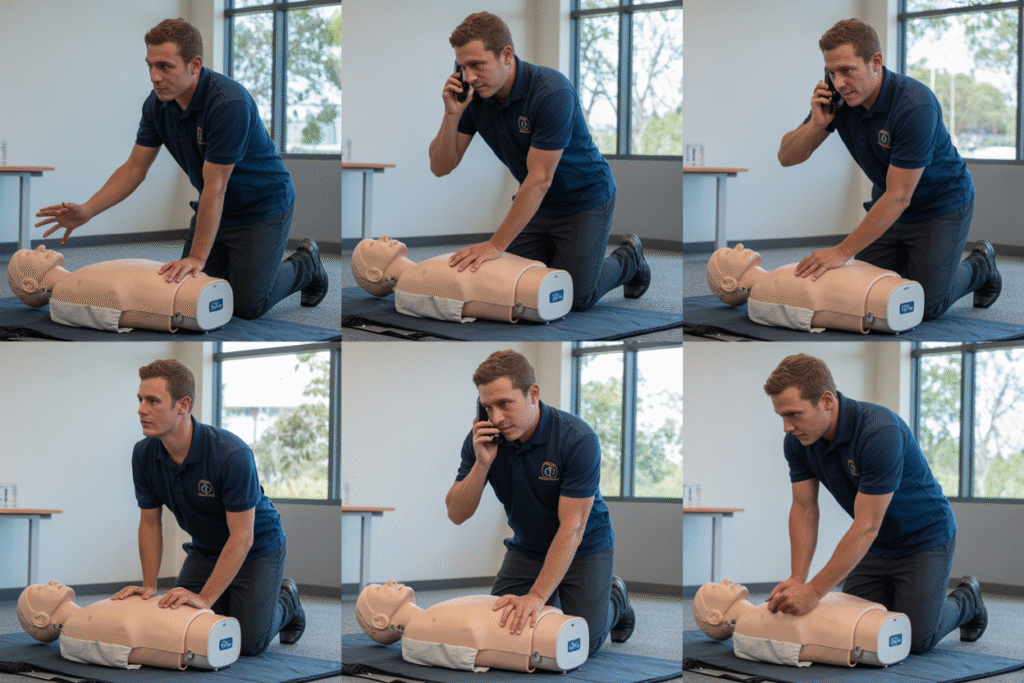
Breaking Down Each DRSABCD Step
| Step | What It Means | What Assessors Check |
|---|---|---|
| D - Danger | Check the scene is safe | You verbally identify hazards and state "It's safe to approach" |
| R - Response | Check if person is conscious | You tap shoulders and call out "Can you hear me?" |
| S - Send for Help | Call emergency services | You call or direct someone specific to call 000 |
| A - Airway | Open the airway | You perform head tilt-chin lift and check for obstructions |
| B - Breathing | Check if they're breathing | You look, listen, feel for 10 seconds |
| C - CPR | Perform compressions and breaths | You maintain 30:2 ratio with correct technique |
| D - Defibrillation | Use AED if available | You attach pads correctly and follow prompts |
Mastering Chest Compression Technique
Correct Hand Placement
Hand placement is non-negotiable. Here’s exactly where your hands need to be: the center of the chest, on the lower half of the breastbone. Find where the ribs meet in the middle of the chest. Place the heel of one hand two finger-widths above that point. Place your other hand on top, interlocking your fingers.
Your fingers should be lifted off the chest. Position your shoulders directly above your hands. Your arms should be straight, elbows locked. This lets you use your body weight to compress rather than arm strength.
Compression Depth and Rate
Two numbers to burn into your brain: 5-6cm depth and 100-120 compressions per minute.
5-6cm is deeper than most people think. You need to compress hard enough to circulate blood. The rate works out to about 2 compressions per second—that’s fast.
Here’s the trick everyone uses: Think of the Bee Gees song “Stayin’ Alive.” The beat is almost exactly 100 beats per minute. Hum it in your head while you compress, and you’ll nail the rhythm.
Letting the Chest Recoil Completely
After each compression, let the chest come back up completely before you push down again. When you release pressure, blood flows back into the heart. If you’re leaning on the chest between compressions, you’re preventing that refill.
Maintaining Consistent Rhythm
Around the 90-second mark, most people get tired and their compressions get slower. Keep that song playing in your head, focus on the count, keep your core engaged, and breathe normally while you compress.
Rescue Breath Technique
The Head Tilt-Chin Lift Maneuver
Place one hand on the person’s forehead and gently tilt the head back. Place two fingers under the bony part of the chin and lift it forward and up. Maintain this position while you deliver breaths.
Delivering Effective Rescue Breaths
After 30 compressions, it’s time for 2 rescue breaths. Maintain the head tilt-chin lift with one hand. With your other hand, pinch the person’s nose shut. Take a normal breath. Seal your lips completely around their mouth. Blow steadily for about 1 second, watching the chest rise.
If the chest rises, that’s an effective breath. Remove your mouth, let the chest fall, then repeat for the second breath.
Common Rescue Breath Mistakes
Not pinching the nose—air goes out their nose instead of into their lungs. Blowing too hard or too fast can push air into the stomach. Breaking the seal means air escapes. Not watching the chest means you don’t know if your breath was effective. Taking too long between compressions and breaths—deliver both breaths in about 5 seconds total.
The 30:2 Cycle
30 chest compressions to 2 rescue breaths. This cycle repeats continuously. You’ll typically complete 5 cycles (150 compressions and 10 breaths total, taking about 2 minutes). After you deliver the second breath, hands go straight back to the chest and you start compressing again.
Common Mistakes That Cost People Points
Performance Errors
Rushing through DRSABCD steps – Slow down and verbalize each step clearly.
Incorrect hand placement – Take an extra second to find the correct position before you start compressing.
Insufficient compression depth – Really commit to those compressions. Push hard.
Inconsistent compression rate – Keep that mental song playing the whole time.
Not allowing full chest recoil – Lift that pressure even though you’re fatigued.
Breaking the airway seal during rescue breaths – Nose pinched, lips sealed, head position maintained.
Excessive pauses – You should be back to compressing within 10 seconds of stopping.
Technique Issues
Bent elbows during compressions—straighten those arms. Fingers pressing on ribs—keep them lifted. Looking around during CPR—keep your eyes on your hands and the chest. Stopping compressions to talk or think—keep compressing while you figure it out.
Protocol Mistakes
Skipping the danger check, forgetting to send for help, not checking for breathing properly, or starting compressions before checking breathing—all of these will cost you points.
The “I’m Nervous” Mistakes
Stop apologizing constantly. Don’t stop to ask if you’re doing it correctly during assessment. Don’t redo steps you’ve already done fine. If you freeze when you forget what’s next, think about the acronym—DRSABCD—and that’ll usually jog your memory.
How to Practice Before Your Course
What You Can Practice at Home
Memorize DRSABCD – Write it out. Say it out loud. Quiz yourself.
Watch technique videos – Australian Resuscitation Council and Safe Work Australia have official CPR demonstration videos.
Practice your 30-count rhythm – Put your hands in the compression position on a firm surface. Practice counting to 30 at the right rhythm.
Practice the head tilt-chin lift on yourself – You can feel the movement and understand the mechanics.
Mental Rehearsal Techniques
The night before your course, mentally walk through the entire scenario. You approach a collapsed person, check for danger, check for response, send for help, check airway and breathing, start compressions. Run through this mental movie a few times—it reduces anxiety.
What Happens If You Don’t Pass?
Retake Options and Process
Remember that 94% of students pass on their first attempt. But if you’re in that 6% who need another go, most Brisbane CPR training providers offer immediate retake opportunities—often on the same day.
Your instructor will identify which specific skill needs improvement, take you through that skill again, give you time to practice it, then reassess. In many cases, you can demonstrate the corrected skill within 15-20 minutes and walk away with your certificate the same day.
Most training organizations don’t charge you extra for retakes if it’s within a reasonable timeframe (usually 30 days from your original course).
Additional Support Available
If you’re struggling with a particular skill during practice time, speak up. Instructors have seen every learning challenge before and they’ve got tricks to help. Some Brisbane training centers offer pre-course resources you can review beforehand.
For people with learning difficulties, physical limitations, or language barriers, accredited training providers can make reasonable accommodations.
No Shame in Needing Extra Practice
Not everyone learns physical skills at the same speed. Some people walk into the course and nail compressions on their first try. Others need 40 practice attempts before they get the depth right. Both people can become competent at CPR.
The only way you truly fail is if you give up. As long as you’re willing to practice and keep trying, you will get there.
Conclusion
Your CPR skills test doesn’t need to be the stressful experience you’re probably building it up to be in your head.
You now know exactly what assessors are checking for. You understand the DRSABCD protocol and why each step matters. You’ve got the specific techniques for compressions and rescue breaths, you know the common mistakes to avoid, and you’ve got practical strategies for preparing before your course.
Walk into that training room with this knowledge, pay attention during practice time, ask questions when you need help, and trust that the 90+ minutes of hands-on practice you’ll get is enough time to develop competence. Your instructor wants you to pass, the assessment is designed for you to demonstrate capability rather than perfection, and the vast majority of students walk out with their certificate on the same day.
The person whose life you save with these skills won’t care if your compression rhythm was exactly perfect or if you had to self-correct your hand placement. They’ll care that you knew what to do and you did it.
You’ve got this. Book your course, show up ready to learn, and you’ll be certified before you know it.
Book Your First Aid Training Now
Fast, affordable, and nationally accredited training delivered by professionals who care
Frequently Asked Questions About CPR Skills Tests
Q.What happens if I fail the CPR skills test?
If you don't pass on your first attempt, you can retry. Most Brisbane training providers offer immediate retake opportunities—often on the same day. Your instructor will identify which specific skill needs work, give you additional practice time, then reassess just that component. Around 94% of students pass on their first attempt, so the odds are in your favor.
Q.Do I need to be physically fit to pass the CPR test?
You don't need to be super fit, but CPR is physically demanding. You'll be doing chest compressions for 2 minutes, which requires some upper body strength and stamina. If you have physical limitations or concerns, let your instructor know when you book—they can often make reasonable accommodations or suggest modifications.
Q.Can I practice on the manikin before the test?
Absolutely. That's the whole point of the practice session. You'll get 90-120 minutes of hands-on practice time with the manikin before anyone assesses you. During practice, you can try techniques multiple times, ask questions, and get feedback from your instructor.
Q.How hard do I need to push during compressions?
You need to compress 5-6cm deep on an adult, which is deeper than most people think. On the training manikin, there's usually a clicker or light that tells you when you've reached the right depth. Don't be afraid to push hard—you can't hurt the manikin, and in real CPR, the person is already dead so you can't make things worse.
Q.How long is my CPR certificate valid for?
CPR certificates (HLTAID009) are valid for 12 months in Australia. You'll need to renew annually to maintain your certification. Some training providers offer automatic renewal reminders, which is helpful since it's easy to forget until your employer asks for your updated certificate.
Q.Can I do CPR training if English isn't my first language?
Yes. Accredited training providers in Brisbane can make accommodations for language barriers. Some offer courses in different languages, provide translated materials, or allow extra time for comprehension. Let the training center know when you book so they can arrange appropriate support.
Q.What if I have a disability or health condition?
Accredited training providers must make reasonable accommodations under Australian law. If you have a physical disability, learning difficulty, or health condition that might affect your performance, inform the training center when you book. They can adjust their teaching approach or assessment methods where appropriate.
Q.Can I use my phone or notes during the skills test?
No. The assessment tests whether you can perform CPR from memory in an emergency situation. You won't have your phone or notes when someone collapses in real life, so you can't use them during the test either. That's why the practice session is so important—it's when you develop muscle memory.
Q.What's the pass rate for CPR skills tests in Brisbane?
Around 94% of students pass on their first attempt in accredited courses. The assessment is designed to check competence, not perfection. As long as you pay attention during the course, practice the techniques, and can demonstrate the key skills safely, you'll pass.
Q.Do I need to bring anything to the CPR course?
Most training providers supply everything you need—manikins, face shields, training materials. You just need to bring yourself, wear comfortable clothes, and bring water if you want it. Some people bring a pen for taking notes during the theory component. Check your confirmation email for any specific requirements.
Making first aid training more affordable for
every classroom
We believe every student deserves access to life-saving first aid knowledge. That’s why we offer specially reduced pricing for schools and educational groups. Whether you’re booking for a single class, a year group, or your entire school, our flexible packages make training more accessible and cost-effective — without compromising quality.
