
Your CPR certificate expires in 10 days, and you’ve just realized you can’t work your next shift without it. Sound familiar? You’re not alone—70% of Brisbane professionals book their HLTAID009 CPR course under deadline pressure, frantically searching for the fastest, most convenient training option.
Here’s the good news: HLTAID009 Provide CPR is a streamlined 3-hour course designed specifically for time-poor professionals like you. Unlike full first aid training, this focused certification gets you qualified fast without sacrificing quality or compliance.
In this guide, you’ll discover:
- What HLTAID009 CPR training actually involves (and what it doesn’t)
- Exactly what happens during your 3-hour course
- How to choose the right Brisbane training location for your schedule
- When you’ll receive your nationally recognized certificate
- Who needs this certification (and whether you need CPR or full first aid)
Whether you’re a personal trainer in Chermside, a teacher aide in Sunnybank, or an aged care worker in Logan, this article walks you through everything you need to confidently book and complete your HLTAID009 CPR training in Brisbane.
What is HLTAID009?
HLTAID009 (Provide Cardiopulmonary Resuscitation) is Australia’s nationally recognized CPR certification course. This streamlined training teaches you how to perform life-saving CPR on adults, children, and infants in emergency situations.
Key details about HLTAID009:
- Duration: Almost 2 hours (theory + practical assessment)
- Certificate validity: 12 months from issue date
- Training includes: CPR techniques, chest compressions, rescue breathing, defibrillator (AED) use
- Prerequisites: None required
- Age requirement: Minimum 14 years old
- Format: Face-to-face practical training (no online-only option)
- Recognition: Nationally accredited under Australian Skills Quality Authority (ASQA)
HLTAID009 replaced the previous course code HLTAID001 in 2021. If your employer requires “CPR certification” or “current resuscitation training,” HLTAID009 is the qualification you need.
What Happens During Your HLTAID009 CPR Course (Step-by-Step)
Most Brisbane professionals booking HLTAID009 training want to know exactly what they’re walking into. Will it be intimidating? Difficult? Boring? Here’s the honest breakdown of your 3-hour CPR course from arrival to certificate.
Course Structure and Timeline
Your CPR training follows a structured but relaxed format. Here’s how your 3 hours breaks down:
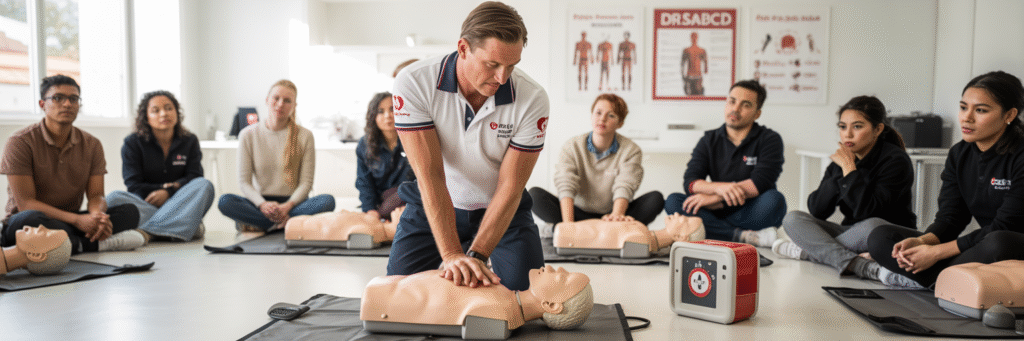
Welcome and Registration: You’ll arrive, sign in, and complete a brief registration form. Instructors introduce themselves and explain what to expect. Classes are small—only 8-12 people—so you won’t feel lost in the crowd.
Theory Session: CPR Fundamentals: The instructor covers the essential knowledge you need. This isn’t a boring lecture—it’s interactive, uses real scenarios, and answers the questions everyone’s thinking but too nervous to ask.
Hands-On Practice with Mannequins: You’ll practice CPR techniques on mannequins multiple times. Each person gets their own mannequin, and you’ll work through adult, child, and infant CPR. The instructor corrects technique gently—no public call-outs, no embarrassment.
Practical Assessment: One at a time, you’ll demonstrate your CPR skills. It sounds nerve-wracking, but by this point you’ve practiced so many times the movements feel automatic.
Theory Component: What You’ll Learn
Don’t worry—the theory isn’t overwhelming. It’s presented in plain English with real-world scenarios you can relate to.
The DRSABCD Action Plan: This is your step-by-step guide for any emergency: Danger, Response, Send for help, Airway, Breathing, CPR, Defibrillation.
When to Perform CPR (and When Not To): You’ll learn to recognize cardiac arrest versus other emergencies. This removes the guesswork that stops people from acting in real emergencies.
Legal Protection Under Good Samaritan Laws: In Australia, you’re legally protected when you perform CPR in good faith. Even if something goes wrong, you can’t be sued for trying to save someone’s life.
Chain of Survival Concept: Immediate CPR can double or triple chances of survival after cardiac arrest—but only 12% of out-of-hospital cardiac arrests in Australia currently receive bystander CPR.
There’s no written test. No multiple choice. No memorization quiz. The instructor just checks you understand the concepts by asking simple questions during the practical assessment.
Practical Training: Hands-On Practice
Each participant gets their own mannequin to practice on. You’ll practice all three techniques:
- Adults: Two hands, full compression depth
- Children: One or two hands, slightly less force
- Infants: Two fingers, gentle compressions
The instructor demonstrates each technique first, then you copy. They’ll adjust your hand placement, compression depth, or rhythm as needed—quietly, no shouting corrections across the room.
You’ll practice this 5-8 times before your assessment. By the time you’re assessed, the movements feel natural.
🎵
The Rhythm: "Stayin' Alive"
CPR compressions should be 100-120 per minute. That's the exact tempo of "Stayin' Alive" by the Bee Gees. Some instructors even play the song while you practice.
Assessment Process (And Why You Won’t Fail)
In Brisbane CPR courses, 99.8% of participants pass on their first attempt. The assessment is competency-based—the instructor is checking: “Can this person perform CPR correctly?”
You’ll demonstrate:
- 2 minutes of continuous CPR on an adult mannequin
- Correct AED application
- Verbal explanation of DRSABCD
If you need a second attempt, the instructor provides immediate coaching and lets you try again—same day, no extra cost, no judgment.
Who Needs HLTAID009 CPR in Brisbane?
If you’re searching for HLTAID009 training, chances are your employer, industry body, or professional registration requires it. Here’s who legally needs CPR certification in Brisbane and Queensland.
Mandatory CPR Requirements by Industry
| Industry/Role | Requirement | Renewal Frequency |
|---|---|---|
| Fitness Instructors/Personal Trainers | HLTAID009 + HLTAID011 | 12 months (CPR), 3 years (First Aid) |
| Teachers & Teacher Aides | HLTAID009 + HLTAID011 | Annually (typically) |
| Childcare Educators | HLTAID009 + HLTAID011 + Asthma & Anaphylaxis | 12 months (CPR), 3 years (First Aid) |
| Aged Care Workers | HLTAID009 (minimum) | 12 months |
| Healthcare Students | HLTAID009 + HLTAID011 | Annually |
| Security Guards | HLTAID009 + HLTAID011 | 3 years |
| Swim Instructors/Lifeguards | HLTAID009 + Pool Lifeguard | 12 months |
Most industries want both CPR and first aid qualifications because CPR covers cardiac arrest and choking, while first aid covers bleeding, burns, breaks, allergic reactions, and everything else.
“Should I Get CPR Even If It’s Not Required?”
Yes, if you spend time around other humans. Cardiac arrest doesn’t only happen at work. The average ambulance response time in Brisbane is 10-15 minutes. Brain damage from oxygen deprivation starts at 4-6 minutes. If someone near you has a cardiac arrest and you don’t know CPR, you’ll spend those 10 minutes watching them die while feeling completely helpless.
HLTAID009 vs HLTAID011: Which Do You Need?
This is the question everyone asks: “Do I need just CPR or do I need the full first aid course?”
When CPR Alone (HLTAID009) is Sufficient
You probably only need HLTAID009 if:
✓ Your employer specifically states “CPR certification only”
✓ You’re updating an expired CPR component of a current first aid certificate
✓ You want personal knowledge for family situations
✓ You have time constraints right now
Most Brisbane professionals who book HLTAID009 come back within 6-12 months to get HLTAID011 because their employer later requires full first aid, or they change jobs and the new role needs it.
When You Need Full First Aid (HLTAID011)
Go straight to HLTAID011 if:
✓ You’re a personal trainer, teacher, childcare worker, or aged care worker
✓ Your employment contract says “current first aid certificate”
✓ You’re designated as a workplace first aid officer
✓ You work in construction, electrical, security, or trades
The full first aid course gives you skills to handle 95% of workplace emergencies versus just cardiac arrest, and the certification lasts 3 years (though CPR needs annual renewal).
The CPR Annual Renewal Requirement
Even if you get HLTAID011 (valid for 3 years), the CPR component expires after 12 months. So your timeline looks like this:
- Today: Complete HLTAID011
- 12 months later: Complete HLTAID009 (CPR renewal)
- 24 months later: Complete HLTAID009 (CPR renewal)
- 36 months later: Complete HLTAID011 again
Your Certificate: What You’ll Receive and When
Same-Day Digital Certificate
Most Brisbane CPR training providers issue your certificate digitally within 2-6 hours of completing your course. The digital certificate is a PDF that includes your name, date of birth, certificate number, course code (HLTAID009), issue date, expiry date (12 months later), and training provider details.
This PDF is legally valid. You can email it to your employer, upload it to your professional registration portal, or show it on your phone. It’s not a “temporary” certificate—it’s your actual certificate in digital form.
Physical Certificate Card
Within 5-10 business days, you’ll receive a physical card in the mail. This wallet-sized card contains the same information as the digital certificate in a more durable format.
Certificate Validity and Renewal
Your HLTAID009 certificate expires exactly 12 months from the issue date. Good training providers send reminder emails at 60, 30, 14, and 7 days before expiry.
Add the expiry date to your phone calendar with your own reminders. Don’t rely solely on the provider’s system.
What Happens If Your Certificate Expires?
You can’t legally work in roles requiring current CPR, and your professional registration might become invalid. You just book a new HLTAID009 course and get recertified. There’s no penalty for letting it expire—you just need to redo the training.
What If You Lose Your Certificate?
Most Brisbane training providers will reissue your certificate for a small fee. Contact the provider, confirm your identity (name, date of birth, course date), and they’ll send you a duplicate.
Ready to Book Your HLTAID009 CPR Course?
You’ve got all the information you need. You know what HLTAID009 involves, what happens during the course, where to train in Brisbane, and when you’ll get your certificate.
Here’s what you’re committing to:
- Almost 2 hours of your time
- Same-day digital certificate
- Skills that could genuinely save someone’s life when it matters most
The course you keep putting off needs to happen. Courses fill up during peak periods—especially Saturday mornings—so booking now gives you choice of location and time.
You Will Get Certified
Small classes, patient instructors, multiple practice attempts before assessment. The 99.8% pass rate isn’t luck—it’s how the system works. Show up, pay attention, practice the techniques, and you’ll walk out certified.
The peace of mind of knowing you could save a life starts with booking an almost 2-hour course. Don’t put it off another week. Your future self (and possibly someone experiencing a cardiac emergency) will thank you for getting this done.
Book Your HLTAID009 CPR Course Today
Choose your preferred Brisbane location and available date. Booking takes 60 seconds online, and you can reschedule if your plans change.
Book Your First Aid Training Now
Fast, affordable, and nationally accredited training delivered by professionals who care
Frequently Asked Questions About HLTAID009 CPR Brisbane
Q.Is there an online CPR course option?
No. HLTAID009 must be completed face-to-face with hands-on practical training because you can't learn CPR techniques by watching videos. Some providers offer "blended learning" where you do theory online then attend a shorter face-to-face session for practical assessment, but you still need to physically show up and demonstrate CPR on mannequins. If someone's advertising a "100% online CPR course," they're not issuing legitimate HLTAID009 certificates that your employer will accept.
Q.What should I wear to my CPR course?
Wear comfortable clothes you can kneel and move in—casual pants or jeans, a t-shirt or casual top, and comfortable shoes you can remove. You'll be getting down on the floor, leaning over mannequins, and doing chest compressions for extended periods, so avoid work suits, tight skirts, high heels, or anything restrictive. No one cares what you look like—dress for comfort, not appearance.
Q.Do I need to bring anything to the course?
Bring photo ID (driver's license or passport), your confirmation email (printed or on phone), and a pen for registration forms. It's also smart to bring a water bottle since you'll get thirsty during practical training, a phone charger in case your battery dies, and any medical information the instructor should know about.
Q.What if English isn't my first language?
The course is taught in English, but instructors work with people from diverse language backgrounds regularly since Brisbane is multicultural. The practical component is mostly visual (watch and copy), technical terms are explained in simple language, you can ask for clarification or repetition, and instructors speak clearly and demonstrate slowly. You don't need perfect English—you need to understand the concept and demonstrate the physical skill.
Q.Do I need to renew every 12 months even if I don't use the skills?
Yes. The 12-month renewal requirement isn't about whether you've used CPR—it's about keeping your skills current because CPR techniques are updated based on new research, skills deteriorate without practice, compliance requirements demand current certification, and your employer's insurance requires up-to-date qualifications. Set calendar reminders 60 days before expiry so you're not scrambling at the last minute.
Q.What happens if I fail the assessment?
You won't—the 99.8% pass rate is reality, not marketing. But if something goes wrong, the instructor will stop the assessment, provide immediate coaching, let you practice again, and reassess you same day at no extra charge. You get as many attempts as you need during your course session, so if you show up, pay attention, and make an honest attempt, you will leave with your certificate.
Q.Can I do CPR and First Aid on the same day?
Yes, if you book a combined HLTAID011 course (Provide First Aid) that runs 6-8 hours and covers CPR plus all first aid training. You'll walk out with both certificates—HLTAID009 (valid 12 months) and HLTAID011 (valid 3 years, though the CPR component needs annual renewal). This is more time-efficient than doing CPR today then coming back later for first aid.
Making first aid training more affordable for
every classroom
We believe every student deserves access to life-saving first aid knowledge. That’s why we offer specially reduced pricing for schools and educational groups. Whether you’re booking for a single class, a year group, or your entire school, our flexible packages make training more accessible and cost-effective — without compromising quality.
