
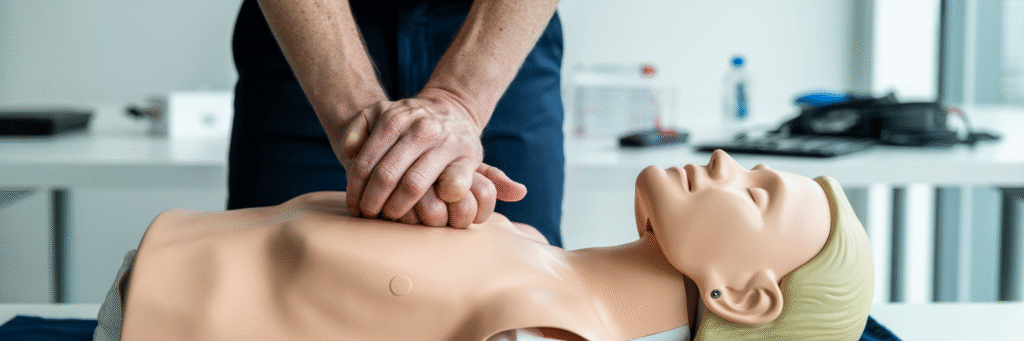
Your first aid certificate expired two years ago. You remember nothing from that training – maybe something about compressions? Or was it breaths first? And if you’re being honest with yourself, if someone collapsed in front of you right now, you’d absolutely panic.
Here’s the thing though – you’re not alone in feeling this way.
St John Ambulance Australia reckons bystanders provide initial care in 70% of emergencies. Sounds good, right? Except here’s the kicker – only 1 in 5 Australians actually feel confident responding to a medical crisis. That means four out of five people are standing there thinking “I have no idea what I’m doing” while someone needs help.
Whether you’re managing a retail team, training clients at a gym, or you just want to feel confident you could help your kids or elderly parents if something happened, mastering first aid skills isn’t about ticking some compliance box. It’s about genuinely knowing what to do when seconds count and someone’s life might depend on you not freezing up.
In this guide, we’re gonna break down the 10 critical first aid skills everyone should know. We’re talking real, practical stuff – performing CPR correctly, managing serious bleeding, treating burns, recognizing heart attacks and strokes. Not just the “what” but the “why” these skills matter.
Ready to become someone who can actually help in an emergency? Let’s get into it.
What First Aid Skills Should Everyone Know?
Everyone should know these 10 essential first aid skills to respond effectively in emergencies:
- CPR (Cardiopulmonary Resuscitation) – Chest compressions to maintain blood flow during cardiac arrest
- Choking Response – Abdominal thrusts for blocked airways
- Severe Bleeding Control – Direct pressure and wound management
- Burns Treatment – Proper cooling and coverage for thermal injuries
- Fracture Management – Immobilization and support for broken bones
- Shock Recognition – Identifying and responding to circulatory failure
- Heart Attack Response – Recognizing symptoms and providing immediate care
- Stroke Identification – Using FAST test to spot warning signs
- Anaphylaxis Management – Recognizing severe allergic reactions
- Recovery Position – Safely positioning unconscious casualties
These skills form the foundation of the nationally recognized HLTAID011 Provide First Aid course in Australia.
Why These 10 First Aid Skills Matter
Look, you might be thinking “I’ve gotten by fine without knowing this stuff.” And yeah, you probably have. But here’s what the statistics actually tell us.
According to the Australian Resuscitation Council, brain damage starts happening after just 4-6 minutes without oxygen. Queensland Ambulance Service is fantastic, but they can’t teleport to your location. When bystanders step in with proper first aid, survival rates improve by 40-70%. That’s massive. That’s the difference between someone making it or not making it.
And if you’re in any kind of management or business owner role? You’ve got legal obligations under Work Health and Safety regulations. Safe Work Australia requires businesses to have adequate first aid provisions – trained staff who actually know what they’re doing.
These 10 skills prepare you for the most common emergencies you’re actually likely to encounter. Real stuff that happens to real people every single day.
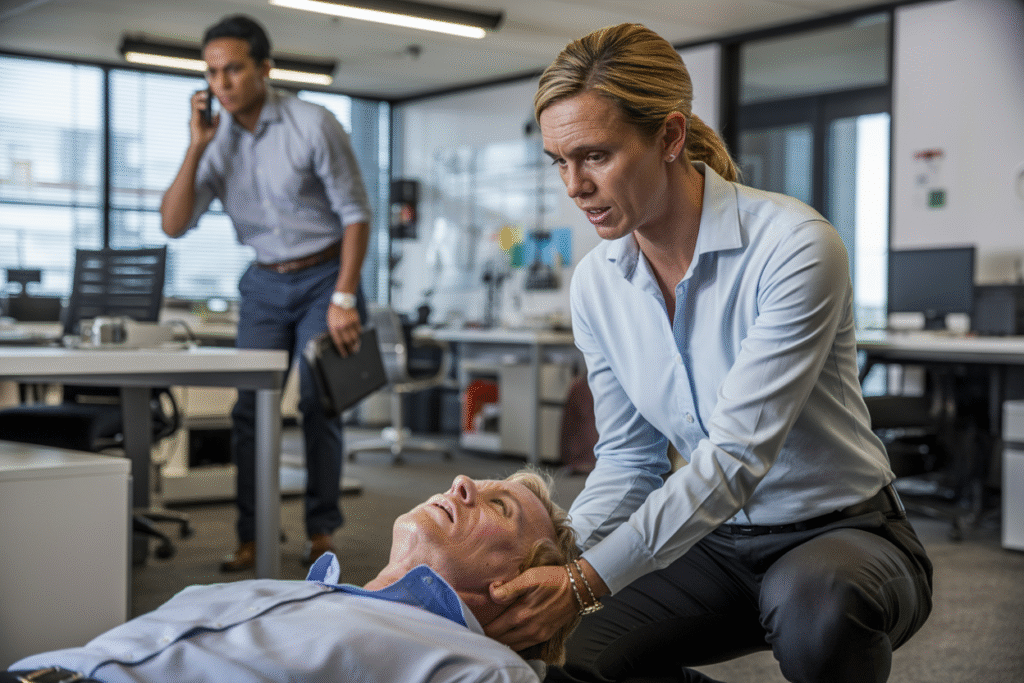
1. CPR (Cardiopulmonary Resuscitation) – The Most Critical Skill
CPR is hands-down the most important skill on this list.
When CPR is Needed
CPR becomes necessary when someone’s heart stops beating effectively or they stop breathing normally. This is cardiac arrest – different from a heart attack. Heart attack is a plumbing problem. Cardiac arrest is an electrical problem – the heart just stops working. Person collapses, becomes unconscious, stops breathing. That’s when you need CPR.
Here’s something that should get your attention: 80% of cardiac arrests happen at home or in the workplace.
CPR Steps for Adults (DRS ABCD Protocol)
D – Danger: Check the scene is safe.
R – Response: Tap their shoulders firmly and shout. “Can you hear me?” If no response – they’re unconscious.
S – Send for help: Call 000 immediately. Point at someone specific and say “You – call 000 now.”
A – Airway: Open their airway by tilting their head back and lifting their chin.
B – Breathing: Put your ear close to their mouth and watch their chest. Look, listen, and feel for normal breathing.
C – CPR: If they’re not breathing normally, start CPR:
- Kneel beside them at chest level
- Place the heel of one hand in the centre of their chest
- Put your other hand on top and interlock your fingers
- Keep your arms straight and use your body weight
- Push down hard and fast – 5 to 6 centimetres deep
- Compress at a rate of 100-120 per minute (think “Stayin’ Alive”)
- Do 30 compressions, then give 2 rescue breaths
- Keep going until help arrives
D – Defibrillator: If there’s an AED nearby, use it. Turn it on and follow the voice prompts.
The biggest mistake people make? Not pushing hard enough. You might break their ribs doing CPR, and that’s okay. That’s normal if you’re doing it right.
2. Choking Response – Clearing Blocked Airways
Choking happens way more often than you’d think. Restaurants, cafes, family barbecues, office morning teas.
Severe Choking Signs
Severe choking is when they can’t speak, cough, or breathe at all. They’re making the universal choking sign – both hands clutching their throat. Their face starts turning red, then purple. This person will die in minutes if you don’t act.
Back Blows and Abdominal Thrusts
Step 1: Five Back Blows
- Stand behind them and slightly to the side
- Support their chest with one hand and lean them forward
- Give five sharp blows between their shoulder blades
Step 2: Five Abdominal Thrusts
- Stand behind them and wrap your arms around their waist
- Make a fist and place it just above their belly button
- Grab your fist with your other hand
- Pull sharply inward and upward five times
Step 3: Alternate Keep alternating between five back blows and five abdominal thrusts until the object comes out, they start breathing, or they become unconscious (start CPR if this happens).
3. Severe Bleeding Control – When Every Second Counts
Someone’s cut themselves badly. Blood’s going everywhere. What do you do?
The Direct Pressure Technique
Direct pressure is your first, best, and most important response:
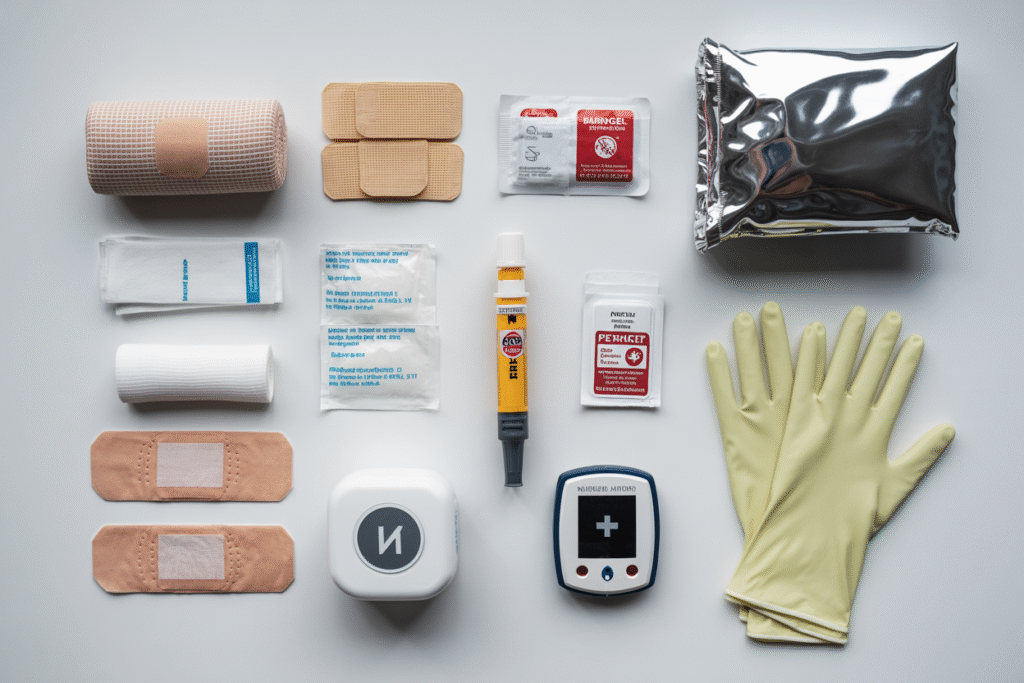
- Put on gloves if possible
- Apply direct pressure to the wound with a clean cloth, bandage, or even your hand
- Press HARD
- Keep the pressure on for at least 10 minutes without checking
- If blood soaks through, add more padding on top – don’t remove the first layer
What Not to Do
❌ Don’t remove embedded objects – pad around them
❌ Don’t keep lifting the bandage to check – you’re disrupting the clotting process
Direct pressure works in about 95% of cases.
4. Burns Treatment – Cooling and Covering Correctly
Burns are tricky because your instinct and what you should actually do are often complete opposites.
The 20-Minute Rule
Run cool (not cold) water over the burn for 20 minutes. Not 5 minutes. Twenty full minutes.
Why? Because burns continue damaging tissue even after the heat source is removed. That 20 minutes of cooling stops the burn from getting worse.
Remove jewelry, watches, tight clothing near the burn site WHILE you’re cooling it – swelling happens fast.
What to Apply
After cooling:
DO apply:
- Clean, non-stick dressing
- Plastic wrap
- Burn gel if you’ve got it
NEVER apply:
- Ice directly
- Butter, oil, or egg whites
- Cotton wool
Call 000 if the burn is larger than a 20-cent piece, on the face/hands/feet, or you’re unsure how serious it is.
5. Fracture Management – Immobilize and Support
Recognizing Fractures
You can’t always tell if something’s broken. Signs that suggest a fracture:
- Heard or felt a snap or crack
- Severe pain that doesn’t ease up
- Obvious deformity
- Can’t move the injured part
- Immediate swelling
If you’re not sure? Treat it like a fracture.
RICE Protocol
R – Rest: Stop. Don’t try to “walk it off.”
I – Ice: Apply ice wrapped in a cloth.
C – Compression: Gentle support to reduce swelling.
E – Elevation: Raise the injured part above heart level.
Immobilization
The goal: stop the injured part from moving.
For arms, use a sling. For legs, keep them lying down and pad around the injury. Don’t try to straighten bent limbs.
6. Shock Recognition – The Silent Killer
Medical shock happens when the body’s circulatory system starts failing. Not enough blood and oxygen getting to vital organs.
Signs of Shock
Early signs:
- Pale, cold, clammy skin
- Rapid, weak pulse
- Fast, shallow breathing
- Mild confusion
Advanced signs:
- Blue lips and fingernails
- Barely detectable pulse
- Unconsciousness
How to Treat Shock
- Call 000 immediately
- Lay them down flat with legs elevated
- Keep them warm
- Loosen tight clothing
- Don’t give them anything to eat or drink
- Monitor breathing and pulse constantly
7. Heart Attack Response – Recognizing and Acting Fast
Heart attacks don’t always look like what you see in movies.
Symptoms
Classic symptoms:
- Chest pain or discomfort (pressure, squeezing)
- Pain spreading to left arm, neck, jaw, or back
- Shortness of breath
- Sweating, nausea, dizziness
Atypical symptoms (especially in women):
- Unusual fatigue
- Indigestion feeling
- Upper back or shoulder pain
- Just feeling “off”
What to Do
- Call 000 immediately – don’t drive them to hospital
- Help them sit down comfortably
- Loosen tight clothing
- Give them aspirin if available (300mg chewed)
- Keep them calm
- Be ready to do CPR if they become unconscious
Don’t wait. Heart muscle starts dying without oxygen.
8. Stroke Identification – The FAST Test Saves Lives
Quick recognition matters because treatments within 4.5 hours can dissolve clots and minimize damage.
The FAST Test
F – Face: Ask them to smile. Does one side droop?
A – Arms: Ask them to raise both arms. Does one drift downward?
S – Speech: Ask them to repeat a simple sentence. Is it slurred?
T – Time: If you see ANY of these signs, call 000 immediately.
Don’t wait. Don’t “see if it gets better.” Call 000.
Time is critical – every minute counts.
9. Anaphylaxis Management – Severe Allergic Reactions
Anaphylaxis goes from “I feel weird” to “I might die” in about 15 minutes.
Recognizing Anaphylaxis
Anaphylaxis usually affects multiple body systems:
- Hives, redness, or swelling
- Difficulty breathing or wheezing
- Throat tightness
- Rapid, weak pulse
- Dizziness or fainting
- Nausea, vomiting
The danger sign: Allergic reaction AND trouble breathing or shock.
How to Use an EpiPen
- Remove from container
- Form a fist around it with orange end pointing down
- Remove the blue safety cap
- Push orange end firmly into outer thigh (can go through clothing)
- Hold for 3 seconds
- Remove and massage injection site
- Call 000 – even if they feel better, they need hospital assessment
Don’t worry about doing it wrong – better to use it than wait and watch someone die.
10. Recovery Position – Protecting Unconscious Casualties
The recovery position prevents unconscious people from choking on their own vomit or tongue.
When to Use It
Use when someone is:
- Unconscious but breathing normally
- Unresponsive but has a pulse
Don’t use it if:
- They’re not breathing (do CPR instead)
- You suspect spinal injury
The Technique
- Kneel beside them
- Straighten their legs
- Place the near arm straight out at a right angle, palm up
- Bring the far arm across their chest
- Bend the far knee up
- Roll them toward you by pulling on the bent knee
- Adjust the top leg so hip and knee are at right angles
- Tilt their head back slightly
- Monitor breathing constantly
How to Learn These Skills Properly
You’ve just read through 10 life-saving skills. You understand what CPR is, how to do the FAST test, when to use an EpiPen. But here’s the uncomfortable truth – reading about these skills doesn’t mean you can actually do them.
Why Hands-On Practice Changes Everything
There’s a massive difference between knowing what you should do and being able to do it under pressure when someone’s life depends on it.
Reading tells you: “Push down 5-6cm at 100-120 compressions per minute.”
Hands-on practice teaches you: What 5-6cm actually feels like. How hard you really need to push. What 100-120 per minute feels like. How exhausting it is. How to keep going when you’re tired.
You can’t learn muscle memory from an article. You need to actually do it – with real equipment, real scenarios, and someone experienced correcting your technique.
What Proper First Aid Training Involves
A proper first aid course (HLTAID011 Provide First Aid) isn’t sitting in a room watching PowerPoints.
Quality training includes:
Theory + Demo:
- Instructor explains each skill
- Demonstrates the technique
- Shows common mistakes
Practice + Assessment:
- You practice CPR on mannequins repeatedly
- You practice choking response
- You practice bandaging techniques
- You work through realistic scenarios
- Instructor corrects your technique
By the end:
- Your hands know what to do
- You’ve done CPR so many times you could do it without thinking
- You feel genuinely prepared
The Bottom Line
You’ve learned what the 10 essential first aid skills are. You understand why they matter. You know that reading about them isn’t enough – you need hands-on practice with proper equipment and qualified instruction.
CPR, choking response, bleeding control, burns treatment, fracture management, shock recognition, heart attack response, stroke identification, anaphylaxis management, and recovery position. These aren’t theoretical concepts. They’re practical skills that regular people use to save lives every single day.
The gap between knowing what to do and being able to do it gets bridged through proper training. HLTAID011 Provide First Aid gives you that training – hands-on practice, expert instruction, nationally recognized certification.
Your workplace probably requires it. Your family deserves for you to have it. You’ll sleep better knowing that if something happens, you’re not gonna freeze up – you’re gonna know exactly what to do.
Emergencies happen at shopping centres, gyms, offices, homes, parks. When they do, trained bystanders make the difference between tragedy and survival.
Be one of those trained bystanders.
Book your course. Show up ready to learn. Practice the skills properly. Get confident. Get certified. Be prepared.
Because the alternative – standing there helpless while someone needs help you could have learned to provide – that’s not something you want to live with.
Ready to learn these skills properly? Contact us about HLTAID011 Provide First Aid training.
Book Your First Aid Training Now
Fast, affordable, and nationally accredited training delivered by professionals who care
Frequently Asked Questions
Q.Do I really need formal training or can I just learn from YouTube?
You can learn the theory from YouTube and articles, but you can't learn the practical skills without hands-on practice with proper equipment and qualified supervision - it's like the difference between watching a surgery video and actually performing one. Lives depend on these skills being done correctly, and most employers require recognized certification (HLTAID011), not "I watched some videos online."
Q.How long is the HLTAID011 certificate valid?
HLTAID011 Provide First Aid certificate is valid for 3 years, but the CPR component needs annual renewal, so you'll need to do a CPR refresher each year to stay compliant with most workplace requirements.
Q.What if I fail the practical assessment?
Most students pass first time when training with quality providers because the assessment isn't designed to trick you - it's just checking you can demonstrate the skills safely, and if you do need more practice, good providers give you additional coaching at no extra cost until you're confident.
Q.Is CPR hard to do? I'm not very strong.
CPR is physically demanding but it's about technique more than strength - you use your body weight, not just arm strength, and people of all ages and fitness levels complete CPR training successfully. If you have physical limitations like wrist problems, knee issues, or back pain, just mention it at the start of the course and the instructor can show you modified techniques.
Q.Do I need to bring anything to the course?
Just yourself in comfortable clothing you can kneel and move around in - everything else is provided including training mannequins and equipment, student manual (usually digital), and practice supplies, though you should bring lunch or money for nearby cafes since most courses have a lunch break.
Q.What's the difference between HLTAID011 and HLTAID012?
HLTAID011 (Provide First Aid) is the standard first aid for most workplaces like retail, hospitality, fitness, and office workers, while HLTAID012 (First Aid in Education & Care) is specifically for childcare educators, teachers, and school staff and includes everything in HLTAID011 plus child-specific scenarios, asthma management, and anaphylaxis training - so if you work in childcare or education, you need HLTAID012, otherwise you need HLTAID011.
Making first aid training more affordable for
every classroom
We believe every student deserves access to life-saving first aid knowledge. That’s why we offer specially reduced pricing for schools and educational groups. Whether you’re booking for a single class, a year group, or your entire school, our flexible packages make training more accessible and cost-effective — without compromising quality.
