
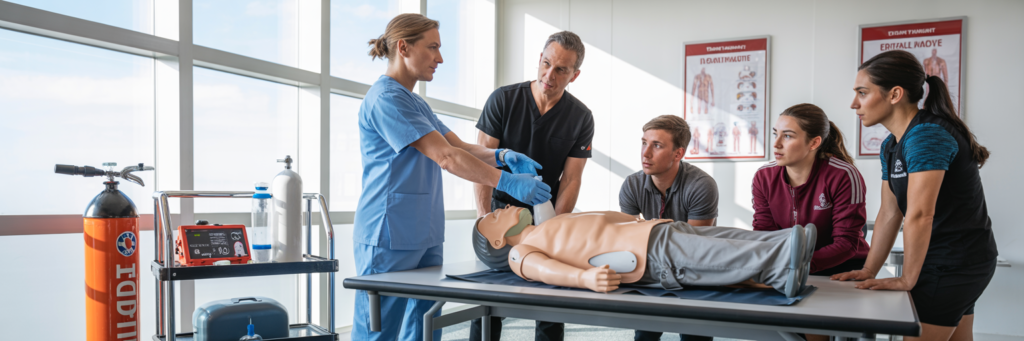
Applying for Queensland Ambulance Service paramedic training? Working in healthcare and need advanced emergency skills? Searching for a first aid course in Brisbane that goes beyond basic CPR?
Basic emergency life support (HLTAID010) is the certification that bridges the gap between basic first aid and professional emergency care. While most Brisbane residents hold standard first aid certificates, BELS teaches the advanced skills paramedic students learn in Week 1 of their graduate programs—oxygen therapy, advanced airway management, suction, and bag-valve-mask ventilation.
If you’ve been researching “basic emergency life support Brisbane” or comparing BELS to standard first aid courses, you’re likely serious about emergency care preparation. Whether you’re building a competitive QAS application, upskilling as a nurse or allied health professional, or working in fitness and need comprehensive emergency training, BELS certification demonstrates genuine commitment beyond minimum compliance.
This guide covers everything you need to know about basic emergency life support training in Brisbane: what BELS actually teaches, how it differs from HLTAID011 (Provide First Aid), and how to choose the right course provider for your career goals.
What is Basic Emergency Life Support (BELS)?
Basic emergency life support (BELS), officially coded as HLTAID010, is an advanced first aid certification that teaches emergency responders how to manage life-threatening situations using oxygen therapy, advanced airway equipment, and ventilation devices. BELS sits between standard first aid (HLTAID011) and advanced resuscitation training in Australia’s emergency care hierarchy.
BELS certification covers:
- Oxygen delivery systems (nasal cannula, Hudson masks, non-rebreather masks)
- Advanced airway management (oropharyngeal and nasopharyngeal airways)
- Suction equipment operation for airway clearance
- Bag-valve-mask (BVM) ventilation techniques
- Automated external defibrillation (AED)
- Integrated emergency scenario management
The course is nationally recognized, valid for three years, and teaches the same foundational skills covered in Week 1 of Queensland paramedic graduate programs.
If you’re preparing for paramedic training, BELS gives you hands-on experience with the exact equipment you’ll use on Day 1. If you’re a healthcare professional, BELS fills the gap between your CPR certification and the advanced skills you might need in emergency situations. And if you’re building a QAS application, BELS is one of the certifications that separates you from the 450+ other applicants who only have basic first aid.
What Makes BELS Different from Standard First Aid in Brisbane?
Most people doing their research get confused here, so let’s clear this up right away: BELS isn’t a replacement for your standard first aid certificate. It’s an upgrade.
If you hold HLTAID011 (Provide First Aid), you’ve got the baseline skills that workplaces require—CPR, AED use, basic wound management, fracture stabilization. That’s the foundation. BELS builds on that foundation by adding advanced emergency equipment and skills that go way beyond bandages and CPR.
Think of it like this: HLTAID011 teaches you what to do when you’re the first person on scene with nothing but your hands and whatever’s in a basic first aid kit. BELS teaches you what to do when you’ve got professional emergency equipment available—oxygen cylinders, airway adjuncts, ventilation devices—and you need to keep someone alive until paramedics arrive.
HLTAID011 vs HLTAID010 – The Critical Differences
| Feature | HLTAID011 (First Aid) | HLTAID010 (BELS) |
|---|---|---|
| Course Name | Provide First Aid | Basic Emergency Life Support |
| Validity | 3 years | 3 years |
| Core Skills | CPR, AED, bandaging, fracture management | All First Aid PLUS oxygen, airways, BVM, suction |
| Equipment Complexity | Basic (CPR mannequin, bandages) | Advanced (oxygen cylinders, BVM, airways) |
| Target Audience | General public, compliance | Aspiring paramedics, healthcare professionals |
| Career Value | Minimum workplace requirement | Competitive advantage, professional development |
| Interview Content | Generic (everyone has this) | Specific examples of advanced skills |
What You’ll Actually Learn That First Aid Doesn’t Cover
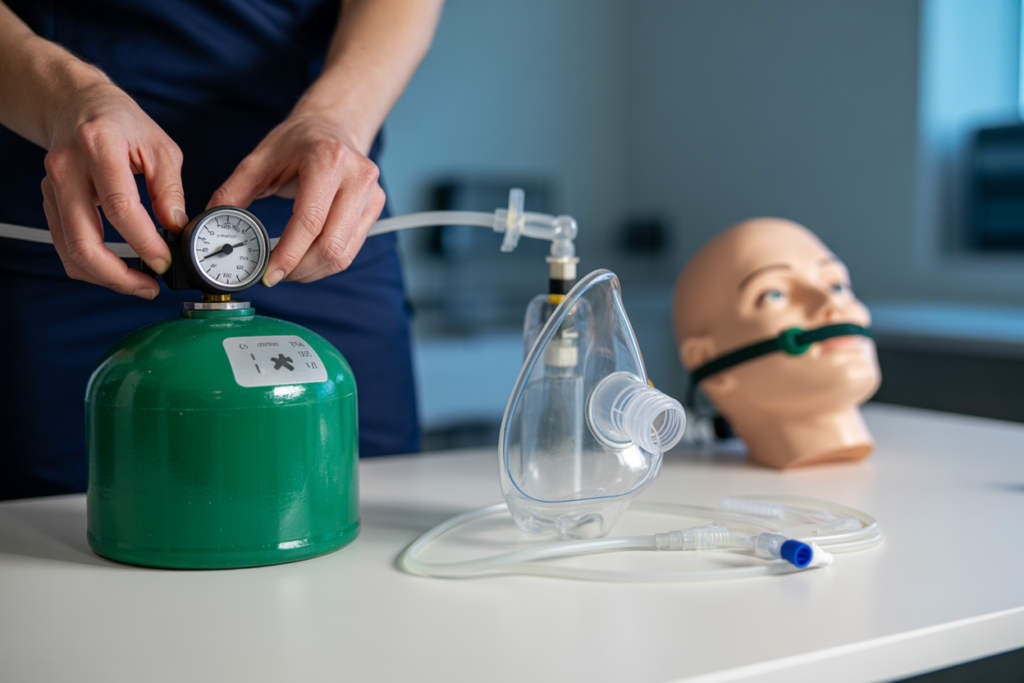
Oxygen therapy systems: You’ll learn how to set up and operate different oxygen delivery devices. Nasal cannulas for conscious patients who need supplemental oxygen. Hudson masks for moderate oxygen delivery. Non-rebreather masks for high-concentration oxygen in severe respiratory distress. You’ll practice calculating flow rates, checking cylinder pressure, and troubleshooting common problems.
Advanced airway management: When someone’s unconscious and their tongue is blocking their airway, basic first aid teaches you head-tilt-chin-lift. BELS teaches you how to insert oropharyngeal airways (OPAs) and nasopharyngeal airways (NPAs)—the same devices paramedics use to maintain open airways. You’ll practice sizing them correctly, inserting them properly, and knowing when each type is appropriate.
Suction equipment: Vomit, blood, and secretions can block airways fast. BELS teaches you how to use portable suction units to clear airways safely. You’ll learn proper suction catheter technique, pressure settings, and when suction is needed vs when it could cause harm.
Bag-valve-mask ventilation: This is probably the biggest skill difference. BVM is how you manually ventilate someone who isn’t breathing adequately. It’s harder than it looks—you need proper mask seal, correct ventilation rate, and the right tidal volume. BELS courses spend significant time on BVM technique because it’s something you can’t learn from a textbook.
Standard first aid courses might mention some of these skills exist, but they don’t give you hands-on practice with the actual equipment. BELS courses do.
Who Actually Needs Basic Emergency Life Support Certification?
BELS isn’t for everyone. Basic HLTAID011 is sufficient for most retail or office roles. But BELS makes a critical difference in specific high-stakes situations.
Aspiring Paramedics & Emergency Services
The Reality: Queensland Ambulance Service receives 450-500 applications per intake and accepts only 30-40 people (6-8% acceptance rate).
Why BELS Matters:
- Statistical edge: Only 20% of applicants have BELS versus 95% with basic first aid
- Interview advantage: Discuss oxygen delivery, BVM ventilation, and advanced airways—Week 1 graduate program content
- Confidence boost: Arrive prepared, not panicking through skills you’ve already practiced
BELS isn’t required for QAS applications, but when competing against 450+ candidates for 35 positions, controllable advantages matter.
Registered Nurses & Allied Health
The Gap: You’ve called a code and the MET team is 3-5 minutes away. Patient breathing deteriorates. Your options are limited without BVM experience.
BELS bridges standard nursing skills and advanced resuscitation. Most nursing graduates finish university having seen BVM once or twice in simulation—BELS gives you automatic competency. For allied health professionals, it demonstrates clinical capability beyond your scope when emergencies occur during treatment.
Fitness & Sports Professionals
Common Scenarios: Chest pain during intense workouts, severe asthma attacks, diabetic emergencies during early sessions.
Standard first aid covers calling 000 and CPR. BELS covers the critical minutes before paramedics arrive when breathing is compromised but cardiac arrest hasn’t occurred yet—oxygen administration, BVM support, suction management.
Essential for CrossFit boxes, functional fitness gyms, and bootcamps where high-intensity training increases emergency risk.
Workplace First Aid Officers
For designated officers in high-risk environments (construction, manufacturing, remote sites, large facilities), BELS proves serious commitment beyond minimum compliance. When someone needs airway management or oxygen therapy with only HLTAID011 training, you’re out of your depth. BELS provides confidence for complex situations.

What You’ll Actually Learn in a BELS Course
Let’s walk through the five main skill areas you’ll practice and why each skill matters in real emergency situations.
Oxygen Therapy Systems & Delivery Methods
You’ll start with oxygen equipment—standard D-size oxygen cylinders that paramedics carry. Your instructor will teach you how to check the pressure gauge, calculate remaining oxygen time, and understand flow rate settings.
Nasal cannulas – are small prongs that sit in the nostrils. You’ll learn when these are appropriate for conscious patients with mild respiratory distress, how to set the correct flow rate, and how to position them comfortably.
Hudson masks – are simple face masks that provide moderate oxygen concentrations. You’ll practice achieving proper mask fit—no gaps around the edges where room air can dilute the oxygen.
Non-rebreather masks – are for serious situations—masks with reservoir bags attached, delivering high oxygen concentrations. You’ll learn the critical step: always inflate the reservoir bag BEFORE placing the mask on the patient.
What surprises most people: flow rate isn’t random. Your instructor will teach you how to assess the patient’s condition and match the appropriate delivery device and flow rate to their needs.
Advanced Airway Management Techniques
Basic first aid teaches head-tilt-chin-lift for unconscious patients. BELS teaches you how to use oropharyngeal airways (OPAs) and nasopharyngeal airways (NPAs)—actual medical devices that keep airways open when positioning alone isn’t enough.
Oropharyngeal airways – are curved plastic tubes that sit in the mouth and hold the tongue forward. Your instructor will teach you sizing—measure from the corner of the patient’s mouth to the angle of their jaw. Wrong size causes problems: too small and it pushes the tongue back, too large and it triggers gagging.
You’ll practice insertion technique on mannequins. Insert upside down, rotate 180 degrees as you advance it. This technique prevents pushing the tongue backward during insertion.
Nasopharyngeal airways – are softer tubes that go through the nostril and sit behind the tongue. These are better for patients who aren’t deeply unconscious because they’re less likely to trigger gag reflex. You’ll practice lubing the device and inserting with a gentle rotating motion.
Suction Equipment & Airway Clearance
Your instructor will set up portable suction units and teach you proper technique. Yankauer suction tips are the rigid ones for clearing the mouth of blood, vomit, or thick secretions. You’ll practice the correct motion: sweep the tip around the inside of the mouth, don’t just jam it down the throat. Suction while withdrawing, not while inserting.
Flexible suction catheters are for deeper suctioning. Your instructor will teach you how to measure insertion depth, when to apply suction, and how to recognize when you’ve suctioned enough versus when you’re just causing irritation.
Bag-Valve-Mask (BVM) Ventilation
BVM is probably the most difficult skill you’ll learn in BELS. Managing BVM alone is hard. Achieving proper mask seal while squeezing the bag with adequate volume and correct rate requires practice.
Your instructor will teach you the C-E grip technique: thumb and index finger make a “C” around the top of the mask, applying downward pressure. The other three fingers make an “E” along the jawline, lifting the jaw up into the mask.
Sounds simple. In practice, everyone struggles at first. You’ll practice on mannequins with chest rise indicators so you can see whether your ventilations are effective. No chest rise means either your seal is inadequate or you’re not squeezing the bag with enough volume.
You’ll also practice two-person BVM technique, which is significantly easier and more effective. One person maintains mask seal with both hands, the other person squeezes the bag. In real emergencies, always use two-person technique if you have another trained responder available.
Integrated Emergency Scenario Training
The final component involves putting all these skills together in realistic scenarios. Your instructor will create situations where you need to assess the patient, choose appropriate interventions, and manage the emergency from start to finish.
You might face a conscious patient with severe difficulty breathing who needs oxygen therapy. Or an unconscious patient with noisy breathing who needs an airway adjunct and BVM ventilation. Or a multiple casualty scenario where you need to quickly triage and determine who needs immediate intervention.
These scenarios teach decision-making under pressure. It’s not enough to know how to use a BVM—you need to recognize when BVM is required versus when simpler interventions suffice.
The scenarios also build confidence. First time through, everyone feels overwhelmed. By the third or fourth scenario, you’re making decisions faster and your hands know what to do without conscious thought. That’s the goal—automatic response so that in a real emergency, you can act instead of freezing.
Ready to Book Your BELS Course? Here’s What to Do Next
You’ve learned what BELS teaches, how it differs from standard first aid, and what to expect during the course. Now comes the actual decision: book the course or keep researching?
If You’re Preparing for QAS Paramedic Applications
Your timeline matters. QAS recruitment opens twice yearly. Application windows are short. By the time recruitment opens, you need all your certifications already completed.
If recruitment is 4-6 months away, book BELS now. This gives you the certification with recent completion date (looks good on applications), enough time to practice and remember the skills for interviews, and buffer time if courses get cancelled.
If recruitment is 2-3 months away, book BELS immediately. Weekend courses fill fast during pre-recruitment periods. You’re competing with 450+ other applicants who are also scrambling to complete certifications before deadlines.
Don’t wait until the last minute. Brisbane BELS courses book out weeks in advance during peak periods.

The Reality Check
Understand this clearly: BELS certification doesn’t guarantee QAS acceptance. You can complete BELS with perfect technique, hold every recommended certification, and still receive a rejection email because 450+ people applied for 35 positions.
BELS is one piece of a competitive application. It’s not the deciding factor. It’s a supporting element that signals commitment, demonstrates preparation, and provides specific content for interview discussions.
But here’s what BELS does do: it moves you from the general applicant pool (everyone with basic first aid) into a smaller subset (applicants with advanced emergency training). It gives you genuine skills that reduce Week 1 paramedic training anxiety. It provides interview content beyond generic first aid responses.
Skills Matter More Than Certificates
The real value of BELS isn’t the piece of paper proving you completed the course. It’s the actual skills you develop—confidence managing airways, competence operating oxygen equipment, capability performing BVM ventilation when someone’s breathing is failing.
Those skills matter in real emergencies. The certificate gets you through application screenings and satisfies compliance requirements. The skills might save someone’s life when you’re first on scene at an accident, when a colleague collapses at work, or when a family member has a medical emergency.
Take the course seriously. Practice the skills properly. Ask questions when you’re unsure. Request additional coaching if you’re struggling. Use the training to genuinely build competency, not just tick a box for your application checklist.
Because eventually you might find yourself in a real emergency situation where someone needs oxygen, or airway management, or BVM ventilation, and your BELS training is the difference between effective response and panicked freezing.
That’s what basic emergency life support is actually about.
Book Your First Aid Training Now
Fast, affordable, and nationally accredited training delivered by professionals who care
Frequently Asked Questions About BELS in Brisbane
Q.How long does BELS certification last?
BELS certification is valid for three years from your course completion date. However, there's an important detail most people miss: the CPR component of BELS expires after 12 months, while your advanced skills (oxygen, airways, BVM, suction) remain valid for the full three years. This means if your employer requires current CPR certification, you'll need annual CPR refresher courses (HLTAID009) to keep that component current, even though your BELS qualification itself hasn't expired. For QAS applications, recent training looks better than certification that's technically valid but getting close to expiry—interview panels notice when your BELS is two years old versus three months old.
Q.Do I need Provide First Aid before doing BELS?
Technically no—BELS doesn't list Provide First Aid as a mandatory prerequisite. You can book straight into BELS without holding current first aid certification. However, whether you should depends on your background. If you've got healthcare experience (nursing, allied health, medical background), you can jump straight into BELS without issues because you already know DRSABCD protocols, CPR, and basic patient assessment. If you've got no first aid background at all, going straight to BELS is challenging but not impossible—it's like skipping beginner swimming and starting with intermediate. Most BELS instructors assume students understand basic first aid concepts and focus on the advanced skills that distinguish BELS from standard first aid.
Q.Is BELS recognized nationally or just in Queensland?
BELS (HLTAID010) is a nationally recognized unit of competency within the Australian Qualifications Framework, which means your certification is valid across all Australian states and territories, not just Queensland. A BELS certificate issued in Brisbane is recognized in Melbourne, Sydney, Perth, anywhere in Australia. This matters if you're considering paramedic applications in other states or if you're relocating for work. However, individual employers set their own training requirements—just because BELS is nationally recognized doesn't mean every employer in every state requires or values it. For QAS specifically, BELS from any Australian RTO (Registered Training Organization) is recognized regardless of where you got certified.
Q.Does BELS cover CPR certification?
Yes, BELS includes HLTAID009 (Provide CPR) as a component. When you complete BELS, you're certified in both BELS and CPR—your certificate will show HLTAID010, and that automatically encompasses CPR competency. However, remember the validity difference we mentioned earlier: CPR expires after 12 months while BELS expires after three years. Your BELS certificate satisfies CPR requirements for the first year, but after that you need annual CPR refreshers to maintain current CPR certification alongside your still-valid BELS. For workplace compliance, your employer might require "current CPR certification" which means updated within the last 12 months, so you'd need those annual refreshers even though your BELS hasn't expired.
Q.Can I refresh my BELS before it expires?
Yes, you can refresh BELS certification at any time by taking another complete HLTAID010 course. This resets your certification date and gives you another three years validity. Most providers charge full price for recertification because it's the same training delivery—same instructor time, same equipment, same venue. Some providers offer slight discounts for returning students, but don't expect half price just because you've been certified previously. Between BELS recertifications, you'll need annual CPR updates if your workplace requires current CPR—these are shorter courses that cost less and keep your CPR current while your BELS remains valid. If you did BELS 2.5 years ago and you're applying for QAS recruitment soon, consider doing full BELS recertification instead of waiting until expiry—recent training looks better on applications.
Making first aid training more affordable for
every classroom
We believe every student deserves access to life-saving first aid knowledge. That’s why we offer specially reduced pricing for schools and educational groups. Whether you’re booking for a single class, a year group, or your entire school, our flexible packages make training more accessible and cost-effective — without compromising quality.
