

It’s 2:30 AM at a remote mine site, 280 kilometers from the nearest hospital. A worker is trapped under machinery with severe crush injuries and massive bleeding. The Royal Flying Doctor Service is 90 minutes away. As the site’s first aid officer, every decision you make in the next five minutes could mean the difference between life and death. Do you know the advanced first aid safety procedures that could save his life?
For remote site supervisors, FIFO workers, and first aid officers, basic CPR and bandaging skills simply aren’t enough. When you’re managing extended care emergencies with no backup, you need to master advanced first aid safety procedures that go far beyond entry-level certification. This guide covers 10 life-saving techniques every remote worker must know—from controlling severe hemorrhaging to managing airways in trauma situations. Whether you’re preparing for your HLTAID014 certification or need a refresher on protocols that actually work when you’re hours from help, you’ll discover the exact procedures that could save a coworker’s life when seconds count and there’s no one else coming.
What Are Advanced First Aid Safety Procedures?
Advanced first aid safety procedures are life-saving techniques that go beyond basic first aid certification to manage severe trauma, extended care scenarios, and complex medical emergencies. These procedures are what you need when professional medical help is delayed or unavailable, particularly in remote worksites, mining operations, and construction sites where you might be the only person standing between a casualty and a bad outcome.
Key advanced first aid safety procedures include:
- Severe hemorrhage control using tourniquets and hemostatic dressings
- Advanced airway management for unconscious or trauma patients
- Shock recognition and treatment for life-threatening emergencies
- Extended casualty care when evacuation is delayed 60+ minutes
- Multi-casualty triage for managing multiple injured persons
- Spinal injury management with manual stabilization techniques
- Chest injury protocols including tension pneumothorax recognition
- Burns management for chemical, thermal, and electrical injuries
- Medical emergency response for cardiac events and allergic reactions
- Communication protocols for coordinating with emergency services
These procedures are taught in HLTAID014 (Provide Advanced First Aid) certification courses and are specifically designed for workplace first aid officers, remote site supervisors, and professionals responsible for emergency response in isolated locations.
⚠️ CRITICAL REMINDER: You have 3-5 minutes to control severe bleeding before blood loss becomes life-threatening. Don't hesitate—escalate your response immediately if basic pressure isn't working.
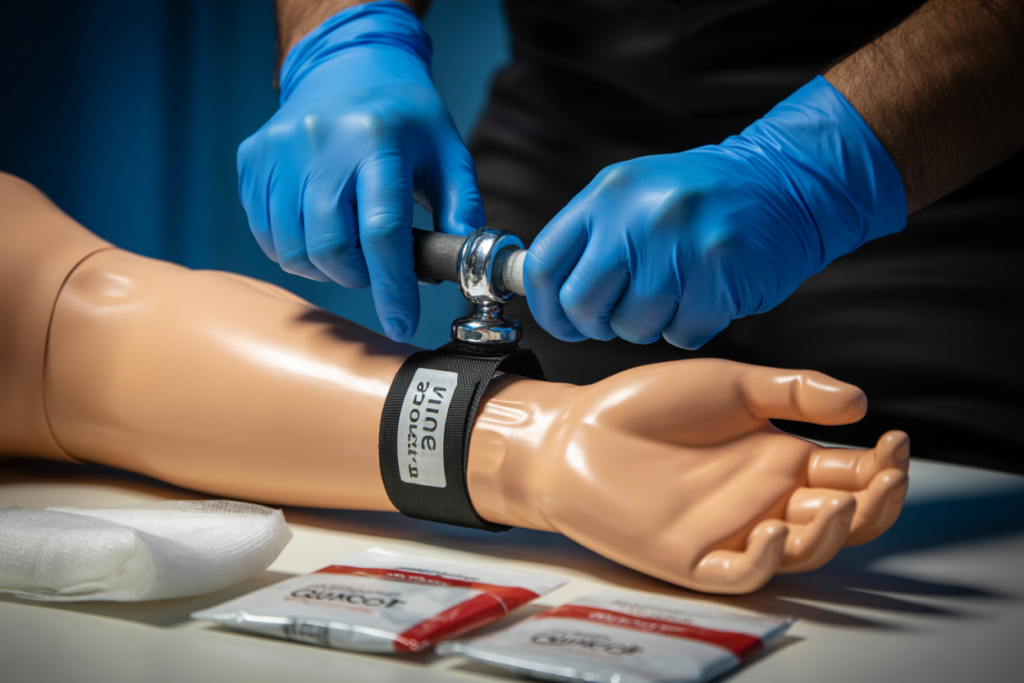
1. Severe Hemorrhage Control Techniques
Uncontrolled bleeding is the number one preventable cause of trauma death. When someone’s losing more than 500ml of blood, or when you’re seeing blood pooling on the ground or arterial spurting, that’s severe hemorrhage. You’ve got maybe 3-5 minutes to get it under control before things go sideways fast.
Direct pressure is still your first line of defense. Place your gloved hands directly on the wound and apply firm continuous pressure for a minimum of 10 minutes. The biggest mistake people make is lifting their hands to check if the bleeding stopped. Don’t do this. Every time you lift pressure, you’re disrupting clot formation and you’re back to square one.
When direct pressure alone isn’t controlling the bleeding, escalate to hemostatic dressings. Products like QuikClot and Celox are impregnated with clotting agents that accelerate coagulation. For deep wounds, pack the wound cavity with hemostatic gauze, working from the deepest part outward, then apply pressure over the top.
Tourniquet application is needed when you’re dealing with complete or partial limb amputation, crush injuries, or any scenario where direct pressure isn’t controlling hemorrhage. Here’s the step-by-step:
- Expose the wound completely by cutting away clothing
- Place the tourniquet high and tight, 5-7 centimeters above the wound
- Tighten until bleeding stops completely
- Lock the windlass and secure it
- Mark the time directly on the tourniquet in HH:MM format
- Do NOT remove the tourniquet once applied
- Monitor the casualty for shock
Studies show commercial tourniquets are 87% more effective than improvised ones. If you’re responsible for first aid in remote locations, your kit needs to include actual purpose-built tourniquets, not improvised options.
2. Advanced Airway Management
An obstructed airway will kill someone faster than almost any other emergency you’ll face. Brain damage starts at 4-6 minutes without oxygen. Partial obstruction shows noisy breathing—stridor, wheezing, gurgling. Complete obstruction is silent and deadly—no sounds, no cough, no air movement, rapid deterioration to unconsciousness.
For casualties without suspected spinal injuries, use the head-tilt chin-lift. But when you’re dealing with trauma, you have to assume spinal injury until proven otherwise. The jaw-thrust maneuver maintains spinal alignment while opening the airway. Kneel at the casualty’s head, place your hands on either side stabilizing it, place your fingers behind the angles of the jaw, and lift the jaw forward without tilting the head back.
Blood, vomit, and secretions in the airway require mechanical suction. Measure your suction catheter from the corner of the mouth to the earlobe—that’s your maximum insertion depth. Insert without suction, then apply suction as you withdraw. Each pass should take no more than 10 seconds.
Oropharyngeal airways work in completely unconscious casualties with no gag reflex. Size matters—measure from the corner of the mouth to the earlobe. For adults, insert the OPA upside down, advance until you feel resistance, then rotate it 180 degrees. Once in place, you still need to maintain head position and monitor continuously.
3. Shock Recognition and Management
Medical shock is circulatory failure where your cardiovascular system can’t deliver enough oxygen-rich blood to vital organs. This progression can happen in 30-60 minutes if shock isn’t recognized and managed.
Early shock signs include pale, cool, clammy skin, rapid weak pulse, rapid breathing, anxiety and restlessness, thirst, nausea. Check capillary refill time—press on a fingernail until it blanches white, release, and count how long until pink color returns. Normal is less than 2 seconds. In shock, capillary refill slows to 3-4 seconds or longer.
Take a radial pulse at the wrist. In early shock it’s present but rapid (over 100 beats per minute) and feels thready. As shock progresses, the radial pulse disappears. Mental status changes are huge indicators—someone who was alert suddenly becomes confused or agitated.
The shock position is simple: lay the casualty flat and elevate their legs about 30 centimeters. This redirects blood from the lower extremities back toward vital organs. But there are situations where you can’t use standard shock position—suspected spinal injuries, chest injuries, or if they’re unconscious and vomiting.
Hypothermia accelerates shock dramatically. Remove wet clothing immediately, insulate them from the ground, cover them with emergency blankets. The head loses a disproportionate amount of heat, so covering the casualty’s head matters.
4. Extended Casualty Care Protocols
When medical response is 60-90 minutes or longer, you’re preventing deterioration, managing complications, and maintaining vital functions. Set a timer for 5-minute intervals and run through quick assessments: consciousness level, airway patency, breathing quality, circulation signs, bleeding control status, shock indicators, pain level. Document findings to spot trends.
Pain management without medications requires positioning and psychological support. For fractures, gentle stabilization in the position of comfort helps. Talk to the casualty, explain what’s happening, give them something to focus on besides pain. Preserve their dignity by covering them with blankets and explaining procedures before performing them.
5. Multi-Casualty Triage Principles
When you’re facing multiple casualties simultaneously, you need to make decisions about who gets treated first. Without triage training, most people gravitate toward whoever’s making the most noise, and that instinct can lead to preventable deaths.
START (Simple Triage And Rapid Treatment) uses four categories: Red (Immediate), Yellow (Delayed), Green (Walking Wounded), and Black (Deceased/Expectant). The START assessment is rapid: Can they walk? Green. Are they breathing? If no, open airway—if they start breathing, tag Red. If they don’t, tag Black. If breathing, check respiratory rate—over 30 per minute is Red. Check circulation—radial pulse absent or capillary refill over 2 seconds is Red. Check mental status—can’t follow simple commands is Red. Everyone else is Yellow.
Move quickly through the scene asking “Can anyone who can walk, walk over here?” That identifies all your Green casualties immediately. For everyone who can’t walk, spend 30-60 seconds doing your START assessment. Don’t stop to treat during initial triage except for opening an airway or applying a tourniquet for life-threatening limb hemorrhage.
Once you’ve triaged everyone, treat all Reds first, focusing on the most immediately life-threatening issues. Then reassess and move to Yellows. The utilitarian approach: greatest good for the greatest number.
🛡️ PROTECTION PRINCIPLE: If the mechanism could possibly have caused spinal damage, assume spinal injury. The mechanism matters more than the casualty's current symptoms. Adrenaline and shock mask pain.
6. Spinal Injury Assessment and Management
If the mechanism of injury could possibly have caused spinal damage, assume spinal injury until proven otherwise. High-energy trauma means spinal precautions—vehicle accidents, falls from heights, direct blows to the head or torso, diving injuries, being struck by equipment.
Manual in-line stabilization is your primary tool. Approach from above the casualty’s head, place your hands on either side with fingers spread, support the head firmly, align it with the spine in neutral position, and maintain this continuously. Your hands will tire, but you can’t let go.
Log-rolling requires minimum three people. One person maintains head control and calls the count, others position along the body. On the count, everyone rolls the casualty as one unit—no twisting, no bending. Proper spinal immobilization uses a long spine board with head blocks and straps. Strap the torso first, then head, then legs.
7. Chest Injury Recognition and Response
Chest injuries directly affect breathing and circulation. Life-threatening chest injuries include tension pneumothorax, massive hemothorax, flail chest, and open pneumothorax. General signs include severe difficulty breathing, rapid shallow breathing over 30 breaths per minute, asymmetric chest movement, cyanosis, distended neck veins, and tracheal deviation.
Tension pneumothorax happens when air leaks into the space between the lung and chest wall with a one-way valve effect. The pressure builds, the lung collapses, and pressure pushes on the heart. Early signs include severe shortness of breath, chest pain, rapid breathing, anxiety. Late signs include severe respiratory distress, cyanosis, distended neck veins, tracheal deviation. Your role is recognition, positioning the casualty upright, giving oxygen if available, and getting them to definitive care immediately.
Flail chest shows paradoxical movement—when the casualty breathes in, that segment moves inward instead of outward. Position them semi-upright or leaning toward the injured side, encourage slow deep breaths despite pain, and consider light stabilization with a pillow.
Open chest wounds need immediate sealing. Use an occlusive dressing applied over the wound. Tape three sides only, leaving one side open—this creates a flutter valve effect where air can escape but can’t enter. Position the casualty sitting up or leaning toward the injured side.
8. Burns Assessment and Management
Burns are classified by depth: superficial (red, painful, dry), partial-thickness (blistering, intense pain), full-thickness (white, brown, or charred), and fourth-degree (extension into muscle or bone).
The Rule of Nines: head and neck 9%, each arm 9%, chest 9%, abdomen 9%, upper back 9%, lower back 9%, each leg 18%, groin 1%. Burns over 15-20% total body surface area cause systemic effects.
For thermal burns, stop the burning process, then cool with running water for 20 minutes. After cooling, cover loosely with clean non-stick dressings. Remove jewelry immediately before swelling starts.
Chemical burns require massive irrigation—15-30 minutes minimum. For dry chemicals, brush off as much as possible before adding water. Remove contaminated clothing. Chemical burns to eyes require 15-20 minutes of irrigation with eyelids held open.
Electrical burns hide internal damage. Scene safety is non-negotiable before touching an electrical casualty. Look for entry and exit wounds. All electrical casualties need cardiac monitoring.
9. Medical Emergency Protocols (Cardiac and Allergic)
Cardiac arrest recognition is straightforward: the casualty is unresponsive and not breathing normally. Your response follows DRSABCD. CPR technique means 30 chest compressions followed by 2 rescue breaths, continuous cycles. Compressions are hard and fast—push down 5-6 cm at 100-120 compressions per minute.
AEDs are designed for lay rescuers. Turn it on, expose the casualty’s bare chest, apply pads as shown in the diagram, ensure nobody is touching during analysis, press shock button if advised, then immediately resume CPR. Continue this cycle until help arrives.
Anaphylaxis is severe allergic reaction that can kill in 15-30 minutes. Early signs include hives, swelling of lips/tongue/throat, abdominal pain. Severe signs include difficulty breathing, wheezing, rapid weak pulse, dizziness or collapse. If someone has an EpiPen and they’re having anaphylactic reaction, use it immediately. Inject into outer mid-thigh, hold for 3 seconds, note the time. Call emergency services even if symptoms improve.
For asthma attacks, help the casualty sit upright and use their reliever inhaler—4 puffs initially, one at a time with 4 breaths between each. Wait 4 minutes. If no improvement, give another 4 puffs. If still no improvement, call emergency services.
Hypoglycemia (low blood sugar) shows as pale sweaty skin, shaking, confusion, weakness. If conscious, give fast-acting sugar immediately—glucose tablets, half a can of regular soft drink, honey. Wait 15 minutes and reassess. Once symptoms improve, give complex carbohydrates.
10. Emergency Communication and Coordination
When calling Triple Zero, provide specific information in the first 60 seconds: “Ambulance required at [specific location with GPS coordinates], we have [number and severity of casualties], this is [your name], I’m calling from [phone number].”
Give detailed location information, access requirements, casualty specifics, and ongoing hazards. Stay on the line until dispatch says you can hang up. Update emergency services if the situation changes.
For radio communication in remote sites, use emergency protocols: “Emergency, emergency, emergency—medical emergency at [location].” Give your location, nature of emergency, number of casualties and severity, immediate actions needed, and your callback contact.
Use the MIST format for handover to paramedics: Mechanism of injury, Injuries found, Signs and vital signs, Treatment given. Provide your documentation of times, actions, and vital signs trends.
Document everything while it’s fresh—times, actions, observations, who was present. Use objective language describing what you saw, heard, and measured. Include negative findings. Times are critical for legal and medical purposes. Your documentation protects you legally and helps investigators understand what happened.
How HLTAID014 Training Prepares You
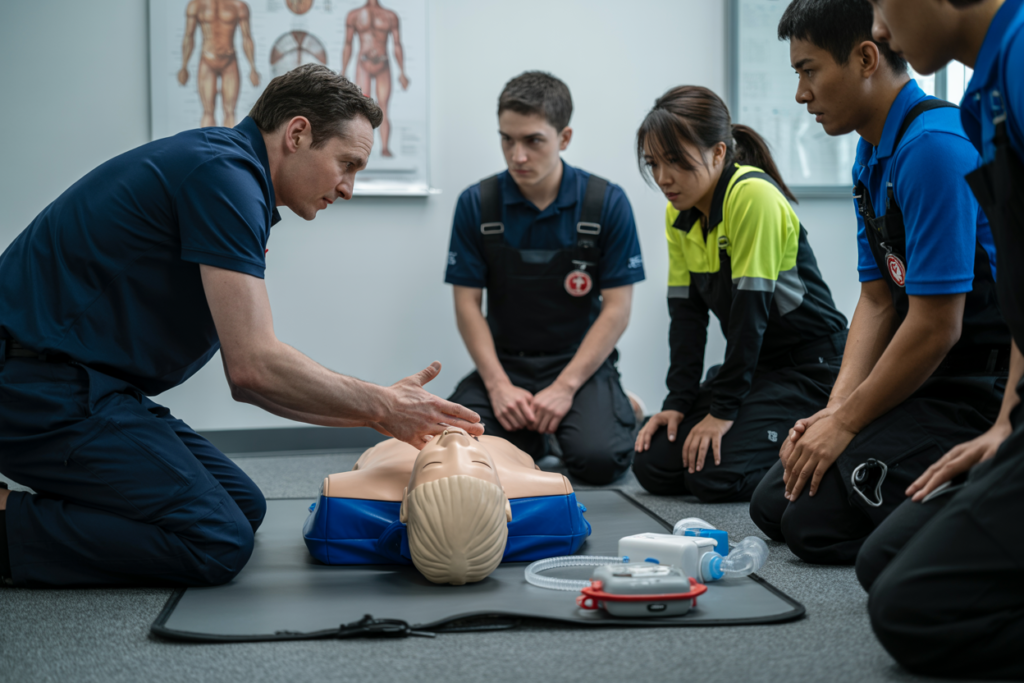
HLTAID014 (Provide Advanced First Aid) prepares you for complex scenarios, extended care, and the leadership role of workplace first aid officer. Core competencies include advanced resuscitation with oxygen therapy, management of multiple injuries, advanced bleeding control including tourniquets, spinal injury management, shock management for extended care, triage principles, and complex medical emergencies.
The most valuable component is extensive scenario practice. You’ll practice severe hemorrhage with simulated arterial bleeding, unconscious casualties with airway compromise, multi-casualty accidents requiring triage, cardiac arrest with prolonged CPR and AED use, anaphylaxis requiring EpiPen administration, and spinal injury with log-roll and immobilization.
Look for instructors with backgrounds in paramedicine, emergency nursing, military medicine, or remote area first response. Experienced instructors teach from real examples and answer questions with actual incident experience.
Skills decay without practice. Regular refreshers include monthly first aid kit checks, quarterly scenario drills, reviewing your course manual, and attending refresher workshops. For critical skills like CPR, practice regularly. Tourniquet application should be practiced quarterly if you work in environments with severe bleeding risks.
Your Next Step: From Knowledge to Confidence
Reading about advanced first aid safety procedures is one thing. Being able to perform them confidently when someone’s life depends on you is something completely different.
The reality is this: if you’re working remote sites, managing crews, or responsible for workplace safety, basic first aid isn’t enough anymore. You need the skills covered in this guide—hemorrhage control, airway management, shock treatment, extended care protocols—and you need them practiced until they’re automatic.
HLTAID014 certification gives you those skills through hands-on training with experienced instructors who’ve actually worked these emergencies. You’ll practice tourniquet application until you can do it in your sleep. You’ll manage realistic trauma scenarios so you understand what extended care actually requires. You’ll work through multi-casualty situations and make triage decisions under pressure.
When that 2:30 AM emergency happens—and in remote work environments, it’s not “if” but “when”—you’ll respond with confidence instead of hesitation. You’ll know exactly what to do right away, you’ll have practiced the techniques dozens of times, and you’ll have the competence that keeps someone alive until definitive help arrives.
Don’t wait until you’re facing an emergency situation to wish you’d gotten proper training. The life you save with these advanced first aid safety procedures might be a coworker, a mate, or someone’s family member counting on you to know what to do when it matters most.
Book Your First Aid Training Now
Fast, affordable, and nationally accredited training delivered by professionals who care
Frequently Asked Questions
Q.What's the difference between basic first aid and advanced first aid?
Basic first aid (HLTAID011) covers immediate response assuming help arrives within 10-15 minutes. Advanced first aid (HLTAID014) prepares for complex trauma, extended care lasting 60-90+ minutes, multi-casualty situations, and advanced equipment use for workplace first aid officers and remote supervisors.
Q.How long does HLTAID014 certification last?
HLTAID014 is valid three years, but CPR requires annual renewal. Skills decay faster than three years, so refresher sessions every 6-12 months are recommended.
Q.Can I use a tourniquet if I'm not a paramedic?
Yes. Tourniquets are within advanced first aid scope. HLTAID014 includes comprehensive tourniquet training. Properly applied commercial tourniquets save lives, and early application by trained first aiders improves survival significantly.
Q.How do I know if my HLTAID014 course is legitimate?
Check the provider's RTO registration with ASQA. Verify course code is HLTAID014 and they provide nationally recognised certificates. Quality courses include substantial hands-on practice with instructors having real emergency response backgrounds.
Making first aid training more affordable for
every classroom
We believe every student deserves access to life-saving first aid knowledge. That’s why we offer specially reduced pricing for schools and educational groups. Whether you’re booking for a single class, a year group, or your entire school, our flexible packages make training more accessible and cost-effective — without compromising quality.
