
Imagine responding confidently to a serious medical emergency on your remote site—managing airways, controlling severe bleeding, and providing extended care until help arrives. That’s the difference advanced first aid certification makes.
If you’re a site supervisor, FIFO worker, outdoor professional, or anyone responsible for safety in remote or high-risk environments, advanced first aid certification isn’t just a compliance checkbox—it’s the difference between confidence and helplessness when seconds count.
This comprehensive guide covers everything you need to know about advanced first aid certification (HLTAID014): the difference between basic and advanced training, course requirements, what you’ll actually learn, how to choose the right provider, and how this certification can advance your career while giving you genuine life-saving capability.
Whether you’re meeting employer requirements, pursuing career advancement, or simply want the competence to protect your team, you’ll find the answers you need to make an informed decision.
What is Advanced First Aid Certification?
Advanced first aid certification (HLTAID014 Provide Advanced First Aid) is a nationally recognized qualification that trains individuals to manage complex medical emergencies and provide extended care until professional help arrives. Unlike basic first aid, which covers immediate response to common injuries, advanced certification prepares you for serious trauma, multi-casualty incidents, and situations where medical assistance may be delayed for hours.
Advanced first aid certification includes:
- Extended patient care – Managing casualties for 2+ hours in remote locations
- Advanced clinical skills – Oxygen therapy, advanced airway management, and trauma care
- Multi-casualty triage – Prioritizing treatment when multiple people are injured
- Complex medical emergencies – Heart attacks, strokes, severe allergic reactions, and shock management
- Leadership responsibilities – Coordinating emergency response and directing others
This certification is required for workplace first aid officers, remote site supervisors, outdoor recreation professionals, and anyone responsible for safety in high-risk or isolated environments where immediate medical help isn’t available.
Advanced First Aid vs Basic First Aid: Understanding the Difference
Here’s what confuses most people: they hear “advanced first aid” and assume it’s just a more intense version of the basic course. Not quite. Advanced first aid certification builds on basic skills, sure, but it’s designed for completely different scenarios—specifically, situations where you’re managing someone for hours, not minutes.
What Basic First Aid Covers (HLTAID011)
Basic first aid—officially called HLTAID011 Provide First Aid—is your standard course that most people are familiar with. You learn CPR, how to manage bleeding, treat burns, handle basic wounds, and recognize shock. It’s designed for everyday emergencies where an ambulance is coming quickly.
The course covers CPR and defibrillation, managing unconscious casualties, controlling bleeding and treating wounds, burns and scalds, fractures and sprains, anaphylaxis and asthma, and basic shock management.
Who’s it for? Office workers, retail staff, teachers, parents—basically anyone who wants basic emergency response capability in urban or suburban environments where professional medical help arrives quickly.
⚠️The limitation: Basic first aid assumes help is coming soon. You're taught to stabilize someone temporarily, then hand over to paramedics. If you're 200 kilometers from the nearest hospital? Basic first aid isn't enough.
What Advanced First Aid Adds (HLTAID014)
Advanced first aid certification takes everything from basic first aid and layers on the clinical skills and knowledge you need when you’re the only medical response for extended periods. We’re talking 2+ hours managing a casualty, sometimes longer.
On top of basic first aid skills, you’ll learn oxygen therapy, advanced airway management using oropharyngeal and nasopharyngeal airways, extended patient monitoring including tracking vital signs over hours, multi-casualty triage for deciding who gets treatment first when multiple people are injured, advanced trauma care for managing serious crush injuries and severe bleeding, complex medical conditions like recognizing and managing heart attacks and strokes, and leadership and coordination skills for directing others and managing the scene.
Who’s it for? FIFO workers, mine site supervisors, construction site managers, outdoor guides, remote farm managers, event coordinators, designated workplace first aid officers—anyone working in high-risk or isolated environments.
When You Need Advanced vs Basic Certification
You need advanced first aid certification if:
- You work more than 30 minutes from the nearest hospital or ambulance station
- Your employer designates you as the workplace first aid officer
- You’re responsible for a team in mining, construction, or remote operations
- You lead outdoor expeditions, adventure tours, or remote activities
- Your position description specifically requires HLTAID014
- You work FIFO and could be managing emergencies on remote sites
Basic first aid is probably sufficient if:
- You work in urban or suburban environments
- Emergency services can reach you within 20-30 minutes
- You’re not the designated first aid officer
- Your employer only requires HLTAID011
Here’s a practical test: If someone had a heart attack at your workplace right now, how long until paramedics arrived? If the answer is “90 minutes by helicopter,” you need advanced certification.
What You’ll Actually Learn in Advanced First Aid Training
This is where things get real. Let me tell you exactly what you’re walking out with after your advanced first aid training.
Advanced Clinical Skills You’ll Master
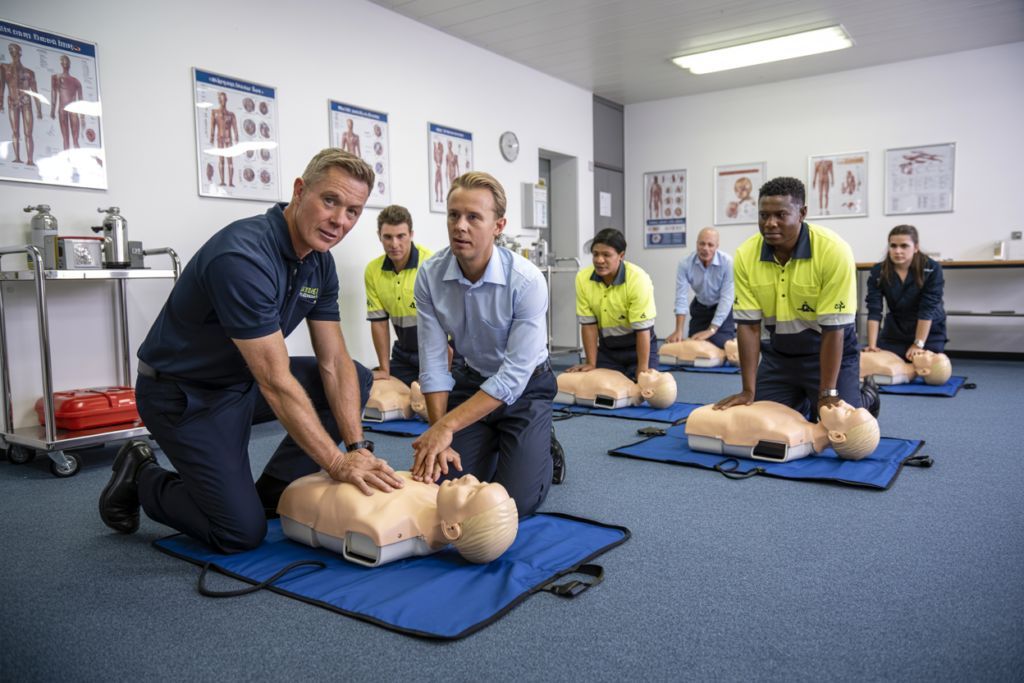
You’re going to be hands-on with equipment, practicing on manikins, running through scenarios until you can do this stuff without thinking.
Airway management beyond “tilt the head back” – You’ll learn to insert oropharyngeal airways (OPAs) and nasopharyngeal airways (NPAs). These are devices that keep someone’s airway open when they’re unconscious and standard head positioning isn’t working.
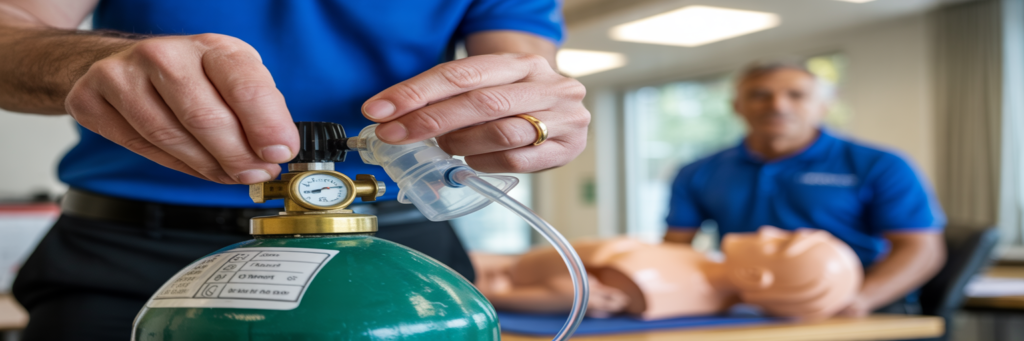
Setting up and running oxygen therapy – You’re going to handle actual oxygen cylinders, regulators, masks, and nasal cannulas. You’ll learn flow rates, how to check cylinder pressure, and how to assemble the system safely.
Advanced bleeding control techniques – This goes way beyond applying pressure with a bandage. You’ll learn tourniquet application, hemostatic dressings for severe bleeding, pressure points, and how to pack wounds properly.
Patient assessment systems – You’ll learn DRSABCD in depth, plus secondary surveys where you systematically check someone from head to toe looking for injuries they might not even know they have yet.
Vital signs monitoring – Heart rate, breathing rate, blood pressure, oxygen saturation, level of consciousness. You’ll practice taking these measurements repeatedly and learning what changes mean.
Managing Extended Care Situations
Here’s what makes advanced first aid different: you’re not just stabilizing someone for 15 minutes. You’re managing them for 2, 3, maybe 4 hours until help arrives.
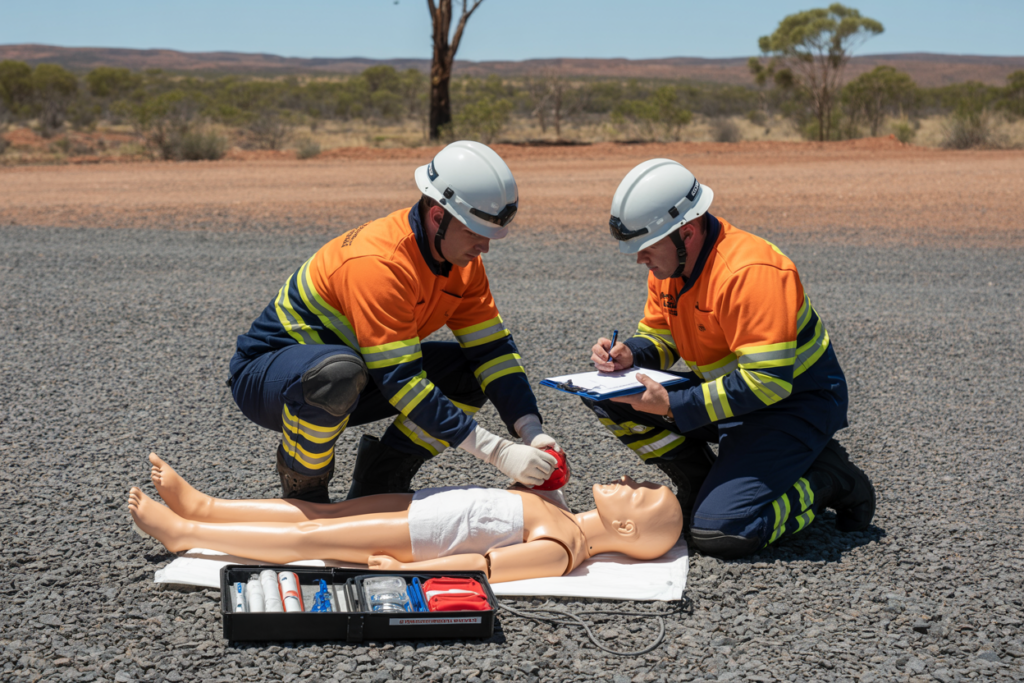
You’ll practice realistic remote scenarios like a worker falling from height with suspected spinal injury and broken leg while help is delayed, someone having a heart attack at a remote site while the Royal Flying Doctor Service is dispatched but delayed, and multi-vehicle incidents with three casualties with varying injuries.
Extended care includes positioning casualties for comfort and safety over hours, managing pain when you don’t have pain medication, keeping casualties warm or cool in extreme conditions, providing psychological first aid, knowing when to move someone vs. when to absolutely not move them, and documenting everything for handover to paramedics.
Multi-Casualty Incident Management
If you’re ever in a situation where multiple people are injured at once, you’ll be glad you practiced this.
You’ll learn the START triage system—how you quickly assess multiple casualties and decide who needs help immediately vs. who can wait. You’ll learn the categories: immediate (life-threatening but savable), delayed (serious injuries but stable), minor (walking wounded), and deceased.
The training teaches you to suppress the instinct to help the person screaming the loudest and focus on the quiet person who’s barely conscious and bleeding out.
Oxygen Therapy and Advanced Airway Management
This is hands-on equipment training. You’ll learn to check how much oxygen is left, calculate how long it’ll last at different flow rates, and practice setting different flow rates for different situations.
You’ll use nasal cannulas for low flow oxygen, simple face masks for moderate oxygen delivery, non-rebreather masks for high concentration oxygen, and bag-valve-mask devices for when someone’s stopped breathing and you need to breathe for them.
You’ll practice with oropharyngeal airways and nasopharyngeal airways, learning proper sizing, insertion techniques, and when NOT to use them.
Serious Trauma and Bleeding Control
You’re learning to manage injuries that can kill someone in minutes if you don’t know what you’re doing. You’ll practice direct pressure (a lot more than most people think), pressure dressings, tourniquets, hemostatic dressings, and wound packing for deep wounds with arterial bleeding.
Working in mining, construction, or heavy industry? You’ll learn how to manage crush injuries and traumatic amputations, what complications to watch for, and how to handle partial and complete amputations.
Cardiac Emergencies and Advanced CPR
You’ll learn standard CPR in this course, but advanced first aid takes it further. You’ll learn to recognize heart attack signs before they become cardiac arrest, differentiate between angina and heart attack, and practice extended CPR protocols for when you’re performing CPR for 30, 40, maybe 60 minutes because you’re in the middle of nowhere.
Medical Conditions: Stroke, Anaphylaxis, and Shock
You’ll practice FAST assessment for stroke recognition, learn about managing anaphylaxis including biphasic reactions and using multiple adrenaline auto-injectors if needed, and understand different types of shock including hypovolemic, cardiogenic, neurogenic, and anaphylactic shock.
Who Needs Advanced First Aid Certification (And Why)
Let me be straight with you: not everyone needs advanced first aid certification. But if you’re reading this article, chances are you already know you need more than basic.
Industries That Require Advanced Certification
Mining and Resources – Site supervisors, mine safety officers, FIFO crew leaders, underground mining personnel in supervisory roles. Mine sites are remote by definition. WorkCover audits specifically look for advanced first aid certification in remote operations.
Construction and Infrastructure – Site managers, safety officers, leading hands, designated first aid officers on large sites, workers on remote infrastructure projects. Large construction sites typically require multiple first aid officers, at least one with advanced certification.
Outdoor Recreation and Adventure Tourism – Bushwalking guides, rock climbing instructors, 4WD tour operators, kayaking guides, expedition leaders, outdoor education instructors. Insurance companies won’t cover you without it.
Remote Agriculture and Forestry – Station managers, farm supervisors, forestry workers, agricultural contractors. Remote properties can be 2+ hours from the nearest town with medical facilities.
Security and Events – Event security supervisors, venue safety managers, crowd control team leaders, festival coordinators. Large events require designated first aid officers, and many event permits specify advanced certification for supervisors.
Workplace First Aid Officers – Designated first aid officers in manufacturing facilities, safety coordinators in warehouses, HSE officers in industrial operations, mine site first aid officers. Workplace health and safety codes recommend advanced first aid certification for first aid officers in workplaces with more than 50 workers, high-risk industries, remote or isolated workplaces, and workplaces more than 30 minutes from hospital.
Career Benefits Beyond Compliance
Forget compliance for a minute. Let’s talk about what advanced first aid certification actually does for your career. Site supervisors with advanced first aid typically earn significantly more than those without. First aid officer designation often comes with additional allowances. FIFO workers with advanced first aid often get preference for favorable rosters because they’re more valuable to site operations.
Advanced first aid is often the first step in a pathway from trades to management. Each step up that ladder requires the previous qualifications. Advanced first aid is the gateway.
When companies are doing workforce reductions, who gets kept? The workers with multiple skills and qualifications. Advanced first aid makes you more valuable, harder to replace, and less likely to be let go.
Certification Validity and Renewal
Your advanced first aid certification (HLTAID014) is valid for three years from the date you complete the course.
But here’s the catch: While the full HLTAID014 is valid for 3 years, the CPR component (HLTAID009) needs to be renewed annually.
Why the annual CPR requirement? CPR guidelines can change. Compression rates, hand positions, protocol updates—the Resuscitation Council updates these regularly. Annual refreshers keep you current with best practice. Plus, CPR skills decay faster than other first aid skills.
Maintaining Your Skills Between Certifications
Here’s the hard truth: you can be certified for 3 years but forget most of what you learned by year 2 if you never practice.
Practice CPR regularly, even without official refresher courses. Review your course manual every few months. Look for volunteer opportunities like surf lifesaving clubs or SES. Participate actively in workplace drills. Take additional courses to keep building on your skills.
Skills you practice regularly stay sharp. Skills you never use decay. When you do need them, you need them immediately. There’s no time to thumb through your manual or second-guess yourself.
Getting Started: Your Next Steps
You’ve read this far, which means you’re serious about getting your advanced first aid certification. Here’s exactly how to make it happen.
How to Book Your Advanced First Aid Course
Once you’ve found a course that works:
Online booking: Go to provider’s website, select HLTAID014, choose your preferred date and location, fill in your details including your USI, pay, and receive instant confirmation.
Phone booking: Call the provider directly. They’ll take your details over the phone and process payment. Good option if you have questions.
Preparing for Course Day
The night before: Get your gear ready, get decent sleep (7-8 hours minimum), eat a proper breakfast, and check the location and parking.
What to wear: Comfortable clothes you can kneel and move around in, runners or work boots, something you won’t worry about getting dirty.
Mental preparation: Come with the right attitude—you’re here to learn, not just get a certificate. Ask questions when you don’t understand something. Participate in scenarios. Drop the ego and be open to learning.
Arrive early: Get there 10-15 minutes before start time to find parking, find the training room, use the bathroom, and settle in.
What Happens After You Complete Training
You’ll receive a digital certificate via email within 24-48 hours and a physical certification card mailed within 5-10 business days. Give a copy to your employer, keep copies for yourself, and set renewal reminders right away.
Update your resume and LinkedIn with your HLTAID014 qualification. Tell your workplace safety coordinator so you might be eligible for first aid officer designation and additional responsibilities.
Using Your Certification at Work
Update your employer records with copies of your certificate. Ask to be designated as workplace first aid officer if your workplace needs them. Understand your workplace first aid protocols—where kits are located, what equipment is available, who else is certified, emergency response procedures.
Familiarize yourself with actual equipment you’d use in a real emergency. Participate actively in workplace emergency drills. Keep learning with additional courses and regular skills practice.
💡The confidence factor: Most people don't feel like experts after getting their certification. They feel more capable, but also more aware of how much can go wrong in an emergency. That's normal. That's good, actually. Realistic confidence—knowing you have skills but respecting the complexity of medical emergencies—is exactly where you want to be.
Conclusion
Advanced first aid certification (HLTAID014) is more than a compliance requirement—it’s a career investment and life-saving capability that separates competent first responders from those simply holding a certificate. Whether you’re a FIFO worker, site supervisor, outdoor professional, or designated workplace first aid officer, this qualification gives you the confidence and skills to manage serious emergencies when you’re the only help available for hours.
From extended casualty care and oxygen therapy to multi-casualty triage and advanced trauma management, HLTAID014 prepares you for the realities of remote and high-risk work environments. With the right training provider—featuring experienced instructors, hands-on practice, and industry-relevant scenarios—you’ll gain genuine capability, not just paperwork.
Don’t wait for an emergency to wish you were better trained.
Book Your First Aid Training Now
Fast, affordable, and nationally accredited training delivered by professionals who care
Frequently Asked Questions About Advanced First Aid Certification
Q.How long does advanced first aid certification last?
Your HLTAID014 qualification is valid for 3 years from the date you complete the course. However, the CPR component (HLTAID009) needs annual renewal, so you'll need to do a CPR refresher course each year to maintain currency. This means in Year 1 you're fully certified, in Years 2 and 3 you need annual CPR refreshers, and in Year 4 you need to redo the full advanced first aid course to renew everything for another 3 years.
Q.What's the difference between HLTAID014 and HLTAID011?
HLTAID011 is basic first aid (Provide First Aid)—a shorter course covering immediate response to common injuries when help arrives quickly. HLTAID014 is advanced first aid—a more comprehensive course that includes everything from basic first aid plus extended care, oxygen therapy, advanced airways, multi-casualty management, and skills for managing casualties for hours in remote locations. Advanced is required for workplace first aid officers, remote site workers, and anyone who might need to manage emergencies when help is delayed.
Q.What happens if I fail the assessment?
Most people pass because you've been practicing the skills throughout the course, but if you don't demonstrate competency in something, the instructor will coach you and give you another opportunity during training. For written assessments, you can usually retake them, and for practical assessments, you might need remedial training and reassessment which may or may not incur additional fees depending on the provider. The instructors want you to succeed and will work with you during the course to ensure you're competent by assessment time.
Q.Can I do advanced first aid training online?
No, not entirely. Some providers offer blended learning where you complete theory modules online then attend face-to-face for practical skills, but you cannot do the full HLTAID014 course online because the practical component requires hands-on assessment with equipment and scenarios. Any provider offering fully online advanced first aid certification is not legitimate—the qualification requires you to physically demonstrate skills like CPR, oxygen therapy, airway management, and casualty management, which can't be assessed remotely.
Q.Do I need my own first aid kit for the course?
No, the training provider supplies all equipment including manikins, oxygen gear, bandages, airways, and everything else you need for training. You just need to bring yourself, appropriate clothing you can kneel and move around in, closed-toe shoes, your photo ID, and your USI number. You'll receive a course manual to take home, but you don't need to bring any medical equipment or supplies—everything required for learning and assessment is provided by the training organization.
Making first aid training more affordable for
every classroom
We believe every student deserves access to life-saving first aid knowledge. That’s why we offer specially reduced pricing for schools and educational groups. Whether you’re booking for a single class, a year group, or your entire school, our flexible packages make training more accessible and cost-effective — without compromising quality.
