

Need your Advanced Resuscitation certificate renewed but don’t know where to start? Confused about whether you need ART, BERS, or ALS? Worried about finding a course that’s actually advanced enough for your clinical experience?
You’re not alone. Last month, I spoke with an ICU nurse who’d let her certification lapse because she kept putting it off. Not because she didn’t care about being qualified — she just couldn’t figure out which course was right for her experience level, and she couldn’t find one that fit between her rotating night shifts and family commitments.
Thousands of healthcare professionals face these challenges every year when it’s time to get their advanced resuscitation certificate. Between deciphering certification acronyms that all sound the same, finding AHPRA-compliant courses that actually count, and fitting training into impossible shift work rosters, the whole process feels more complicated than it should be. You’re already exhausted from long shifts — the last thing you need is spending hours researching courses only to end up more confused.
This complete 2025 guide removes the confusion. You’ll discover exactly which Advanced Resuscitation certificate you need for your specific role, understand the real eligibility requirements, learn what the training actually involves and whether it’s genuinely advanced or just rebranded basic CPR with a higher price tag, understand how to pick quality providers who actually know critical care, and find out how to schedule around your roster without burning precious days off recovering from night shift.
By the end, you’ll have a clear action plan to get certified or recertified — with zero wasted time, zero wasted money, and zero regrets about picking the wrong course.
⚡ Quick Answer: Advanced resuscitation certification is a 3-year qualification teaching ICU-level life support skills including advanced airway management, rhythm recognition, drug protocols, and team leadership. Required for critical care nurses, paramedics, and healthcare professionals managing emergencies. Provides 12 AHPRA CPD hours.
What is an Advanced Resuscitation Certificate?
An advanced resuscitation certificate is a nationally recognized qualification certifying healthcare professionals in advanced life support techniques beyond basic CPR. This is the real deal — skills you need when you’re the senior clinician managing a code.
In Australia, advanced resuscitation training typically includes:
- Advanced airway management — LMA insertion, BVM techniques, oxygen delivery systems
- Cardiac rhythm recognition — identifying VF, VT, PEA, and Asystole
- Drug administration protocols — Adrenaline, Amiodarone, Atropine dosing under pressure
- Team leadership during resuscitation — role delegation, closed-loop communication
- Post-ROSC management — the critical first hour after return of spontaneous circulation
- ARC 2024 guideline compliance — updated Australian Resuscitation Council standards
The certificate is required for registered nurses in critical care (ICU, ED, CCU), paramedics, doctors performing procedural work, dentists using sedation, and healthcare professionals managing medical emergencies.
It’s valid for 3 years and provides 12 AHPRA CPD hours upon completion.
Understanding Advanced Resuscitation Certificates in Australia
The Different Types of Advanced Resuscitation Courses
Not all advanced resuscitation training is created equal. Some courses are genuinely advanced, others are entry-level with “advanced” in the name.
ART (Advanced Resuscitation Techniques) — Most comprehensive option for nurses and paramedics. Covers everything from rhythm recognition to team leadership. This is what most ICU and ED nurses need.
BERS (Basic Emergency Resuscitation Skills) — Entry level for general ward nurses, allied health professionals, and people needing workplace compliance without managing critical patients.
ALS (Advanced Life Support) — Medical and intensive care paramedic focus. More pharmacology, complex algorithms. Requires strong medical background.
ILS (Immediate Life Support) — Middle ground. Good for general nurses and dentists doing procedural work.
Most healthcare professionals searching for an advanced resuscitation certificate actually need ART.
Who Actually Needs an Advanced Resuscitation Certificate?
Let’s get specific, because “do I need this?” is the question everyone asks before they book.
You definitely need advanced certification if you’re:
Registered nurses in critical care environments — ICU, Emergency Department, Coronary Care Unit, High Dependency Unit, Operating Theatres. If you’re the senior RN running a code, you need this. No question. Your hospital probably requires it, but even if they don’t, you want it. When the crash cart comes out and everyone’s looking at you to lead, you need confidence that comes from recent practice.
Paramedics — Whether you’re with public ambulance service or private ambulance, you’re managing arrests in unpredictable environments. You need to stay current. Three-year certification cycle means you’re refreshing regularly.
General practitioners and specialists — Especially if you’re doing any procedural work. Joint injections, minor surgery, endoscopy, anything where a patient could arrest in your clinic. The Medical Board doesn’t mess around with this stuff. You need documented proof you can manage an emergency.
Dentists performing procedural sedation — Sedation carries risk. If someone stops breathing in your chair, you can’t wait for an ambulance to arrive. You need immediate skills. Your insurance company probably requires current certification too.
Allied health professionals in acute settings — Physios and OTs working in ICU or ED, respiratory therapists, anyone who might be first on scene when a patient arrests. You need more than basic CPR.
Still not sure? Here’s a simple checklist:
✅ You need ADVANCED certification if you:
- Work in ICU, ED, CCU, HDU, or Theatre
- Are a registered paramedic
- Perform procedural sedation (GPs, dentists)
- Lead resuscitation teams in any capacity
- Work in retrieval medicine or patient transport
- Are applying for Clinical Nurse positions (usually required)
⚠️ You might only need BASIC/INTERMEDIATE if you:
- Work in general ward nursing without critical patients
- Are allied health like physio or OT in non-acute settings
- Work in aged care or community health
- Are required by employer but not in acute care
- Haven’t touched a crash cart in years and probably won’t
If you’re reading this article, you probably already know you need the advanced level. Trust your gut. If you’re worried a basic course won’t challenge you or teach you anything new, you’re right. Go advanced.
⚠️ Reality Check: Theory is 30-40% of the course. You'll spend most of your time with hands on equipment, running scenarios, and getting real-time feedback. If a provider advertises "mostly theory," run.

What You’ll Learn in Advanced Resuscitation Training
Advanced Skills and Scenario Training
The course combines theory with extensive hands-on practice. You’ll cover ARC 2024 guideline updates — focused discussion about actual changes and why they matter.
Advanced airway management includes LMA insertion with clinical reasoning. When do you use an LMA vs BVM? What if it doesn’t seat properly? You practice until it’s smooth.
BVM ventilation follows. Most people do it wrong — squeezing too hard, ventilating too fast, not maintaining proper seal. You practice two-person technique, troubleshooting poor chest rise.
Cardiac rhythm recognition — the monitor shows a rhythm, you’ve got seconds to call it. VF? VT? PEA? Asystole? You need instant recognition during real codes.
Defibrillation protocols follow. You’re charging the defib, calling “clear,” delivering shocks.
Drug administration covers Adrenaline, Amiodarone, Atropine. Not just what the drugs are, but when, why, and how much.
Scenario practice follows. You work through shockable rhythms as a team, rotating through roles. Instructors throw complications at you. “Patient’s not responding. What now?” “Can’t get IV access. What’s your backup?”
Complex Scenarios and Assessment
Advanced courses include team dynamics and leadership. How do you direct a team during chaos? Handle a panicking junior? Navigate conflicting instructions?
Complex scenarios follow. Not textbook arrests. Messy situations. Pregnant patient with difficult airway. Multi-casualty simulation with limited resources. You prioritize, delegate, manage chaos.
Post-ROSC care gets covered. You got them back, now what? First hour management, titrated oxygen, managing post-arrest syndrome. Special circumstances — pregnancy, trauma, drowning, anaphylaxis.
Assessment includes practical scenarios demonstrating competency and written components.
What Makes Training “Advanced” vs Basic CPR
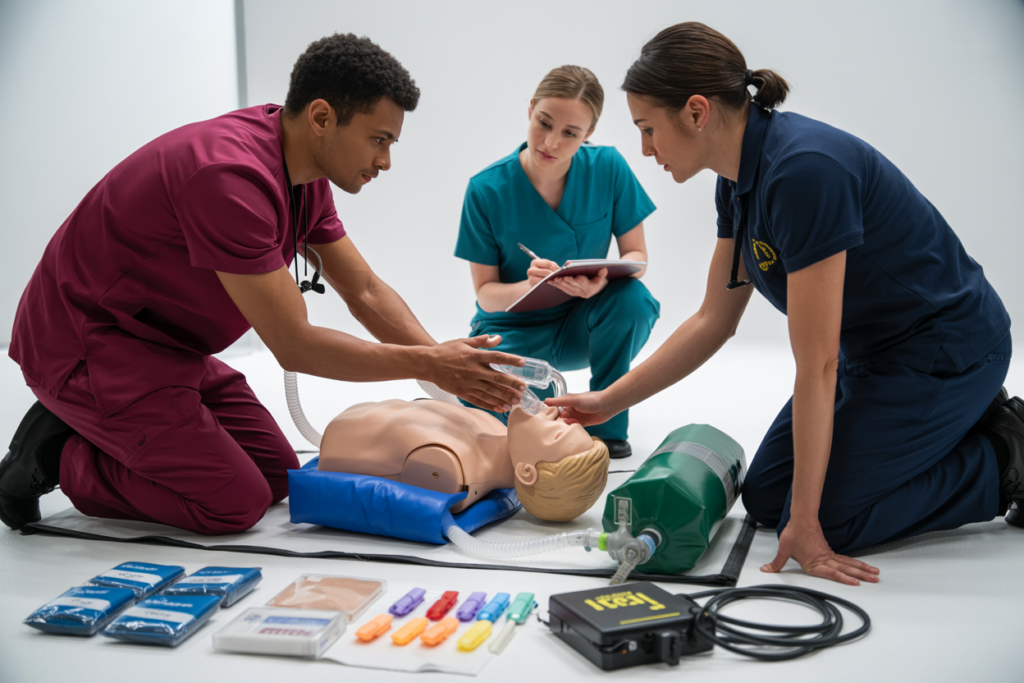
Equipment: Advanced uses realistic manikins with actual anatomy, monitoring equipment showing ECG rhythms, real defibrillators, advanced airway devices. Basic uses simple manikins with push-lights.
Clinical decision-making: Advanced requires constant decisions about rhythms, drugs, doses, roles. Basic is: Call 000. Start compressions. Use AED.
Team leadership: Advanced includes role delegation, closed-loop communication, conflict resolution. Basic focuses on individual skills.
Evidence-based practice: Advanced explains WHY guidelines changed, research supporting protocols. Basic tells you what to do.
How to Choose the Right Advanced Resuscitation Provider
Instructor Credentials That Actually Matter
This is non-negotiable. The instructor makes or breaks the course.
You want someone who’s actually worked critical care. Not just “qualified trainer” or “registered first aid instructor” — those qualifications mean they passed an educator course, not that they’ve run real codes in real emergencies with real consequences.
Look for instructors who are:
Former or current ICU nurses — Someone who’s spent years managing ventilated patients, running codes, titrating drugs under pressure. They understand your world. They’ve been the senior RN at 2am when three patients tried to die at once. They teach from experience, not just from a manual.
Experienced paramedics — Particularly intensive care paramedics or those who’ve worked retrieval. They’ve managed arrests in the back of moving ambulances, in people’s homes, on the side of highways. That kind of experience translates to realistic, practical teaching.
Emergency department doctors or nurses — They see the full spectrum of resuscitation. Trauma, medical arrests, pediatrics, elderly patients with ten comorbidities. They know what actually happens in chaotic environments.
What you DON’T want is someone whose entire resume is “First Aid Trainer, 2018-present.” That person might be great at teaching basic CPR to office workers. They’re probably not the right fit for teaching advanced resuscitation to ICU nurses.
Check the instructor bios on the provider’s website. If they’re hiding credentials or being vague (“our experienced team of trainers”), that’s a red flag. Good providers proudly display their instructors’ clinical backgrounds. “Sarah Chen, RN, 14 years ICU experience, current casual ED shifts” — that’s what you want to see.
Course Content: Red Flags vs Quality Indicators
Red flags: “Suitable for everyone,” no specific skills mentioned, “Get certified fast!,” American certifications (AHA, ACLS).
Quality indicators: Specific skill lists, ARC 2024 compliance, healthcare-specific terminology, clear prerequisites, scenario-based training emphasized (70% practical).
Class Size and Hands-On Practice
This is huge and most people don’t think about it until they’re sitting in a room with 40 other people watching one instructor demonstrate on one manikin.
Maximum class size should be limited for quality training. With smaller groups (12-15 participants maximum), you can split into groups of 3-4 for scenario practice. Everyone gets meaningful practice time. Everyone gets individual feedback. The instructor can actually watch you perform skills and correct technique.
With 25-30 people? You’re watching other people practice most of the time. Maybe you get one turn at running a scenario. Maybe. You walk away with a certificate but not with confidence.
Ask before you book: “What’s the maximum class size?”
If they say “it varies” or won’t give a number, that’s concerning. Good providers cap their classes because they know quality drops with too many participants.
Hands-on practice time matters more than lecture time. You already know the theory. You’ve read the guidelines (or at least you’ve skimmed them). What you need is practice. Muscle memory. Repetition until it’s automatic.
A good advanced resuscitation certificate course should be at least 60-70% practical. You should be tired from practicing skills, not from sitting in a chair watching PowerPoint slides.
Ask: “What’s the breakdown between theory and practical time?”
If they say it’s mostly lecture-based, find a different course. You’re not paying to sit through a lecture you could watch on YouTube.
Getting Certified: The Process
Determine which certificate you need: ICU/ED/CCU/HDU/Theatre nurses need advanced (ART). Paramedics need advanced. GPs doing procedures and dentists using sedation need advanced. General ward nurses probably need basic (BERS).
Find AHPRA-approved providers: Look for RTO number on their website. Ask colleagues for recommendations. Check reviews for specific mentions from healthcare workers.
Book your course: Find weekend dates when you’re off. Not directly after night shifts. Book online if possible. Get confirmation. Add reminders.
Prepare: Skim ARC 2024 guidelines beforehand. Get enough sleep. Pack comfortable clothes.
Attend and participate: Ask questions. Practice deliberately. Participate fully in scenarios. Take notes on key points.
Store your certificate: Save digital copy to multiple locations. Print hard copy. Upload to AHPRA account. Forward to manager or HR. Set renewal reminders for 2.5 years.
⚠️ Common Mistake: Assuming your ACLS from overseas counts in Australia. It doesn't. AHA ≠ ARC. You need Australian-recognized certification for AHPRA compliance.
Maintaining Your Certification
Set renewal reminders immediately:
2.5 years from certification — “Start looking at recertification courses.” This gives you six months buffer.
2 years 9 months — “Book recertification NOW.”
2 months before expiry — “Final warning.”
Set these as recurring reminders. When you recertify, dates update automatically. Don’t rely on memory alone. Three years goes fast.
If you miss renewal:
Book immediately. Don’t wait for the “perfect” weekend. Take the next available course even if timing’s not ideal.
Notify your manager as soon as you realize you’re expired. Most managers appreciate honesty.
Understand workplace implications. Most hospitals will redeploy you from critical care until compliant. There’s no grace period. Expired means expired.
Stay current between certifications:
Participate in hospital mock codes. Most ICU and ED units run quarterly or semi-annual simulations.
Mentor junior staff during actual codes. Teaching reinforces your own knowledge.
Review ARC guideline updates when published. You don’t need to memorize every change, but staying aware helps.
The goal isn’t peak performance for three straight years. The goal is not completely forgetting everything so recertification isn’t starting from scratch.
Taking Action: Your Next Steps
Quick checklist:
When does your current certificate expire? If less than 3 months, book today.
Are you currently compliant? If expired, book next available course.
What’s your roster for next 8 weeks? Find weekends you’re off both days.
Do you need basic or advanced? ICU/ED/CCU/Theatre = advanced. Paramedic = advanced. GP doing procedures or dentist using sedation = advanced.
Recommended timeline:
Research providers. Check instructor credentials and reviews.
Look at available course dates. Cross-reference with your roster.
Book the course. Get confirmation. Add to calendar with reminders.
Attend course. Practice skills. Complete assessment.
Submit certificate to HR. Set renewal reminders for 2.5 years.
What slows people down: Overthinking which provider. Waiting for “perfect” date. Analysis paralysis.
Pick a legitimate provider with good reviews and qualified instructors. Book soonest available dates. Done. Stop overthinking.
Get Your Advanced Resuscitation Certificate Sorted Today
You know which advanced resuscitation certificate you need, what training involves, how to pick quality providers, and how to fit it into your roster.
The difference between professionals who stay current and those who lapse isn’t knowledge — it’s action.
Three years goes fast. Before you know it, you’re non-compliant and scrambling.
Search for providers, pick one with qualified instructors and good reviews, book a weekend that works. Today, not next week.
Your patients deserve a healthcare professional who’s current, confident, and competent. You deserve peace of mind knowing you can save someone when it counts.
Get certified. Stay certified. Be the nurse (or paramedic, or doctor, or dentist) everyone wants during an emergency.
Book Your First Aid Training Now
Fast, affordable, and nationally accredited training delivered by professionals who care
Frequently Asked Questions About Advanced Resuscitation Certification
Q.How long does an advanced resuscitation certificate last?
Three years from the date you complete the course. Not from when you receive it or when it gets issued — from the actual completion date. So if you finish on March 15, 2025, it expires March 15, 2028. You can recertify early (many people do at 2.5 years to avoid last-minute scrambling), and your new certificate will be valid for another three years from that new completion date. Set reminders now because three years disappears faster than you think.
Q.What's the difference between ART and BERS?
ART (Advanced Resuscitation Techniques) is comprehensive training for critical care professionals — ICU nurses, paramedics, people who actually run codes. BERS (Basic Emergency Resuscitation Skills) is entry-level for general ward nurses and allied health who need compliance but aren't managing critical patients. ART covers rhythm interpretation, advanced airways, drug protocols, team leadership. BERS is basically CPR with a few extra steps. If you work ICU or ED, BERS will bore you to tears. You need ART.
Q.Can I do advanced resuscitation training online?
No, not fully. The theory component might be available as online pre-learning with some providers (blended learning model), but the practical skills component MUST be face-to-face. You cannot learn LMA insertion, BVM technique, or manual defibrillation through a Zoom screen. Anyone selling "fully online advanced resuscitation certification" is either lying or selling you something that won't count for AHPRA CPD or hospital compliance. Don't waste your money.
Q.Can I use my ACLS certification instead of getting Australian certification?
No. ACLS (Advanced Cardiac Life Support) is American Heart Association training based on AHA guidelines. In Australia, you need ARC (Australian Resuscitation Council) aligned training for AHPRA CPD hours and hospital compliance. The differences between AHA and ARC guidelines are small but they exist. Most Australian hospitals won't accept ACLS for compliance. If you trained in the US and moved to Australia, you need to recertify using Australian courses. Sorry.
Q.What if I fail the assessment?
Uncommon but it happens. Usually means you need more practice time, not that you're incompetent. Most providers will let you attend another course for a reduced fee or offer one-on-one coaching to get you ready for reassessment. Don't panic. Get the extra practice, try again. The assessment isn't designed to trick you — if you've been present, engaged, and practicing all weekend, you'll pass. If you're genuinely struggling with a particular skill, tell the instructor during the course so they can give you extra attention.
Q.How do I know if a provider is legitimate?
Check for an RTO (Registered Training Organization) number on their website — should be displayed in the footer or on an accreditation page. No RTO number means it might not count for AHPRA CPD. Check instructor credentials — look for former/current ICU nurses, paramedics, ED staff with real clinical experience, not just "qualified trainers." Read reviews from other healthcare professionals (not generic 5-star reviews with no detail). Ask specific questions before booking: "Who's teaching? What's their background? What's the class size?" Good providers answer confidently.
Making first aid training more affordable for
every classroom
We believe every student deserves access to life-saving first aid knowledge. That’s why we offer specially reduced pricing for schools and educational groups. Whether you’re booking for a single class, a year group, or your entire school, our flexible packages make training more accessible and cost-effective — without compromising quality.
