

You’ve just booked your HLTAID012 course and received an email with a lengthy ‘learner guide’ PDF attached. Do you actually need to read all of this before course day? What parts matter? And why does it feel like it’s written in a different language?
Here’s the truth: Your HLTAID012 learner guide wasn’t designed for childcare educators—it was designed to meet government training package requirements. That’s why it’s full of terms like “performance evidence,” “knowledge evidence,” and “assessment conditions” that mean very little to someone who just wants to confidently manage anaphylaxis and asthma emergencies.
I get it. You’re already exhausted from managing toddlers all week, you’ve got your own kids to look after, and now you’re supposed to read a lengthy document full of bureaucratic language. It feels like one more thing piling onto an already overwhelming to-do list.
But buried inside that dense document is actually useful information about what you’ll learn, how you’ll be assessed, and what skills you need to demonstrate on course day. You just need someone to translate it into plain English.
This article breaks down your HLTAID012 learner guide into practical, straightforward information. We’ll cover what’s inside the guide, which sections childcare educators should focus on, and how to use it effectively.
No overwhelming detail. No confusing jargon. Just what you need to know.
💡 QUICK TAKEAWAY: Your HLTAID012 learner guide is a reference manual, not required pre-reading. Skim it before your course, then use it as your go-to resource when you need to refresh protocols after certification. The asthma and anaphylaxis sections will become your most-used pages.
Do You Need to Read Your HLTAID012 Learner Guide Before Course Day?
Short answer: No. The learner guide is a reference document, not required pre-reading.
What you should do instead:
- Skim the course overview to know what to expect
- Check assessment requirements so you understand how you’ll be evaluated
- Note any pre-course requirements (like bringing Photo ID)
- Save detailed reading for after the course when you need to reference specific protocols
Why most of it isn’t relevant before course day:
- Your instructor teaches everything from scratch
- Hands-on practice matters more than theoretical knowledge
- The guide uses technical training package language that’s clearer after you’ve learned the practical skills
Focus your energy on getting a good night’s sleep before your course—that’s more valuable than cramming information you’ll learn better through practice.
What Is the HLTAID012 Learner Guide? (And Why It Feels Overwhelming)
The Official Purpose (What Training Packages Require)
Every ACECQA-approved HLTAID012 provider must include this document as part of their training delivery. It’s not optional—it’s required by Australian Skills Quality Authority regulations.
Your learner guide exists because government training package requirements mandate that Registered Training Organisations provide learners with comprehensive written materials. The Australian Skills Quality Authority (ASQA) can audit training providers at any time, so these guides are written primarily for compliance purposes, not for ease of reading.
That’s why your guide is full of formal, technical language. It’s designed to satisfy government auditors, not to be user-friendly for childcare educators.
The Practical Reality (What It Actually Is for You)
Here’s a better way to think about it: Your HLTAID012 learner guide is a reference manual, not a textbook.
It’s like your car’s owner manual—you don’t read it front-to-back before driving, but it’s handy when you need to check something specific. Same thing here. You won’t sit down and read the entire document before your course. But later when a new child with severe asthma enrolls and you want to refresh yourself on the response protocol, you’ll flip to that section and read the pages that matter.
The guide becomes most valuable AFTER you’ve completed your course. Once you’ve practiced the skills hands-on, the written guide serves as a quick reference tool when you need to check protocols or refresh your memory.
Why Childcare Educators Find It Confusing
Learner guides are written for training compliance, not user-friendliness. The language doesn’t match how childcare educators actually talk or think about first aid.
For example, your guide might say: “Performance Criteria 2.3: Learners must demonstrate the ability to identify and respond appropriately to life-threatening bleeding using appropriate techniques and infection control measures.”
What that actually means: “You’ll practice applying pressure to stop bleeding and you’ll learn when to call an ambulance.”
See the difference? Only a portion is directly relevant to you as a childcare educator. The rest is training package terminology and regulatory information.
Here’s a quick translation guide for common jargon:
| What the Learner Guide Says | What It Actually Means for You |
|---|---|
| "Demonstrate competency in performance criteria" | You'll practice CPR on a manikin and show you can do it correctly |
| "Apply knowledge evidence requirements" | You'll answer some questions to show you understand the theory |
| "Simulate assessment conditions" | You'll respond to realistic emergency scenarios during the course |
| "Performance evidence must be observed" | Your instructor will watch you demonstrate the skills |
Once you decode the language, the actual content is pretty straightforward.
What’s Inside Your HLTAID012 Learner Guide: Section-by-Section Breakdown
Section 1 – Course Overview & Units of Competency
This section explains that HLTAID012 is actually four units bundled together:
- HLTAID009 – Provide cardiopulmonary resuscitation (CPR)
- HLTAID010 – Provide basic emergency life support
- HLTAID011 – Provide First Aid
- HLTAID012 – Provide First Aid in an education and care setting
Section 2 – Assessment Requirements (THIS ONE MATTERS)
This section breaks down exactly how you’ll be assessed:
- Written assessment format (usually short answer questions)
- Practical assessment requirements (what you’ll demonstrate)
- Observation criteria (what the instructor is looking for)
What you’ll be doing on course day:
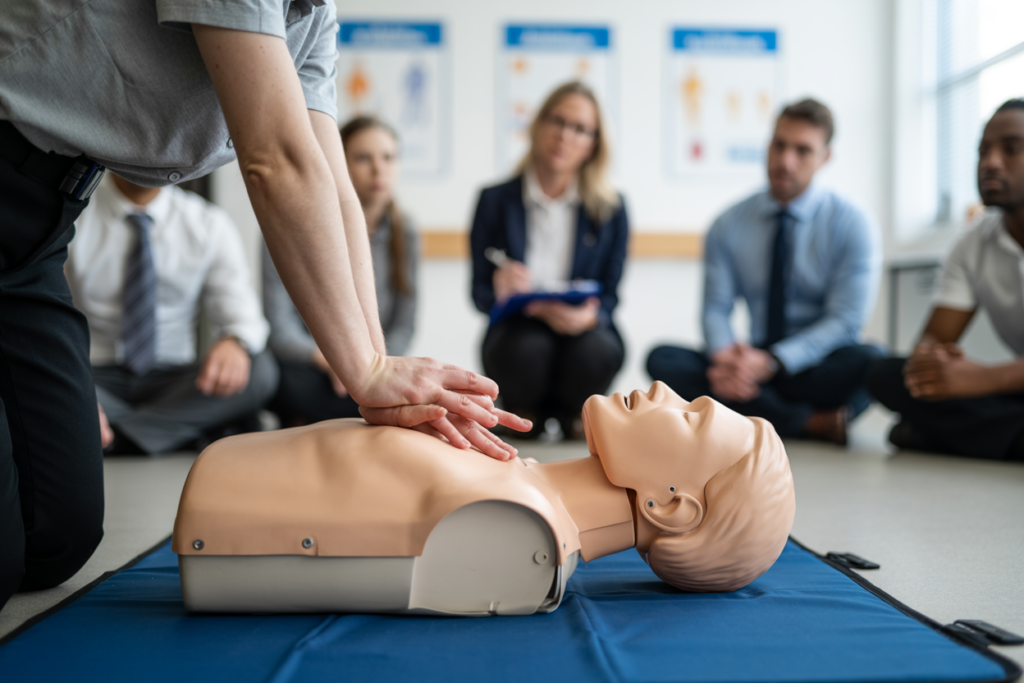
You’ll demonstrate CPR continuously on an adult manikin. You’ll use an EpiPen trainer on both infant and child manikins. You’ll respond to realistic emergency scenarios like a child choking on food, an asthma attack during outdoor play, or an allergic reaction at lunchtime.
The written test is OPEN BOOK. You can reference your materials while answering questions. The point isn’t to memorise everything—it’s to show you understand the concepts.
This is the most valuable section to read before your course because it removes the mystery about what you’ll be asked to do. Most people pass on their first attempt, and the instructor will give you multiple opportunities to demonstrate each skill.
Section 3 – Emergency Response Procedures
This covers:
- DRSABCD action plan (Danger, Response, Send for help, Airway, Breathing, CPR, Defibrillation)
- When to call 000 and what information to provide
- Handover procedures when paramedics arrive
- Infection control protocols
Your instructor will walk through each step in detail and you’ll practice it in realistic scenarios. Don’t stress about memorising this beforehand—the instructor teaches everything from scratch. This section makes a lot more sense AFTER you’ve done the hands-on training.
Section 4 – Asthma Management Protocols ⭐ CRITICAL
This is one of the two sections you’ll reference most often after your course, because asthma is incredibly common in childcare settings.
The guide will explain the exact protocol:
Step 1: Sit the child upright and keep them calm
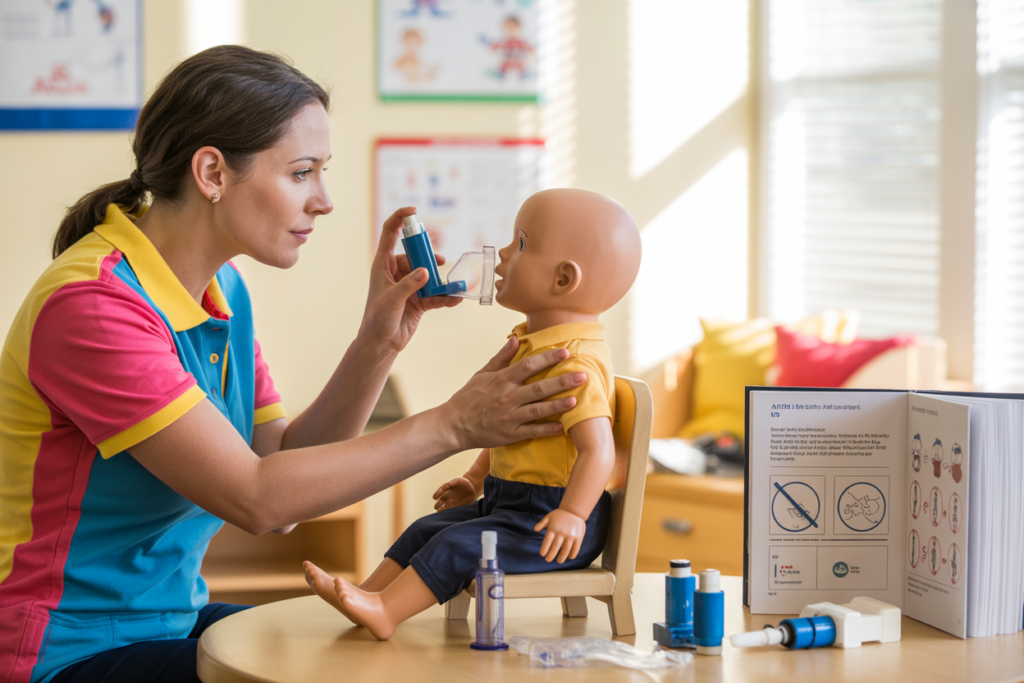
Step 2: Give puffs of reliever medication (usually blue inhaler) through a spacer
Step 3: Wait and observe
Step 4: If there’s no improvement, repeat medication and call emergency services
During your course, you’ll practice this procedure multiple times so it becomes second nature. Your instructor will teach you the specific signs to watch for—like whether the child’s breathing is becoming easier, whether they can speak in full sentences. The guide includes a helpful checklist of warning signs that indicate you need to call emergency services immediately.
Section 5 – Anaphylaxis Management Protocols ⭐ CRITICAL
This is the other section you’ll reference constantly. Even if you only have one child with severe allergies in your room, you need to know exactly what to do if they have a reaction.
Here’s the basic protocol:
Lay the child flat (don’t let them stand or walk)
Give the EpiPen immediately – orange end to the outer mid-thigh, hold firmly
Call emergency services – always, even if the child seems to improve
Stay with the child until paramedics arrive
During your course, you’ll practice using EpiPen trainers multiple times on both infant and child-sized manikins. By the time you leave your course, your hands will remember the motion. The instructor will also give you tips for staying calm under pressure.
Section 6 – Legal & Regulatory Requirements
This section explains your legal obligations when providing first aid in an education and care setting, including ACECQA National Quality Standard requirements, duty of care, incident reporting procedures, and documentation requirements.
Most of this you probably already know from your childcare training, but it’s good to understand how first aid response fits into the broader regulatory framework.
Section 7 – Quick Reference Resources
This is the section you’ll actually use most often. Many educators print out the quick reference cards and keep them in their emergency kit or post them near the first aid supplies. These one-page summaries are perfect for those moments when you need to check something quickly.
How to Use Your HLTAID012 Learner Guide
Before Your Course
You don’t need to read the entire guide before course day. Here’s your prep plan:
Course Overview: Skim the first few pages to understand the four units you’ll be completing.
Assessment Requirements: Read through exactly what you’ll be asked to do during assessments. This removes mystery and reduces anxiety.
Skim Asthma and Anaphylaxis Sections: Don’t try to memorise—just get familiar with the general approach.
Quick Reference Section: Bookmark this for later access.
What you can skip:
- Detailed performance criteria matrices
- Training package mapping documents
- Assessment validation procedures
That stuff is for the RTO’s compliance purposes. It doesn’t help you learn.
🌙 The night before: Get a good night's sleep. Pack Photo ID, water bottle, and wear comfortable clothes.
During Your Course
Most people don’t actually open their learner guide much during the course itself. Your instructor is teaching everything you need to know in real-time.
You might reference it during breaks for clarification, or during the written assessment since it’s open book. But you won’t need to follow along during demonstrations—watch the instructor, not the page.
After Your Course (Long-Term Value)
This is when your learner guide becomes genuinely useful. You’re back at work with real children in your care.
When a new child with severe allergies enrolls, open your learner guide to the anaphylaxis section. Refresh yourself on the exact technique. When a child has an asthma attack and you can’t quite remember the exact protocol, pull out your guide. The asthma section has it clearly written.
Real-world scenarios where educators reference their guides:
- New child with medical condition enrolls
- Centre policy review
- Incident reporting after managing an emergency
- Training new staff
- Annual refresher to keep skills sharp
📱 How to keep your guide accessible: Some educators keep a physical copy in their emergency kit. Others save the PDF on their phone. A few laminate the quick reference pages and post them near the medication fridge. Do whatever works for your situation.
Making Your Learner Guide Work for You Long-Term
Create Your Own Quick Reference System
Identify the scenarios you’re most likely to encounter:
- Choking (especially in toddler rooms)
- Asthma attacks
- Anaphylaxis
- Minor injuries
- CPR
Find those sections in your learner guide. Print or screenshot just those pages. Create a simple folder with just those protocols. Much easier to grab and check when you need it.
Use It When Training New Staff
Your learner guide is perfect for showing new staff emergency protocols. Instead of explaining from memory, open your guide and walk through it together. This ensures you’re teaching the correct protocol.
Keep It With Child-Specific Medical Plans
When a child with severe allergies or asthma enrolls, keep your learner guide section on that condition together with their individual medical management plan. Now everything related to managing that child’s condition is in one place.
Use It to Build Confidence
When you’ve got a child with severe allergies starting soon and you’re feeling anxious, reading through the anaphylaxis section helps. Not because you forgot the protocol, but because reviewing it reminds you that you DO know what to do.
The learner guide works best when you see it as an ongoing support tool, not just a one-time study document.
Final Thoughts
Your HLTAID012 learner guide doesn’t need to be overwhelming. Now that you understand what’s inside, which sections matter most, and how to use it effectively, you can approach your training with confidence instead of anxiety.
Remember: The guide is a reference tool, not a test you need to pass. Your instructor will teach you everything you need to know on course day. The learner guide simply supports that learning and gives you something to refer back to when needed.
Ready to get your HLTAID012 certification and receive your comprehensive learner guide? Book your course today and experience training that builds genuine confidence—not just compliance.
Book Your First Aid Training Now
Fast, affordable, and nationally accredited training delivered by professionals who care
Frequently Asked Questions About HLTAID012 Learner Guides
Q.How often should I refer back to my learner guide?
Most educators reference their guide about 4-6 times in the first six months after certification, usually when a new child with medical needs enrolls or when they want to confirm they're following correct protocols. After that initial period, you'll probably only open it once or twice a year—typically right before recertification or when training new staff. The asthma and anaphylaxis sections get the most use because these are the emergencies you're most likely to encounter in childcare settings. Set a reminder to skim these critical sections every few months to keep the information fresh in your mind.
Q.What if the information in my guide contradicts what my instructor taught?
This occasionally happens, especially with older learner guides that haven't been updated to reflect the latest guidelines. First aid protocols do change based on new research, and sometimes there's a lag between updated guidelines and updated training materials. If you notice a contradiction during your course, ask your instructor immediately—they'll clarify which approach is current. After your course, always follow what your instructor taught, as they're delivering the most up-to-date protocols. You can also check the Australian Resuscitation Council website for the latest official guidelines if you're unsure.
Q.My learner guide is really long. Do other providers have shorter ones?
Guide length varies significantly between providers—some are around 30 pages while others exceed 60 pages. Length doesn't necessarily indicate quality though. Longer guides might include more examples and detailed explanations, while shorter guides are more concise and easier to navigate. What matters more than length is clarity and organization. A well-organized 30-page guide with plain language is far more useful than a 60-page guide full of confusing jargon and complicated tables. Focus on whether you can easily find and understand the information you need, not on how many pages it contains.
Q.Can I still use my learner guide after my certification expires?
Your certification expires after three years, but the core information in your learner guide doesn't really "expire"—the fundamental principles of CPR, asthma management, and anaphylaxis response don't change drastically year to year. However, there are occasional updates to guidelines based on new research, so some details might become outdated. You can still reference your old guide, but be aware it might not reflect the most current best practice. When you complete your recertification course, you'll receive an updated learner guide that includes any changes to protocols, so you'll always have access to current information.
Q.Should I bring my learner guide to work and keep it at the centre?
It depends on your work situation and your centre's policies. If you're a full-time educator at one centre and you're the designated first aid officer, keeping your guide in your room or staff office makes sense for quick reference. If you're a relief educator working across multiple centres, keeping the digital version on your phone is more practical than carrying a physical guide around. Some centres have specific policies about where first aid reference materials should be stored, so check with your director. Just make sure you don't keep your only copy at work—if you change jobs, you'll want to take your guide with you or at least have a digital backup.
Q.Does my learner guide meet ACECQA requirements for childcare centres?
Your HLTAID012 certification meets ACECQA requirements—the learner guide is simply part of how you earned that certification. ACECQA doesn't specifically approve or reject individual learner guides; they care about whether you hold a current, valid HLTAID012 certificate from an ASQA-registered training provider. If you completed your course with a legitimate RTO and have the certificate to prove it, you're compliant with ACECQA standards. The learner guide is for your reference and ongoing professional development, not something ACECQA inspectors will ask to see during regulatory assessments.
Making first aid training more affordable for
every classroom
We believe every student deserves access to life-saving first aid knowledge. That’s why we offer specially reduced pricing for schools and educational groups. Whether you’re booking for a single class, a year group, or your entire school, our flexible packages make training more accessible and cost-effective — without compromising quality.
