

It’s 11:45 AM in your toddler room. Fifteen 2-year-olds are eating lunch when suddenly, Mia starts clawing at her throat—her severe nut allergy is triggered. Your brain races: “Where’s the EpiPen? Which thigh? How hard do I press? What if I freeze?”
This nightmare scenario keeps Brisbane childcare educators awake at night. And while your HLTAID012 first aid certification is the compliance requirement that lets you work legally, what you actually need is the confidence to save a child’s life when every second counts.
This guide covers everything from ACECQA compliance requirements to choosing quality training that builds real competence—not just paper compliance.
⚡ Quick Answer: HLTAID012 is the only first aid certification that meets ACECQA requirements for childcare educators in Queensland. It's valid for 3 years and includes specialized pediatric emergency training that HLTAID011 doesn't cover.
What is HLTAID012 First Aid Certification?
HLTAID012 (Provide First Aid in an Education and Care Setting) is the nationally recognized first aid qualification required for all staff working in Australian childcare centers, kindergartens, and early learning services. This certification specifically addresses pediatric emergencies and meets ACECQA (Australian Children’s Education & Care Quality Authority) compliance requirements.
HLTAID012 includes:
- HLTAID011 (Provide First Aid) – CPR, choking, bleeding, shock management
- HLTAID010 (Provide Basic Emergency Life Support) – Emergency response protocols
- HLTAID009 (Provide Cardiopulmonary Resuscitation) – CPR techniques for all ages
- Pediatric-specific training – Infant and child CPR, choking procedures
- Anaphylaxis management – EpiPen administration and allergic reaction response
- Asthma emergency management – Inhaler and spacer use, asthma attack protocols
The certification is valid for 3 years and must be renewed before expiry to maintain legal compliance for working in education and care settings in Queensland and across Australia.
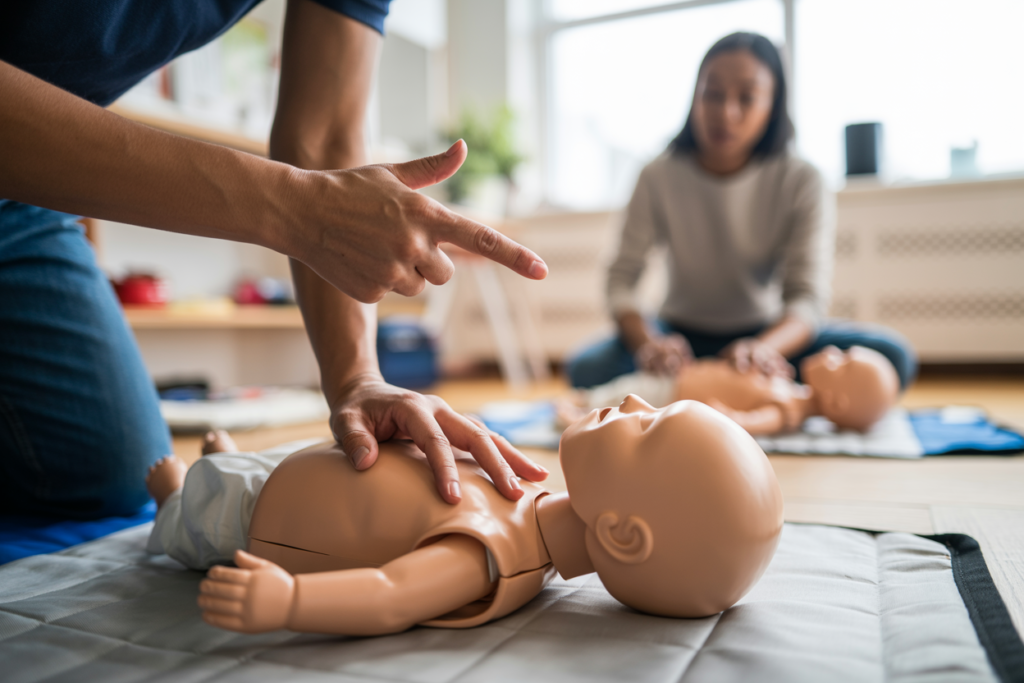
You’re practicing on both infant and child manikins, learning age-appropriate techniques, and running through scenarios that actually happen in childcare environments—like what to do when a toddler chokes during lunch.
Why HLTAID012 is Required for Brisbane Childcare Educators
Let’s cut through the confusion around why you need this specific certification. It’s not just “nice to have” or a suggestion from your center director—it’s actually a legal requirement that’s written into national regulations.
ACECQA National Regulations
Under Regulation 136 of the Education and Care Services National Regulations, every approved education and care service in Australia must have at least one educator on-site with a current approved first aid qualification. And that qualification? It’s HLTAID012.
The regulation exists because parents are trusting you with their children’s lives. When a 2-year-old has an anaphylactic reaction or a baby stops breathing, there’s no time to wait. Someone needs to know exactly what to do, right there in that moment.
Here’s what the regulation requires:
- At least one educator with current HLTAID012 must be physically present whenever children are being educated and cared for
- The certification must be current (not expired)
- It must be from an approved Registered Training Organisation (RTO)
- The certificate must be readily accessible for inspection
Legal Consequences of Non-Compliance
Here’s what happens if your certification expires while you’re still working with children:
For your center:
- Compliance notices and significant fines
- Rating drops (impacting enrollment)
- In extreme cases, suspension of approval to operate
For you personally:
- Cannot legally supervise children
- Removed from floor duties until recertified
- Unpaid leave or roster changes
- Personal liability concerns if incidents occur
- Professional reputation damage
The good news? This is preventable. Mark your certificate expiry date in your phone calendar with reminders at 6 months, 3 months, and 1 month before it lapses.
Quick Comparison:
| Feature | HLTAID011 | HLTAID012 |
|---|---|---|
| ACECQA Approved for Childcare | ❌ No | ✅ Yes |
| Infant CPR (0-12 months) | ❌ No | ✅ Yes |
| Child CPR (1-8 years) | Limited | ✅ Comprehensive |
| EpiPen Training | ❌ No | ✅ Yes |
| Asthma Management | Basic | ✅ Pediatric-focused |
| Childcare Scenarios | ❌ No | ✅ Yes |
| Validity Period | 3 years | 3 years |
HLTAID012 vs HLTAID011: Understanding the Difference
This is where a lot of Brisbane educators get confused—and honestly, I don’t blame you. The alphabet soup of course codes makes it feel like someone’s deliberately trying to confuse you. So let’s break down the difference between HLTAID011 and HLTAID012 in plain English, because booking the wrong course means wasting money and an entire Saturday.
What HLTAID011 Covers (General First Aid)
HLTAID011 is what most people think of when they hear “first aid course.” It’s the standard workplace first aid certification designed for offices, retail stores, warehouses, gyms—basically any workplace that isn’t specifically caring for children.
Here’s what you learn in HLTAID011:
- CPR for adults (focus on people over 8 years old)
- Managing conscious and unconscious casualties
- Bleeding control and wound management
- Fractures, sprains, and musculoskeletal injuries
- Burns, scalds, and shock management
- Basic emergency response procedures
- How to use an Automated External Defibrillator (AED)
But here’s the critical part: HLTAID011 does NOT meet ACECQA requirements for childcare work because it doesn’t cover the pediatric-specific skills you need when caring for babies and toddlers.
What Makes HLTAID012 Different
HLTAID012 includes everything from HLTAID011, plus a whole additional layer of pediatric emergency training. Think of it as HLTAID011 on steroids, specifically designed for people who work with children under 8 years old.
The pediatric-specific content you get in HLTAID012 includes:
Infant CPR (0-12 months): You’re using two fingers, not your whole hand. The compression depth is different. The head positioning is different. You need to actually practice this on an infant manikin because it feels completely different from adult CPR. And honestly? The first time you practice infant CPR, it’s terrifying. These tiny little chest compressions on a baby-sized manikin really drive home the reality of what you might need to do.
Child CPR (1-8 years): Different technique again—you’re using one hand for toddlers, transitioning to two hands for older preschoolers. The compression depth changes, the landmarks change, everything’s scaled down. You can’t just “guess” at this stuff when a 3-year-old stops breathing.
Age-appropriate choking procedures: Back blows and chest thrusts for infants versus abdominal thrusts for children. The techniques are completely different depending on the child’s age and size, and using the wrong technique could cause serious internal injuries.
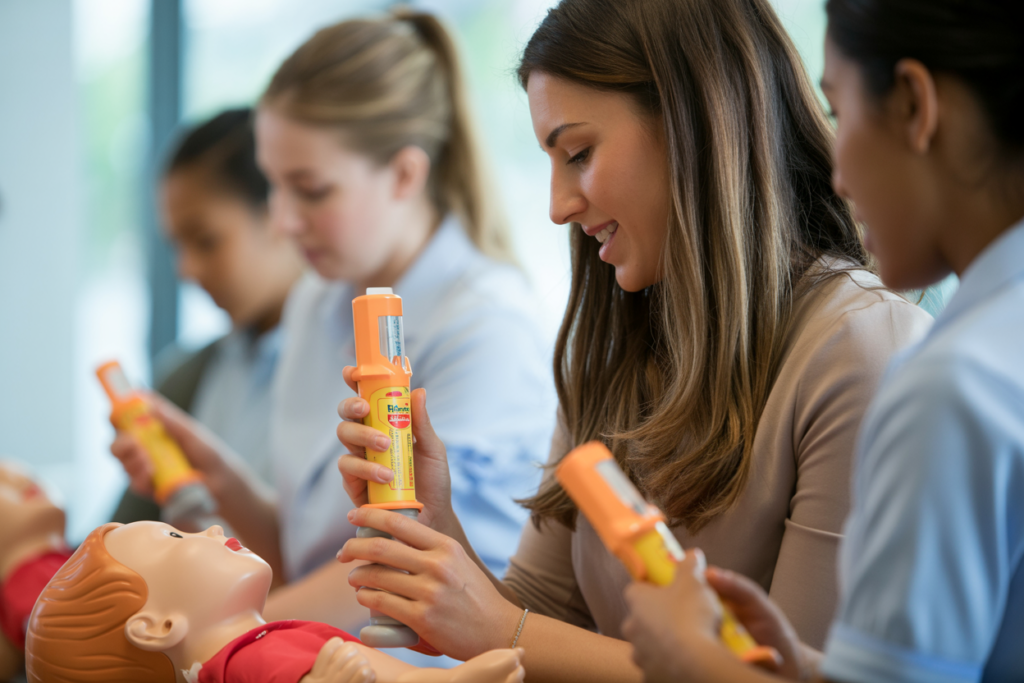
Anaphylaxis management: This is the big one that keeps childcare educators awake at night. You’re learning exactly how to recognize anaphylaxis in children (which can present differently than in adults), how to use an EpiPen correctly, when to administer it, and what to do while waiting for the ambulance. You practice on training EpiPens multiple times, not just watch a demonstration once.
Asthma emergency management: How to use inhalers with spacers (because toddlers can’t “take a deep breath and hold it” like adults can), recognizing different severity levels of asthma attacks, when to call 000 versus when to manage it yourself, and specific protocols for children who forget their inhaler or run out of medication.
Education and care setting scenarios: You’re running through realistic childcare emergencies—what do you do when multiple children are present? How do you manage a choking incident during lunch when you’ve got 14 other toddlers at the table? What if a child has an allergic reaction during outdoor play and you’re the only adult present?
Here’s what really matters: you’re not just learning what to do—you’re practicing until it becomes automatic. Because when a 2-year-old is turning blue from an allergic reaction, your brain doesn’t have time to think through the steps. Your hands need to know what to do without conscious thought.
Can You Use HLTAID011 for Childcare Work?
Short answer: No. Absolutely not.
ACECQA specifically requires HLTAID012—not HLTAID011—for anyone working in education and care settings. This isn’t open to interpretation, and it’s not a “close enough” situation.
Here’s what happens if you book HLTAID011 by mistake:
- You waste money on the course fee and a full Saturday
- You’re still not compliant for childcare work
- You still need to book and pay for HLTAID012
When you’re booking, look for these exact words:
- “HLTAID012”
- “Provide First Aid in an Education and Care Setting”
- “Childcare First Aid”
- “ACECQA-approved for early childhood educators”
If the website doesn’t use these specific terms, call and ask directly: “Is this HLTAID012 that meets ACECQA requirements for childcare educators?” Don’t book until you get a clear yes.
💡 What to Expect: Quality HLTAID012 training includes hands-on practice with infant and child manikins, trainer EpiPens, and realistic childcare emergency scenarios. You should practice each critical skill at least 3-5 times—not just watch demonstrations.
What You’ll Learn in HLTAID012 Training
A quality HLTAID012 course should have you on the floor with manikins, practicing techniques until your hands remember what to do even when your brain is panicking.
Core CPR Skills
Infant CPR: You’re using two fingers placed in the center of the baby’s chest. The compression depth is about 4 centimeters, which feels terrifyingly deep when you’re pressing on a tiny infant manikin for the first time. The ratio is 30 compressions to 2 breaths.
Child CPR: For toddlers and preschoolers, the technique shifts depending on size. Smaller toddlers might need one-handed compressions, while bigger preschoolers need two hands. You’re aiming for about 5 centimeters compression depth.
Anaphylaxis Management
This is the number one fear for educators—it’s sudden, life-threatening, and you’re the first responder.
EpiPen Administration Steps:
- Call for help immediately
- Get the EpiPen from storage
- Remove from carrier tube
- Form a fist around it (orange end down)
- Position against child’s outer mid-thigh
- Push down firmly until you hear a click (hold for 3 seconds)
- Remove and massage injection area
- Note the time for potential second dose
Quality courses give you trainer EpiPens to practice with multiple times—not just watch a demonstration once.
Asthma Emergency Protocols
The 4x4x4 Protocol:
- Sit the child upright
- Give 4 puffs of reliever (with spacer)
- Wait 4 minutes
- If no improvement, give 4 more puffs
How to Choose Quality HLTAID012 Training
Not all HLTAID012 courses are created equal. You can pay for training and get transformative education that genuinely prepares you for pediatric emergencies, or get a box-ticking exercise with zero confidence.
What Makes Training “Quality”
Multiple practice rounds – You should practice each critical skill 3-5 times minimum until your hands know what to do without conscious thought. If you practice something once, you’ve been shown how to do it. If you practice it five times, you’ve learned how to do it.
Realistic scenarios – Quality training includes chaotic, realistic scenarios that prepare you for actual emergencies way better than calm demonstrations.
Post-training support – Refresher webinars, renewal reminders, and ongoing instructor access separate quality providers from those who just certify and forget.
Common Mistakes Brisbane Educators Make
Booking the Wrong Course
You Google “first aid course Brisbane,” see HLTAID011 advertised, book it, complete it—then your director says: “This isn’t HLTAID012. This doesn’t meet our requirements.”
How to avoid this: Always specify “I need HLTAID012 for ACECQA compliance.” Look for “HLTAID012,” “Provide First Aid in an Education and Care Setting,” or “ACECQA-approved for early childhood educators.”
Letting Certification Expire
Your certificate expires without you realizing, then you’re scrambling to find urgent training while being told you can’t supervise children.
How to avoid this: Set calendar reminders at 6 months, 3 months, and 1 month before expiry.
Not Practicing Skills After Certification
Six months after completing HLTAID012, you’re foggy on details. Two years later, you struggle to remember which thigh the EpiPen goes in.
How to avoid this: Quarterly self-review (15 minutes reviewing materials), staff meeting refreshers (practice with the center’s manikin), and mental rehearsal during work.
Maintaining Your HLTAID012 Skills Between Renewals
Getting certified is just the starting point. What you do over the next 3 years determines whether you’re actually prepared when a real emergency happens.
Studies show CPR skills start declining within 3-6 months after training. The same applies to EpiPen administration, choking response, and asthma protocols. Your brain stores these as procedural memories, but without practice, the neural pathways weaken.
Monthly mental rehearsal: Pick one scenario and mentally walk through your response while driving to work or before sleep. Visualize it step by step.
Quarterly hands-on practice: Four times a year, actually practice with your center’s CPR manikin and trainer EpiPen. Get a colleague to practice with you.
Use real incidents as learning: If another room has a first aid incident, ask the educator about their experience. What did they do? What was hard?
Your Path Forward: From Compliance to Genuine Confidence
Getting your HLTAID012 certificate is the easy part. But what you actually need is the genuine confidence that you’ll remember what to do when a child in your care has an anaphylactic reaction. That you won’t freeze when a baby stops breathing.
That confidence comes from quality training with adequate practice time, followed by regular skill maintenance over the years between certifications.
Your Next Steps
Step 1: Check your current certificate expiry date. Put reminders in your phone at 6 months, 3 months, and 1 month before expiry.
Step 2: Research HLTAID012 providers with small class sizes and good reviews from childcare educators.
Step 3: Book well before your certificate expires. Don’t procrastinate.
Step 4: Email your new certificate to your director the same day you receive it.
Step 5: Schedule quarterly practice sessions and set renewal reminders for 3 years from now.
You’re going to book your HLTAID012 training. You’re going to practice CPR on manikins and use trainer EpiPens until the motion feels natural. And you’ll walk out with actual confidence.
Months or years might pass without needing those skills. That’s the best-case scenario.
But if the day comes when a child needs emergency care, you’ll respond. Your hands will know what to do because you practiced enough times for it to become automatic.
You work in childcare because you care about children. Being genuinely prepared to protect them in medical emergencies is part of that commitment.
Go book your training. Choose quality over convenience. Practice the skills regularly. And trust that you’re capable of learning what you need to know.
Ready to book your HLTAID012 training? Research providers offering small class sizes and comprehensive practical training. Check Google reviews from other childcare educators, and book well before your current certificate expires. Your future self—and the children in your care—will thank you for choosing quality training over just checking a compliance box.
Book Your First Aid Training Now
Fast, affordable, and nationally accredited training delivered by professionals who care
Frequently Asked Questions About HLTAID012
Q.How long is HLTAID012 certification valid for?
HLTAID012 certification is valid for 3 years from the date of completion. However, the CPR component (HLTAID009) technically should be refreshed annually according to Australian Resuscitation Council guidelines, though ACECQA accepts the 3-year renewal cycle for childcare compliance. Set calendar reminders at 6 months, 3 months, and 1 month before your expiry date to avoid last-minute scrambling for recertification.
Q.Can I use HLTAID011 instead of HLTAID012 for childcare work?
No, HLTAID011 (Provide First Aid) does not meet ACECQA requirements for childcare educators. ACECQA specifically requires HLTAID012 because it includes pediatric-specific training like infant CPR, child choking procedures, EpiPen administration, and asthma management that aren't covered in HLTAID011. Booking the wrong course means you'll waste money and still need to complete HLTAID012 to work legally in childcare settings.
Q.What happens if my HLTAID012 certificate expires while I'm working?
If your certificate expires, you legally cannot supervise children until you're recertified. Your center director must remove you from floor duties, which typically means unpaid leave or roster changes until you complete another course. The center can also face compliance violations, fines, and rating reductions if ACECQA discovers expired certifications during inspections. Beyond the legal issues, there's the personal liability concern if you need to provide first aid without current certification.
Q.Do I need separate CPR certification on top of HLTAID012?
No, HLTAID012 includes HLTAID009 (CPR), HLTAID010 (Basic Emergency Life Support), and HLTAID011 (Provide First Aid) as components—it's the complete package. You don't need to book separate CPR training because it's already included in your HLTAID012 certification. Some employers offer optional annual CPR refresher courses between your 3-year recertifications, which is good practice for skill maintenance but not legally required.
Q.Can I complete HLTAID012 fully online without attending face-to-face training?
No, "100% online" HLTAID012 courses are not legitimate and won't meet ACECQA requirements because the certification requires practical assessment of CPR skills that can't be demonstrated through a computer screen. However, "blended learning" is valid—this means you complete theory components online (2-3 hours) then attend a face-to-face practical session (4-5 hours) for hands-on practice and assessment. If a provider advertises "complete from home with no in-person requirement," they're either lying or providing worthless certificates.
Making first aid training more affordable for
every classroom
We believe every student deserves access to life-saving first aid knowledge. That’s why we offer specially reduced pricing for schools and educational groups. Whether you’re booking for a single class, a year group, or your entire school, our flexible packages make training more accessible and cost-effective — without compromising quality.
