
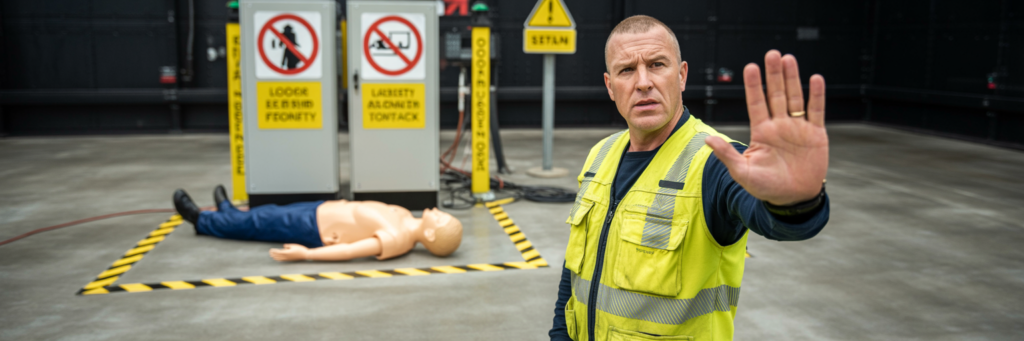
You’re on a job site. Your apprentice is convulsing against a live 240V panel. Everyone’s looking at you—the licensed sparkie. What do you do in the next 10 seconds?
Electrical incidents happen across Australian worksites every week. Safe Work Australia reports these remain among the most severe workplace injuries, with many fatalities because bystanders didn’t know proper rescue procedures.
I’ve seen three incidents in my career. Two we handled right. One we didn’t. The difference? Training and knowing what to do instinctively.
This guide covers what electricians need—from assessment through CPR. You’ll learn step-by-step protocols that comply with WorkSafe requirements and could save your crew member’s life.
What Are the Steps for Electrical Rescue?
- Assess the scene safely – Don’t touch the victim. Check if you can approach without becoming victim number two. Look for water, conductive surfaces, multiple power sources.
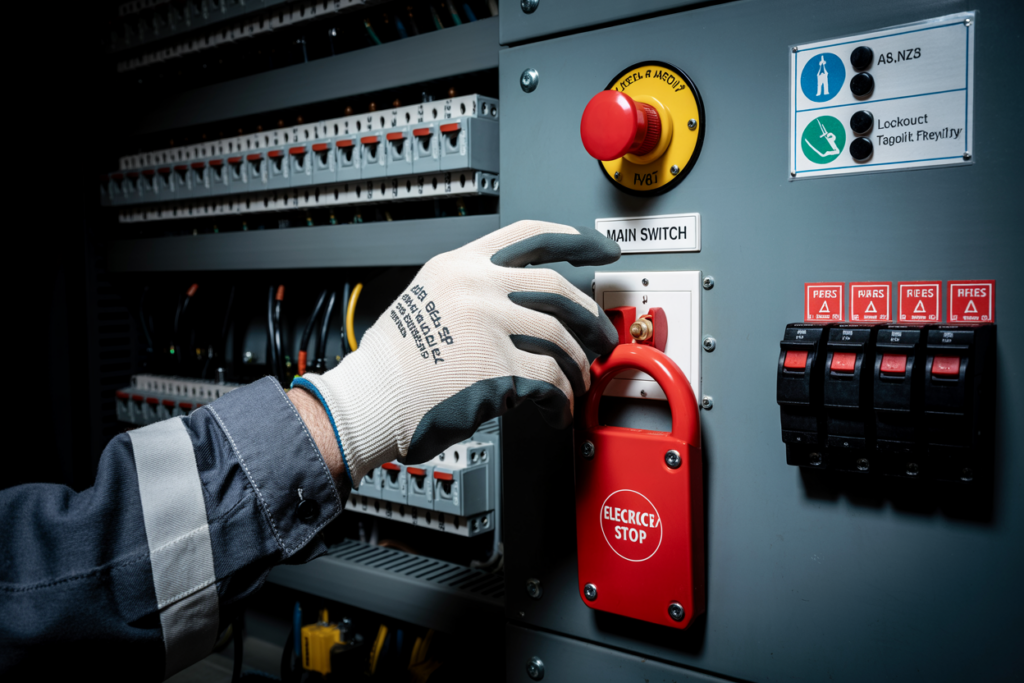
- Isolate the power source – Hit the main power supply or circuit breaker immediately.
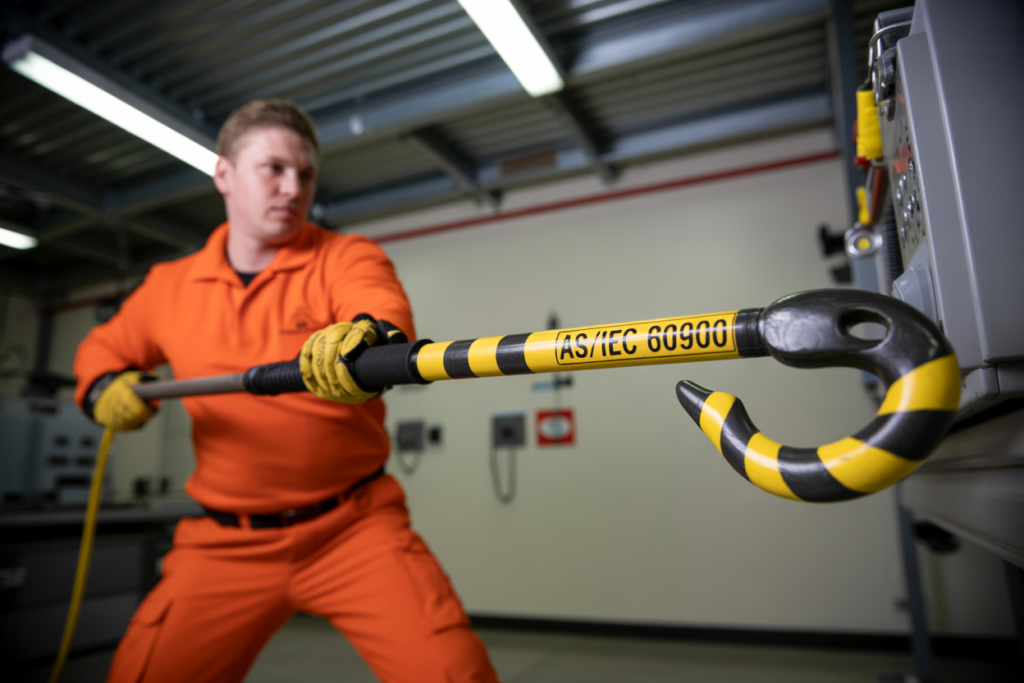
- Separate the victim – If you can’t kill the power, use a non-conductive object like a wooden pole or insulated rescue hook. Never use hands or metal.
- Check for responsiveness – Once separated, check if conscious and breathing normally. Shake shoulders, call their name loudly.
- Begin CPR if needed – If unresponsive and not breathing, start chest compressions immediately.
- Call emergency services – Ring 000 and report electrical incident. Tell them voltage, location, number of victims.
- Monitor until help arrives – Watch for cardiac symptoms and continue CPR as needed.
Never attempt rescue without isolating power or having proper insulated equipment. Becoming a second victim helps no one. I’ve seen rescuers grab victims—both get electrocuted.
These procedures follow WorkSafe Australia and Australian Resuscitation Council guidelines.
Understanding Electrical Emergencies
When current passes through someone’s body, it takes over their nervous system. Muscles contract involuntarily—the “cannot let go” phenomenon.
I watched a bloke get hit by 240V. His hand clamped onto the active conductor. He couldn’t release it. That’s physics taking over biology.
Current follows the path of least resistance. Best case: hand to hand or foot. Worst case: across the chest through your heart. Even 30-50 milliamps can cause ventricular fibrillation.
Amperage is what kills:
- 1-5 mA: Painful
- 10-20 mA: Hard to let go
- 30-50 mA: Respiratory paralysis, cardiac arrest
- 100-200 mA: Ventricular fibrillation almost certain
Body resistance changes based on wetness, what you’re standing on, contact area. Dry skin: 100,000 ohms. Wet skin: 1,000 ohms. Same voltage, ten times the current.
Australia runs on AC at 50Hz. AC is more dangerous than DC—it locks you on rather than throwing you off. The 240V residential and 415V commercial power we work with can kill in under a second if current crosses your heart.
💡 REMEMBER THIS: The "3-Second Rule" saves lives: Stop (1 second) → Assess the scene (2 seconds) → Plan your approach (3 seconds) → Then act. Three seconds of thinking prevents two victims instead of creating them. Rushing in is panic, not courage.
Pre-Rescue Safety Assessment
Rushing in without thinking kills rescuers. Your mate’s getting electrocuted, adrenaline kicks in, every instinct says grab them. Don’t.
I know a sparkie who grabbed his apprentice stuck on a live panel. Both got hit. Apprentice survived. The sparkie? Three weeks in hospital with cardiac damage and permanent nerve issues.
Before moving toward any incident, stop and assess. Takes five seconds.
Look, Assess, Don’t Touch:
Is victim still in contact? Is there water? Multiple power sources? What’s conducting—metal floor, wet concrete?
Can you reach the isolator safely? Is it labeled? Do you know which circuit? Is there backup power still live?
Don’t touch until you’ve got a plan.
WorkSafe recommends a 3-meter safety zone around live equipment. During emergencies that matters even more. Electricity can arc. Floor might conduct. Metal structures might be energized.
When to Call 000 First
Call emergency services before attempting rescue if:
- High voltage (over 1000V): You’re not equipped. Keep everyone back 10+ meters.
- Multiple victims: Major incident. You need backup.
- Confined spaces: Rescue complexity multiplied. Needs specialized training.
- Fire or explosion risk: Evacuate and call.
If the scene’s not safe and you can’t make it safe, call for help and keep others back.
Power Isolation Procedures
Standards Australia requires main switchboards within 20 meters of service entry, clearly accessible. Reality? Older buildings often don’t comply.
During site induction, actually walk to the main board. Open it. Check labels. Know where your hand’s going if someone yells “kill the power.”
In emergencies, hit the main switch. Kill everything. Someone’s life matters more than inconvenience.
Once isolated, lock out that switch. You don’t want someone turning power back on while you’re doing CPR.
Never Assume Isolation is Complete
Switches fail. Backfeed happens. Multiple supplies exist.
If you have time and safe access, use a voltage tester. Test on known live source first, then isolated circuit, then known live source again.
In rescue situations where someone’s still in contact? Isolate what you can, then use insulated equipment to break contact.
Commercial buildings might have multiple sources—main supply, backup generator, solar inverters, UPS systems. If you’re not certain you’ve killed all sources, treat as still live.
When Isolation Isn’t Possible
Sometimes you can’t reach the isolator fast enough. It’s locked, too far, unknown. Victim’s been in contact 30 seconds already.
Use insulated rescue equipment to break contact without killing power. This is riskier. Only attempt if trained, have proper equipment, and assessed you won’t contact live parts.
Physical Rescue Techniques
Proper insulated rescue hooks look like shepherd’s crooks on fiberglass poles. Rated minimum 1000V for low voltage work.
AS/IEC 60900 is the Australian standard. Look for that marking. Insulated tools need annual testing—check the date sticker.
Pole length: 1.5-2 meters minimum. Gives reach without getting close.
No rescue hook? Use dry wooden broom handle, PVC pipe, fiberglass ladder rail. Key word: dry. Wet wood conducts.
Never use metal poles, aluminum ladders, steel bar, copper pipe.
| Rescue Method | When to Use | Risk Level |
|---|---|---|
| Power isolation then direct contact | Power can be isolated quickly | LOW - Safest option |
| Insulated rescue hook | Power isolated or can't be isolated | MEDIUM - Requires proper equipment |
| Dry wooden pole | No rescue hook available | MEDIUM-HIGH - Only if bone dry |
| Grab clothing (not skin) | No equipment, power off | HIGH - Last resort only |
| Jump technique | Desperate, no options | VERY HIGH - Life threatening |
Breaking Contact
Hook around victim’s arm, leg, or torso. You’re breaking contact fast, not being gentle.
Use both hands. Feet planted wide. Pull straight away from source. Not up, not sideways—straight back.
If they’re locked on, hook and lever. Get hook between them and source, use pole as lever to pry away.
Keep pulling until 3 meters clear minimum.
You’re standing on concrete, dirt, steel. If that surface is wet or conductive, you’re part of the circuit. Don’t stand in water or touch metal framework.
Without Equipment
No rescue hook? Grab their clothing—not them. Dry clothing provides some insulation.
Last resort: jump in air as you make contact. Both feet off ground means no complete circuit to earth. Grab mid-jump, use momentum to break contact, fall away together.
Desperation territory. Only when someone’s dying and no other options.
Once separated, drag them 3 meters from source. Don’t lift—drag by shoulders or ankles. Speed matters more than comfort.
Medical Assessment and Response
Kneel next to them. Shake shoulders firmly. “Can you hear me?”
No response? They’re unconscious. Move fast.
Airway: Tilt head back, lift chin. Clear anything blocking airway.
Breathing: Ear near mouth. Look at chest. 10 seconds maximum.
- Look: Chest rising?
- Listen: Breath sounds?
- Feel: Air on cheek?
Not breathing normally (including gasping)? Start CPR.
Don’t waste time finding a pulse. WorkSafe and Australian Resuscitation Council say—if unresponsive and not breathing normally, start CPR immediately.
You’re an electrician, not a doctor. See no breathing, start CPR.
Electrical-Specific Injuries
Current enters at one point, exits another. Entry wound might be small. Exit wound can be massive.
Check hands, feet, anywhere touching metal or ground. Burns might look small on surface but internal damage is severe. Electricity cooks from inside out.
Current travels through nerves and blood vessels. Tissue heats and cooks along the pathway. Heart, lungs, kidneys, brain can have thermal damage with no external sign.
Even someone seeming okay needs hospital assessment. Internal injuries can kill hours later.
Watch for arrhythmia signs: irregular pulse, chest pain, shortness of breath, confusion, collapse after initially seeming okay.
Never let someone “walk it off.” Blokes have gone back to work, collapsed 30 minutes later. Dead before ambo arrived.
CPR for Electrical Shock Victims
Heel of one hand center of chest, other hand on top, fingers interlaced. Arms straight. Shoulders over hands. Push hard and fast.
Australian Resuscitation Council: 100-120 compressions per minute. Count to 30, two breaths if trained, straight back to compressions.
Use “Stayin’ Alive” tempo—that’s the right rhythm.
Push 5-6 centimeters deep (one-third chest depth). Might crack ribs. Can’t worry. Broken ribs heal. Dead doesn’t.
Fully release between compressions. Let chest come all the way up. Allows blood flow back to heart.
AED Use
If there’s an AED, grab it immediately while doing CPR.
Turn it on, follow prompts. Place pads as shown. Machine won’t shock unless needed.
After shock, resume CPR immediately. Don’t wait. Straight back to compressions.
Stop CPR Only When:
- Paramedics take over
- Victim recovers and starts breathing
- You’re physically unable and no one can relieve you
Don’t stop because “it’s been 10 minutes.” People survive after 45+ minutes of CPR. Keep going.
Post-Rescue Monitoring
Someone stays with victim constantly. Electrical injuries can worsen over time.
If conscious, keep talking. Ask name, location, date. Getting confused or drowsy? Bad sign.
Count breaths per minute. Normal: 12-20. Too fast (over 25) or slow (under 10) is a problem.
Look at face, lips, fingernails. Going pale, grey, or blue? Poor circulation or lack of oxygen.
Someone can seem fine 10-30 minutes, then go into cardiac arrest. Watch for chest pain, shortness of breath, dizziness.
Even if seeming okay, they need hospital assessment. Full workup—cardiac enzymes, kidney function, imaging. Not optional.
Don’t leave them alone until paramedics assess.
Common Mistakes
Rushing In: Every instinct screams “DO SOMETHING NOW.” That gets rescuers killed.
I know a sparkie—15 years experience. Apprentice got hit. He ran over and grabbed him. Both went down. Apprentice survived. Sparkie? Three weeks in hospital, permanent nerve damage. Can’t work electrical anymore.
Stop. Take one breath. Count three seconds. Look at scene. Then act deliberately.
Grabbing Victim Still Connected: Most common fatal mistake. Current goes through them into you. Both stuck. Both dying.
Never touch victim still in contact. Isolate power or use insulated equipment. No exceptions.
Inadequate Isolation: Flipped breaker but backup generator still feeding. Or solar backfeeding. Or second service point.
If not 100% certain power’s dead, treat as live.
Not Calling 000 Soon Enough: “I’ll rescue then call.” Wrong. Someone else calls immediately. If alone, call first, then rescue.
Point at specific person: “You—call 000 now.”
Conclusion
You cannot help if you become victim number two. Every rescue starts with assessment and isolation. Take five seconds to think.
Training works. The incidents where everyone survived? Someone had current training and followed it. Keep certification current.
CPR keeps people alive until paramedics arrive. Start compressions immediately if unresponsive and not breathing. Push hard and fast.
Equipment accessibility saves time. Rescue hook everyone knows about beats the best hook buried in a van.
Your license requires preparation. Low Voltage Rescue isn’t optional. WorkSafe expects competent response. Your crew expects you to know what to do.
This isn’t theoretical. Electrical emergencies happen. Question is whether you’ll be ready.
Reading this doesn’t replace hands-on training. You can’t develop muscle memory from an article. Need to physically practice until automatic.
Training requires practical assessment with ASQA-registered RTO. Look for instructors with electrical backgrounds. Former sparkies teaching means learning from someone who’s been on tools.
Don’t wait till certificate’s about to expire. Book well in advance.
Certificate valid three years. Competence degrades faster. Mental rehearsal helps. Scenario discussions with crew. Equipment familiarization on every site.
I’ve been a licensed electrician over 20 years. Seen three serious incidents. Two survived. One didn’t—rescuer hesitated because expired training, wasn’t confident. By the time he acted, too late.
Your certification isn’t paperwork. It’s preparation for the worst day of your career—when someone’s dying and you’re the one who has to save them.
Get trained properly. Stay current. Know where rescue equipment is. Hopefully you’ll never need this.
But if you do, you’ll be ready.
Book Your First Aid Training Now
Fast, affordable, and nationally accredited training delivered by professionals who care
Frequently Asked Questions
Q.How long does Low Voltage Rescue certification last?
Low Voltage Rescue certification is valid for 3 years from the date of issue. However, the CPR component (HLTAID011) often requires annual renewal, so many electricians choose to renew the entire qualification yearly to avoid tracking different expiry dates. Your electrical license renewal will require current certification, so don't let it lapse—book your refresher training at least 3 months before expiry to ensure you maintain continuous coverage.
Q.Can I perform electrical rescue if my training has expired?
Legally you're still obligated to help in an emergency under duty of care provisions, but if your training has expired, you're at significant risk of making fatal mistakes that could kill you, the victim, or both. WorkSafe Queensland can also penalize you for performing electrical work (including rescue) without current certification, and your insurance may not cover you if something goes wrong. Keep your training current—it's not just a license requirement, it's life insurance for you and your crew.
Q.What's the difference between Low Voltage Rescue and standard first aid?
Low Voltage Rescue training specifically covers electrical emergency scenarios including safe power isolation, use of insulated rescue equipment, electrical-specific injury assessment, and modified CPR techniques for electrical shock victims. Standard first aid doesn't teach you how to safely approach an electrocution victim or use specialized rescue equipment. For electrical workers, Low Voltage Rescue is mandatory because standard first aid training alone won't keep you alive when dealing with live electrical hazards.
Q.Do I need Low Voltage Rescue certification if I only do domestic electrical work?
Yes, absolutely. The Electrical Safety Act 2002 (Queensland) and equivalent legislation in other states requires Low Voltage Rescue certification for anyone performing electrical work, regardless of whether it's domestic, commercial, or industrial. A 240V residential circuit can kill you just as dead as a 415V commercial system, and domestic properties have just as many electrical emergencies as commercial sites. Your electrical license is invalid without current certification.
Q.What should I do if someone gets electrocuted and I don't have rescue equipment?
First, never touch them while they're still in electrical contact—you'll become victim number two. Your priority order: isolate the power source if you can reach it safely, call 000 immediately, then use whatever non-conductive materials are available (dry wood, thick rubber, dry clothing) to break their contact with the electrical source. Once separated and power is off, begin CPR if needed. It's better to use improvised non-conductive materials than to wait for proper equipment if someone's dying, but proper training teaches you how to assess what's actually safe to use.
Q.What's the most common mistake electricians make during rescue attempts?
The most fatal mistake is rushing in without assessment and grabbing someone who's still in electrical contact. This creates two victims instead of one, and I've read too many WorkSafe investigation reports where an experienced electrician died trying to save an apprentice because they didn't follow the "Look, Assess, Don't Touch" principle. Your instinct screams to grab them immediately, but that instinct kills rescuers. Three seconds of assessment saves two lives—yours and theirs.
Making first aid training more affordable for
every classroom
We believe every student deserves access to life-saving first aid knowledge. That’s why we offer specially reduced pricing for schools and educational groups. Whether you’re booking for a single class, a year group, or your entire school, our flexible packages make training more accessible and cost-effective — without compromising quality.
