

Need your low voltage rescue certification sorted before Monday’s job start? You’re not alone.
Every week, hundreds of electricians face the same panic: expired certs, project managers asking for compliance docs, and WorkSafe requirements threatening their license. Thursday afternoon text from the PM asking for your paperwork, Friday evening scramble trying to find a course that doesn’t make you lose next week’s income, Sunday night anxiety about delaying a job start.
Here’s the problem most sparkies run into: they waste time and money on the wrong training. They book weekday courses that cost them lost income—sometimes hundreds of dollars in missed billable hours on top of course fees. They sit through useless PowerPoint presentations where they learn absolutely nothing about actually performing a rescue. They wait weeks for certificates that should arrive the same day, missing job opportunities while paperwork sits in the mail. And three years later, they’re back in the same panic because nobody reminded them about renewal.
This guide cuts through all that noise. You’ll learn exactly how to get your low voltage rescue certification right the first time—without losing work days, without wasting money on dodgy RTOs that might get your cert rejected by ESO Queensland, and without carrying a certificate you don’t actually believe in because the training was garbage.
These 5 tips will save you time, money, and stress: weekend courses that protect your income, ASQA verification that prevents rejection, practical training that builds real skills, same-day certificates that keep jobs on track, and automated reminders that eliminate the renewal scramble.
Let’s get your compliance sorted properly.
What Is Low Voltage Rescue Certification?
Low voltage rescue certification (PERFORM RESCUE FROM A LIVE LOW VOLTAGE PANEL) is a WorkSafe Queensland-mandated qualification that trains electricians to perform emergency rescue from live electrical panels. It’s legally required under the Electrical Safety Act 2002 for all Queensland electrical license holders.
The certification covers emergency response procedures, safe isolation techniques, rescue using insulated equipment, victim separation, and CPR for electrical shock victims (HLTAID011). Licensed electricians, apprentices, and electrical contractors must hold current certification, which is valid for 3 years.
💡 Quick Reality Check: Most sparkies lose hundreds in billable hours every time they book weekday training. Weekend courses eliminate this problem completely—protecting your income while maintaining compliance. Zero lost work days means zero lost revenue.

Tip #1: Book Weekend Training (Not Weekday Courses That Cost You Income)
Every electrician faces the same dilemma: you need certification to keep your license, but you can’t afford to lose a work day. Missing a full weekday for training means hundreds in lost billable hours on top of course fees. For subcontractors juggling multiple commercial projects, young families, and mortgage payments—losing weekday income isn’t just expensive. It’s a financial penalty for staying compliant.
Why Weekday Training Destroys Your Cash Flow
Missing a weekday creates problems beyond just money. When you tell a project manager you can’t start Monday because you need to “sort your certs out,” they remember that conversation. Next time there’s a choice between you and another subbie with identical rates and similar experience, they choose the one who’s always available. That’s just how it works in this industry.
The electrical community is tight-knit. Word spreads fast through project managers, contractors, and industry networks. “He’s good work, but he’s not always available when we need him.” That reputation sticks. Three months later you’re wondering why fewer PMs are calling you back for quotes. Six months later you’re scrambling for work while competitors who prioritize availability stay busy.
I’ve seen sparkies lose major contracts because they couldn’t start on required dates—stuck waiting for weekday courses. One guy missed a hospital fit-out opportunity worth months of steady work. The PM gave it to someone else who could start immediately, and that someone else became their go-to contractor for the next five projects. All because of a Tuesday training commitment.
The Weekend Advantage
Weekend courses eliminate these problems completely. You maintain zero lost work income while staying compliant. You can confidently commit to Monday job starts without scheduling conflicts. Your reputation stays intact as the “always available” contractor that project managers prefer. You’re done before afternoon—still got time with family. Your partner can plan around one known date instead of you disappearing mid-week unexpectedly.
Think about it: you’re protecting your full weekly earning capacity. Monday through Friday stays clear for billable work. Weekend morning training doesn’t compete with your income generation. You’re not choosing between compliance and cash flow—you’re getting both.
What to Look For
Not all weekend courses deliver on their promises. Here’s what actually matters:
✅ Courses run every weekend consistently (not once per month when they “have enough people”)
✅ Single-day intensive format (not split across multiple weekend sessions)
✅ Bundle options available (CPR + LV Rescue same day knocks out two requirements)
✅ Reliable scheduling (you can plan ahead, not wait for “next available”)
Red flags that indicate problems:
❌ “Weekend courses available” but when you call, they only run them quarterly
❌ Split sessions requiring multiple weekends (your time gone twice)
❌ “Contact for weekend availability” usually means they rarely offer it
❌ Limited weekend slots that book out weeks in advance
Providers who genuinely understand sparkies run courses every single weekend without fail. Not once a month. Not “when we have enough people.” Every weekend. Because they know compliance emergencies don’t wait for convenient schedules, and electricians can’t afford to lose weekday income just to maintain licensing requirements.
Weekend training isn’t a luxury—it’s the only financially sensible option for working sparkies.
Tip #2: Verify ASQA Registration Before You Book (Some RTOs Are Dodgy)
Not all training providers are legitimate. There are dozens of RTOs offering low voltage rescue certification, but not all are properly registered with ASQA. Some are outright certificate mills—high-volume operations that issue worthless certifications that get rejected by ESO Queensland when you try to use them for license renewal.
The consequences hit hard and fast. You pay for training, receive what looks like a legitimate certificate, submit it for license renewal—and ESO rejects it outright. You’ve wasted money and time, and now you’re facing urgent re-certification under pressure. Even worse: if you’ve been working with an invalid certificate, you could face WorkSafe prosecution. That’s not theoretical—it actually happens to sparkies who don’t verify registration before booking.
Warning Signs of Dodgy RTOs
Certificate mills exist because they’re cutting corners to maximize volume and profit. Here’s what to watch for:
🚩 Suspiciously cheap pricing with no clear explanation why they’re cheaper than competitors (because they’re not delivering proper training—that’s why)
🚩 Online-only training claiming you can “complete from home” for a hands-on skill that WorkSafe requires practical demonstration for
🚩 No ASQA registration number visible anywhere on their website, or just vague claims about being a “registered training provider” without specifics
🚩 Instructors who aren’t licensed electricians—career training consultants with no electrical background who can’t answer trade-specific questions
🚩 Massive class sizes cramming too many students together, resulting in minimal individual attention and barely any hands-on practice time per person
These operators cut corners systematically. Massive classes reduce instructor cost per student. Generic trainers cost less than qualified licensed electricians. Skipping proper practical assessments speeds up throughput. You’re paying less because you’re getting less—and what you’re getting might not meet legal WorkSafe requirements.
How to Check ASQA Registration (Takes 2 Minutes)
Do this verification before you book anything. It’s simple:
Step 1: Find the RTO number on the training provider’s website. Look in the footer, “About Us” section, or accreditation page. Format: RTO #XXXXX (5-digit number). If you can’t find it easily displayed, that’s already a major red flag. Legitimate RTOs show their registration prominently because it’s their primary credibility marker.
Step 2: Visit training.gov.au and use their official RTO search function. Click “Find an RTO,” enter the number you found, and check the registration status carefully.
Step 3: Verify two critical things: Status must show “Current” (not expired, suspended, or cancelled). Scope must include “PERFORM RESCUE FROM A LIVE LOW VOLTAGE PANEL” specifically listed.
Even if they’re ASQA-registered for other training, they might not be registered to deliver low voltage rescue. Check their scope carefully. If LV rescue isn’t explicitly listed in their scope of registration, they’re not legally authorized to issue that certification. Doesn’t matter if they’re registered for fifty other courses—they can’t certify you for this one.
Your Verification Checklist
Before booking any course, verify these five things:
- ASQA registration number clearly visible on website
- Registration status shows “Current” on training.gov.au
- Scope specifically includes “PERFORM RESCUE FROM A LIVE LOW VOLTAGE PANEL”
- Instructors are licensed electricians (not generic OHS trainers)
- You can reach someone by phone to verify details and ask questions
This verification takes exactly 2 minutes but saves you potentially thousands in re-certification costs, WorkSafe fines, and lost work opportunities.
Tip #3: Choose Practical Training (Not PowerPoint Presentations)
You’re probably carrying a low voltage rescue certification you don’t actually believe in. You sat through a course, watched slides, maybe practiced on a mannequin briefly, got your certificate, and walked out knowing you’d freeze if you actually had to perform a rescue.
That’s the reality for most electricians. They’ve got the paper. They don’t have the skill. And that matters because when your apprentice is convulsing against a live panel, there’s no time to remember steps from a PowerPoint slide. You need muscle memory that kicks in automatically.
The PowerPoint Problem
Most training follows a predictable pattern: hours of slides covering hazards, procedures, theory, regulations. You’re fighting to stay awake. Then a brief “practical” where too many students share one or two mannequins. Maybe ten minutes practice total. Zero practice on actual electrical rescue procedures with panels or specialized equipment.
Total hands-on time: minimal. Electrical-specific training: zero. You paid for that. You know you learned nothing useful. But you got the certificate you needed for compliance.
Why Generic First Aid Isn’t Enough
Electrical rescue differs fundamentally from standard first aid:
Standard First Aid: Check scene → Approach victim → Assess → Begin CPR
Electrical Rescue: DO NOT APPROACH → Isolate power → Use insulated equipment → Verify isolation → Then first aid
Approach wrong and you’ve got two casualties instead of one. Generic OHS trainers can’t teach electrical-specific procedures. You need instructors who’ve worked with live panels, understand isolation procedures, and know what equipment you’ll actually have during emergencies.
What Real Training Looks Like
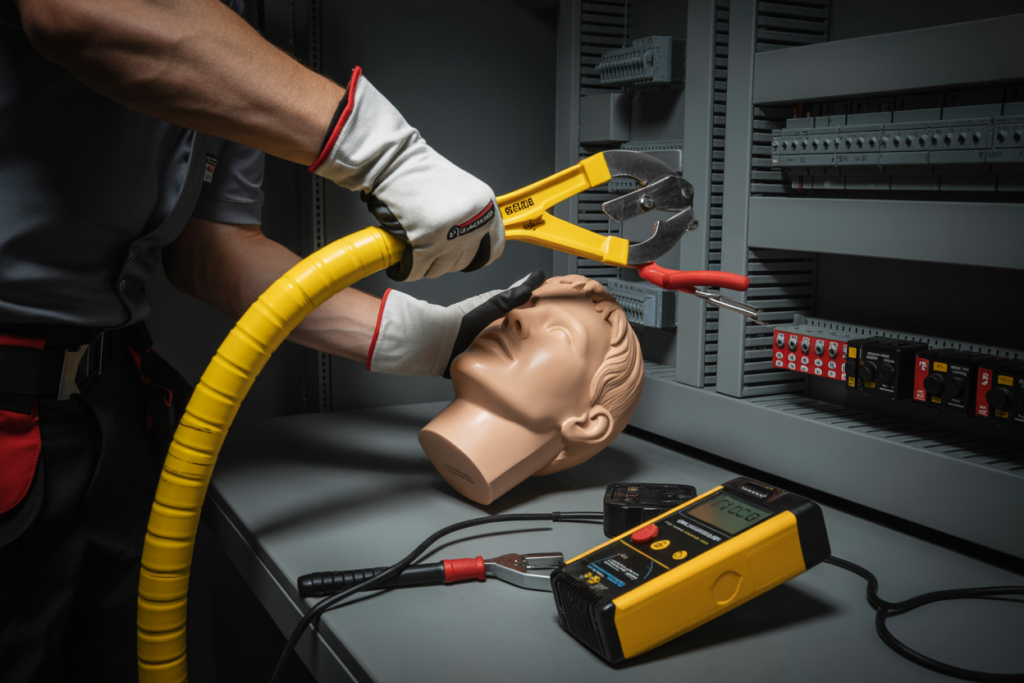
Proper training includes: Mock electrical panels simulating real job sites. Multiple rescue repetitions per student until procedures become automatic. Actually using insulated rescue hooks repeatedly. Licensed electrician instructors with substantial trade experience. Different scenarios requiring real problem-solving.
Instructors who worked as commercial sparkies report most students coming through have done certification before—sometimes multiple times—but never practiced on realistic electrical equipment. First time many properly use an insulated rescue hook is during quality training.
Red Flags
❌ Too many students (minimal practice time)
❌ No electrical equipment visible
❌ Instructor isn’t a licensed electrician
❌ Hours of theory, minimal practical
❌ “Try it once” approach without repetition
Tip #4: Get Same-Day Digital Certificates (Stop Waiting Weeks)
Thursday afternoon: project manager texts. “Need all compliance docs by Monday.” You check your files. Low voltage rescue? Expired last month.
You book a weekend course. Show up. Do the training. Walk out. Then what?
Most providers: “Your certificate will be mailed within 7-14 business days.” That means you can’t start Monday’s job. Can’t give the PM documentation. Another sparkie who’s ready gets the work.
Same-day digital certificates eliminate this completely.
The Waiting Problem
Week 1: No certificate. Can’t start projects. PM asking for docs you don’t have.
Week 2: Still waiting. Calling provider. PM getting impatient. Another sparkie gets your job.
Week 3: Finally arrives. Scan it (terrible quality). Email to PM. Job already went elsewhere.
You did the training. You’re compliant. But no way to prove it when it matters.
Why Same-Day Digital Matters
Immediate Compliance: Finish training → Certificate in inbox same day → Forward to PM that evening → Start Monday fully compliant
Mobile Access: PDF on your phone. Forward from job site. Upload to ESO portal immediately. No scanning physical certificates.
Backup Protection: Email doesn’t get lost. Save multiple locations. Always accessible for audits.
Professional Image: PM asks Thursday, you send Thursday. No “waiting for mail” excuses. Shows you’re organized and ready.
What to Confirm
✅ Digital certificate emailed same day
✅ PDF format (ESO-compatible)
✅ Online portal access
✅ Mobile-friendly delivery
🔔 Break the Panic Cycle: You can't remember cert expiry dates—your brain's got too much else going on. Automated SMS + email reminders at 90/60/30 days before expiry catch renewals before they become emergencies. Let the system remember so you don't have to.

Tip #5: Set Up Automated Renewal Reminders (Stop the 3-Year Panic Cycle)
Sunday evening, checking compliance docs for Monday’s job. You look at your low voltage rescue certification. Expired. Two months ago.
How? Because you’re running a business, managing projects, dealing with family. Tracking cert expiry dates isn’t top of mind when you’re finishing installations before deadline.
Then you’re scrambling. Panic searching at 8pm Sunday. Hoping someone has weekend availability. Stressing about Monday start. This happens constantly. Not because sparkies are disorganized—because there’s no system reminding them before it’s urgent.
The 3-Year Cycle
Year 1: Fresh cert. “I’ll remember when this expires.”
Year 2: Cert stored somewhere. Busy with work.
Year 3: Getting close but you don’t realize it.
Expiry: Discover it’s expired when someone asks. Panic.
Repeat every three years. Same panic every time.
Why Manual Tracking Fails
You can’t remember cert expiry dates. Your brain tracks multiple projects, scheduling, quoting, materials, family obligations, mortgage, insurance renewals, electrical license, CPR, working at heights. That’s too much. Something slips through—usually the thing that only comes up every three years.
How Automated Reminders Work
90 Days Before: “Your cert expires in 3 months. Book now.” Early enough that you’re not panicking. Can browse dates. Book without stress.
60 Days Before: “2 months until expiry. Courses filling up.” Getting closer. If you haven’t booked, this reminds you. Still not urgent.
30 Days Before: “Expires in 30 days. Urgent: Book now.” Final warning. Still got time if you act immediately.
SMS hits you immediately. Email provides booking link. Both methods ensure you’re covered.
What Good Systems Include
✅ SMS + Email delivery
✅ Multiple timeframes (90/60/30 days)
✅ Direct booking links (no searching)
✅ Mobile-friendly (book from job site)
✅ Permanent system (every renewal)
One sparkie renewed five times over 15 years. Every time was panic. After switching to automated reminders, got 90-day SMS in his van. Booked from phone in 2 minutes. Done. “First time in 15 years I sorted it without stress. System remembered so I didn’t have to.”
What Happens Without Reminders
Working with expired cert exposes you to prosecution. ESO requires current certs for license renewal—delays mean you can’t legally work. Can’t start jobs without certification. Every day waiting is a day not earning. PMs remember disorganized sparkies. That reputation costs future work.
Setup Checklist
When booking, confirm:
- Automated renewal reminders offered
- SMS and email both
- 90/60/30 day reminders minimum
- Direct booking links included
- Works for all future renewals
If they don’t offer this, ask why. Basic customer service for compliance training.
Your Next Steps: Getting It Right
You’ve got the five tips:
Tip #1: Weekend courses protect weekday income
Tip #2: 2-minute ASQA verification prevents rejection
Tip #3: Practical training builds real competence
Tip #4: Same-day certificates enable Monday starts
Tip #5: Automated reminders eliminate panic cycles
Now book proper training instead of repeating common mistakes.
What Proper Training Delivers
Weekend training with no lost income. Licensed electrician instructors who’ve performed rescues. Hands-on practice building muscle memory. Same-day certificate delivery. Automated reminders for next renewal.
Making the Decision
Can you lose weekday income? (Tip #1 solves this)
Risk certificate rejection from dodgy RTO? (Tip #2 prevents this)
Comfortable with a cert you couldn’t actually use? (Tip #3 fixes this)
Wait weeks while jobs start without you? (Tip #4 eliminates waiting)
Want to panic every three years? (Tip #5 automates reminders)
Get your low voltage rescue certification sorted properly. Weekend courses. Licensed instructors. Same-day certificates. Automated reminders. Never stress about compliance again.
Your license depends on current certification. Your income depends on Monday readiness. Your competence depends on proper training.
Book Your First Aid Training Now
Fast, affordable, and nationally accredited training delivered by professionals who care
Frequently Asked Questions
Q.How long is low voltage rescue certification valid?
Low voltage rescue certification is valid for 3 years from the date of issue. After three years, you need to complete a renewal course to maintain compliance with WorkSafe Queensland requirements and keep your electrical license current. Most training providers offer renewal courses with the same format as initial certification.
Q.Can I do low voltage rescue training online?
While some theory components might be available online, WorkSafe Queensland requires practical demonstration of rescue procedures for valid certification. Fully online courses without hands-on assessment don't meet legal requirements and certificates from these providers get rejected by ESO Queensland during license renewal. You need in-person training with actual electrical equipment practice.
Q.What's the difference between low voltage rescue and CPR?
Low voltage rescue (PERFORM RESCUE FROM A LIVE LOW VOLTAGE PANEL) includes electrical-specific procedures like power isolation and using insulated equipment before standard first aid, while CPR (HLTAID011) covers standard cardiopulmonary resuscitation. Electrical rescue requires understanding how to safely approach electrocution victims without becoming a second casualty. Many courses bundle both certifications together since electricians need both for license compliance.
Q.Do I need low voltage rescue for my electrical apprenticeship?
Yes, electrical apprentices (typically 3rd and 4th year) need current low voltage rescue certification to work on electrical installations in Queensland. Your employer usually arranges and pays for this training, but you're responsible for maintaining current certification throughout your apprenticeship and career. Check with your employer about their training schedule and requirements.
Q.What happens if my low voltage rescue certification expires?
Working with expired certification exposes you to WorkSafe prosecution, invalidates your public liability insurance, and prevents license renewal with ESO Queensland. During site audits, WorkSafe can suspend licenses on the spot for expired certifications. Project managers remove you from jobs when certificates come back invalid during verification checks. Get it renewed before expiry to avoid these consequences.
Q.What should I bring to low voltage rescue training?
Most training providers require valid photo ID (driver's license), covered work boots, and comfortable clothing suitable for practical exercises. Some provide all equipment and materials, while others ask you to bring your own pen and note-taking materials. Contact your training provider before the course to confirm their specific requirements and whether they provide lunch or if you need to bring your own.
Q.Is low voltage rescue certification recognized across Australia?
Low voltage rescue certification is nationally recognized across Australia, though state-specific licensing requirements vary. Your Queensland certification is valid for work in other states, but you'll need to comply with that state's electrical licensing requirements. Always verify with the relevant state electrical safety authority about their specific requirements before working interstate on electrical installations.
Making first aid training more affordable for
every classroom
We believe every student deserves access to life-saving first aid knowledge. That’s why we offer specially reduced pricing for schools and educational groups. Whether you’re booking for a single class, a year group, or your entire school, our flexible packages make training more accessible and cost-effective — without compromising quality.
