
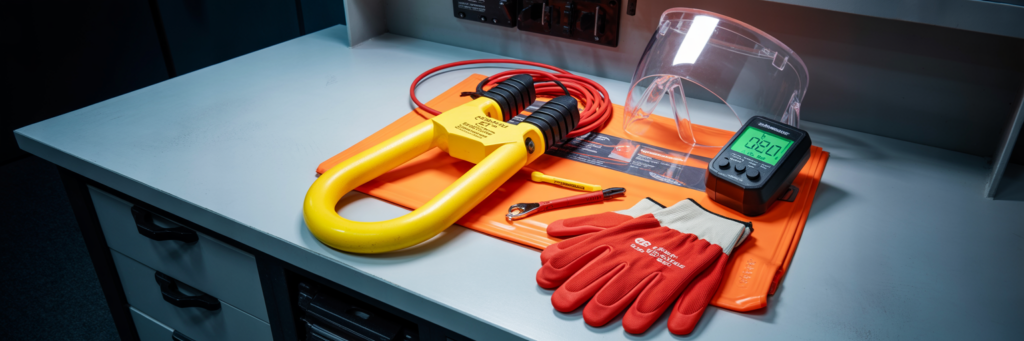
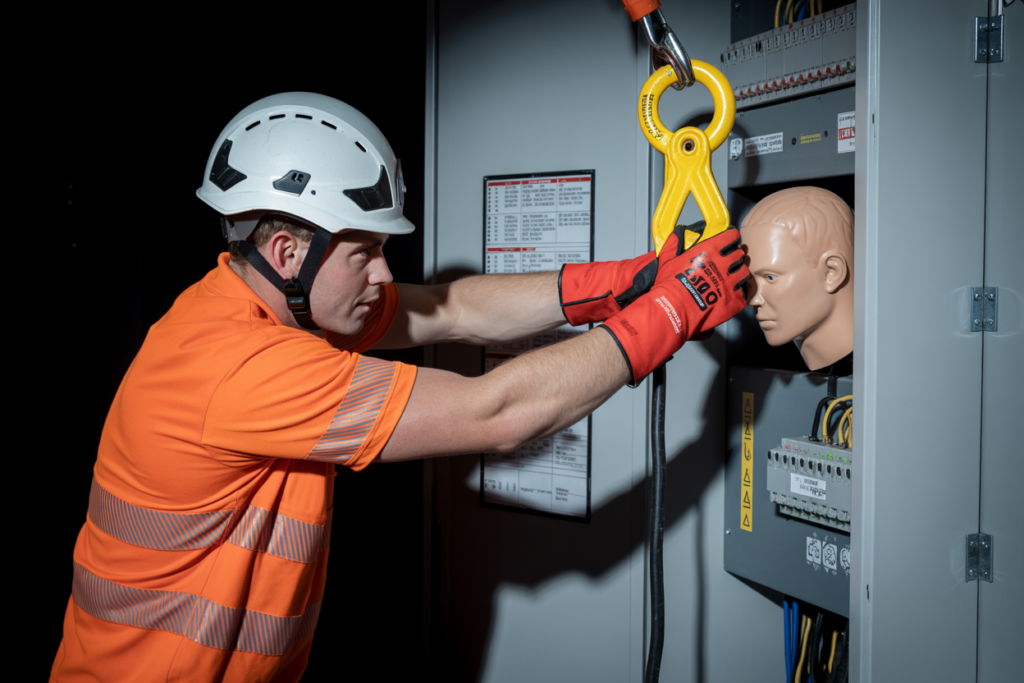
It’s early morning on a job site. Your apprentice starts work on a switchboard. Thirty seconds later, he’s convulsing against the panel—240V coursing through his body. You sprint over. Your hand reaches for the insulated rescue hook.
Except it’s not there.
Your low voltage rescue kit is incomplete. Or worse—you don’t have one at all. The seconds tick by. Every moment matters.
This complete low voltage rescue kit checklist makes sure you’re prepared for the emergency you pray never happens. Whether you’re a licensed electrician, a subcontractor managing multiple job sites, or an electrical contractor equipping your crew, having the right equipment isn’t optional—it’s a WorkSafe Queensland legal requirement.
⚡ QUICK REFERENCE: Electrical incidents happen in seconds. Brain damage starts at 30 seconds. Your rescue kit needs to be within arm's reach, not buried in your van. This isn't about passing audits—it's about saving lives.
What is Required in a Low Voltage Rescue Kit?
A compliant low voltage rescue kit for Queensland electricians must contain the following equipment as mandated by WorkSafe Queensland:
Essential Equipment:
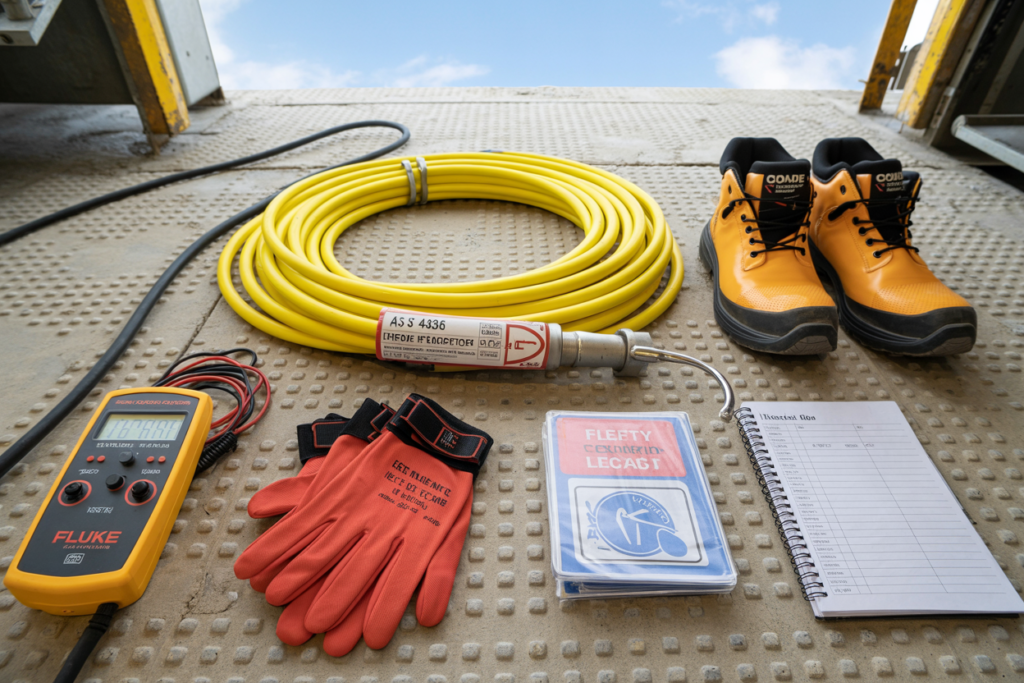
- Insulated rescue hook (minimum 1 meter length, rated for electrical use)
- Insulated gloves (Class 00 or higher, tested and certified)
- Safety boots (electrical hazard rated, non-conductive sole)
- Voltage detector/tester (non-contact type, properly calibrated)
- First aid kit (including CPR face shield)
- Emergency contact information (posted and accessible)
- Inspection/maintenance log (documenting equipment checks)
Additional Recommended Items:
- Insulated blanket for victim covering
- Torch/flashlight (battery-operated)
- Warning signs and barrier tape
- Emergency procedure card
All equipment must be regularly inspected, properly maintained, and readily accessible at the work site.
Here’s what most sparkies miss: having the equipment is completely different from knowing how to use it. WorkSafe can ask you to demonstrate rescue procedures on site. If you freeze or fumble with that rescue hook, your certificate doesn’t mean much.
Why Every Queensland Electrician Needs a Low Voltage Rescue Kit
Legal Requirements Under WorkSafe Queensland
The Electrical Safety Act 2002 doesn’t give you options here. If you’re performing electrical work in Queensland, you’re required to have appropriate rescue equipment available where you’re working. Right now.
WorkSafe Queensland’s Electrical Safety Code of Practice spells it out: any person performing electrical work must have access to rescue equipment suitable for the voltage they’re working with.
Electrical incidents move fast. You’ve got maybe 30 seconds before brain damage starts. Maybe 4 minutes before it’s likely fatal. Your rescue kit isn’t about passing an audit—it’s about those 30 seconds.
Your License Depends On It
Every project manager you work with knows you need current Low Voltage Rescue training and rescue equipment accessible.
Here’s what happens during a WorkSafe audit: inspector shows up, checks your licenses, then asks “Where’s your rescue equipment?” You open the kit. The insulated gloves have cracks. The rescue hook is missing. The voltage detector has dead batteries.
License suspended on site. Can’t work electrical for a minimum of 6 months. Your reputation is destroyed. Your income is zero.
All because your low voltage rescue kit wasn’t maintained.
Complete Low Voltage Rescue Kit Checklist (2025 Compliance)
Primary Rescue Equipment (Non-Negotiable)
Insulated Rescue Hook
This is the tool that separates a victim from a live electrical source without you becoming victim number two.
Minimum length: 1 meter. But here’s what experienced sparkies know—1 meter is too short for most commercial switchboards. A 1.5 meter or 2 meter hook gives you the distance you actually need.
Voltage rating: Must be rated for at least 1000V for low voltage work. Don’t buy a hook with no rating label.
Australian Standard: AS 4836. Check the label. If it doesn’t reference this standard, it’s probably imported rubbish.
Insulated Gloves
These aren’t your regular work gloves. These are tested, certified, Class-rated electrical safety gloves.
For low voltage work, you need Class 00 minimum. That’s rated for up to 500V AC. Class 0 goes to 1000V AC.
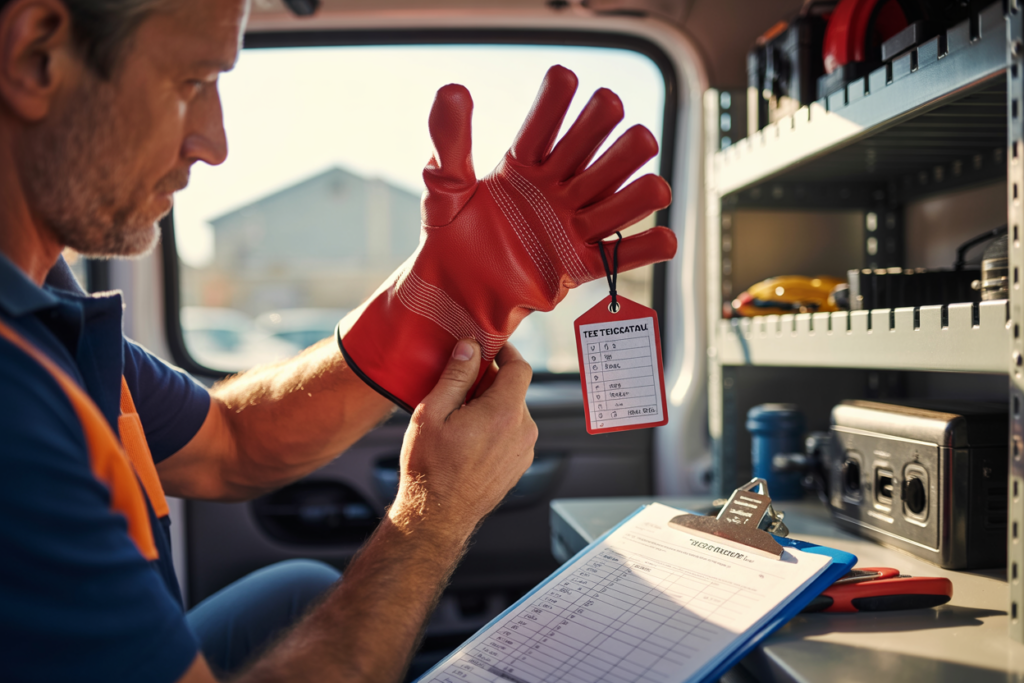
Here’s the bit that catches people: insulated gloves need testing every 6 months. Not “inspect them yourself.” Actual electrical testing by a certified facility. The gloves come back with a test date stamp. If that stamp is over 6 months old, WorkSafe will fail you on the spot.
Storage kills gloves faster than use. Don’t leave them in your van in summer. Heat destroys the rubber. Don’t fold them. Don’t store them under heavy tools. Keep them in the bag they came in, somewhere climate controlled if possible.
Signs your gloves are done: cracks, punctures, ozone damage (looks like tiny cracks all over), swelling, stiffness. Bin them. Don’t risk it.
Voltage Detector/Tester
Non-contact voltage detector. The kind that beeps and lights up when it detects voltage.
Must be calibrated and functioning. Test it on a known live source before every job. Keep spare batteries in your kit.
Cheap detectors give false readings. When you’re verifying an installation is de-energized before rescue, you need accuracy.
The Reality Check
Here’s what most Low Voltage Rescue training doesn’t tell you: having this equipment and knowing how to use it under pressure are completely different things.
Your last training, you practiced on a mannequin in a well-lit room with everyone watching calmly. Real electrical incidents are chaos. Alarms are screaming. Someone’s screaming. Your apprentice is convulsing. The panel is arcing. You’ve got maybe 20 seconds before permanent brain damage starts.
In that moment, your hands need to know what to do automatically.
Personal Protective Equipment (PPE)
Safety Boots (Electrical Hazard Rated)
Not just steel caps. Electrical hazard rated boots with non-conductive soles.
The rating you’re looking for: ASTM F2413-11 or AS/NZS 2210.3. Regular work boots with steel caps can actually conduct electricity through the sole.
Arc Flash Protection
Face shields and arc-rated long sleeves are smart on switchboard work. Arc flash is hot enough to cause third-degree burns and bright enough to damage your eyes.
First Aid and Emergency Response
CPR Equipment
Face shields and pocket masks are required. Keep multiple CPR face shields in your kit because they’re single-use.
Electrical shock affects the heart differently than other emergencies. The person might look dead but might still have a shockable rhythm.
Emergency Contact Cards
Laminated cards with triple zero (000), site address, nearest hospital, WorkSafe Queensland incident reporting number, and your company’s emergency contact. Under stress, you forget basic information.
Documentation and Compliance Records
Equipment Inspection Logs
Simple notebook where you record date, equipment checked, pass/fail, any issues, and your signature. Do this before each job. Takes 2 minutes.
During an audit, if you’ve got 6 months of documented checks, you look organized. If you’ve got nothing, you look negligent.
Testing Certificates for Insulated Equipment
Your gloves come back from testing with a certificate showing date tested, voltage rating verified, pass/fail result, next test due date, and testing facility details. Keep this with the gloves or in your kit.
🚫 OVERSEAS EQUIPMENT WARNING: That $80 rescue hook from eBay? Probably doesn't meet AS 4836. WorkSafe knows every fake label and dodgy import. If it breaks during an actual rescue, you've got no warranty, no insurance coverage, and potentially a dead apprentice. Buy Australian Standards-compliant equipment from reputable suppliers.
How to Choose Quality Low Voltage Rescue Equipment
Australian Standards You Need to Know
AS/NZS 2481 – Insulated Gloves
When you buy gloves, the label must reference this standard. If it doesn’t, they’re not compliant.
AS 4836 – Rescue Hooks
Your hook needs permanent labels showing manufacturer, voltage rating, standard compliance, and manufacturing date.
AS/NZS 61243 – Voltage Detectors
Cheap voltage detectors don’t meet this standard. They might miss lower voltages or give false readings.
The Overseas Equipment Problem
eBay and Alibaba are full of “electrical rescue equipment” for a third of the price. Most of it doesn’t meet Australian Standards. WorkSafe knows what to look for.
If that cheap rescue hook breaks when you’re pulling someone off a live panel, you’ve got no recourse. No Australian warranty. No insurance coverage because you knowingly used non-compliant equipment.
What to Look for When Buying Rescue Hooks
Length Matters
Commercial switchboards are often mounted high. You might be reaching at awkward angles. One meter works in training rooms. In real job sites, it’s often too short.
Voltage Rating
For low voltage work, you need minimum 1000V AC rating clearly marked on the hook. Permanent label, not a sticker.
Material Quality
Check for smooth finish, solid construction, properly secured hook end, and weatherproof coating. The hook end should catch clothing and belts, not just push.
Insulated Gloves: Class Ratings Explained
Class 00 – Up to 500V AC
For most sparkies doing residential and light commercial. Covers single-phase and most low voltage work.
Class 0 – Up to 1000V AC
For three-phase commercial work regularly.
Testing Requirements
Every 6 months, your gloves go to a certified testing facility for electrical testing.
Storage Requirements
Heat degrades rubber. Ideal storage: cool, dry place away from direct sunlight. Not folded, not compressed under tools.
When to Replace
Replace immediately if you see visible cracks, punctures, chemical damage, stiffness, or failed electrical testing. Don’t try to patch or repair insulated gloves.
Low Voltage Rescue Kit Maintenance and Inspection
Daily Pre-Job Site Inspections
The two-minute van check before your first job:
- Rescue hook: Still there? No visible cracks or damage?
- Gloves: No tears or cracks? Test date stamp current?
- Voltage detector: Press test button. Does it work?
- First aid gear: Face shields still sealed?
- All equipment accessible: Can grab it quickly if needed?
Write the date and your initials in your log.
Monthly Detailed Equipment Checks
Once a month, do the proper inspection.
Insulated Glove Testing: Check for cracks, punctures, embedded debris, discoloration, and stiffness. Do the inflation test: blow air in, roll the cuff to trap air, squeeze. Air leaking out means there’s a hole.
Rescue Hook Integrity: Run your hands down the full length. Feel for cracks, rough spots, splintering. Check the hook end is secure. Verify labels are still readable.
When to Replace Equipment
Insulated Gloves: Failed testing, visible cracks or tears, punctures, or over 3 years old.
Rescue Hooks: Cracks in handle, loose hook end, splintering fiberglass, labels worn off, or previously used in actual rescue.
Voltage Detectors: False readings, physical damage, or over 5 years old.
Low Voltage Rescue Procedures: Using Your Equipment
The Critical First 30 Seconds
Electrical current passing through the human body causes muscle contractions. The victim can’t let go. You’ve got maybe 30 seconds before serious brain damage begins. Maybe 4 minutes before it’s likely fatal.
Your brain is screaming at you to grab them. That’s also what gets two people killed instead of one.
Step-by-Step Rescue Procedure
Step 1: Scene Assessment – Stop. Don’t rush in. Identify the electrical source. Call out: “Stop! Electrical incident! Nobody touch them!”
Step 2: Isolate the Power – If you can safely and quickly hit the emergency stop or switch off the isolator, do it first.
Step 3: Don Protective Equipment – Put on your insulated gloves fast. If you can’t get gloves on immediately, proceed with the rescue hook anyway.
Step 4: Use Rescue Hook – Hook the victim’s clothing or belt. Pull firmly away from the electrical source in one smooth motion. Once clear, drop the hook.
Step 5: Verify De-Energization – Use your voltage detector to check around the victim before touching them.
Step 6: Check Responsiveness – “Are you OK?” If they respond, monitor them and call 000. If no response and not breathing, move immediately to CPR.
Step 7: Begin CPR – 30 compressions, 2 rescue breaths. Continue until help arrives.
Common Mistakes That Get People Killed
Mistake #1: Grabbing the victim without thinking. If they’re still in contact with the source, you become part of the circuit.
Mistake #2: Standing in water while performing rescue. That water might be energized.
Mistake #3: Not calling for help fast enough. Call early. Get others to call while you rescue.
Why Reading This Doesn’t Mean You’re Prepared
You understand the steps intellectually. But if an electrical incident happened tomorrow, you’d probably freeze.
Because knowing steps and performing them under stress are completely different. Information doesn’t save lives. Trained responses do.
You need to actually practice with rescue hooks, put on gloves under time pressure, perform procedures 10-15 times. That’s what proper Low Voltage Rescue training provides.
Training Requirements: Making Your Equipment Actually Useful
The Gap Between Having Equipment and Knowing How to Use It
Everything’s tested, maintained, compliant. WorkSafe would pass you. But could you actually save someone’s life with this equipment?
Most sparkies know the answer is “probably not.” The actual technique? The muscle memory? That’s gone.
What WorkSafe Actually Requires for Training
Anyone performing electrical work must have current training in:
- PERFORM RESCUE FROM A LIVE LOW VOLTAGE PANEL
- HLTAID011 Provide CPR
Training validity: 3 years. Must be delivered by an ASQA-registered RTO.
The Difference Between Compliant Training and Competent Training
| Training Type | What You Get | What You Don't Get |
|---|---|---|
| Compliant | Certificate, legal compliance, PowerPoint slides, quick mannequin practice | Muscle memory, confidence under pressure, realistic scenarios, repetition |
| Competent | All of the above PLUS hands-on practice, electrical scenarios, 10-15 repetitions, stress training | Nothing - you're actually prepared |
Choosing Quality Low Voltage Rescue Training
Red Flags: “Online training available,” instructors with only OHS qualifications, “quick certificate” marketing, no ASQA registration visible.
Green Flags: Instructors are licensed electricians with extensive experience, heavy hands-on component, mock electrical scenarios, multiple practice repetitions, ASQA registered, other sparkies recommend them.
When to Renew Your Training
Your certificate is valid for 3 years. Most sparkies wait until the last minute, then scramble.
Better approach: Renew 6-12 months early
Training 2.5 years ago means your skills have deteriorated. Renewing early means skills stay fresher. When your certificate expires in 8 months, there’s no urgency. When it expires in 6 weeks, you’re scrambling.
Making the Training Investment
Training is required every 3 years.
What You’re Actually Buying: Legal compliance, WorkSafe audit confidence, insurance protection, actual emergency competence, crew safety capability, professional reputation.
What Training Prevents: WorkSafe fines, license suspension, deaths because you froze, insurance claim denials, career-ending reputation damage.
Your rescue equipment is ready. Are you?
Conclusion: Being Genuinely Prepared, Not Just Compliant
Early morning. Job site. Your apprentice is convulsing against a live panel.
In that moment, what matters is: rescue hook in your hand, muscle memory kicking in, competent response saving someone’s life.
Everything in this guide—the equipment checklists, the maintenance schedules, the compliance requirements—exists to prepare you for those 30 seconds you pray never happen.
Your low voltage rescue kit protects:
- Your crew’s lives
- Your electrical license
- Your income and livelihood
- Your family’s financial security
- Your professional reputation
Equipment + training = actual preparedness.
You can have the best rescue hook money can buy. Perfectly maintained gloves. Compliant voltage detector. But if you haven’t practiced rescue procedures in 2+ years, if you’d freeze under pressure—that equipment doesn’t help.
Don’t just check the box. Be genuinely ready.
Get the gear. Get the training. Be prepared.
Book Your First Aid Training Now
Fast, affordable, and nationally accredited training delivered by professionals who care
Frequently Asked Questions
Q.How often do I need to test my insulated gloves?
Insulated gloves must be electrically tested every 6 months by a certified testing facility. This isn't optional or something you can do yourself—it's a WorkSafe Queensland requirement. The testing facility will return your gloves with a certificate showing the test date, voltage rating verified, and next test due date. If your gloves are over 6 months past testing during a WorkSafe audit, you'll fail on the spot regardless of how good the gloves look visually.
Q.Can I keep my rescue equipment in my van permanently?
You can keep most equipment in your van, but insulated gloves should go home with you each night. Summer temperatures inside vehicles can exceed 60°C, which rapidly degrades the rubber in electrical gloves and causes them to fail testing early. Store gloves in a cool, dry place at home and bring them to work daily. Everything else can stay in the van if stored in a protective case or bag, but check it regularly for heat damage.
Q.Do I need different equipment for single-phase vs three-phase work?
No, the same equipment covers both if it's properly rated. For standard low voltage work (up to 1000V AC), your rescue hook should be rated for at least 1000V and your gloves should be Class 00 (500V) or Class 0 (1000V). Single-phase residential work (240V) and three-phase commercial work (415V) both fall within these voltage ratings. However, make sure your equipment voltage rating covers the maximum voltage you work with.
Q.What's the minimum length rescue hook I need?
The legal minimum is 1 meter, but experienced sparkies recommend 1.5 to 2 meters for most commercial work. One meter works in training environments but is often too short when you're reaching into elevated switchboards, working at awkward angles, or trying to create safe distance from the electrical source. The extra length provides better reach and safety margin in real-world scenarios. Check with your training provider or WorkSafe requirements for specific work environments.
Q.Can I buy second-hand rescue equipment to save money?
Not recommended. You don't know the storage history, whether it's been damaged and repaired, if it was used in previous rescues, or if testing certificates are legitimate. Australian Standards labels might be fake or from non-compliant equipment. The money you save upfront isn't worth the risk of equipment failure during an actual rescue or being failed during a WorkSafe audit. Buy new equipment from reputable suppliers with proper documentation and warranties.
Q.My voltage detector is working but the batteries are low. Can I still use it?
No. Low batteries can cause false readings or complete failure at the worst possible moment. Replace batteries immediately when the low battery indicator shows, and keep spare batteries in your kit at all times. Testing your voltage detector on a known live source before each job (like a standard power point) helps verify it's functioning properly. A voltage detector that misses live voltage because of weak batteries can kill you.
Making first aid training more affordable for
every classroom
We believe every student deserves access to life-saving first aid knowledge. That’s why we offer specially reduced pricing for schools and educational groups. Whether you’re booking for a single class, a year group, or your entire school, our flexible packages make training more accessible and cost-effective — without compromising quality.
