
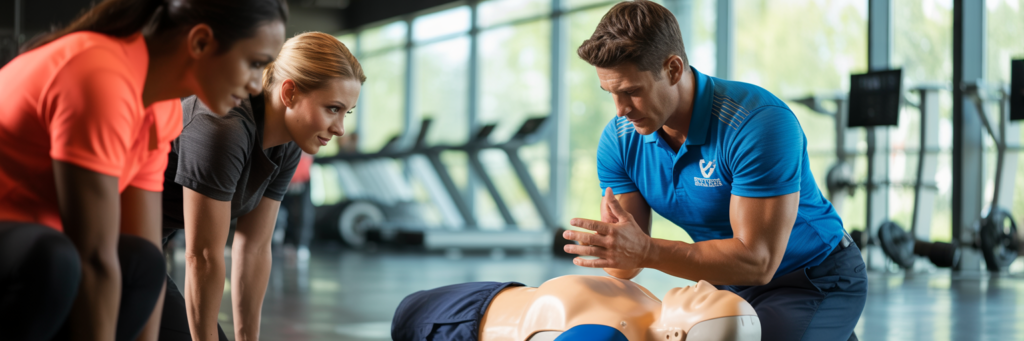
Your 58-year-old client collapses during burpees at the park. His face is grey. He’s not breathing. Your hands are shaking. You know you did CPR training 11 months ago, but right now, your mind is completely blank. Do you tilt the head back first? How many compressions? How deep do you push?
This nightmare scenario is why understanding exactly what HLTAID009 course covers isn’t just about ticking a compliance box—it’s about having the muscle memory to save a life when every second counts.
Whether you’re a Brisbane personal trainer rushing to renew before your Fitness Australia deadline, or a gym instructor wanting genuine confidence (not just a certificate), this guide breaks down the 10 critical skills you’ll master in HLTAID009 training—and why each one could protect your clients, your insurance coverage, and your entire fitness career.
Let’s get into what HLTAID009 course actually covers—and why it’s the most important investment in your training career.
⚠️ Sobering Statistics: Studies show 70% of cardiac arrests in fitness facilities occur in people with no prior symptoms. CPR performed immediately increases survival rates by 200-300%. Without CPR, brain damage begins within 4-6 minutes. Your HLTAID009 training is literally the difference between life and death for your clients.
What Does HLTAID009 Course Cover? (Quick Answer)
HLTAID009 course covers essential CPR (Cardiopulmonary Resuscitation) skills required to respond to life-threatening emergencies. This nationally recognized certification teaches you to:
- Assess emergency situations and recognize when CPR is needed
- Perform high-quality chest compressions at correct depth (5-6cm) and rate (100-120/min)
- Deliver effective rescue breaths using proper airway management techniques
- Use Automated External Defibrillators (AEDs) to restore normal heart rhythm
- Manage choking incidents in conscious and unconscious casualties
- Provide CPR for adults, children, and infants with age-appropriate modifications
- Handle multiple casualty scenarios and prioritize treatment
- Communicate with emergency services (000 in Australia) effectively
- Recognize when to stop CPR based on signs of life or paramedic arrival
- Complete accurate incident documentation for legal and insurance purposes
HLTAID009 certification is valid for 12 months and meets Australian Resuscitation Council guidelines. Brisbane personal trainers, fitness instructors, and gym staff require this certification for Professional Indemnity insurance and Fitness Australia registration compliance.
The 10 Essential Skills HLTAID009 Course Covers
HLTAID009 training goes far beyond “push hard on the chest and hope for the best.” This nationally recognized certification teaches 10 specific, evidence-based skills that work together to give a cardiac arrest victim their best chance of survival. Whether you’re training clients at gyms or running outdoor bootcamps, these are the exact techniques you’ll practice hands-on during your HLTAID009 course.
| Skill | What You Learn | Why It Matters for Brisbane Trainers |
|---|---|---|
| DRSABCD Protocol | Emergency scene assessment | Prevents you becoming the second casualty |
| Chest Compressions | Correct depth (5-6cm), rate (100-120/min) | Most critical skill—effective compressions = 2-3x survival rate |
| Rescue Breathing | Airway management, breath delivery | Delivers oxygen to brain during cardiac arrest |
| AED Operation | Defibrillator use | Restarts heart rhythm—can't be done with CPR alone |
| Choking Management | Back blows, chest thrusts | Common gym emergency (protein shakes, gum, supplements) |
| Pediatric CPR | Child/infant modifications | Family bootcamps, home training with kids present |
| Multiple Casualties | Triage and prioritization | Outdoor group training accidents |
| Calling 000 | Effective communication | Gets paramedics to exact location fast |
| Recognizing Need | When to start/stop CPR | Prevents unnecessary CPR or fatal hesitation |
| Documentation | Incident reports | Protects you from liability claims |
Skill #1: Emergency Scene Assessment & Safety (DRSABCD Protocol)
Before you even touch a collapsed client, you need to make sure you’re not about to become the second casualty.
The DRSABCD protocol is your mental checklist for those first chaotic 10 seconds: Danger (check for hazards), Response (is the person conscious?), Send for help (call 000), Airway (open and clear), Breathing (check if breathing normally), CPR (start compressions if needed), Defibrillation (use AED if available).
Your client collapses next to the squat rack. You rush over without looking. Another trainer is re-racking heavy plates overhead. Those plates fall. Now there’s two people down instead of one.
Checking for danger isn’t paranoia—it’s making sure you can complete the rescue. Your Professional Indemnity insurance doesn’t cover you if you get injured during an unsafe rescue attempt. During HLTAID009, you’ll practice until it’s automatic: tap shoulders firmly, shout “Are you okay?”, watch for response.
Skill #2: High-Quality Chest Compressions (Correct Depth, Rate & Recoil)
This is where most personal trainers discover their CPR training from last year completely failed them.
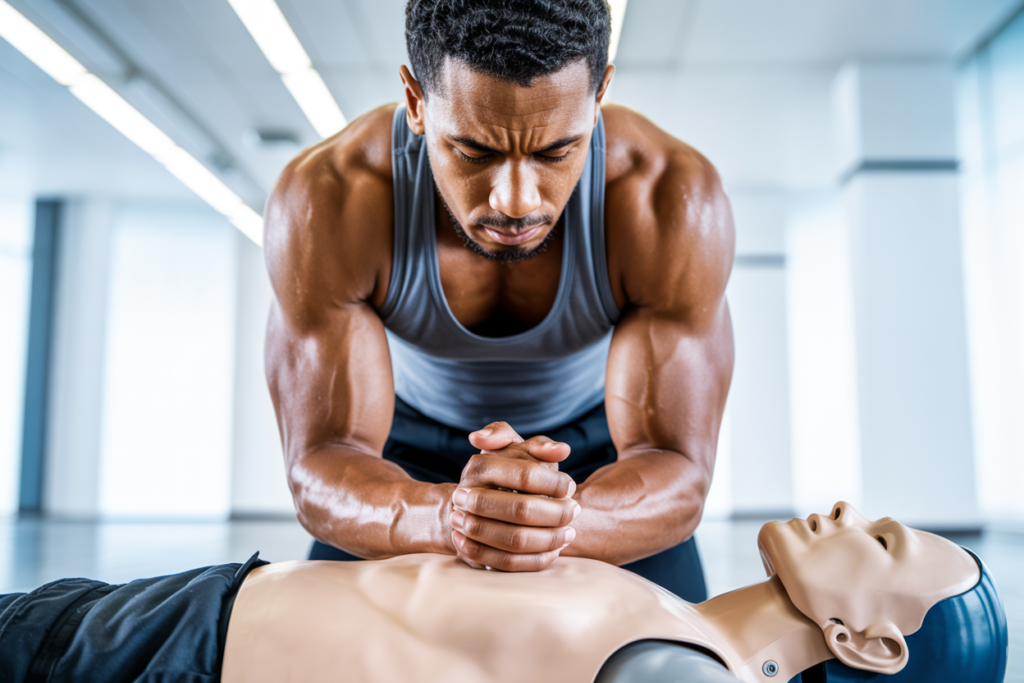
Compression depth: 5-6cm for adults
Not 2cm. Not “press kinda hard.” Exactly 5-6 centimeters. That’s roughly the height of a stack of three credit cards.
Why does depth matter? Because the heart sits behind the sternum, and you need to physically compress it between the sternum and the spine to force blood out into circulation. Too shallow and you’re just pushing on chest fat and muscle—no blood moves, no oxygen reaches the brain.
Compression rate: 100-120 per minute
This is the tempo of the Bee Gees’ “Stayin’ Alive.” Too slow and you’re not circulating enough blood volume. Too fast and the heart doesn’t have time to refill between compressions.
Hand placement: center of chest, lower half of sternum
Find where the ribs meet in the middle, place two fingers above this point, then place the heel of your other hand next to your fingers. Stack your second hand on top, interlocking fingers. Position your shoulders directly over your hands.
Get this wrong and you risk broken ribs, punctured lungs, or ineffective compressions that don’t save the person.
Skill #3: Rescue Breathing & Airway Management
Before rescue breaths, you need to open the airway. A collapsed person’s tongue falls back and blocks their throat. The technique: place one hand on their forehead, two fingers under their chin, tilt the head back while lifting the chin up.
Checking for normal breathing: Get your face close. LOOK at their chest, LISTEN for breath sounds, FEEL for air movement on your cheek. You’ve got 10 seconds max.
Here’s what trips up trainers: agonal breathing—gasping, irregular, occasional breaths. It’s not enough. Their brain is suffocating. HLTAID009 shows you the difference.
Giving rescue breaths: Two breaths after every 30 compressions. Maintain head tilt, chin lift. Pinch nose shut. Seal your mouth over theirs. Blow for 1 second—watch chest rise. Turn your head, watch chest fall. Back to compressions immediately.
Face shields and pocket masks: Your HLTAID009 course shows you these barriers. Carry one—they’re about $10, fit in your gym bag, and you’re way more likely to perform rescue breaths knowing you’ve got that barrier.
What if you can’t do rescue breaths? Compression-only CPR is still effective. Studies show similar survival rates for the first 6-8 minutes. Doing compressions without breaths is infinitely better than doing nothing.
Skill #4: AED (Automated External Defibrillator) Operation
Most personal trainers have seen the AED cabinet on the gym wall. Most have never touched one. Here’s the thing: these devices are idiot-proof, designed so a panicking bystander can save someone’s life.
What an AED does: It delivers an electrical shock to stop an abnormal heart rhythm. The heart’s electrical system has gone haywire. The AED delivers a massive electrical reset so the heart’s natural pacemaker can take over.
Step-by-step operation: Someone retrieves the AED while you continue compressions. Open the case—it turns on automatically and starts talking: “Stay calm. This device will guide you through the process.”
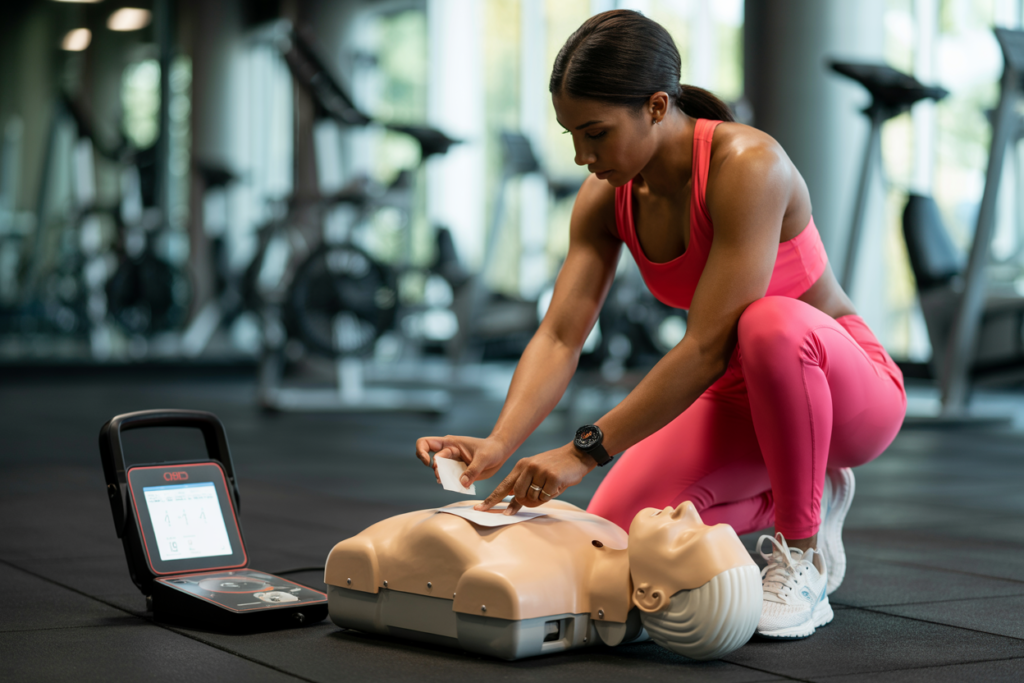
Cut the shirt off. Apply the pads—one on the right side of chest below the collarbone, one on the left side below the left nipple. The pads show exactly where they go.
“Analyzing heart rhythm. Do not touch the patient.” You shout: “Everyone clear!” Make sure no one is in contact.
If shockable rhythm detected: “Shock advised. Press the flashing orange button now.” You shout: “Everyone clear! I’m shocking!” Press the button. Their body jerks.
“Shock delivered. Start CPR.” You immediately resume compressions. Don’t check for pulse. The AED told you to do CPR, so you do CPR.
Your HLTAID009 training removes the fear. You’ve practiced this repeatedly. When a real emergency happens, your hands know what to do.
Skill #5: Choking Management (Conscious & Unconscious Casualties)
Your client is doing walking lunges, starts choking on pre-workout gum. Face goes red. Hands clutching throat. Can’t talk. Can’t breathe. You’ve got about 60 seconds.
Recognizing true obstruction: Universal choking sign (hands clutching throat), cannot speak, cannot cough effectively, silent or high-pitched wheezing, face turning red then blue.
If they can cough forcefully, DO NOT interfere. Your HLTAID009 instructor will drill this: “If they can cough, let them cough.”
Back blows: Position slightly to the side and behind. Support their chest, lean them forward. Strike firmly between shoulder blades with heel of your hand. Give up to 5 back blows.
Chest thrusts (Heimlich): If back blows fail, stand behind them, wrap arms around waist. Make a fist above belly button. Pull sharply inward and upward. Up to 5 chest thrusts.
Alternate between 5 back blows and 5 chest thrusts until object comes out, they breathe, or they become unconscious.
When they become unconscious: Choking management becomes CPR. Lower them down, call 000, look for the object in their mouth. If not visible, start CPR. After every 30 compressions, check their mouth before rescue breaths. Sometimes compressions dislodge the object.
Skill #6: CPR for Children & Infants (Age-Appropriate Modifications)
You’re running a family bootcamp or training at a client’s home when their 8-year-old collapses. Suddenly, you need pediatric CPR.
Age definitions: Infant (less than 1 year), Child (1 year to puberty, roughly 12-14 years), Adult (puberty onward).
Infant CPR: Use TWO fingers only (index and middle). Hand placement: center of chest, just below nipple line. Compression depth: 4cm (one-third chest depth). Rate: 100-120 per minute. Why two fingers? An infant’s sternum is tiny—using your whole hand would break ribs or damage organs.
Rescue breaths for infants: Cover BOTH mouth AND nose with your mouth. Use gentle puffs—just enough for chest rise. Too much air pressure can rupture infant lungs.
Child CPR: Use ONE hand on center of chest. For larger children approaching puberty, use two hands like adult CPR. Compression depth: 5cm (one-third chest depth).
Why technique matters: Using full adult force on a 3-year-old can break multiple ribs, puncture lungs, lacerate liver or spleen. Blowing full adult breath into an infant can rupture lung tissue.
This is why HLTAID009 can’t be done online. You need practice on actual infant and child-sized mannequins to feel how much less pressure is required.
Skill #7: Multiple Casualty Management & Prioritization
Three clients go down simultaneously during outdoor bootcamp. All unconscious. You’re the only trained person. Who do you help first?
Triage principle: Treat the person most likely to survive with immediate intervention. Not the most injured. Not the loudest. The person who will die in the next 2-3 minutes without help, but who you can save.
Priority 1 (Immediate): Not breathing → Start CPR immediately. Severe bleeding → Apply pressure, move to next casualty.
Priority 2 (Urgent): Breathing but unconscious → Recovery position. Fractured bones but stable → Reassure, minimize movement.
Priority 3 (Non-urgent): Conscious and alert → Give them a job (call 000, bring first aid kit).
Managing as solo rescuer: Call for help or delegate. Rapid triage—assess all casualties quickly. Treat highest priority first. After 2 minutes CPR, reassess and move to next priority.
Using bystanders: Point at specific person: “You in the red shirt! Start chest compressions on this person while I check the others! 30 compressions, push hard and fast in center of chest!” Don’t ask for volunteers—give specific instructions.
Skill #8: Calling 000 Effectively (Critical Information Delivery)
What 000 operators need:
Location (specific): Not just “the park”—”South Bank Parklands, near the Wheel of Brisbane, riverside path between Streets Beach and the Arbour.”
What’s happening: “Man in his 50s collapsed during exercise, not breathing, no response.”
What you’re doing: “I’m starting CPR now.”
Additional hazards: “We’re on wet grass, it’s raining” or “Three other casualties, all breathing but injured.”
Switch to speakerphone immediately. Place phone near casualty’s head. Don’t hang up until paramedics arrive.
When paramedics arrive: Quick handover: “He’s 52, doing burpees, collapsed suddenly, no pulse, not breathing, we’ve been doing CPR for 6 minutes, AED delivered one shock.”
Skill #9: Recognizing When CPR is Needed (vs When It’s Not)
Clear-cut case: Not breathing (chest not rising, no breath sounds, no air movement) and unresponsive → Start CPR immediately. No pulse check required.
Confusing cases:
Agonal breathing: Occasional gasping sounds, chest barely moving once every 5-10 seconds. Your instinct says they’re breathing. HLTAID009 training says: Agonal breathing is NOT normal breathing. Start CPR immediately.
Just fainted: Client stands up quickly, goes pale, collapses. Check breathing first—if breathing normally, they’ve just fainted. Lay them down, elevate legs.
Key distinction: Breathing = no CPR needed (yet). Unconscious doesn’t automatically mean CPR. The critical factor is adequate breathing.
When in doubt, start CPR. If you’re deciding for more than 15 seconds, the answer is YES. If they don’t need it, they’ll wake up and push you away. If they DO need it and you’re debating, brain damage is happening.
Skill #10: Incident Documentation & Legal Requirements
The emergency doesn’t end when paramedics leave. Your legal obligations are just beginning.
What to document: Date, time, location. What activity was happening. Your assessment findings (responsive/unresponsive, breathing/not breathing). Actions you took and when (started CPR at 6:47am, applied AED at 6:51am). When paramedics arrived. Client’s condition when leaving.
Write factually: “Client’s face turned grey. He grabbed his chest and said ‘my arm hurts.’ He collapsed. I checked for response—no movement. I checked for breathing—chest not rising. Started CPR at 6:47am.” NOT: “Client probably had heart attack because of family history.”
Complete within 24 hours. Details fade fast. Who gets copies: PI insurance (within 72 hours), gym manager, Fitness Australia if required, your records (keep 7 years).

How to Retain CPR Skills After Your Course
CPR skills deteriorate after 3-6 months without practice. Compression depth becomes shallow, rate drifts off tempo, hand placement gets sloppy.
Monthly practice (10 minutes): Practice compression technique on firm pillow—hand position, body positioning, rhythm counting. Mental walk-through of DRSABCD. Watch AED training videos.
Quarterly hands-on practice: Find 2-3 trainers for practice sessions with a mannequin. Get feedback. Do two-person CPR relays. Practice with distractions.
Mental rehearsal (weekly): Visualize detailed emergency scenarios. Your brain doesn’t fully distinguish between visualized and actual practice.
Teach others: Best retention method. When you teach, you articulate steps clearly, demonstrate correct technique, answer questions. Teachers retain 90% of content vs 30% for passive learners.
Don’t be part of the 92% of certified trainers who never practice between courses. Your certificate tells clients you’re trained. Your actual competence determines whether they survive.
Your HLTAID009 certification protects your ability to earn income legally, maintains your insurance coverage, preserves your Fitness Australia registration, and gives you genuine competence to save lives. It’s not an expense—it’s the cheapest insurance policy you’ll ever buy.
Book your HLTAID009 course this week. Find a provider with weekend availability. Verify their RTO registration. Set calendar reminders so you never let it expire.
Because the worst time to realize your CPR certification expired is when you’re standing over a client who’s not breathing, and your hands are frozen because you can’t remember what to do.
Your clients trust you to keep them safe. Your HLTAID009 certification is how you honor that trust.
Book Your First Aid Training Now
Fast, affordable, and nationally accredited training delivered by professionals who care
Frequently Asked Questions About HLTAID009
Q.How long does HLTAID009 certification last?
HLTAID009 certification is valid for exactly 12 months from the date of issue, not from the date you complete the course. This is a hard expiry—there's no grace period, and being "one day expired" is the same as being "six months expired" in the eyes of insurance companies and Fitness Australia. You need to complete your renewal course and receive your new certificate before the 12-month mark, which means booking your course at least 30-60 days before expiry to account for scheduling and any potential complications.
Q.Can I do HLTAID009 online or does it have to be in person?
HLTAID009 legally requires hands-on practical assessment, so you cannot get legitimately certified 100% online under Australian regulations. Some providers offer a "blended" model where you complete theory components online (maybe 1-2 hours of pre-reading and videos) and then attend an in-person practical session (2-3 hours) to demonstrate competency on mannequins and with AED trainers. However, any provider claiming "fully online CPR certification with no attendance required" is either running a scam or providing a certificate that won't be accepted by Australian insurance companies and Fitness Australia.
Q.What do I need to bring to my HLTAID009 course?
You must bring valid photo ID (driver's license or passport) for identity verification on your certificate, and if you're renewing, some providers request your expired or expiring certificate as proof of previous certification. You should wear comfortable clothes that allow you to kneel and move freely (avoid tight jeans or restrictive clothing), closed-toe shoes for safety, and bring a water bottle since you'll be physically active. Some providers supply all training materials, while others recommend bringing a notepad for taking notes, but the essentials are really just your ID and appropriate clothing for physical activity.
Q.Do I need to renew HLTAID009 every year or can I do it every 3 years?
HLTAID009 must be renewed annually—it expires exactly 12 months from issue date with no exceptions. This is different from HLTAID011 (Provide First Aid), which is valid for 3 years for the first aid component but still requires annual CPR renewal. The Australian Resuscitation Council determined that CPR skills decay rapidly without regular practice, and annual recertification ensures fitness professionals maintain current competency in life-saving techniques and stay updated on any guideline changes.
Q.Is HLTAID009 the same as CPR certification?
Yes, HLTAID009 is the official Australian unit code for CPR certification—when you see ads for "CPR course Brisbane" or "CPR certification," they're referring to HLTAID009 training. The unit code changed from previous versions (HLTCPR211A, HLTAID001) to HLTAID009 as part of updates to the Australian Qualifications Framework, but all versions cover fundamentally the same skills: cardiopulmonary resuscitation using the DRSABCD protocol, chest compressions, rescue breathing, AED operation, and choking management.
Making first aid training more affordable for
every classroom
We believe every student deserves access to life-saving first aid knowledge. That’s why we offer specially reduced pricing for schools and educational groups. Whether you’re booking for a single class, a year group, or your entire school, our flexible packages make training more accessible and cost-effective — without compromising quality.
