

You’re scrolling through adult CPR training options late on a Sunday night, trying to find a course that fits your schedule. You spot several “online CPR certification” ads promising same-day certificates without leaving your couch. Sounds perfect—until you start wondering: “Will my insurance company actually accept this? Can I really learn life-saving skills from a video?”
Here’s the thing—I get calls from personal trainers every week who made the wrong choice. They paid for an online CPR course, got a certificate in their email… and then discovered their Professional Indemnity insurance won’t accept it. Or Fitness Australia flagged their registration. Or—worst case—they froze during an actual client emergency because watching someone do compressions on a screen is completely different from feeling your hands sink into a mannequin’s chest.
Adult CPR training has changed a lot in 2025. Online courses are everywhere. Traditional face-to-face training is still around. Then there’s hybrid options trying to do both. And if you’re a fitness professional, choosing the wrong format isn’t just inconvenient—it could invalidate your insurance, breach your registration requirements, and leave you genuinely unprepared when someone’s life is actually in your hands.
This guide compares online vs face-to-face adult CPR training across everything that actually matters: HLTAID011 compliance, insurance acceptance, practical skill development, and whether you’ll be able to perform CPR confidently. You’ll find out which format meets Australian regulatory standards and which one builds genuine competence instead of just giving you a certificate.
What is the Difference Between Online and Face-to-Face CPR Training?
The key differences between online and face-to-face adult CPR training come down to one thing: can you actually save someone’s life after completing the course, or did you just get a certificate?
Online CPR Training:
- Theory-only format with video demonstrations
- No hands-on practice with mannequins
- Self-paced completion
- Not accepted for HLTAID011 certification in Australia
- May not meet insurance or registration requirements
- You watch someone do compressions, but never practice yourself
Face-to-Face CPR Training:
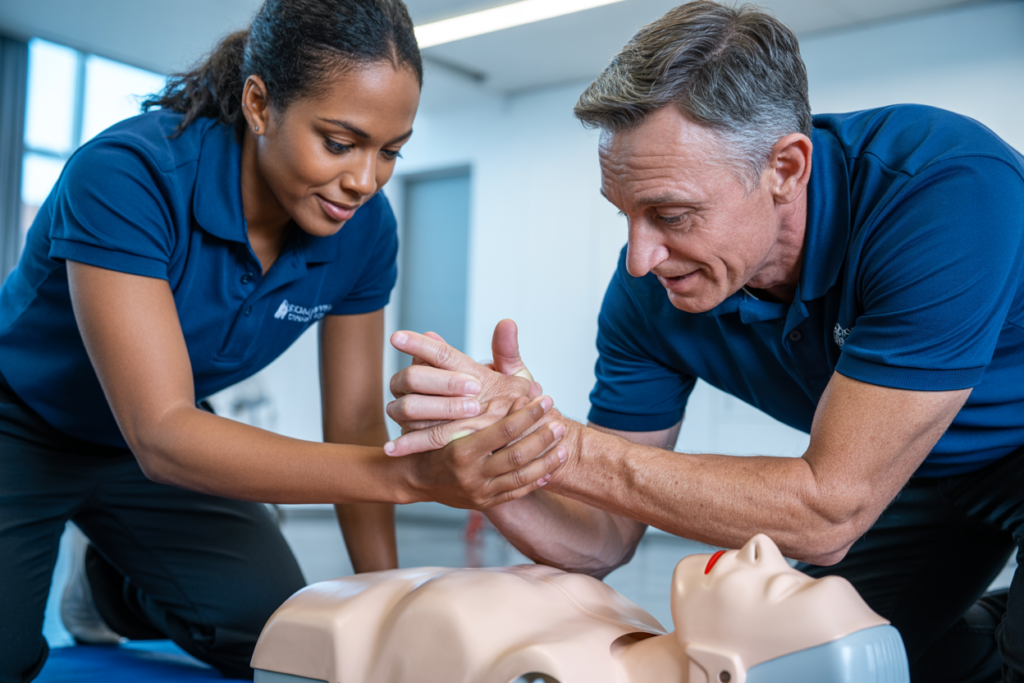
- Hands-on practice with CPR mannequins and qualified instructors
- Real-time feedback on compression depth and technique
- In-person assessment
- Provides nationally recognized HLTAID011 certification
- Required for most professional industries (fitness, healthcare, childcare)
- Your hands actually learn what proper compression depth feels like
For professional compliance in Australia, face-to-face or hybrid formats with practical assessments are what you need. Online-only courses might be cheaper and faster, but they won’t get you through a Fitness Australia audit or an insurance renewal.
| Format | Hands-On Practice | HLTAID011 Compliant | Insurance Accepted | Muscle Memory | Best For |
|---|---|---|---|---|---|
| Online Only | ❌ No | ❌ Usually No | ❌ Rarely | ❌ No | Personal knowledge only |
| Face-to-Face | ✅ Yes | ✅ Yes | ✅ Yes | ✅ Yes | First-time certification |
Understanding Adult CPR Training Requirements in Australia (2025)
Before we get into comparing formats, you need to know what actually counts as valid CPR training in Australia. Because here’s what happens all the time: someone books the cheapest online course they can find, completes it, gets a certificate… and then finds out it’s completely useless for their professional requirements.
What is HLTAID011 (Provide CPR) Certification?
HLTAID011 is the official code for “Provide CPR” training under Australia’s national training framework. It’s the qualification that Fitness Australia, insurance companies, and employers actually recognize. The Australian Resuscitation Council sets the guidelines, and Registered Training Organisations (RTOs) deliver courses that meet those standards.
When you complete HLTAID011 training, you’re certified to recognize cardiac arrest, perform CPR on adults, use an AED, manage an unconscious person, call for emergency help, and continue CPR until paramedics arrive.
The certificate lasts 12 months. CPR skills decay fast without practice—studies show most people forget proper compression depth within 6-8 months of training.
HLTAID011 is CPR-only. If you need broader first aid certification, that’s HLTAID009 (Provide CPR and First Aid). But for insurance and registration purposes, HLTAID011 on its own is the minimum baseline for personal trainers.
Who Needs Adult CPR Training?
If you work in any role where someone might collapse on your watch, you probably need adult CPR training:
- Fitness professionals: Personal trainers, group fitness instructors, gym staff, bootcamp operators
- Healthcare workers: Nurses, paramedics, allied health, aged care staff
- Education: Teachers, childcare educators, school sports coaches
- Workplace first aiders: Office first aiders, construction supervisors, retail managers
According to Safe Work Australia data, around 58% of Australian workplaces now have mandatory first aid requirements, and CPR is almost always part of that. For fitness professionals specifically, it’s basically non-negotiable.

Online Adult CPR Training: How It Works
Let’s be straight about online CPR courses—they’re tempting. You’re sitting on your couch after a long training day, you realize your cert expires soon, and an ad pops up: “Get CPR Certified – No Travel Required.” I get why people click.
But before you hand over your credit card, you need to understand what online adult CPR training actually is, what it’s not, and whether it’ll hold up when your insurance company asks for proof of certification.
The Online CPR Training Format
Online CPR courses are video-based learning platforms. You create an account, pay your fee, and get access to training modules that cover CPR theory:
- Video demonstrations of CPR techniques on mannequins
- Interactive quizzes after each module
- Digital workbooks with diagrams and protocols
- Self-paced timeline – complete it whenever you want
- Final assessment – pass a quiz and get a certificate emailed to you
The whole thing happens on your laptop or phone. No mannequins. No instructor watching your technique. No one checking if you’re pushing hard enough. Just you, a video, and some quiz questions.
What You Actually Learn in Online CPR Courses
Online courses cover the knowledge component: CPR theory and protocols, recognition of cardiac arrest, DRSABCD action plan, chain of survival concepts, AED awareness, and compression ratios and rates. You’ll memorize that it’s 30 compressions to 2 breaths for adults, rate of 100-120 per minute, depth of 5-6cm.
Here’s what’s missing: you don’t actually DO any of it. You don’t feel what 5-6cm of compression actually feels like. You don’t learn how exhausting it is to maintain 100 compressions per minute. You don’t discover that getting a proper airway seal for rescue breaths is harder than it looks on video.
It’s like learning to drive by watching YouTube videos. You’ll know the theory, but the first time you’re behind the wheel in traffic? Completely different experience.
Certification Process for Online CPR Training
Most online CPR courses will give you a certificate. The question is: what’s that certificate actually worth?
Assessment: Usually a multiple-choice final exam. Some courses ask you to film yourself demonstrating CPR, but there’s no qualified instructor watching in real-time to correct your technique.
Accreditation Limitations: This is the killer. Most online-only CPR courses are NOT registered to issue HLTAID011 certification. They might give you a “CPR Certificate” or “CPR Training Completion,” but it’s not the nationally recognized qualification that Fitness Australia or your insurance company requires.
According to 2024 data from the Australian Skills Quality Authority, roughly 73% of online-only CPR courses in Australia don’t meet HLTAID011 requirements. They’re selling certificates, but not compliance.
Pros and Cons of Online Adult CPR Training
Pros:
- Flexible scheduling – complete it whenever you want
- No travel required
- Learn at your own pace
- Review materials unlimited times
Cons:
- No hands-on practice with mannequins
- No instructor feedback on technique
- Not HLTAID011 compliant in most cases
- May not meet insurance requirements
- No muscle memory development
- False confidence without practical skills
The real question: are you trying to tick a compliance box, or are you trying to be able to save someone’s life? Because if a client collapses during training, your online certificate isn’t going to help you remember what proper chest compressions feel like when you’re panicking.
✅ The Gold Standard: Face-to-face training gives you 4x better skill retention than online-only courses. When a client's heart stops, your hands will remember what 5-6cm compression depth actually feels like.
Face-to-Face Adult CPR Training: The Traditional Approach
Face-to-face CPR training is what most trainers actually need. This is the format that gives you HLTAID011 certification, insurance compliance, and—most importantly—the actual physical skills to save someone’s life when it matters.
What Happens in a Face-to-Face CPR Course
Classroom Theory Component: You’ll start with an instructor running through the basics—DRSABCD, chain of survival, when to start CPR, how to recognize cardiac arrest.
Hands-On Mannequin Practice: This is where face-to-face training earns its value. You’ll practice CPR on mannequins. Not watch someone do it. Actually do it yourself. The instructor demonstrates first, then you practice. And practice. And practice some more. You’ll do compression cycles until your arms ache. You’ll learn how much force you actually need to compress a chest properly.
Real-Time Technique Correction: While you’re practicing, instructors walk around checking everyone’s technique. They’ll say “You’re not going deep enough—push harder” or “Your hands are too high—move them down to the center of the chest.” You can’t get this feedback from a video.
Practical Assessment: At the end, the instructor watches you perform CPR on the mannequin, checking that you can do proper compressions, maintain the correct ratio, use the AED correctly, and follow DRSABCD protocol. You need to demonstrate competency—not just answer questions about it.
Practical Skills You Develop
The difference between watching CPR and doing CPR is massive:
Correct Hand Placement and Compression Depth: You’ll learn that 5-6cm is deeper than it looks. The mannequins give feedback when you hit the right depth. Your hands learn what that depth feels like.
Compression Rate Accuracy: 100-120 compressions per minute is faster than you think. You’ll practice maintaining that rate even when you’re tired.
Airway Management and Rescue Breaths: Getting a proper seal on someone’s mouth, tilting their head back correctly, delivering breaths that actually inflate the lungs—this stuff is fiddly. You’ll practice until you can do it smoothly.
AED Operation: You’ll actually handle an AED training unit. Turn it on, place the pads on the mannequin’s chest, press the shock button when it tells you to. Practice makes it automatic.
Research shows skill retention is about 4x higher with hands-on practice compared to theory-only learning. A 2023 Australian study found that people who completed face-to-face CPR training were 76% more likely to perform effective compressions in a simulated emergency compared to people who’d only done online training.
HLTAID011 Certification Through Face-to-Face Training
When you complete a face-to-face CPR course through a registered RTO, you’ll receive proper HLTAID011 certification:
- Nationally recognized – accepted everywhere in Australia
- Meets Fitness Australia/PAA standards – no ambiguity, no rejections
- Digital certificates – emailed within hours so you can upload proof immediately
Pros and Cons of Face-to-Face Adult CPR Training
Pros:
- Hands-on practice builds genuine competence
- Instructor feedback corrects mistakes immediately
- HLTAID011 compliant and insurance-accepted
- Develops muscle memory for emergencies
- Confidence through repeated practice
- Scenario-based learning
Cons:
- Fixed schedule (must attend specific time/date)
- Travel to training location required
- Requires blocking out part of your day
- May conflict with work schedule
The cons are real, especially for busy trainers. But here’s the thing: those cons are inconveniences. The pros are “you can actually save someone’s life and your insurance will cover you if something goes wrong.”
🎯 Decision Time: First-time certification? Go face-to-face. Annual renewal? Hybrid works great. Not a fitness/healthcare professional? Online might be fine for personal knowledge (but won't meet professional requirements).
Which CPR Training Format is Right for You?
You’ve got the information—now you need to actually make a decision.
Are You a Fitness Professional or Healthcare Worker?
If YES: You need HLTAID011 certification. That means face-to-face or hybrid only. Online-only courses won’t meet your requirements.
Your insurance company requires it. Your registration body requires it. And honestly, your clients deserve a trainer who can actually perform CPR, not someone who watched videos and guessed their way through a quiz.
Recommended: Face-to-face training for first-time certification. Hybrid acceptable for annual renewals once you’ve got the baseline skills.
Is This Your First CPR Certification?
If YES: Go face-to-face. You need the full hands-on experience. You need to feel what proper compression depth is like. You need an instructor watching you and correcting your mistakes.
If NO (Recertification): Hybrid becomes more viable. You already know what CPR feels like from last year. The online theory is just refreshing your memory.
Quick Decision Matrix
Choose FACE-TO-FACE if:
- This is your first CPR certification
- You want maximum confidence and practice time
- You need guaranteed insurance/registration compliance
Choose ONLINE ONLY if:
- You’re not in a professional role requiring HLTAID011
- You’re doing this for personal knowledge, not compliance
- You understand it won’t meet insurance/registration requirements
For fitness professionals: 90% of you should pick face-to-face or hybrid. Online-only is almost never the right answer.

Final Recommendations
For First-Time CPR Certification
Book a face-to-face HLTAID011 course. Show up and learn properly. You need maximum hands-on practice time to build genuine skills and confidence.
For Annual Recertification
Hybrid training if available and convenient. Online theory at home, practical session on a day that works for you. You already have baseline CPR skills—the hybrid format refreshes efficiently.
If hybrid isn’t available, just do face-to-face again. The extra practice time is never wasted.
If Your Cert Expires Soon
Search for courses with availability this week. Call providers directly. Take whatever’s available. Confirm same-day digital certificate delivery. You’re in crisis mode—getting certified fast matters more than convenience.
What NOT to Do
❌ Don’t book online-only courses thinking they’ll meet HLTAID011 requirements
❌ Don’t wait until your cert expires
❌ Don’t skip verification of RTO registration
❌ Don’t forget to download and save your certificate immediately
Ready to Get Certified?
Your next steps:
- Check your current CPR certification expiry date
- Decide between face-to-face or hybrid based on your situation
- Search for registered RTO providers offering HLTAID011
- Book a course before you need it
- Show up, learn, get certified
Don’t overthink it. Pick a compliant provider, book the course, block out the time in your calendar, and get it done.
Your insurance company will thank you. Fitness Australia will thank you. Your clients will thank you. And if you ever need to perform CPR, you’ll thank yourself for learning it properly instead of taking shortcuts.
Book Your First Aid Training Now
Fast, affordable, and nationally accredited training delivered by professionals who care
Frequently Asked Questions About Adult CPR Training
Q.Can I get HLTAID011 certification completely online?
No. HLTAID011 certification requires a practical assessment where you physically demonstrate CPR skills on a mannequin while a qualified instructor watches and assesses your technique. You can do the theory component online (that's what hybrid training is), but you must attend an in-person practical session to receive valid HLTAID011 certification that meets Fitness Australia and insurance requirements.
Q.How long does HLTAID011 certification last?
HLTAID011 certification is valid for 12 months from the date of issue, then you need to recertify. The annual renewal requirement exists because CPR skills decay significantly after 6-8 months without practice—studies show most people forget proper compression depth and rate within this timeframe. Set a calendar reminder 60 days before your cert expires so you can book your recertification course in advance.
Q.What's the difference between HLTAID011 and HLTAID009?
HLTAID011 is CPR-only certification (cardiopulmonary resuscitation), while HLTAID009 is comprehensive first aid that includes CPR plus treatment for wounds, fractures, burns, anaphylaxis, asthma, bleeding, and shock. For basic personal trainer insurance and Fitness Australia registration, HLTAID011 is the minimum requirement. However, HLTAID009 opens more opportunities (corporate training, childcare work) and makes you more valuable to gym partners and clients.
Q.Can I fail a CPR course?
It's unlikely if you're genuinely trying—pass rates for HLTAID011 courses are typically 95-98%. The assessment isn't difficult because you practice extensively before being assessed, and instructors correct your technique throughout the session. You'll be asked to demonstrate DRSABCD response, perform CPR with correct hand placement and compression depth, and use an AED training unit. Most providers offer free reassessment within 30 days if needed, and they'll work with you until you achieve competency.
Q.Is online CPR training valid in other Australian states?
If it's not HLTAID011 compliant, it's not valid anywhere in Australia—state doesn't matter. However, if it IS proper HLTAID011 from a registered RTO, then yes, it's valid nationwide because HLTAID011 is a national qualification recognized across all Australian states and territories. You won't need to recertify just because you move from one state to another. The confusion comes from online-only courses that claim to be "nationally recognized" but aren't actually HLTAID011—those aren't valid anywhere.
Making first aid training more affordable for
every classroom
We believe every student deserves access to life-saving first aid knowledge. That’s why we offer specially reduced pricing for schools and educational groups. Whether you’re booking for a single class, a year group, or your entire school, our flexible packages make training more accessible and cost-effective — without compromising quality.
