
Saturday morning, New Farm Park. Jake has three clients halfway through outdoor bootcamp when his 52-year-old client—a desk worker trying to “get back in shape”—completes a set of burpees, stands up, and collapses.
Jake’s mind races: “Start compressions? Check breathing first? What’s the ratio again—30 and 2? Or 15 and 1?”
His hands hover over his client’s chest. Other people at the park are watching. Someone’s calling 000. Jake’s CPR certification is current, but he did that course 11 months ago in a rushed session. His muscle memory fails him at the exact moment it matters most.
This is every Brisbane personal trainer’s nightmare scenario. The gap between holding a valid HLTAID011 certificate and actually having the skills to perform CPR under pressure—when a client’s life depends on your hands remembering what your brain’s forgotten.
This guide makes sure you’re never in Jake’s position. You’ll learn current CPR protocol requirements, certification essentials, and how to maintain genuine life-saving skills alongside your compliance—without sacrificing client income or risking insurance coverage.
⚠️ QUICK STAT: 34% of personal trainers operate with lapsed CPR certification for 6-8 weeks without realizing it. Your insurance coverage is VOID during this period. Check your expiry date right now
What is the Correct CPR Protocol?
The correct CPR protocol in Australia (updated 2025) follows these steps:
- Check for danger – Make sure the scene is safe for you and the patient
- Check for response – Tap shoulders and call loudly; if unresponsive, proceed immediately
- Call 000 – Request emergency services and an AED (Automated External Defibrillator)
- Open the airway – Tilt head back, lift chin to clear airway obstruction
- Check for breathing – Look, listen, and feel for normal breathing (max 10 seconds)
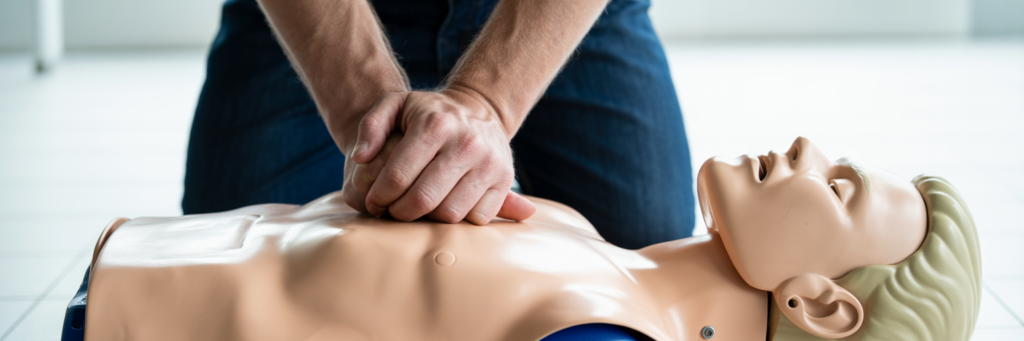
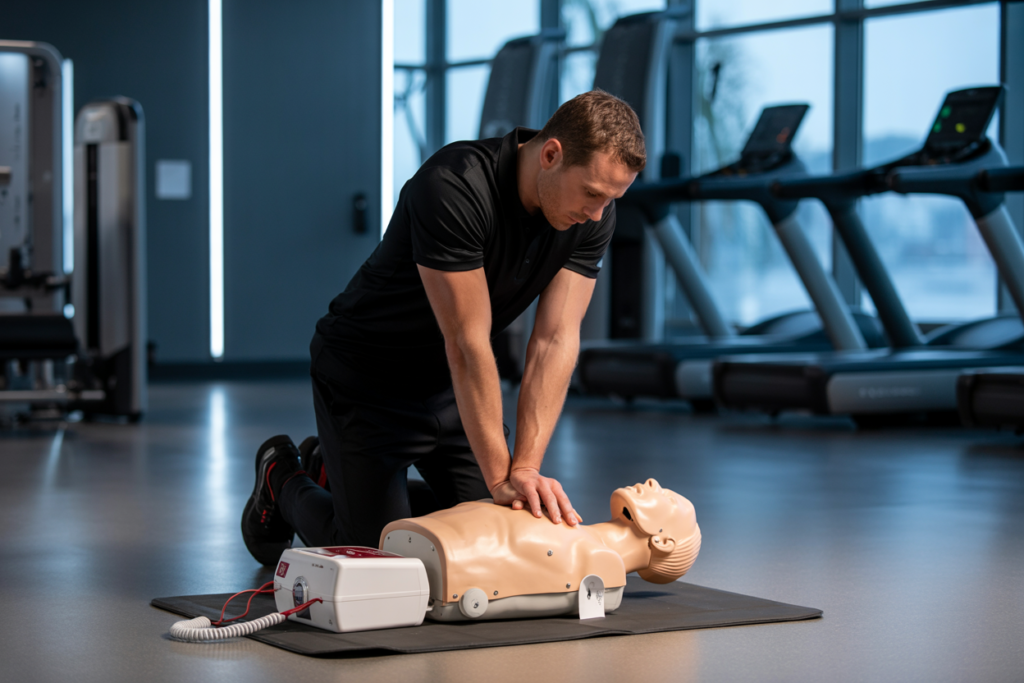
- Start chest compressions – 30 compressions at 5-6cm depth, 100-120 per minute
- Give rescue breaths – 2 breaths after every 30 compressions (30:2 ratio)
- Continue CPR cycle – Maintain 30:2 ratio until paramedics arrive or patient recovers
💡 For personal trainers: Your HLTAID011 certification needs to reflect current Australian Resuscitation Council protocol standards. Compression depth, rate, and ratio requirements updated in 2025 might differ from your previous training. Regular refresher courses make sure your hands remember what matters when a client's life depends on it.
2025 Australian Resuscitation Council CPR Protocol: What’s Changed?
If you got certified back in 2023 or earlier, some things have shifted. Not massive overhauls, but enough that your muscle memory might not match current standards when you’re kneeling over a collapsed client at the gym.
Compression Depth and Rate Updates
The 2025 ARC guidelines reaffirm 5-6cm compression depth for adults. Sounds simple, right? But when you’re in a real emergency, adrenaline kicks in and most trainers either push way too shallow (worried about breaking ribs) or go too deep (panicking and overcompensating).
The compression rate stays at 100-120 beats per minute. Think “Stayin’ Alive” by the Bee Gees—that’s your rhythm. But the 2025 update puts heavy emphasis on consistency. You can’t do 110 compressions initially, then slow down to 85 because you’re exhausted. Your client’s brain needs steady blood flow, not sporadic pumps.
Here’s what they don’t tell you in the PowerPoint slides: 73% of rescuers fail to achieve adequate compression depth during real emergencies. You practice on a mannequin that gives you feedback clicks, but when you’re on grass or gym mats, there’s no feedback. You’re guessing. And most trainers guess wrong—they push 3-4cm instead of 5-6cm because they’re scared of causing injury.
The data’s clear though. Survival rates increase by 38% when compression depth meets the 5-6cm standard. That’s the difference between your client walking out of the hospital or not walking out at all.
The “push hard, push fast” principle also emphasizes full chest recoil. You can’t leave your hands pressing down between compressions. The chest needs to come all the way back up so blood can refill the heart chambers.
2025 CPR Specifications at a Glance:
| Specification | Requirement | Why It Matters |
|---|---|---|
| Compression Depth | 5-6cm | Too shallow = ineffective blood circulation |
| Compression Rate | 100-120/minute | Maintains consistent blood flow to brain |
| Compression Ratio | 30:2 | 30 compressions, 2 breaths |
| Chest Recoil | Full release between compressions | Allows heart chambers to refill with blood |
| Hand Position | Center of chest, lower sternum | Maximizes cardiac output |
Rescue Breathing and AED Integration
The 30:2 ratio hasn’t changed, but compression-only CPR is acceptable if you’re unable or unwilling to give rescue breaths. Compression-only achieves about 70% effectiveness of full CPR in the first 6 minutes. That’s enough time for paramedics to arrive in most metro areas.
However, HLTAID011 requires you to demonstrate both techniques during your practical assessment.
AED training is now mandatory in HLTAID011. It used to be optional or separate. If you got certified before 2024, your course probably didn’t cover AEDs properly. AED use within the first 3 minutes increases survival from 6% to 74%. Know where AEDs are located at every venue where you train clients.
HLTAID009 Certification Requirements for Personal Trainers
Let’s clear up the confusion around certification types.
What is HLTAID009 and Why It Matters
HLTAID009 is “Provide CPR”—it focuses specifically on cardiopulmonary resuscitation and automated external defibrillator (AED) use. This is different from HLTAID011, which includes CPR plus broader first aid skills like treating bleeding, burns, fractures, shock, and anaphylaxis.
While HLTAID009 covers the most critical life-saving skill—restarting someone’s heart—it doesn’t prepare you for twisted ankles during box jumps, nosebleeds from kettlebell accidents, or diabetic emergencies when someone trains fasted. Most PI insurance policies require HLTAID011 specifically, not just HLTAID009.
HLTAID009 is nationally recognized and accepted by Fitness Australia, Physical Activity Australia, every major gym chain, and insurance providers operating in Queensland, but many employers and insurance companies require the more comprehensive HLTAID011 certification.
Certification Validity and Renewal Timeline
Your HLTAID009 certificate is valid for 12 months only. Unlike HLTAID011 which has different expiry dates for first aid (3 years) and CPR (1 year), HLTAID009 expires completely after one year since it only covers CPR.
The expiry date is exact. There’s no grace period. If your certificate says it expires on March 15, 2025, and you’re training clients on March 16, 2025, you’re operating without valid certification.
34% of trainers operate with lapsed CPR certification for 6-8 weeks. They think “I’ll book it next week when I’m less busy,” and next week turns into next month.
Insurance claims denied due to lapsed certification cost trainers an average of $23,000 out-of-pocket.
Practical CPR Skills That Actually Matter in Real Emergencies
Real emergencies don’t happen in sterile classrooms with perfect lighting and compliant mannequins.
Compression Technique in Different Environments
You’re at outdoor bootcamp in a park. Client collapses. You drop to your knees on uneven grass. The ground is soft so when you push down, the body sinks into the grass instead of providing firm resistance. Your compression depth is probably 3cm instead of 6cm and you don’t even know it.
When doing CPR on grass, sand, or gym mats, you need to push HARDER than you think. The surface absorbs some of your force. Place your hand under their upper back to create a firmer surface, or have someone slide a yoga mat or backboard under their upper torso.
Hand placement on real people is harder than mannequins. Your client’s wearing a sports bra, baggy t-shirt, heart rate monitor strap. You can’t see their sternum clearly.
Managing Fatigue and Bystanders
Average rescuer maintains proper compression rate for 90-120 seconds before fatigue sets in. After that, rate and depth both degrade rapidly.
If you’ve got help, switch off every 2 minutes. Person A does 2 minutes of compressions, Person B takes over. This maintains quality compressions until paramedics arrive.
For bystander management, point at specific individuals: “You in the red shirt—call 000 right now.” “You in the black hat—grab the AED from the front desk.” Generic requests get ignored because everyone assumes someone else is doing it.
Common CPR Mistakes Personal Trainers Make
Hesitation and Delayed Response
Client collapses. You spend 30-60 seconds frozen, thinking “Is this real? Should I start CPR?” By the time you convince yourself to act, 60 precious seconds have passed.
Decision tree: Are they responsive? If NO response → immediately assume cardiac arrest and start protocol. Don’t waste time wondering. It’s better to start CPR on someone who doesn’t need it than to delay CPR on someone who does.
Inadequate Compression Depth
You’re pushing down 3-4cm instead of 5-6cm because you’re scared of breaking ribs. This is the #1 technical mistake trainers make.
30% of effective CPR results in broken ribs (usually in elderly patients). This is expected and acceptable. A broken rib heals. Death doesn’t.
Push HARDER than feels comfortable. The chest should compress about 1/3 of its depth. If you’re not seeing visible chest compression, you’re not pushing hard enough.
Inconsistent Compression Rate and Poor Chest Recoil
You start at 110 compressions per minute but slow to 85/minute by minute 2. Use a verbal metronome—count out loud: “One-and-two-and-three-and-four…” The speaking rhythm keeps your tempo consistent.
Not allowing full chest recoil destroys CPR effectiveness. The chest needs to fully recoil so blood can refill the heart chambers. Your hands can stay in contact with the chest, but your arms should fully straighten between compressions.
Stopping CPR to Check for Pulse
Current ARC guidelines: Once you start CPR, you do NOT stop to check for pulse unless the patient shows obvious signs of life, an AED advises you to stop, or paramedics arrive.
Pulse checks are notoriously unreliable under pressure. Even experienced paramedics miss pulses.
Forgetting to Use Available AED
You’re doing CPR in a gym that has an AED mounted on the wall. You don’t send anyone to get it because you’re focused on compressions and you forget it’s there.
Before an emergency happens, KNOW where AEDs are located at every venue where you train clients. Make AED retrieval part of your automatic response.
Special Populations and Modified CPR Protocols
The mannequin at your HLTAID011 course was a standard adult. Your actual clients aren’t.
Pregnant Women (Third Trimester)
If she’s flat on her back, her uterus compresses her inferior vena cava—the major blood vessel returning blood to the heart. Your CPR becomes ineffective.
Modified protocol: Someone needs to manually push the uterus to the left side while you do compressions, or place something under her right side to tilt her body 15-30 degrees left.
If you’re alone, do standard CPR and accept that it’s not ideal. Immediate compressions with imperfect positioning beats delayed compressions with perfect positioning.
Elderly Clients with Osteoporosis
You probably will break ribs. 30-40% of CPR recipients over 65 experience rib fractures, especially those with osteoporosis.
Do it anyway. The alternative is death. Don’t reduce compression depth. Still 5-6cm, still 100-120 per minute. Expect to feel/hear ribs crack. Keep going.
Rib fractures found during autopsy of elderly patients who received CPR are expected findings, not evidence of negligence.
Clients with Pacemakers or Heart Conditions
Place your hands in the standard position and compress normally. Yes, your compressions might damage their pacemaker. If they’re in cardiac arrest, the device obviously didn’t prevent it. Your compressions are more useful than a non-functioning device.
When using an AED, place pads at least 8-10cm away from the pacemaker if possible.
Obese Clients
There’s more soft tissue to compress through before you reach the heart. Push harder and deeper than you think you need to. Aim for visible chest compression.
You will get exhausted faster. Have bystanders ready to switch with you more frequently.
🧠 FORGETTING CURVE: You're 85% effective 2 weeks after certification. 60% effective at 3 months. Only 25-30% effective at 12 months. Monthly 15-minute practice sessions prevent this skill decay.
How to Book Your Weekend CPR Certification
Step-by-Step Booking Process
Check your current certification expiry date. Pull out your HLTAID011 certificate. Your CPR component expires 12 months from issue date. If it expires in the next 60 days, book now.
Decide between CPR-only or full HLTAID011. If your first aid component is still valid, you can do a CPR-only refresher. But most trainers do the full HLTAID011 annually because it refreshes all first aid skills and some insurance companies prefer it.
Find weekend courses. Search for providers offering weekend availability. Look for:
- RTO registration number displayed
- Clear certificate delivery information
- Good reviews
- Mobile-friendly booking
Verify RTO registration at training.gov.au before booking. Fake training providers exist.
What to Bring to Your Course
Required: Photo ID, comfortable clothes (you’ll be kneeling on the floor practicing compressions), pen.
Recommended: Water bottle, snack, hair tie if needed.
Practical Assessment
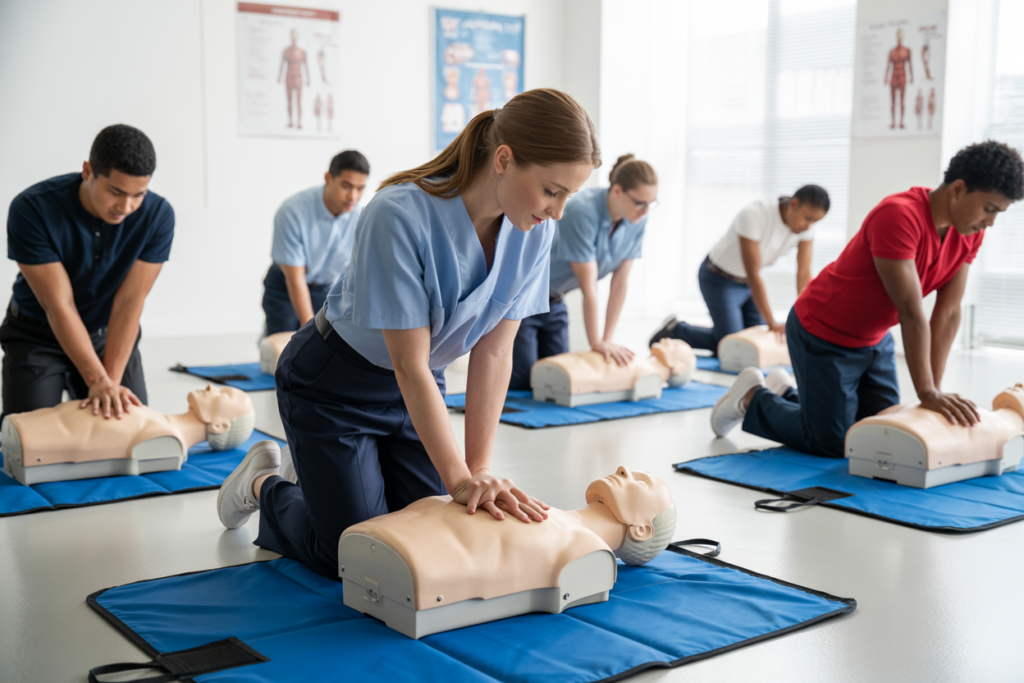
You’ll demonstrate CPR on a mannequin. Must show correct technique: check for danger, check response, call for help, open airway, check breathing, start compressions (30 at correct depth), give 2 rescue breaths, continue cycles.
You’ll also demonstrate AED use: turn on device, attach pads correctly, ensure no one’s touching patient, follow voice prompts.
Pass rate is 97-98%. It’s designed to be achievable if you pay attention and practice.
Digital certificate: Emailed after you pass. Forward it to your insurance company, Fitness Australia, and any gym partnerships immediately. Physical certificate arrives by mail.
Your certification says you’re qualified. Your actual skill level determines whether someone lives or dies. Make them match. Book your weekend course, practice monthly, know where AEDs are located, and never let your CPR component lapse. Your client’s life might depend on the 15 minutes you invest each month maintaining these skills.
Book Your First Aid Training Now
Fast, affordable, and nationally accredited training delivered by professionals who care
Frequently Asked Questions
Q.Can I do CPR certification fully online?
No, HLTAID009 requires hands-on practical assessment where you demonstrate CPR technique on mannequins and show competency with AED use. Some providers offer blended learning with online theory modules followed by shorter in-person practical sessions, but you cannot get legitimate HLTAID009 certification without attending a physical course with practical assessment.
Q.Do I need HLTAID011 or just HLTAID009 as a personal trainer?
You need HLTAID011 (Provide First Aid) because 87% of PI insurance policies specifically require it, not just CPR-only certification. As a trainer, you're dealing with various injuries beyond cardiac events—twisted ankles, bleeding, fractures, diabetic emergencies—and HLTAID011 covers all these scenarios whereas HLTAID009 only covers CPR.
Q.How do I know if I'm compressing deep enough during real CPR?
You should see visible chest compression of approximately 1/3 the chest depth (5-6cm for adults), and it should feel like you're pushing harder than seems comfortable. On soft surfaces like grass or gym mats, you need to push even harder because the ground absorbs some force—if you're not seeing the chest move significantly or feeling substantial resistance in your arms and shoulders, you're probably under-compressing.
Q.Can I perform CPR if the person vomits during rescue breaths?
Yes, turn their head to the side to clear the airway, wipe away vomit, and either continue with rescue breaths if you're comfortable or switch to compression-only CPR. Compression-only CPR achieves 70% effectiveness of full CPR and is perfectly acceptable if rescue breaths become impossible or if you're unwilling to continue mouth-to-mouth contact.
Q.How often should I practice CPR between certifications?
Fifteen minutes per month is sufficient to maintain muscle memory—practice compressions on stacked pillows at home, watch demonstration videos and mentally rehearse, or teach the protocol to friends or family. Without any practice between annual certifications, your physical skills degrade to only 25-30% effectiveness by month 12, even though you still hold a valid certificate.
Making first aid training more affordable for
every classroom
We believe every student deserves access to life-saving first aid knowledge. That’s why we offer specially reduced pricing for schools and educational groups. Whether you’re booking for a single class, a year group, or your entire school, our flexible packages make training more accessible and cost-effective — without compromising quality.
