

Your HLTAID014 is expiring. Your company’s insurance register needs a current certificate uploaded by end of week. You’ve got one shot to find a provider who delivers genuinely advanced training — not a padded-out standard course with a higher price tag — issues the right unit code on the certificate, and runs courses on weekends so you don’t burn annual leave.
Not every site supervisor finds out their certificate is expiring with a comfortable runway in front of them. Some get that sinking feeling during a pre-mobilisation check, two days before a government contract kicks off. Others discover the problem mid-toolbox talk when someone asks to see the register. If that sounds familiar, you’re exactly who this guide is written for.
Advanced first aid nationally recognised training in Australia means one thing: HLTAID014 — Provide Advanced First Aid — issued by a registered RTO under ASQA’s national framework. Not all courses marketed as “Advanced First Aid” actually deliver this qualification. Knowing the difference protects your site, your employer, and your professional reputation.
What Does Nationally Recognised First Aid Training Actually Mean?
Nationally recognised first aid training means your qualification is issued by a Registered Training Organisation (RTO) that is registered with the Australian Skills Quality Authority (ASQA) under the national vocational education and training (VET) framework. This means your certificate is valid across all Australian states and territories — not just Queensland.
For Advanced First Aid specifically, nationally recognised training means completing HLTAID014 — Provide Advanced First Aid, the only unit of competency that satisfies advanced-level workplace first aid requirements under Queensland legislation.
A nationally recognised HLTAID014 certificate confirms:
- The training was delivered by a qualified, ASQA-registered RTO — not a private operator running their own curriculum
- The unit code meets insurance, WorkSafe Queensland, and tender pre-qualification requirements — it holds up when someone actually checks it
- The certificate is legally recognised by employers, insurers, and government bodies across Australia — you’re not getting a Queensland-only qualification
- The qualification can be verified through the national training register at training.gov.au — any auditor, insurer, or project manager can confirm it in under a minute
This matters because the phrase “Advanced First Aid” has no legal weight on its own. Any provider can print it on a certificate. What carries weight — the thing that gets uploaded to insurance portals, satisfies tender pre-qualification checklists, and holds up under a WorkSafe Queensland audit — is the unit code. HLTAID014. That’s the one you need, printed clearly on every piece of paperwork before you book.
What Is HLTAID014 and Why the Unit Code Matters
A lot of site supervisors assume HLTAID014 is just a more expensive version of HLTAID011. It’s not. They are distinct qualifications with distinct competencies, distinct assessment requirements, and distinct legal standing when it comes to workplace compliance. Submitting the wrong one to your insurer isn’t a paperwork mix-up — it’s a compliance breach.
The Difference Between HLTAID011 and HLTAID014
| Feature | HLTAID011 | HLTAID014 |
|---|---|---|
| Full Title | Provide First Aid | Provide Advanced First Aid |
| Who It's For | General workplace first aiders | Site supervisors, WHS officers, nominated first aid officers |
| Competency Scope | Single-casualty response, basic life support | Multi-casualty management, triage, extended patient assessment |
| Typical Industries | Offices, retail, hospitality | Construction, mining, energy, government contracts |
| Insurance/Tender Requirement | Satisfies general workplace requirements | Required for larger sites, government contracts, infrastructure tenders |
⚠️ Important: Submitting the wrong unit code to your insurer is not a paperwork error. It is a compliance breach — and it will cost you more to fix than the course did in the first place.
Who Is Legally Required to Hold HLTAID014 in Queensland?
Under WorkSafe Queensland’s first aid guidance and the Safe Work Australia First Aid Code of Practice, HLTAID014 is the required qualification for:
- Construction sites with a significant number of workers — at least one current Advanced First Aid holder must be present on site
- Mining and energy sites — industry-specific safety requirements typically mandate HLTAID014 as the minimum for designated first aid officers
- WHS Officers and nominated First Aid Officers on government contracts — many state and federal contracts list HLTAID014 explicitly in pre-qualification documentation
- Tender pre-qualification for state infrastructure projects — the Queensland government procurement framework regularly requires evidence of a current HLTAID014 holder as a condition of tender submission
If your role involves any of the above, HLTAID014 isn’t optional. It’s the floor, not the ceiling.

What Advanced First Aid Nationally Recognised Training Actually Covers
Knowing what HLTAID014 covers is only half the equation — the other half is making sure the provider delivering it is actually teaching the advanced content the qualification demands. This is where the market gets murky.
There are providers out there running what is essentially a padded HLTAID011 with one extra scenario bolted on, charging HLTAID014 prices, and issuing certificates that technically carry the right unit code. The tell is always in the course description — if it doesn’t name the specific competencies, it probably isn’t delivering them.
Core Competencies Delivered in a Genuine HLTAID014 Course
A legitimate advanced first aid course in Brisbane should cover all of the following by name. If you’re evaluating a provider and their course page doesn’t mention these, move on.
- START triage system and multi-casualty coordination — managing more than one casualty at a scene, prioritising treatment when resources are limited
- Primary and secondary patient surveys — systematic head-to-toe assessment to identify life threats and secondary injuries
- Haemorrhage control including tourniquet application — recognising and managing severe bleeding, including correct tourniquet technique
- Shock recognition and management — identifying the signs of circulatory shock and implementing appropriate first aid response
- Spinal immobilisation — managing suspected spinal injuries, including log roll technique and patient positioning
- Complex anaphylaxis management — beyond the basics; managing severe allergic reactions in high-risk environments with delayed emergency response
- Extended airway management — maintaining a patent airway in an unresponsive or deteriorating patient over an extended period
💡 Pro Tip: If a course description doesn't mention these competencies by name, it is not genuine advanced training — regardless of what the certificate says.
How Advanced Resuscitation Training Delivers HLTAID014 in Brisbane
The course is built around one principle: you should leave with skills that work in a real emergency, not just answers that pass a written assessment.
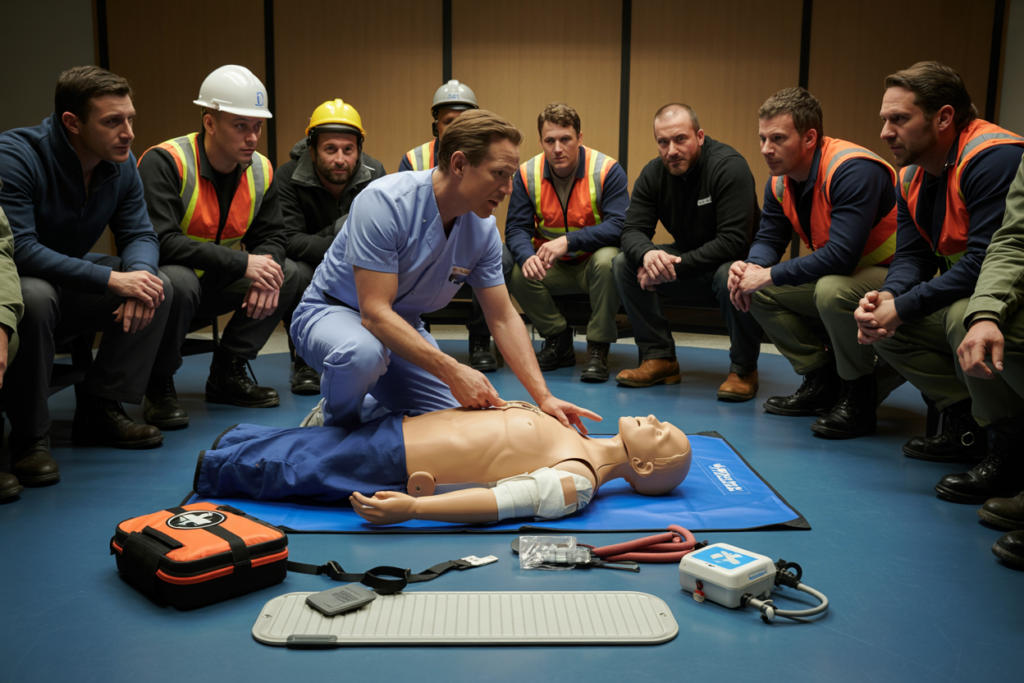
Instructors come from clinical backgrounds — ex-Queensland Ambulance Service paramedics and ICU nurses with real emergency experience. These aren’t trainers who learned first aid to teach first aid. They’ve worked cardiac arrests, traumatic injuries, and multi-casualty incidents. That background changes how they teach, and experienced site supervisors notice the difference immediately.
The equipment is clinical-grade: traction splints, AEDs, and full airway management kits. Not the budget alternatives used by lower-cost providers.
Delivery is scenario-based throughout. No PowerPoint-only sessions. Every competency is assessed through practical scenarios that replicate real workplace emergencies — the kind that happen on construction sites, in mining operations, and on infrastructure projects across South East Queensland.
Your same-day digital certificate is issued on course completion — ready to upload to your insurance register, compliance portal, or tender submission by end of business on course day. The RTO number is on the course page, the booking confirmation, the tax invoice, and the certificate itself. Verify it at training.gov.au before you book.
How to Verify Your Training Provider Is a Legitimate RTO
The other half of choosing the right HLTAID014 course is making sure the provider delivering it is legally authorised to issue that certificate in the first place.
This isn’t a theoretical concern. There are providers operating in the Brisbane market right now whose RTO registration has lapsed, whose scope of registration doesn’t include HLTAID014, or whose certificates don’t carry the unit code at all. Any of those scenarios means your certificate fails an audit. And when that happens, the cost isn’t just a repeat course — it’s a compliance breach on your record, a potential insurance liability, and a conversation with your director you don’t want to have.
The Three-Step RTO Verification Process
Step 1 — Search training.gov.au Go to the national training register at training.gov.au and search the provider’s name. Confirm two things: their RTO registration is current, and HLTAID014 — Provide Advanced First Aid — is listed on their scope of registration. If the unit code isn’t on their scope, they cannot legally issue that certificate. Full stop.
Step 2 — Check the certificate sample Any legitimate provider will show a sample certificate on their course page. Look for the unit code — HLTAID014 — printed clearly on the certificate itself. Not just “Advanced First Aid.” Not just a course title. The unit code. If it’s not there, or if the provider won’t show you a sample, that’s a red flag.
Step 3 — Check the tax invoice Before you book, confirm that the provider’s tax invoice includes their ABN, their RTO registration number, and the unit code HLTAID014 against the participant’s name and course date. This is what your accounts payable team needs, and it’s what an auditor will ask for if your training register gets reviewed.
✅ Verify: Verify any Brisbane first aid provider in 60 seconds at training.gov.au before you book.
Red Flags That Signal a Non-Compliant Provider
These aren’t minor oversights. Every single one of the following is an audit and insurance liability.
- No RTO number displayed on the website — if they’re not showing it, there’s usually a reason
- Certificate does not show the unit code — only a course title like “Advanced First Aid” with no HLTAID014 reference
- Tax invoice missing ABN or RTO registration number — means your accounts team can’t process it and an auditor won’t accept it
- Trainer credentials not disclosed — legitimate providers are proud of their instructors’ backgrounds; if they won’t tell you who’s teaching, ask yourself why
- No scenario-based practical assessment mentioned — HLTAID014 requires hands-on competency assessment; a course with no practical component cannot legally issue the qualification
A provider who ticks all three verification steps — current RTO registration, correct unit code on the certificate, and a compliant tax invoice — is one you can trust. Advanced Resuscitation Training’s RTO number is displayed in the hero section of every course page, linked directly to the training.gov.au verification entry.
Why Brisbane Site Supervisors and WHS Officers Choose Advanced Resuscitation Training
The marketing language around first aid training in Brisbane is pretty much identical across every provider. Experienced instructors. Nationally recognised. Same-day certificate. At some point you stop reading the claims and start looking for evidence.
A Senior Site Supervisor discovered his HLTAID014 was expiring during a pre-mobilisation check for a state government infrastructure project. The project required a current Advanced First Aid holder as a condition of site access. He booked Advanced Resuscitation Training’s next Saturday course, had his digital certificate in his inbox the same afternoon, and uploaded it to the compliance portal before close of business. Site mobilisation proceeded on schedule. His name wasn’t the reason for a problem — it was the reason there wasn’t one.
A Construction Foreman identified during a toolbox talk that two of his designated first aid officers held certificates from a provider whose RTO registration had lapsed. Their qualifications weren’t nationally recognised, couldn’t be verified on training.gov.au, and wouldn’t hold up under a WorkSafe Queensland audit. He enrolled both staff in the next available weekend course. Both certificates passed the subsequent audit without issue. He now checks every provider on training.gov.au before booking, and he’s told every WHS contact he has to do the same.
Every HLTAID014 course at Advanced Resuscitation Training is delivered by instructors with genuine clinical backgrounds — ex-Queensland Ambulance Service paramedics and ICU nurses who worked real emergencies before they ever stepped into a training room. The difference shows up in how scenarios are set up, how feedback is delivered during practical assessments, and how questions get answered when someone asks what actually happens in a real emergency versus what the textbook says. That’s the standard Advanced Resuscitation Training holds its instructors to.
The Bottom Line on Advanced First Aid Nationally Recognised Training in Brisbane
HLTAID014 isn’t a qualification you renew because it’s on a checklist. It’s the thing that stands between a workplace incident and a WorkSafe Queensland investigation where your lapsed certificate becomes the central liability question. It’s the credential that gets an infrastructure tender across the line. It’s the reason your insurance audit comes back clean.
The Brisbane market has no shortage of providers happy to take your money and hand you a certificate. What it has a shortage of is providers who treat HLTAID014 as the genuinely advanced qualification it is — who staff their courses with real clinicians, run scenario-based assessments that actually test your competency, and issue paperwork that holds up every time someone checks it.
That’s the standard that matters when it’s 3am and you’re running through the scenarios that keep site supervisors up at night. Not whether you found the cheapest course. Whether you found the right one.
Advanced Resuscitation Training’s HLTAID014 course in Brisbane was built for people who can’t afford to get this wrong. If that’s you, the next available Saturday course is one booking away.
Book Your First Aid Training Now
Fast, affordable, and nationally accredited training delivered by professionals who care
Frequently Asked Questions
Q.What does nationally recognised first aid training mean?
Nationally recognised first aid training means your qualification is issued by an ASQA-registered RTO under Australia's national VET framework, making it valid across all states and territories. For Advanced First Aid, that means HLTAID014 — Provide Advanced First Aid — the only unit of competency that satisfies advanced-level workplace first aid requirements under Queensland legislation. Any employer, insurer, or government body can verify it at training.gov.au.
Q.Is HLTAID014 the same as Advanced First Aid?
HLTAID014 is the unit of competency behind the course title "Advanced First Aid" — but not every course marketed as Advanced First Aid actually delivers HLTAID014. The unit code is what carries legal weight with insurers, WorkSafe Queensland, and tender pre-qualification requirements. Always confirm HLTAID014 appears explicitly on the certificate, the booking confirmation, and the tax invoice before you commit to a provider.
Q.How long is HLTAID014 valid in Queensland?
HLTAID014 is valid for three years in Queensland, with the CPR component — HLTAID009 — requiring annual renewal. Most employers and insurers expect both to be current, so it's worth tracking them separately on your site first aid register rather than assuming one renewal covers everything.
Q.What is the difference between HLTAID011 and HLTAID014?
HLTAID011 — Provide First Aid — covers single-casualty response and basic life support for general workplace settings. HLTAID014 — Provide Advanced First Aid — adds multi-casualty triage, extended patient assessment, haemorrhage control, spinal immobilisation, shock management, and complex anaphylaxis management. They are distinct qualifications with distinct competency requirements, and submitting HLTAID011 when a contract or insurer requires HLTAID014 is a compliance breach — not a paperwork error.
Q.What happens if my HLTAID014 certificate has already expired?
A lapsed certificate doesn't disqualify you from re-enrolling — you simply complete the full HLTAID014 course again rather than a renewal. The practical issue is that there may be a gap period where you're not current, which can affect site access, insurance compliance, and tender eligibility. Booking the next available weekend course and getting the same-day digital certificate is the fastest way to close that gap.
Making first aid training more affordable for
every classroom
We believe every student deserves access to life-saving first aid knowledge. That’s why we offer specially reduced pricing for schools and educational groups. Whether you’re booking for a single class, a year group, or your entire school, our flexible packages make training more accessible and cost-effective — without compromising quality.
