
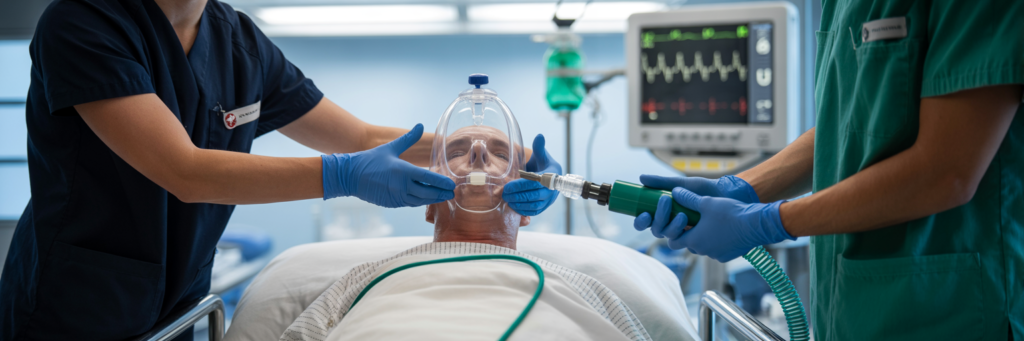
The arrest alarm fires in bay 6. You’re the most senior nurse on the floor, the registrar is four minutes out, and the team is looking at you. You call for the BVM, seat the mask, squeeze the bag — and in the back of your mind, a quiet question surfaces: am I actually doing this right?
That question doesn’t mean you’re incompetent. It means you’re paying attention. Because bag-valve-mask ventilation is one of those skills that gets performed regularly but examined almost never — and the research is pretty clear that even experienced clinicians carry measurable technique errors they don’t know about. Poor mask seal, over-bagging, incorrect head positioning — none of these announce themselves loudly. They show up as an SpO2 that stubbornly refuses to improve.
This guide covers correct BVM technique from the ground up: mask sizing and seal, airway positioning, one- and two-person technique, tidal volume targets, common errors, and when BVM is preferred over supraglottic airways in the pre-intubation window. Everything here is aligned with ANZCOR 2025 guidelines.
How to Perform Bag | Valve-Mask Ventilation
Bag-valve-mask (BVM) ventilation delivers positive-pressure breaths to a non-breathing or inadequately breathing patient. To perform it correctly: select the right mask size; position the airway with head-tilt chin-lift or jaw thrust; form a C-E clamp grip; connect oxygen at 15L/min via reservoir bag; squeeze the bag over one second to produce visible chest rise; ventilate at 10 breaths per minute during CPR per ANZCOR 2025; and reassess mask seal and chest rise after every five breath cycles.
What Is a Bag-Valve-Mask and How Does It Work?
Most clinicians have used a BVM hundreds of times. Fewer have stopped to think about what each component actually does — and why getting it wrong at the device level causes technique failures downstream.
A standard BVM has four main components: the self-inflating bag, the one-way valve, the face mask, and the oxygen reservoir bag. The self-inflating bag re-expands automatically after each squeeze — no manual re-inflation required. The one-way valve prevents exhaled CO2 from re-entering the bag; if it’s faulty or incorrectly assembled after cleaning, it can fail silently. The face mask creates the seal between device and airway, and is where most technique errors originate.
On oxygen flow: a BVM without a reservoir bag at 10L/min delivers approximately 40–60% FiO2 — not resuscitation-grade. With a reservoir bag at 15L/min it approaches 100% FiO2. The reservoir bag needs to be inflated before use. If it’s flat when you reach for the BVM, you’ve got a setup problem — not a flow rate problem.
Understanding how the device works is the foundation. Knowing precisely when to reach for it is what separates a competent response from a confident one.

Indications and Contraindications for BVM Ventilation
BVM ventilation is indicated any time a patient isn’t breathing adequately before a definitive airway is secured — respiratory arrest, pre-intubation oxygenation, and apneic oxygenation support during rapid sequence intubation. BVM is first-line. The laryngoscope comes after the patient is oxygenated, not instead of it.
No contraindication is absolute when the alternative is an unoxygenated patient. Suspected full stomach raises gastric insufflation risk — slow, controlled breaths reduce but don’t eliminate it. Facial trauma may compromise mask seal; jaw thrust and two-person technique may partially compensate. Known airway obstruction means BVM won’t ventilate — manage the obstruction first.
BVM vs. Supraglottic Airway
| Factor | BVM | Supraglottic Airway (LMA/iGel) |
|---|---|---|
| Speed | Immediate | Requires placement time |
| Seal reliability | Operator-dependent | More consistent once seated |
| Gastric insufflation risk | Higher — pressure-dependent | Lower with second-generation devices |
| Fatigue | Significant in single-rescuer | Reduced — hands-free once placed |
| Preferred scenario | First response | Prolonged management, rescue airway |
BVM is almost always the right first move. The decision to switch to a supraglottic airway is typically driven by prolonged pre-intubation time, single-rescuer fatigue, or a seal that cannot be maintained. Gastric insufflation risk increases significantly above 20cmH2O — slow, controlled breaths with one-second inspiratory time keep you well below that threshold.
Step-by-Step BVM Ventilation Technique (Adult)
Mask Sizing and Fit
An adult mask should cover the mouth and nose completely — upper rim across the bridge of the nose, lower rim in the groove between the lower lip and chin. If it’s overlapping the eyes or sitting on the chin, it’s the wrong size. Default to medium adult for most patients. A mask that’s slightly too large is generally easier to seal than one that’s too small. Check the mask before the arrest, not during it.
Airway Positioning
Head-tilt chin-lift is the default for medical cardiac arrest where spinal injury is not suspected — tilt the head back, lift the chin forward to align the oral, pharyngeal, and tracheal axes. Jaw thrust is used when spinal injury is possible: both hands grip the angles of the mandible and push the jaw anteriorly without moving the neck. It’s harder to maintain and more fatiguing, which is one more reason two-person technique is preferred when spinal injury is on the differential. Neither technique works well without a small towel or pillow under the occiput — the sniffing position optimises the airway axis and makes seal easier to hold.
The C-E Clamp: One-Person Technique
Thumb and index finger form a C around the top of the mask. The remaining three fingers form an E along the mandible — middle finger at the chin, ring and little finger along the jaw — lifting the jaw upward into the mask rather than pushing the mask down onto a slack jaw. Pushing down compresses soft tissue and can worsen airway obstruction. Lifting the jaw up into the mask opens the airway and creates seal simultaneously. It’s a compromise — one hand doing two jobs — and it’s worth being honest about that.
💡 Clinical Tip: If your C-E clamp is correct, your elbow should be roughly level with the patient's head. Arm extended downward toward the bed means you've lost the jaw lift.
Two-Person Technique
Two-person BVM is not a backup plan — it’s the preferred technique whenever a second rescuer is available. One clinician uses both hands to hold the mask and maintain airway position. The second manages the bag exclusively. The result is better seal, better tidal volume delivery, and less rescuer fatigue. Switch to two-person technique when single-rescuer seal is inadequate, the patient has facial hair or unusual anatomy, or a second clinician is available and not otherwise occupied.
Tidal Volume, Rate, and Chest Rise
The target tidal volume is 500–600mL — approximately 6–7mL per kilogram of ideal body weight. The correct squeeze is around one-third of the bag over one second. Squeezing fully delivers roughly 1,000–1,200mL — nearly double the target. Visible chest rise is your primary confirmation. No chest rise means a seal, positioning, or obstruction problem — not a volume problem. Squeezing harder is the wrong response.
During 30:2 CPR, deliver 2 breaths after every 30 compressions, both in under 5 seconds. Once an advanced airway is placed, move to asynchronous ventilation: compressions continue uninterrupted at 100–120 per minute, ventilation at 10 breaths per minute without pausing. Do not hyperventilate.
📋 BVM Quick-Reference — ANZCOR 2025: Tidal volume: 500–600mL | Inspiratory time: 1 second | Rate (arrest): 10 breaths/min | O2 flow: 15L/min with reservoir | Seal check: bilateral chest rise + SpO2 trend
Pediatric BVM Considerations
Most nurses in adult ICU and ED environments don’t encounter paediatric arrests frequently — low-frequency, high-stakes scenarios are where technique gaps hurt the most.
The same sizing principle applies: mask covers mouth and nose without overlapping eyes or chin. Ventilation rates differ significantly from adult targets.
| Age Group | Ventilation Rate |
|---|---|
| Infant (< 1 year) | 25 breaths/min |
| Child (1–8 years) | 20 breaths/min |
| Adolescent (8–18 years) | 12–20 breaths/min |
Tidal volume remains weight-based at 6–7mL/kg — for an infant, as little as 30–50mL. Visible chest rise — gentle, bilateral, not exaggerated — is the safest guide.
The infant airway is more anterior and superior than in adults — neutral head position is preferred over head-tilt. Excessive neck extension in neonates occludes rather than opens the airway. A small roll under the shoulders achieves neutral alignment more effectively than any degree of head tilt. In toddlers, the large occiput flexes the neck forward on a flat surface — a towel under the shoulders, not the head, corrects this.
Common BVM Errors and How to Correct Them
These aren’t beginner mistakes. They’re the technique degradations that develop in experienced practitioners who receive no structured feedback — invisible until something goes wrong.
Poor Mask Seal
Poor mask seal is the single most common BVM error, and the hardest to detect. The bag feels the same to squeeze whether air is entering the lungs or leaking around the mask edge. Causes include grip failure where the C-E clamp loses jaw lift under fatigue, anatomical mismatch from facial hair or unusual geometry, and mask size error. If SpO2 isn’t improving despite apparent ventilation effort, mask seal is the first thing to reassess — not oxygen flow.
Over-Ventilation
Over-ventilation feels like doing more — and under pressure, doing more feels like doing better. It isn’t. Rates above 10 breaths per minute and volumes above 600mL increase intrathoracic pressure, reduce venous return, worsen cardiac output, raise gastric insufflation risk, and cause hypocapnia-driven cerebral vasoconstriction in post-arrest care. Ventilation rates of 15–20 breaths per minute are consistently observed in resuscitation audits — nearly double the ANZCOR 2025 target. The driver is almost always anxiety. The correction is deliberate pacing: one breath every six seconds.
Head Position and Rescuer Fatigue
Insufficient head extension collapses soft tissue across the posterior pharynx. Over-extension in older patients can narrow the airway. No occipital support causes the head to flex forward. If chest rise is absent despite correct seal and adequate squeeze, reposition the airway before anything else.
Single-rescuer BVM technique degrades under sustained ventilation — as grip strength declines, jaw lift is the first thing to go. BVM operators should rotate at the same intervals as chest compression rotation. It’s not always done because BVM is perceived as less demanding, but the SpO2 data says otherwise.

BVM Ventilation in the Context of ANZCOR 2025 Guidelines
ANZCOR guidelines are the standard against which your resuscitation competency is measured in Australia. If your technique is based on an earlier iteration, you have a currency problem.
The ventilation rate target of 10 breaths per minute was reaffirmed more explicitly than in previous updates, in direct response to audit data showing widespread over-ventilation. Hyperventilation harms the patient — 10 breaths per minute is the ceiling. Tidal volume guidance was similarly reinforced at 500–600mL, with visible chest rise as the primary confirmation rather than volume estimation. The update also clarified the transition from 30:2 to asynchronous ventilation once an advanced airway is placed — compressions do not pause after that point.
All content here is aligned with ANZCOR Guideline 11.6 — Airway and Ventilation (2025), available via the Australian Resuscitation Council website.
Without an advanced airway, the ratio is 30:2. Once an advanced airway is in place, compressions run continuously at 100–120 per minute and ventilation is delivered asynchronously at 10 breaths per minute. The team leader should call this transition explicitly — never assume everyone has registered it.
Post-ROSC, target SpO2 94–98% and PaCO2 35–45mmHg. Slow down, confirm your rate, and target normocapnia until mechanical ventilation takes over.
Practizing BVM Technique | Simulation vs. Real-World Performance
There’s an assumption that sits quietly in most clinical environments: if you do something regularly, you do it well. For BVM ventilation, the evidence doesn’t support that. Studies in the Resuscitation journal consistently show that even frequent resuscitators carry measurable technique deficits in structured simulation. Skills performed repeatedly without feedback don’t self-correct. They calcify.
The ward doesn’t give you feedback on your mask seal or flag that your ventilation rate was 18 when it should have been 10. The feedback loop that corrects individual technique has to be built deliberately, outside of it.
In simulation, an instructor watches your grip, your jaw lift, your squeeze volume, and your rate — correcting each in real time before the pattern embeds further. That level of individual feedback isn’t available in a real resuscitation, where the focus is rightly on the patient.
Scenario: An ED nurse with six years of experience completes a simulation assessment. Instructor feedback identifies that her C-E clamp consistently loses jaw lift under sustained ventilation — a pattern carried for years without awareness. One correction in simulation. Years of undetected degradation addressed in a single session.
Advanced Resuscitation Training’s courses are designed exclusively for registered healthcare professionals — ICU nurses, ED clinicians, CCU nurses, and allied health professionals in resuscitation environments. Every course is delivered by instructors with real ICU and ED backgrounds.
Conclusion
Bag-valve-mask ventilation is one of the most performed skills in resuscitation — and one of the least examined. The errors that matter aren’t dramatic failures. They’re gradual degradations without feedback: a mask seal that leaks under fatigue, a ventilation rate creeping to 18 when it should be 10, a jaw lift that disappears when grip strength declines.
ANZCOR 2025 gives you clear targets for every parameter in this guide. The question is whether your technique meets them — and whether you’d know if it didn’t.
Ward experience tells you what happened. Simulation tells you why, and what to change.
Book Your First Aid Training Now
Fast, affordable, and nationally accredited training delivered by professionals who care
Frequently Asked Questions
Q.What is the correct ventilation rate for BVM in cardiac arrest?
Per ANZCOR 2025, the correct ventilation rate during cardiac arrest is 10 breaths per minute — one breath every 6 seconds — once an advanced airway is in place. During 30:2 CPR without an advanced airway, deliver 2 breaths after every 30 compressions, keeping the pause under 5 seconds. Rates above 10 breaths per minute increase intrathoracic pressure and reduce cardiac output, making over-ventilation one of the most consequential and most common errors in resuscitation.
Q.What tidal volume should be used with a BVM?
The recommended tidal volume for adult BVM ventilation is 500–600mL, or approximately 6–7mL per kilogram of ideal body weight. Visible chest rise is the primary confirmation — avoid over-bagging, which increases gastric insufflation risk and reduces cardiac output during CPR. The correct squeeze is around one-third of the bag over one second; squeezing fully delivers close to double the target volume.
Q.When should two-person BVM technique be used?
Two-person BVM technique should be used whenever a second rescuer is available. It significantly improves mask seal, reduces rescuer fatigue, and allows one clinician to focus exclusively on airway positioning while the other manages ventilation. Single-rescuer technique is a compromise — two-person is the preferred approach in any resuscitation team environment, and BVM operators should switch as soon as a second clinician is free.
Q.What oxygen flow rate should be used with a BVM?
Set oxygen flow to 15L/min when using a BVM with a reservoir bag — this achieves close to 100% FiO2 delivery. Without a reservoir bag, flow rates of 10L/min deliver approximately 40–60% FiO2, which is insufficient for resuscitation scenarios. Always confirm the reservoir bag is inflated before use; a flat reservoir bag means your FiO2 delivery is significantly lower than you think, regardless of the flow rate set on the wall.
Making first aid training more affordable for
every classroom
We believe every student deserves access to life-saving first aid knowledge. That’s why we offer specially reduced pricing for schools and educational groups. Whether you’re booking for a single class, a year group, or your entire school, our flexible packages make training more accessible and cost-effective — without compromising quality.
