

You’ve responded to cardiac arrests. You’ve run the algorithm under pressure. So why does a gap still sit at the back of your mind every time the arrest alarm sounds?
For a lot of experienced nurses, it’s not clinical ability they’re questioning. It’s whether their certified record of that ability would actually hold up — in a credentialing review, in an AHPRA audit, or in the moment when the registrar is four minutes away and the team is looking at you.
This article covers exactly what’s included in a certified AED training course — the full curriculum, who the course is built for, how AHPRA CPD recognition works, and how to enrol in a 2026 weekend date that fits around your roster.
What Is Included in an AED Training Course?
An AED training course covers the knowledge and practical skills required to respond to sudden cardiac arrest using an automated external defibrillator (AED) in combination with CPR. A certified course in Australia typically includes:
- AED operation — device familiarisation, pad placement, and shock delivery
- CPR integration — compression depth, rate, and minimising interruptions
- Rhythm recognition — shockable vs non-shockable rhythms
- Chain of Survival — early recognition, call for help, early CPR, early defibrillation
- Post-resuscitation care — managing the patient after ROSC
- Team communication — closed-loop communication and role allocation during a cardiac arrest
- ANZCOR 2026 guideline alignment — current evidence-based protocols
Courses are delivered by ASQA-registered RTOs and issue a nationally recognised certificate upon completion.
What Is an AED and Why Does Certified Training Matter?
An automated external defibrillator is a portable device that analyses cardiac rhythm and delivers a controlled electrical shock to restore normal heart activity during sudden cardiac arrest. Unlike the manual defibrillators in your resus bay, an AED guides the operator through the process — voice prompts, pad placement indicators, and automatic rhythm analysis built in. What it doesn’t do is remove the need for a trained, confident operator behind it.
How an AED Works During Cardiac Arrest
When a patient arrests, the AED is applied as early as possible while CPR continues. The device analyses the rhythm, determines whether a shock is indicated, and either delivers it automatically or prompts the operator to do so. According to ANZCOR guidelines, survival from sudden cardiac arrest decreases by roughly 10% for every minute that defibrillation is delayed. What formal AED training does is reduce hesitation, sharpen pad placement speed, and make device integration second nature under pressure.
Why Familiarity Is Not the Same as Certification
Seeing a piece of equipment used dozens of times is not the same as holding a current, externally certified competency in it. Hospital in-services vary — the educator changes, the scenario depth changes, and the certificate that comes out the other end doesn’t always satisfy AHPRA CPD requirements or employer credentialing panels. A defibrillator training course completed through an ASQA-registered RTO produces a nationally recognised certificate that does. That distinction matters every time your registration comes up for renewal or a credentialing committee asks for documentation.
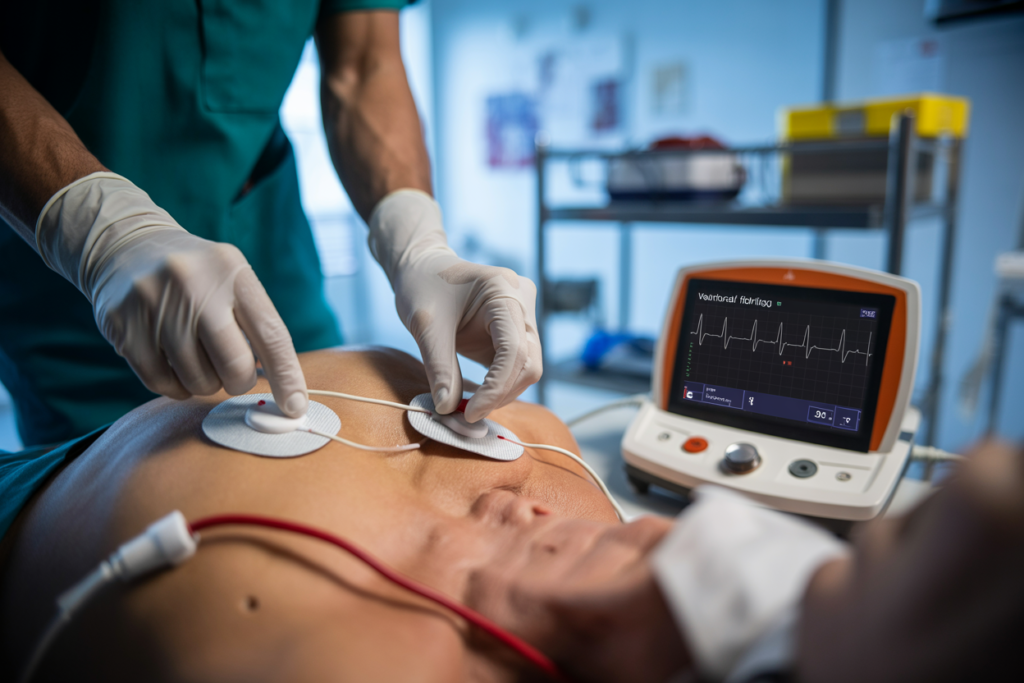
What Does an AED Training Course Cover? Full Curriculum Breakdown
All AED training at ART is aligned to ANZCOR 2026 guidelines — updated to reflect the latest evidence on compression-to-shock ratios and post-ROSC management.
The curriculum is what separates a course worth your Saturday from one that covers ground you’ve already walked a hundred times on the ward.
AED Operation and Device Familiarisation
The course covers the full range of AED models used across Australian clinical and community settings — not just the unit bolted to the wall in your department. That includes device familiarisation, correct pad placement for adult and paediatric patients, and understanding when and how to override or respond to voice prompts. Hands-on practice with an AED trainer unit is built into the session — actual repetition until pad placement and device operation are automatic.
CPR Integration Compression Quality and Minimising Hands-Off Time
CPR integration covers compression depth and rate per ANZCOR 2026 protocols, with a particular focus on hands-off time. Every second the chest isn’t being compressed is a second of perfusion pressure lost. The course works through the compression-to-shock ratio, rhythm analysis cycle timing, and BVM integration during CPR — so the transition between compressions and shock delivery is as tight as the evidence requires.
Shockable vs Non-Shockable Rhythms
Shockable rhythms — ventricular fibrillation and pulseless VT — and non-shockable rhythms — PEA and asystole — are covered with the clinical detail they deserve. Scenario-based rhythm recognition is integrated into the practical component, so you’re making rhythm calls under simulated pressure, not just identifying waveforms on a slide.
Chain of Survival and Early Defibrillation Protocols
The ANZCOR 2026 Chain of Survival — early recognition, early call for help, early CPR, early defibrillation, and post-resuscitation care — sits at the structural core of the curriculum. Time-to-first-shock targets are covered with reference to current evidence, and the course works through the AED operator’s specific role within the arrest team so responsibilities are clear before the scenario starts.
Team Communication During Cardiac Arrest
Clinical skill and team dysfunction are not mutually exclusive — most arrest debriefs will tell you communication is where things fall apart faster than technique. The course covers closed-loop communication as a practised skill, not a concept. Role allocation — compressor, airway, AED operator, team leader, timekeeper — is worked through in simulation so everyone knows their lane before the scenario starts.
Post-Resuscitation Care and Handover
Achieving ROSC is not the finish line. Post-resuscitation care — haemodynamic stabilisation, airway management, targeted temperature considerations, and monitoring — is covered as an extension of the arrest response, not a separate topic. Handover to the receiving team uses the ISBAR framework, and documentation requirements post-arrest are addressed so the clinical record reflects what actually happened in the room.
| AED Training Course (ART) | Standard CPR Course | Hospital In-Service | |
|---|---|---|---|
| ANZCOR 2026 Aligned | ✓ | Varies | Varies |
| Nationally Recognised Certificate | ✓ | ✓ | ✗ |
| AHPRA CPD Hours | ✓ | Limited | Varies |
| Clinical Simulation | High-fidelity | Basic | Limited access |
| Clinical-Peer Cohort | ✓ | Mixed | Clinical only |
The curriculum is built for clinical professionals — but who specifically should be completing this course, and when does it become a credentialing requirement?
Who Should Complete an AED Training Course?
ART’s AED training courses are structured for clinical professionals — if you’re a registered nurse or allied health clinician, you won’t be starting from zero.
Registered Nurses and Healthcare Professionals
The primary audience for ART’s AED training course is registered nurses working in environments where cardiac arrest response is part of the job — ICU, Emergency, Coronary Care, Theatre, HDU, and Cardiac Catheter Lab. Paramedics and allied health clinicians working in high-acuity settings sit in the same category.
If you’re in one of those roles, AED certification isn’t really optional. It’s the documented evidence that your competency is current, externally verified, and formatted for the credentialing systems your employer and AHPRA actually use. For nurses moving into charge nurse, NUM, or clinical education pathways, an externally certified AED course adds something a hospital in-service can’t — a portable, nationally recognised qualification that travels with you regardless of which health network you’re working in.
Workplace First Aid Officers and Nominated Responders
Beyond the clinical workforce, AED certification is increasingly a requirement for workplace first aid officers, nominated emergency responders in schools and childcare centres, and staff in environments where a defibrillator is on site. If the AED is mounted on your wall, someone in your team needs a current certification to use it confidently — not just familiarity with where the cabinet is.
When Your Employer or Hospital Requires AED Certification
Some hospital departments and health networks now specify externally certified AED competency as a credentialing requirement — particularly for roles involving unsupervised clinical responsibility, ICU transfer duties, or anaesthetic assist. If you’ve received a letter from your nurse unit manager or a credentialing reminder from your hospital’s education team, that’s the clearest signal the in-service pathway won’t satisfy what’s being asked of you.
Once you know the course is the right fit, the next question most nurses ask is whether it counts toward AHPRA CPD. Here’s exactly how it works.
AHPRA CPD Recognition: Does an AED Course Count Towards Registration?
This is the question that sits behind almost every booking decision for registered nurses — and it deserves a direct answer, not a hedged one.
Yes. A certified AED training course completed through an ASQA-registered RTO contributes to your AHPRA CPD hours under the continuing professional development registration standard for nurses and midwives.
How AHPRA CPD Categories Work for Nurses
AHPRA requires registered nurses to complete a minimum of 20 CPD hours per registration year — hours that must be relevant to your context of practice and documented in a format that would satisfy an audit. A certified resuscitation course from an RTO sits cleanly within that framework as a formal, structured learning activity with an assessable outcome. What AHPRA is looking for in an audit isn’t a list of things you attended — it’s evidence that learning occurred, that it was relevant to your practice, and that it was delivered by a credible provider.
Where AED Training Sits in Your CPD Portfolio
AED certification through ART contributes CPD hours that can be recorded directly against the professional practice standards most relevant to resuscitation competency. The certificate includes qualification details, provider information, and date of completion — everything your AHPRA CPD portfolio entry needs. Log in to your AHPRA online account, add a CPD activity, enter the course details, upload your certificate, and the entry is audit-ready.
What to Do If You’re Selected for an AHPRA Audit
If you’re selected for an audit, your certificate is your documentation — issued same day, formatted correctly, containing everything a reviewer needs. Keep a digital copy in your CPD portfolio folder and a backup in your email. The nurses who struggle in audits are generally the ones relying on in-service sign-in sheets and verbal confirmations from ward educators.

AED Training Course Format: What to Expect on the Day
Course Structure
The day moves through four stages:
Arrival → Theory Component → Practical Simulation → Debrief → Certificate Issued
The theory component covers ANZCOR 2026 guideline alignment, rhythm recognition, Chain of Survival protocols, and the pharmacological and physiological rationale behind the interventions — delivered at a clinical level. You won’t be sitting through an explanation of what a heart is. The practical simulation component is where the majority of the day is spent, with the certificate issued before you leave the venue.
Cohort Composition
Every participant in the room is a registered healthcare professional. Nurses, paramedics, allied health clinicians. No mixed civilian and clinical cohorts, no diluted content, no time spent re-explaining basics to someone who’s never seen a cardiac monitor. The course starts from your clinical baseline and builds from there.
Practical Simulation: What the Scenario Component Looks Like
Arrest scenarios are run with role allocation assigned before the scenario begins — team leader, compressor, airway, AED operator, timekeeper. Participants rotate through roles so everyone works every position. Rhythm recognition is integrated into the scenarios in real time — you’re calling the rhythm, directing the team, and managing the AED with an instructor who has run actual codes in actual ICUs providing immediate feedback between runs. The structured debrief that follows is where clinical confidence is actually built.
How to Enrol in an AED Training Course | 2026 Dates
Available 2026 Weekend Course Dates
Weekend dates fill ahead of AHPRA renewal cycles, not after. If your registration renews in the second half of 2026, the time to look at dates is now, not six weeks before renewal when availability narrows. Visit the ART booking page for current 2026 weekend availability.
Employer-Funded and Group Bookings
A significant portion of ART bookings are employer-funded — through a hospital education budget, a department training allocation, or a nurse unit manager arranging a cohort. ART can issue a tax invoice or work with a purchase order from your health network’s finance team. Group bookings are available for ward teams or department managers — bringing a cohort through together means consistent certification dates and a team trained the same way, which matters when an arrest happens at 2am.
How to Enroll: Step by Step
- Select your preferred weekend date from the availability calendar on the ART booking page
- Complete the online enrolment form
- Receive your booking confirmation and pre-course reading via email
- Attend your course at the ART training venue
- Certificate issued same day — upload directly to your AHPRA CPD portfolio
The gap that sits at the back of your mind every time the arrest alarm sounds isn’t a skills problem. You’ve run the algorithm. You’ve worked the room. What it usually comes down to is the absence of a current, externally certified record of that competency — one that holds up in a credentialling review, satisfies an AHPRA audit, and reflects guidelines that are actually current.
An AED training course through ART closes that gap in a single weekend day. Clinical peers only, high-fidelity simulation with an instructor who has worked the same rooms you work — and a nationally recognised certificate in your AHPRA CPD portfolio before you leave the venue.
Weekend dates fill well ahead of AHPRA renewal cycles. If your registration renews in the second half of 2026, checking availability now gives you the most date flexibility and the best chance of a spot that fits your roster.
Book Your First Aid Training Now
Fast, affordable, and nationally accredited training delivered by professionals who care
Frequently Asked Questions
Q.What is included in an AED training course?
An AED training course covers AED operation and device familiarisation, CPR integration, shockable and non-shockable rhythm recognition, Chain of Survival protocols aligned to ANZCOR 2026 guidelines, post-resuscitation care and handover using the ISBAR framework, and team communication skills including closed-loop communication and role allocation — all delivered by an ASQA-registered RTO with a nationally recognised certificate issued on completion.
Q.Does an AED training course count towards AHPRA CPD?
Yes. A certified AED training course completed through an ASQA-registered RTO contributes to your AHPRA CPD hours under the continuing professional development registration standard for nurses and midwives. The certificate issued by ART includes all the details required for your AHPRA CPD portfolio entry — confirm current hours and category with ART at the time of enrolment.
Q.Is the AED training certificate nationally recognised?
Yes. Certificates issued by ASQA-registered RTOs are nationally recognised under the Australian Qualifications Framework and have been accepted for hospital credentialing requirements at Metro North Health, Metro South Health, Mater Health Services, Wesley Hospital, and St Andrew's War Memorial Hospital.
Q.Who is the AED training course designed for?
The course is designed for registered healthcare professionals — nurses, paramedics, and allied health clinicians. It is not a mixed civilian and clinical cohort. Content starts from a clinical baseline and covers advanced components including rhythm recognition, BVM integration, and post-ROSC management that are not included in standard community CPR courses.
Making first aid training more affordable for
every classroom
We believe every student deserves access to life-saving first aid knowledge. That’s why we offer specially reduced pricing for schools and educational groups. Whether you’re booking for a single class, a year group, or your entire school, our flexible packages make training more accessible and cost-effective — without compromising quality.
