

There’s a moment every childcare educator knows. You’re supervising outdoor play, the morning is running smoothly, and then a three-year-old trips on the edge of the sandpit, face-plants into the concrete path, and is on their feet screaming before you’ve even processed what happened.
You’re already moving. But as you cross the yard, a quiet question runs through the back of your mind: do I actually know what I’m doing here?
It’s not that you haven’t seen scrapes and cuts before. You’ve cleaned hundreds of them. You’ve put on more bandaids than you can count. But there’s a difference between having done something and knowing you’re doing it right, knowing you’re not missing something, not making it worse, not missing a sign that this one needs more than a plaster and a cuddle.
Wound care might not carry the same weight as anaphylaxis or CPR. Nobody’s writing Facebook posts about the graze on a knee. But for the children in your centre, it’s one of the most common reasons a first aid response is needed, and for the adults responsible for them, it’s one of the most under-discussed parts of the training.
This post covers what wound care training for childcare workers actually includes, why it matters more than most people assume, and what educators and directors should expect from a course that takes it seriously.
What Counts as a Wound in a Childcare Setting?
Before getting into the training itself, it helps to be clear about what we’re actually talking about when we say “wound care” in an early childhood context.
Kids are physical. They fall, they collide, they scrape themselves on every available surface. The injuries that result range from barely-there grazes to cuts that genuinely need medical attention, and one of the most important skills an educator can have is knowing which is which.
Wound types commonly covered in childcare first aid training include:
| Wound Type | What It Looks Like | Common Causes in Childcare |
|---|---|---|
| Abrasion | Skin scraped away, often dirty | Sandpit edges, concrete paths, playground equipment |
| Laceration | Jagged or irregular cut | Falls onto hard surfaces, toy edges |
| Incision | Clean, straight cut | Scissors, broken materials |
| Puncture wound | Small entry point, potentially deep | Splinters, nails, sharp objects |
| Avulsion | Skin or tissue torn away | Severe falls, catching on equipment |
| Bruising / Contusion | No open wound, swelling and discolouration | Collisions, falls |
The graze from the sandpit edge is probably an abrasion. The cut on the chin from hitting the corner of the table might be a laceration that needs medical review. Part of what wound care training teaches is the difference, and what response each one calls for.
The Core Steps: What Wound Care Training Actually Teaches
A good HLTAID012 course will walk educators through wound care as a sequence, not a checklist. The goal is that the response becomes second nature, so that when a child is upset and bleeding and three other children are watching wide-eyed from two metres away, the educator is not trying to remember what comes first.
Assessment before action
The first thing wound care training teaches is to stop and look before you touch anything. What type of wound is it? How deep does it appear? Is there debris or foreign material in it? Is the bleeding controlled or is it significant? Is there any chance of a more serious injury underneath, like a fracture or a head injury from the fall that caused the wound?
Educators learn to do a quick but deliberate assessment before reaching for anything in the first aid kit.
Infection control first
Before touching the wound, gloves go on. This is non-negotiable in a childcare setting. Training covers standard precautions, which means treating every wound as a potential infection risk regardless of how minor it looks. Educators learn proper glove technique, including how to remove gloves without contaminating themselves after the job is done.
Cleaning the wound
This is where a lot of well-meaning but undertrained responses go sideways. Common mistakes include using antiseptic solutions that are no longer recommended, scrubbing a wound in a way that causes more tissue damage, or failing to remove visible debris properly.
Training covers irrigating the wound with clean running water or saline, how to handle visible debris and when not to attempt removal, and why certain products that have been sitting in first aid kits for years are no longer considered best practice.
Controlling bleeding
For wounds that are actively bleeding, educators learn how to apply direct pressure correctly and how to recognize when bleeding is not responding to basic first aid and medical attention is needed.
Dressing the wound
Different wounds need different dressings. Training covers the options available in a standard first aid kit, how to apply them correctly, and how to secure a dressing on a child who may not want to stay still.
Documenting and notifying
In a childcare setting, wound care does not end when the band aid goes on. Educators learn how to complete an incident report accurately, what information needs to be captured, and when and how families need to be notified. This part of the training matters just as much as the physical response, particularly if a child’s injury later becomes a regulatory or insurance matter.
When a Wound Needs More Than First Aid
Not every wound can be managed at the centre. Some injuries look minor and are not. Some look alarming and are fine. Part of what training teaches is developing the judgment to tell the difference, and knowing exactly what to do when a wound is beyond the scope of first aid.
Signs that a wound needs medical attention
Educators are trained to recognise the following as indicators that a child needs to be seen by a medical professional:
- Bleeding that does not stop after sustained continuous direct pressure
- Wounds with edges that are gaping and will not stay closed
- Deep puncture wounds, particularly from rusty or dirty objects
- Wounds with embedded foreign material that cannot be safely removed
- Any wound to the face, particularly near the eyes
- Wounds that are already showing early signs of infection, including redness spreading from the edges, warmth, or swelling beyond what the initial injury would explain
- Any wound where the child’s behaviour suggests the injury may be more serious than it appears
When to call 000
Training also covers the threshold for calling emergency services. This is not just about wound severity. It includes situations where a child loses consciousness following an injury, where there is significant blood loss that is not responding to pressure, or where the wound is accompanied by other concerning symptoms.
Educators learn that calling 000 is not an overreaction. It is a professional decision, and making it promptly is part of doing the job well.
The head injury overlap
Wound care training in a childcare context often addresses head wounds specifically, because scalp lacerations bleed heavily and can look far worse than they are, while at the same time a head injury that looks minor on the outside can involve a more serious issue underneath. Educators learn how to assess a child who has sustained a head injury alongside a wound, what observations to make, and how long to monitor before a child can safely return to normal activity.
Communicating with families
One of the most practically useful parts of this section is learning how to communicate with a parent about an injury that needed or might need medical attention. Educators learn how to describe what happened clearly, what first aid was provided, and what signs the family should watch for at home. Getting this communication right matters for the family, and it matters for the centre.

Wound Care in the Context of HLTAID012
Wound care is not a standalone course. It is one component of the HLTAID012 qualification, which is the first aid unit specifically designed for educators working in early childhood and school age settings.
This matters because wound care is not delivered in isolation. It sits alongside CPR, anaphylaxis management, asthma response, and a range of other paediatric first aid scenarios. The result is educators who understand wound care not just as a procedure, but as part of a broader first aid response framework.
Why the paediatric context changes everything
A generic workplace first aid course will cover wound care. But it will cover it for adults, in workplace scenarios, with adult physiology as the baseline.
Children are different in ways that matter:
- Their skin is thinner and more delicate, which affects how wounds are cleaned and dressed
- They are less able to communicate what they are feeling or where it hurts
- Their distress response can make assessment harder and first aid delivery more challenging
- Certain products and techniques appropriate for adults are not appropriate for children
- The infection risk calculation is different because children’s immune systems are still developing
A course built specifically for education and care settings addresses all of this. Educators learn wound care technique in the context of a four year old who is screaming, wriggling, and asking for their mum, not a calm adult sitting still on a chair.
What ACECQA expects
ACECQA requires that services maintain educators with current HLTAID012 qualifications as a condition of approval. The qualification covers wound care as part of its scope, which means that when a centre’s compliance is assessed, the expectation is that qualified educators can manage wounds appropriately alongside the other first aid competencies the unit covers.
A certificate is only as good as the training behind it. An educator who sat through a course with a trainer who rushed the practical components is not actually prepared, regardless of what the certificate says.
Practical assessment matters
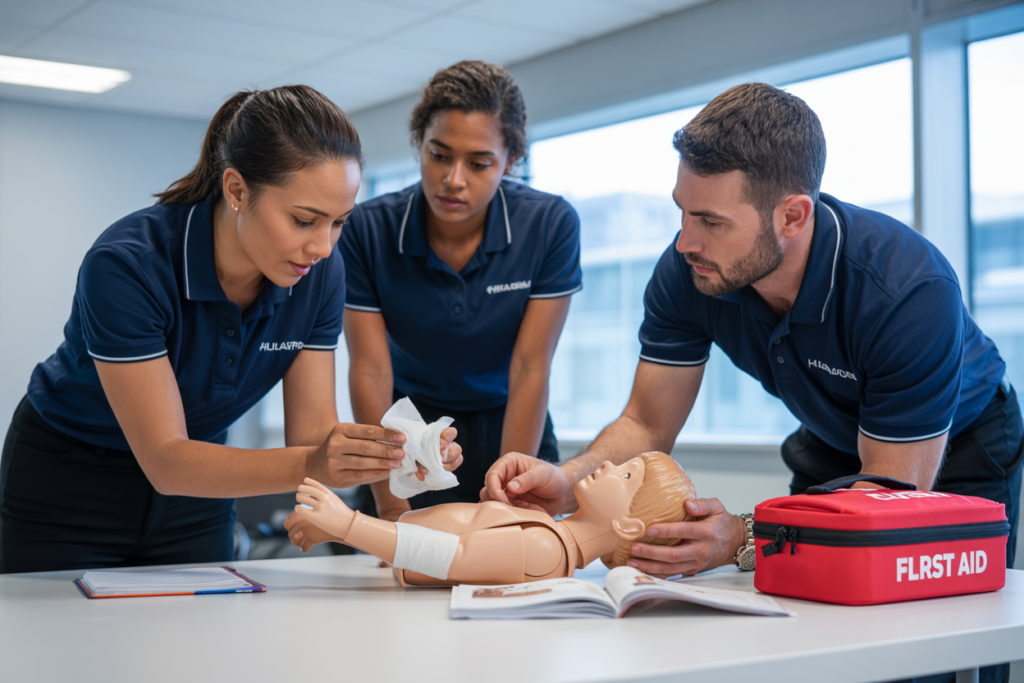
Quality HLTAID012 training includes hands-on practical assessment of wound care technique, not just a written or online component. Educators are observed cleaning, dressing, and managing simulated wounds. They are asked to demonstrate their decision making process out loud. They practice on scenarios that replicate the actual conditions of a childcare environment, not a clinical setting with perfect lighting and a cooperative patient.
This is what separates training that produces genuine competence from training that produces a certificate.
What to Look for in a Provider That Takes Wound Care Seriously
Here is what to look for when evaluating whether a first aid provider actually delivers wound care training that will hold up in a real situation.
The course description mentions paediatric scenarios specifically
If the provider’s website describes wound care in generic terms with no reference to children, that is a signal. A course built for education and care settings should explicitly mention paediatric wound management, child-specific technique, and scenarios drawn from early childhood environments.
Practical components are clearly described
Any provider worth booking should be able to tell you exactly what the hands-on component of the course looks like. Are educators assessed on their technique? Is the assessment observed by a trainer or completed online? If the answers are vague, keep looking.
The trainer has relevant experience
There is a meaningful difference between a trainer who has delivered first aid courses in general workplace settings and one who has genuine experience in paediatric or education and care contexts. It is completely reasonable to ask about trainer backgrounds before booking.
Reviews from childcare professionals
Generic five star reviews tell you very little. Reviews that specifically mention the paediatric focus of the course, the quality of the practical components, or the trainer’s knowledge of early childhood contexts tell you a great deal.
RTO registration is visible and verifiable
The provider’s RTO number should be easy to find and verifiable on the national register at training.gov.au. If it is buried, absent, or does not match the qualification being delivered, walk away.
Wrapping Up
Wound care might not be the first thing that comes to mind when you think about first aid training for childcare educators. Anaphylaxis, CPR, asthma response, those are the topics that tend to dominate the conversation, and for good reason. But the reality of running an early childhood service is that wounds are what educators deal with most often, and the quality of their response matters every single time.
The difference between an educator who has genuinely learned wound care in a paediatric context and one who sat through a rushed generic course is not visible on a certificate. It shows up in the moment. It shows up in how quickly they assess the injury, how confidently they clean and dress it, how clearly they communicate with the family, and how accurately they complete the incident report afterwards.
For directors, the goal was never just compliance. It was always the children. Getting HLTAID012 training right, from a provider who takes the paediatric context seriously and delivers practical skills that actually hold up under pressure, is one of the most direct ways a centre director can honour that goal.
If your educators’ certificates are coming up for renewal, or if you have new staff who need HLTAID012, take the time to find a provider who covers wound care the way it deserves to be covered. Your educators will feel the difference. And so will the children in your care.
Book Your First Aid Training Now
Fast, affordable, and nationally accredited training delivered by professionals who care
Frequently Asked Questions
Q. Is wound care covered in HLTAID012?
Yes. Wound care is a core practical component of HLTAID012, the first aid qualification required for educators in early childhood and school age care settings. The unit covers wound assessment, cleaning, bleeding control, dressing selection, and knowing when an injury requires medical attention beyond what first aid can provide.
Q. Do childcare educators need a separate wound care certificate?
No separate qualification is required. Wound care is embedded within HLTAID012, which is the qualification ACECQA requires services to hold across their educator teams. What matters is choosing a provider who delivers wound care in a genuinely paediatric context rather than adapting a generic adult workplace course.
Q. What should I do if a child's wound keeps bleeding?
Maintain firm, continuous direct pressure and keep the child as calm as possible. Do not lift the dressing to check on the wound while pressure is being applied. If bleeding is not slowing after sustained pressure, or if the wound is deep, gaping, or accompanied by other concerning signs, call 000 and notify the family immediately.
Q. What should be in a childcare centre's first aid kit for wound care?
A well-stocked childcare first aid kit should include non-latex gloves in multiple sizes, saline solution or access to clean running water for wound irrigation, sterile dressings in a range of sizes, hypoallergenic tape, and wound closure strips for lacerations with gaping edges. A qualified HLTAID012 trainer should walk educators through the kit contents and the purpose of each item as part of the course.
Q. How often does HLTAID012 need to be renewed?
HLTAID012 is valid for three years. Most providers and regulatory guidance recommend renewing before the expiry date rather than waiting until the certificate lapses, particularly for educators counted toward a centre's minimum ratio requirements under Regulation 136.
Making first aid training more affordable for
every classroom
We believe every student deserves access to life-saving first aid knowledge. That’s why we offer specially reduced pricing for schools and educational groups. Whether you’re booking for a single class, a year group, or your entire school, our flexible packages make training more accessible and cost-effective — without compromising quality.
