

It’s a Tuesday morning at a Brisbane long day care center. A four-year-old with a documented nut allergy begins to react – fast. The educator on duty completed her asthma and anaphylaxis training over a year ago. She reaches for the adrenaline auto-injector. Her hands are shaking. She can’t quite remember the steps in order.
That gap – between having a certificate and actually being ready – is exactly what this article is about.
ASCIA, the peak clinical body that sets Australia’s anaphylaxis management standards, periodically reviews and updates its guidelines. When those guidelines change, training completed before the update may no longer reflect current best practice. The certificate on file might still be valid. The knowledge behind it might not be.
If you’re a childcare director or OSHC coordinator in Brisbane, an asthma and anaphylaxis guidelines course aligned to the latest ASCIA protocols is the difference between a team that can genuinely respond – and one that freezes. This article covers what the 2026 updates mean for your center, what ACECQA actually requires, and how to get your team trained without disrupting operations.]
What Is an Asthma and Anaphylaxis Guidelines Course?
An asthma and anaphylaxis guidelines course is accredited training that teaches educators and childcare workers how to recognize and respond to asthma attacks and anaphylactic reactions using current ASCIA protocols. In Queensland, it’s a mandatory ACECQA compliance requirement for all childcare services.
A compliant course typically covers:
- Recognising the early and severe signs of an anaphylactic reaction
- Correct use of adrenaline auto-injectors (EpiPen and Anapen)
- Asthma first aid – reliever vs preventer inhaler use and spacer technique
- Following an individual ASCIA Action Plan for Anaphylaxis
- When and how to call Queensland Ambulance Service (QAS)
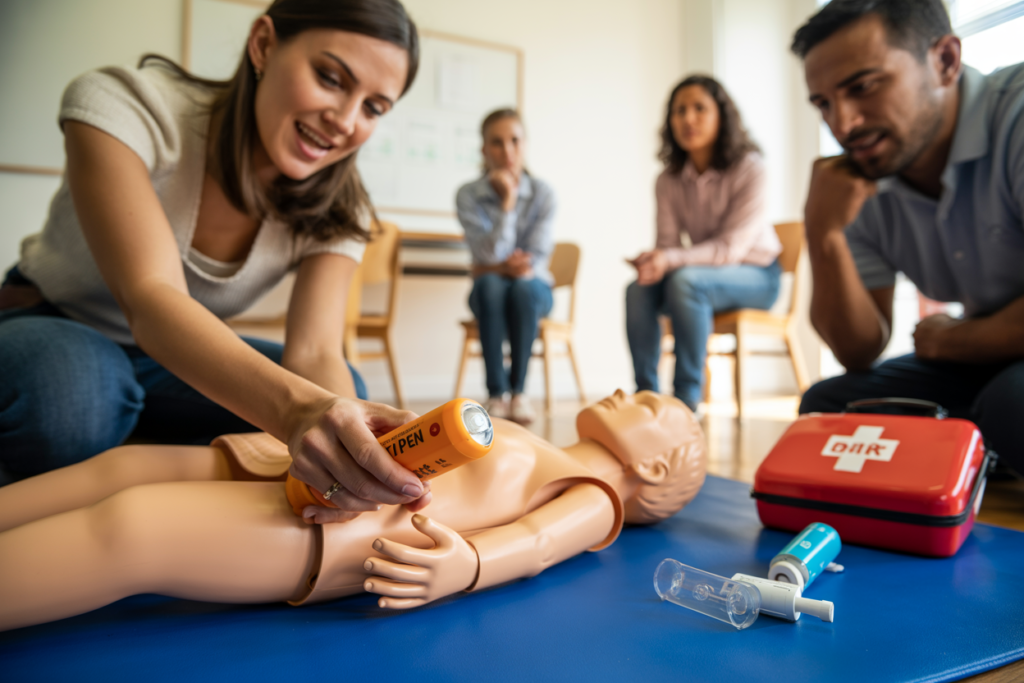
- Practical scenario-based assessment using EpiPen trainer devices
Why the 2026 ASCIA Guidelines Matter for Brisbane Childcare
ASCIA – the Australasian Society of Clinical Immunology and Allergy – sets Australia’s anaphylaxis management standard. Their guidelines inform what goes into accredited training, what gets assessed during audits, and what your staff are expected to do when a child begins to react. Those guidelines are reviewed over time, and when they change, the protocols your staff learned in their last session may no longer reflect current best practice.
What ASCIA Updated in 2026
Confirm specific 2026 changes before publishing. If no major 2026 guideline revision has been issued, reframe this section as “the most recent ASCIA guideline review” and note the year of last revision throughout. Do not publish year-specific claims without verification against ascia.org.au.
Why Outdated Training Creates Real Risk
A certificate doesn’t expire the moment guidelines change your educator’s cert might still show a valid date while the steps she learned have shifted. Under pressure, people default to what they practiced. If that practice was based on an older protocol, that’s what comes out in a real incident. For a four-year-old in anaphylactic shock, the distinction between a valid certificate and current knowledge isn’t a technicality. It’s everything.
⚠️ Compliance Check: Not all courses satisfy ACECQA requirements. The unit codes 22300VIC and 22556VIC must appear on the certificate - HLTAID012 alone does not cover the requirement at all services.
What ACECQA Actually Requires and What Doesn’t Count
The compliance picture here is more specific than most people realise – and getting it wrong shows up at audit. ACECQA doesn’t just require “some first aid training.” There are specific regulations, specific unit codes, and specific currency requirements. Not every course that mentions anaphylaxis actually satisfies them.
The Specific Regulations That Apply
The Education and Care Services National Regulations 2011 sets out exactly what’s required. The three that matter most are:
- Regulation 136 – first aid qualifications required for staff
- Regulation 137 – specific anaphylaxis management training requirements
- Regulation 168 – educational program and practice obligations
Regulations 136 and 137 are the ones auditors check first.
Which Courses Satisfy the Requirement
There’s a common assumption that completing HLTAID012 ticks the anaphylaxis training box on its own. It doesn’t, not at all services.
The specific unit codes ACECQA looks for are:
- 22300VIC – accredited asthma first aid training
- 22556VIC – anaphylaxis management, aligned to ASCIA guidelines
If those codes aren’t on the certificate, an auditor may not accept the training as satisfying Regulations 136 and 137 – regardless of how recent the cert is.
What Auditors Look For
When an ACECQA auditor reviews your training records, they check three things:
- Certificate currency – not just the date, but whether the correct unit codes appear
- Provider ASQA registration – the RTO number must appear on the certificate
- Format and naming – correctly named to the staff member and matching your records
⚠️ Compliance Warning: ACECQA requires that at least one staff member with current anaphylaxis training is present at all times when children are in attendance. A certificate that has lapsed - even by one day - does not satisfy this requirement.
Once you know what’s required, the next question is what a fully compliant course actually covers – and whether your current provider delivers it.
What’s Covered in a Compliant Asthma and Anaphylaxis Course
Knowing the unit codes is one thing. What every director really wants to know is whether her staff will actually handle it – with a real child, in a real moment, under real pressure. A properly structured course covers three core areas.
Anaphylaxis Recognition and Response
In the early stages, mild reactions can look a lot like other things – so knowing what you’re looking at is the first job. A compliant course covers the signs of mild-to-moderate allergic reaction versus full anaphylaxis, and the decision pathway staff follow using the child’s individual ASCIA Action Plan. That action plan isn’t optional paperwork – it’s what your educator should be reaching for at the same time as the EpiPen. The key message: don’t wait for more symptoms. Act.
Correct Adrenaline Auto-Injector Technique
EpiPen and Anapen are both in common use in Australia – and they work differently. The grip is different. The activation is different. A staff member who’s only practiced with one device may hesitate with the other, and in anaphylaxis, hesitation is dangerous.
A compliant course covers:
- The differences between EpiPen and Anapen and how each device operates
- Hands-on practice with EpiPen trainer devices – building the muscle memory that matters under pressure
- When a second dose may be required and how to make that call
- Correct positioning of the child after administration
- How and when to call QAS – and what to tell them
Asthma First Aid
A deteriorating asthma episode that isn’t managed correctly can escalate quickly – and the most common errors are avoidable. The reliever vs preventer distinction is the one that trips people up most. A preventer inhaler used in an acute episode does nothing. It’s the reliever – the blue one – that opens the airways.
A compliant course covers:
- Reliever vs preventer inhalers – which one is used for an acute episode and why
- Correct spacer technique – most children need a spacer to get effective medication delivery
- The 4x4x4 rule – four puffs, four breaths, wait four minutes, repeat if needed
- Recognising the signs that an episode is deteriorating and when to call QAS
Documentation and Reporting
After the immediate response comes the paperwork and in childcare, that paperwork matters. A compliant course covers post-incident obligations: communicating with parents and QAS, completing incident reports for ACECQA purposes, and documenting what happened and when.
Asthma first aid vs Anaphylaxis first aid
| Asthma | Anaphylaxis | |
|---|---|---|
| First action | Sit upright, give reliever via spacer | Follow ASCIA Action Plan - give adrenaline auto-injector |
| Device used | Blue reliever inhaler + spacer | EpiPen or Anapen |
| Repeat dose? | Yes - 4x4x4 rule | Yes - second dose after 5 minutes if no improvement |
| Call QAS? | Yes - if no improvement after 4 minutes | Yes - always, immediately after first dose |
| Position | Sitting upright | Lying flat (or sitting if breathing difficult) |
| Key mistake to avoid | Using preventer instead of reliever | Waiting for symptoms to worsen before acting |
Knowing what’s on the curriculum is important but how that content is taught makes the difference between a certificate and genuine competence.
Practical vs Theory Why the Scenario Component Matters
There’s a version of this training that ticks every compliance box and leaves staff feeling exactly as uncertain as before they walked in. Slides, a multiple-choice quiz, a certificate. That’s the box-tick version. The problem isn’t the certificate – it’s what happens when the real thing occurs.
Why Online-Only Training Has Limits
Blended delivery – theory online, practical face-to-face – is valid and ASQA-compliant. But online delivery can’t sign off competency. Under ASQA’s standards, practical competency assessment requires a face-to-face component. Completing only the online module means completing half the course.
What Good Scenario Practice Looks Like
Here’s what separates a course that builds genuine competence from one that just gets people through the assessment:
- Real EpiPen trainer devices – not diagrams, not demonstrations on a desk. Participants hold the device, go through the activation sequence, and build the physical familiarity that makes the real moment less chaotic
- Role-play under time pressure – scenarios that replicate the actual conditions of a real incident: a child in distress, a room that’s noisy, an action plan that needs to be located and read under stress
- Trainer observation and competency assessment – a qualified assessor watching each participant, giving real-time feedback, and only signing off when competency is genuinely demonstrated
💡 What to ask your training provider: "Do participants use EpiPen trainer devices during the practical component?" If the answer is no - keep looking.
How Often Does Asthma and Anaphylaxis Training Need to Be Renewed?
Short answer: annually. And the renewal question goes beyond regulatory minimums – it’s about the reality of running a centre where staff turn over, certificates expire at different times, and an auditor can arrive with limited notice.
The Regulatory Minimum
ASCIA recommends annual renewal of anaphylaxis training for childcare educators – the benchmark most Queensland services work to and what ACECQA auditors expect in your compliance records.
Key things to know about certificate currency:
- Currency runs from the date of completion – not from the start of the calendar year
- A certificate that expires on a Wednesday is non-compliant from that Wednesday
- ACECQA requires at least one currently certified staff member present whenever children are in attendance
Building a Forward Training Calendar
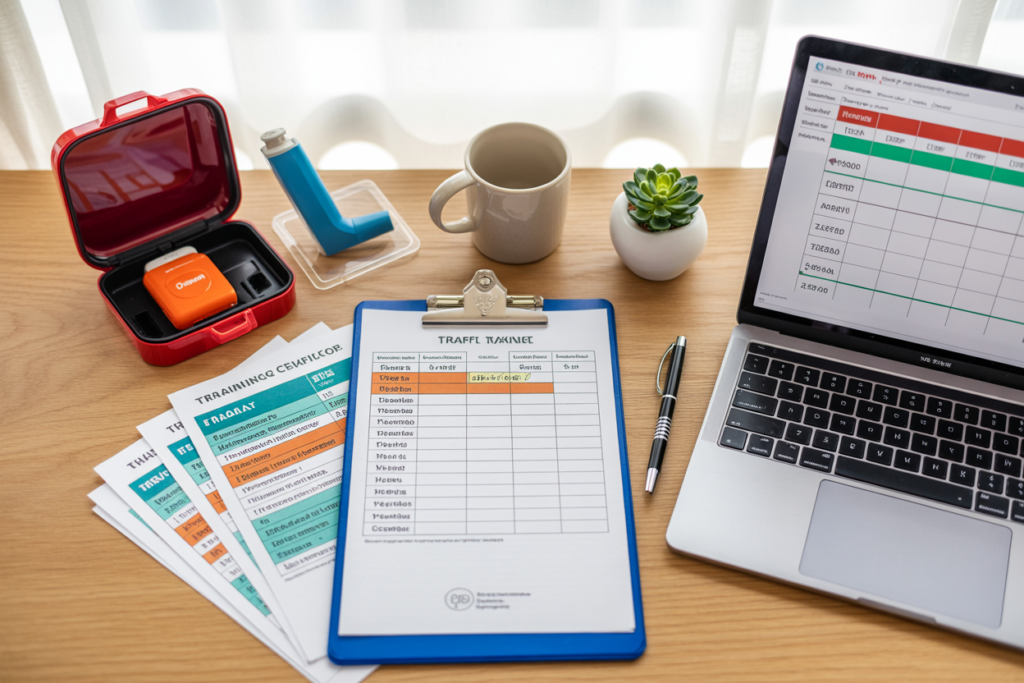
A shared spreadsheet tracking each staff member’s certificate expiry date is enough. Book renewal six weeks before expiry – that buffer covers sick days, roster gaps, and rescheduling. New staff need training before working unsupervised with children, so build it into your onboarding checklist. [BRAND_NAME] can handle individual top-up bookings and whole-team renewal sessions.
Certificate Filing Checklist – Audit Readiness:
- Certificate is dated and correctly named to the staff member
- Unit codes 22300VIC and/or 22556VIC appear on the certificate
- Provider ASQA RTO number is visible on the certificate
- Certificate is stored in the staff member’s compliance file
- Expiry date is recorded in your renewal tracking system
On-Site vs Public Sessions – What Works Best for Childcare Centres
Getting educators off the floor without closing the centre or blowing ratio requirements is the part that keeps most directors up at night. There are two ways to approach it.
Public Sessions Flexibility for Individuals and Small Teams
Public sessions suit one or two staff members who need certification, or when you need someone trained urgently.
On-Site Training: The Whole-Centre Solution
If several staff need certification at the same time, on-site training is almost always the better option. Comes to your centre – no travel, no logistics. Sessions run around your operational hours on weekdays, weekends, and early mornings.
One Last Thing Worth Remembering
The four-year-old at the start of this article – the one reacting fast while an educator’s hands were shaking – that’s not a hypothetical designed to frighten you. It’s the scenario every childcare director in Brisbane carries in the back of their mind. You’ve read the stories. You’ve attended the briefings. You know how fast anaphylaxis moves and how little margin there is for hesitation.
The training isn’t complicated to organise. The compliance requirements are clear, the course content is well-defined, and the booking process takes minutes. What makes the difference is whether the training your team completes actually prepares them to act under pressure – with the right device, following the right protocol, in the right sequence. A certificate that reflects genuine competence is a completely different thing to one that just reflects attendance.
There’s also the ACECQA piece. Getting that right matters more than most directors realise until they’re sitting across from an auditor with a filing system that doesn’t quite add up. The wrong course code, an expired cert, a provider who turned out not to be ASQA registered – these aren’t minor admin errors. They’re the kind of thing that triggers a notice of non-compliance and puts your centre’s rating at risk. The good news is they’re entirely avoidable when you book with a provider who understands exactly what ACECQA is looking for and makes sure the paperwork reflects it.
It’s also worth remembering that this training isn’t something you do once and forget. Staff turn over. Guidelines get updated. Certificates lapse. The centres that stay on top of it are the ones that treat renewal as a normal part of operations – not a crisis to manage in the week before an audit. A simple tracking system, a six-week buffer before expiry, and a provider who makes repeat bookings easy is all it takes to keep your team compliant year-round.
Get the training sorted. Get the certificates filed. Build the renewal calendar so you’re never scrambling. And the next time an auditor walks through your door – or a child in your care begins to react – you’ll know your team is ready. Not just on paper. Actually ready.
Book Your First Aid Training Now
Fast, affordable, and nationally accredited training delivered by professionals who care
Frequently Asked Questions
Q.Is this course accepted by ACECQA for childcare compliance?
Yes. The course is aligned to current ASCIA guidelines and satisfies ACECQA requirements under the Education and Care Services National Regulations 2011, specifically Regulations 136 and 137. Certificates are issued on the day of training and reference unit codes 22300VIC and 22556VIC - the codes auditors look for - so there's no ambiguity at audit.
Q.What is the difference between 22300VIC and 22556VIC?
22300VIC is the unit code for accredited asthma first aid training and 22556VIC covers anaphylaxis management aligned to current ASCIA guidelines. ACECQA requires childcare services to hold current certification in both units, and most providers deliver them as a single combined session - which is the most practical option for busy childcare teams.
Q.Does HLTAID012 satisfy the anaphylaxis training requirement?
HLTAID012 - Provide First Aid in an Education and Care Setting - does not satisfy the specific anaphylaxis and asthma compliance requirement at all services on its own. ACECQA looks for 22300VIC and 22556VIC on the certificate. If those codes aren't present, the training may not be accepted at audit regardless of when or where it was completed.
Q.How often does asthma and anaphylaxis training need to be renewed?
ASCIA recommends annual renewal for childcare educators, and that's the standard ACECQA auditors expect to see in your compliance records. Certificate currency runs from the date of completion - not the calendar year - so it's worth tracking each staff member's expiry date individually and booking renewal with a six-week buffer before the cert lapses.
Q.How quickly will staff receive their certificates?
Certificates are issued on the day of training, correctly named and referencing the unit codes required for ACECQA compliance. Digital copies are sent by email so they can be filed immediately - no waiting, no chasing.
Making first aid training more affordable for
every classroom
We believe every student deserves access to life-saving first aid knowledge. That’s why we offer specially reduced pricing for schools and educational groups. Whether you’re booking for a single class, a year group, or your entire school, our flexible packages make training more accessible and cost-effective — without compromising quality.
