

You’re on site. The principal contractor’s WHS officer pulls you aside and tells you your LVR ticket is expired. Job’s on hold until you can show a current certificate. Sound familiar?
For a lot of electricians, that’s exactly how it goes down. Not a calendar reminder. Not a heads-up from your QBCC renewal notice. A site super with a clipboard, and suddenly your whole week is on hold. It’s more common than most tradies want to admit. You’re running a business, you’re quoting, invoicing, managing materials, chasing payments, and tracking an LVR expiry date is the last thing on your mind until someone else makes it your problem.
The thing is, there’s no grace period. No quiet word with the project manager to buy yourself a few extra days. The moment that ticket lapses, you’re off the site until you can produce a current certificate. And for most sparkies, that lands at the worst possible time, mid-project, peak schedule, crew waiting.
This guide covers everything you need to know about LVR training for electricians. What the UETDRRF018 course actually involves, how long your certificate stays current, how CPR fits into the picture, and what to look for when you’re trying to find a registered RTO that offers Saturday courses with same-day digital certificates.
Whether your ticket just expired and you need a fix fast, or you’re getting ahead of your next renewal before a site supervisor beats you to it, you’re in the right place.
What Is Low Voltage Rescue Training for Electricians?
Low Voltage Rescue (LVR) training is a legally mandated certification for licensed electricians in Queensland who work on or near live low voltage electrical equipment. Delivered under the unit of competency UETDRRF018, the course trains electricians to safely rescue a colleague who has received an electric shock from low voltage equipment and administer CPR until emergency services arrive.
LVR training covers:
- Recognizing a low voltage electrical emergency on site
- Safely isolating the power source before approaching a casualty
- Performing a rescue without becoming a second victim
- Administering CPR in accordance with current ANZCOR guidelines
- Completing the correct incident reporting procedures
LVR certification is required by principal contractors on commercial, infrastructure, and government sites across Queensland. The certificate must be renewed every three years, with CPR renewed annually.
Now you know what LVR training is. Here’s who’s legally required to hold it.
⚠️ Important: Your QBCC license doesn't cover LVR. They're separate obligations. A current QBCC licence keeps you legal to operate. A current LVR certificate keeps you legal on site. Both need to be current. One doesn't cover the other.

Who Needs LVR Training in Queensland?
Licensed Electricians Working Near Live Equipment
If you’re a licensed electrician working on or near live low voltage equipment in Queensland, you’re legally required to hold a current LVR certificate. That obligation sits under the Electrical Safety Act 2002 (QLD) and the Electrical Safety Regulation 2013 and it applies whether you’re a sole trader, a subcontractor, or working for a small electrical firm.
One thing a lot of sparkies get caught out on: your QBCC license does not cover LVR. They’re completely separate obligations. Your QBCC license keeps you legal to operate. Your LVR certificate keeps you legal on site. Tracking that renewal date is on you, nobody else. A lot of electricians assume that because their QBCC license is current and their insurance is paid up, they’re compliant across the board. LVR sits outside all of that. It’s a standalone obligation that doesn’t renew itself and doesn’t get flagged when it lapses.
When a Principal Contractor Requires It
This is where it gets real. Commercial, infrastructure, and government sites require evidence of a current LVR ticket before they’ll grant you site access. And on a lot of the bigger builds, it’s not just before you touch a panel. Some principal contractors won’t let your crew through the gate at all without it in hand.
A WHS officer checking LVR currency is standard practice on larger projects. It’s not a gotcha. It’s their legal obligation. The problem is, it becomes your emergency.
Apprentices and New License Holders
If you’ve just got your license, don’t wait for a site supervisor to flag it. Getting your UETDRRF018 sorted as part of your first compliance setup before your first commercial site induction saves you the embarrassment of being turned away on day one. Some apprentices complete LVR in the final stage of their Certificate III as a job-readiness step. If that wasn’t you, get it done early. New license holders who show up to a commercial site induction without an LVR certificate tend to find out the hard way that principal contractors don’t make exceptions for people who are new to the game. The obligation applies from day one of your license, not after you’ve been on the tools for a few years.
What Does the UETDRRF018 Course Cover?
Course Content Overview
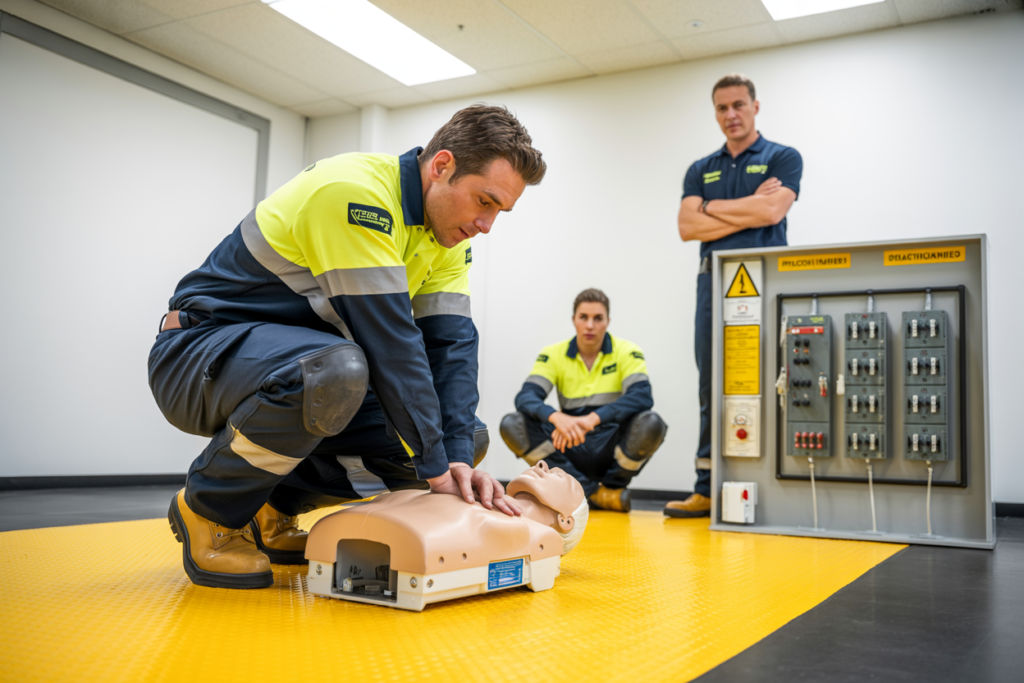
A lot of blokes show up to LVR training not really knowing what to expect. It’s not a lecture hall full of PowerPoint slides. The course is hands-on and practical. Here’s what you’ll actually be doing on the day.
- Electrical hazard identification and risk assessment on a live site
- Safe approach and isolation procedures for low voltage equipment
- Rescue techniques for safely removing a casualty from a live electrical source without becoming a second victim yourself
- CPR delivery in accordance with current ANZCOR guidelines
- Incident documentation and reporting obligations under Queensland WHS legislation
The assessment has both a practical and written component. It’s designed to test real competency, not trip you up.
Is CPR Included in LVR Training?
This is one of the most common questions and it’s worth getting clear on before you book.
CPR (HLTAID009) is typically co-delivered with UETDRRF018 in a single session, but not always. Before you lock in a booking, confirm with the RTO whether CPR is bundled. If it is, you walk out with two certificates from one session. One booking, one Saturday, job done. If CPR isn’t included, you’ll need to book it separately and make sure both certificates are current before your next site induction.
One thing to keep in mind: even when LVR and CPR are delivered together, their renewal schedules split after Year 1. Your LVR certificate is valid for three years. Your CPR needs to be renewed every 12 months. So by Year 2, you’ll need a standalone CPR renewal even though your LVR is still current. A lot of electricians miss this and end up with a current LVR and a lapsed CPR. Both certificates need to be current. Not just one of them.
| Component | Format |
|---|---|
| Theory / hazard identification | Classroom |
| Practical rescue techniques | Hands-on |
| CPR practical + assessment | Hands-on |
| Written assessment | Individual |
| Certificate issuance | Digital, same day |
📅 Renewal Reminder: LVR lasts three years. CPR lasts one. A lot of electricians track the LVR date and miss the CPR renewal. By Year 2, your LVR is still valid but your CPR is already due. Check both dates, not just one.
How Long Does an LVR Certificate Last?
LVR Certificate Validity Period
No grey area here. The UETDRRF018 certificate is valid for three years from the date you complete the course. That’s it. There’s no grace period, no extension, no negotiation with the principal contractor’s WHS officer. An expired ticket is a non-compliant ticket. Full stop.
A lot of sparkies assume there’s a bit of wiggle room. There isn’t. The day your certificate expires is the day you can’t access the site. Principal contractors are legally obligated to enforce it, and the good ones do every time.
CPR Renewal: The Annual Obligation
Here’s where a lot of electricians get caught out, even the ones who stay on top of their LVR renewal.
CPR (HLTAID009) must be renewed every 12 months, not every three years. When LVR and CPR are co-delivered on the same day, they’re issued together and both feel current. But from Year 2 onwards, your LVR is still valid while your CPR is due for renewal. Those two expiry dates diverge, and if you’re only watching the LVR date, your CPR can quietly lapse without you realising.
| Year | LVR Status | CPR Status | Action Required |
|---|---|---|---|
| Year 1 | Current | Current | None |
| Year 2 | Current | Renewal due | Book standalone CPR renewal |
| Year 3 | Current | Renewal due | Book standalone CPR renewal |
| End of Year 3 | Renewal due | Renewal due | Book full LVR + CPR renewal |
How to Check Your Current LVR Expiry Date
Simple enough. Find the issue date on your physical certificate or digital copy and add three years. That’s your expiry date.
If you’ve lost the certificate or can’t remember when you last did the course, don’t guess. Contact the RTO that issued it. They hold completion records and can confirm your currency. Not sure who issued yours or when? [RTO_NAME] can help you check. Call [PHONE_NUMBER].
How to Find a Registered LVR Training Provider
What to Look for in an RTO
Not every provider offering LVR training is worth your time. Booking with the wrong one can cost you more than the course itself if the certificate isn’t accepted on site. Here’s what to check before you hand over your card details.
- Confirm the provider is registered with ASQA, the national regulator for training organisations in Australia
- UETDRRF018 must appear explicitly on the course listing and on the certificate you receive, not just “low voltage rescue” in plain text
- The RTO registration number should be displayed clearly on the website. If you can’t find it, that’s a red flag
- Avoid any provider who can’t confirm same-day digital certificate delivery
Same-Day Digital Certificate: Why It Matters
Some principal contractors will accept a digital certificate emailed the same-day as proof of currency. That means you can complete a Saturday course and be back on site the following week, fully compliant, no delays. For electricians who’ve been stood down mid-job, that turnaround matters. Every day off site is a day you’re not billing.
Before you book, ask the RTO directly: “Will I receive my certificate digitally on the day of completion?” If they hedge or can’t confirm it, that’s worth knowing upfront. Waiting days for a posted certificate when you’ve got a project manager expecting you on Monday is not a situation you want to be in.
Choosing an RTO: quick checklist
| What to check | Why it matters |
|---|---|
| ASQA-registered RTO | Confirms the certificate is nationally recognized |
| UETDRRF018 on course listing | Confirms the correct unit of competency |
| Saturday courses available | Minimizes lost billable work |
| Same-day digital certificate | Gets you back on site faster |
| CPR bundled in session | One booking covers both obligations |
| RTO number on website | Basic credibility signal |

What Happens If Your LVR Ticket Expires?
You Cannot Access the Site
This isn’t a maybe. An expired LVR ticket means no site access. There’s no grace period, no supervisor you can have a quiet word with, no workaround. Principal contractors are legally obligated to enforce it, and on commercial, infrastructure, and government sites, they do.
The frustrating part is the timing. It almost never happens on a slow week. It happens when you’ve got a crew on site, a deadline to hit, and a principal contractor who needs you there Monday morning. One day locked off site waiting to sort your certificate typically costs more in lost billable work than the course itself.
Your Legal Exposure
It’s not just about site access. Working near live low voltage equipment without a current LVR certificate is a breach of the Electrical Safety Act 2002 (QLD). If an incident occurs on site and you can’t produce a current certificate, your liability exposure is significant, personally, and through your QBCC licence.
The Electrical Safety Office conducts random site audits. WorkSafe inspectors don’t give notice. Your documentation needs to be current and available on request, not “somewhere in the ute” and definitely not expired. If an inspector arrives on site and asks to see your LVR certificate, handing over an expired card isn’t a good look. And if something actually goes wrong on site, an expired certificate isn’t just an administrative problem. It becomes a legal one fast.
What to Do Right Now
If your ticket has lapsed, or you’re not sure whether it has, here’s the only plan that makes sense:
- Check your current LVR expiry date
- Find a registered RTO offering the next available Saturday course
- Confirm CPR is bundled and that a digital certificate is issued on the day
- Book. Don’t wait for next week
The longer you leave it, the more likely it is that a site supervisor finds out before you do. And that conversation, standing at the gate on a Monday morning being told you can’t start, is one worth avoiding entirely. Getting your LVR sorted before it becomes a site access problem is the cheapest, easiest fix available to you right now.
Conclusion
Getting your LVR ticket sorted isn’t complicated. It’s a single Saturday, a practical course delivered by a registered RTO, and a digital certificate in your inbox before the day is out. The hard part isn’t the training itself. It’s the moment you find out your ticket has lapsed and you’re standing at a site gate with nowhere to go. That’s the scenario worth avoiding, and the fix is straightforward enough that there’s no good reason to leave it any longer than you already have.
The compliance side of this is non-negotiable. The Electrical Safety Act 2002 (QLD) doesn’t make exceptions for busy schedules or forgotten expiry dates. Principal contractors don’t negotiate. WHS officers don’t look the other way. Your UETDRRF018 certificate either is current or it isn’t, and the day it isn’t is the day your access gets cut. That reality doesn’t change based on how long you’ve been in the trade, how good your relationship is with the builder, or how close you are to finishing the job.
The CPR side of it catches people off guard more than any other part. Most electricians know they need to renew LVR every three years. Far fewer remember that CPR needs to go again every 12 months. If you’ve had your LVR and CPR co-delivered and you’re only tracking one expiry date, there’s a good chance the other one has already lapsed or is getting close. Check both. Book both if you need to. One booking, one Saturday covers it when they’re delivered together.
When you’re choosing an RTO, keep it simple. ASQA-registered, UETDRRF018 on the course listing, Saturday sessions available, digital certificate issued on the day. Those four things cover the basics. A provider who can’t confirm all four isn’t worth your time. Your certificate needs to be accepted on site by a principal contractor’s WHS officer, and the only way to guarantee that is to book with a properly registered RTO who delivers the correct unit of competency.
Your LVR ticket is what keeps you on the tools. It’s what keeps your crew on the job and your relationship with principal contractors intact. Letting it lapse costs you more than a course ever will, in lost work, in professional credibility, and in the kind of stress that comes from being reactive instead of prepared. Get it sorted on a Saturday. Get your certificate the same day. Get back on site and get on with it.
Book Your First Aid Training Now
Fast, affordable, and nationally accredited training delivered by professionals who care
Frequently Asked Questions: LVR Training for Electricians
Q. Do I need LVR if I'm just supervising, not working on panels?
It depends on your proximity to live equipment. If you're working in the vicinity of live low voltage electrical equipment, even in a supervisory role, you may be required to hold a current LVR certificate. Don't assume supervision means exemption. Confirm with your principal contractor's WHS officer before the site induction.
Q. Can I do LVR training online?
No. The practical rescue component of UETDRRF018 must be completed in person at a registered RTO. A fully online LVR certificate is not compliant and will not be accepted by principal contractors on construction sites. If a provider is offering a fully online LVR certificate, walk away.
Q. What's the difference between UETDRRF018 and high voltage rescue training?
UETDRRF018 covers low voltage rescue and is the unit required by most licensed electricians working on commercial and residential sites. High voltage rescue applies to a smaller subset of electrical workers with specific high voltage site exposure. If you're not sure which unit applies to your work, check with your principal contractor's WHS officer before you book.
Q. Is LVR the same as first aid?
No. LVR (UETDRRF018) is specific to electrical rescue scenarios. It trains you to safely rescue a colleague from a live electrical source and administer CPR until help arrives. First aid (HLTAID011) is a separate qualification altogether. Some commercial sites require both, so check your site's specific induction requirements before booking.
Q. How do I know if my LVR certificate will be accepted on site?
Book with an ASQA-registered RTO that lists UETDRRF018 explicitly on the course listing and the certificate. The RTO registration number should be visible on their website. A certificate from a properly registered RTO delivering the correct unit of competency will be accepted by principal contractors on commercial, infrastructure, and government sites across Queensland.
Making first aid training more affordable for
every classroom
We believe every student deserves access to life-saving first aid knowledge. That’s why we offer specially reduced pricing for schools and educational groups. Whether you’re booking for a single class, a year group, or your entire school, our flexible packages make training more accessible and cost-effective — without compromising quality.
