

Starting a trade apprenticeship in Queensland comes with a checklist: most people are ready for white cards, steel-capped boots, the right PPE. What catches a lot of apprentices off guard is the CPR qualification.
Here’s a situation that happens more often than you’d think. An apprentice turns up on their first week, runs through the site induction, and somewhere around item seven on the checklist there it is – current CPR certificate required. No one mentioned it during the interview. No one brought it up at sign-on. And now there’s a Monday morning start at risk because of a course that nobody planned for.
Whether you’re starting a plumbing, electrical, construction, or hospitality apprenticeship, a current CPR certificate is either a direct entry condition, a site induction requirement, or an employer expectation you’ll hit within your first few weeks on the job.
In this article you’ll find out exactly which CPR qualification apprentices need in Queensland, why it’s required, how long it lasts, where to get it fast, and what happens if yours lapses while you’re mid-apprenticeship.
Why Apprentices in Queensland Need a CPR Qualification
It’s Not Always a Legal Requirement But It Might As Well Be
Here’s where a lot of people get confused. There’s no single piece of Queensland legislation that says “all apprentices must hold HLTAID009.” What there is, is a web of WHS obligations, site induction policies, group training organisation conditions, and employer safety requirements that make a current CPR certificate effectively unavoidable.
Under the Safe Work Australia WHS Act and Queensland’s own workplace health and safety framework, employers have a duty of care to maintain a safe working environment and that includes having people on site with current emergency response skills. For electrical apprentices specifically, the Queensland Electrical Safety Act adds another layer of expectation around safety competency.
So while a regulator might not personally knock on the door demanding to see your CPR card, your GTO agreement, your site induction checklist, or your employer’s onboarding paperwork almost certainly will.
Think of it less like a legal technicality and more like a practical reality you’re not getting on most Queensland worksites without it.
Industries Where CPR Is Expected From Day One
The requirement isn’t limited to one trade or sector. Across most of the industries where Queensland apprentices work, a current CPR certificate is expected at or before the point of site entry.
| Industry | CPR Expected At |
|---|---|
| Construction & trades | Site induction |
| Electrical | Pre-site requirement |
| Hospitality | Employer onboarding |
| Childcare | ACECQA legal requirement |
| Community services | NDIS compliance |
| Fitness & sport | Insurance requirement |
Which CPR Certificate Do Apprentices Actually Need?
HLTAID009 – The Current National Standard
The certificate you need is HLTAID009 Perform CPR – a nationally recognised unit of competency delivered by a registered training organisation (RTO) and verified on training.gov.au.
In plain English, HLTAID009 covers everything a bystander needs to respond to a cardiac or breathing emergency before paramedics arrive. That includes:
- Compression-only CPR and full CPR for adults and infants
- Using an automated external defibrillator (AED)
- Placing an unconscious person in the recovery position
- Recognising the signs of cardiac arrest and acting on them
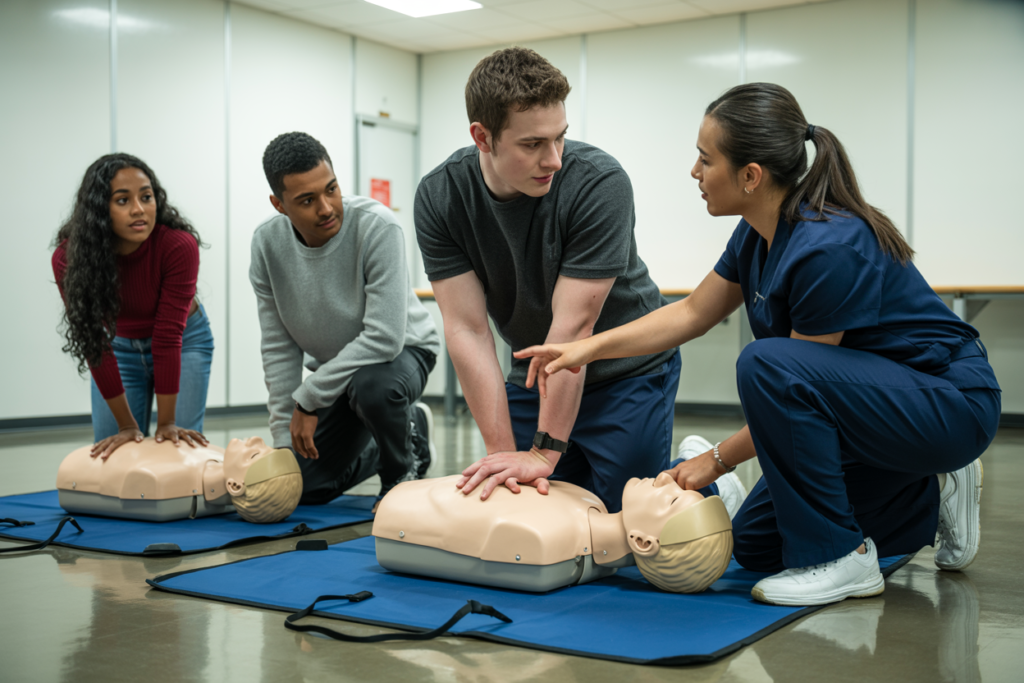
The course includes a face-to-face practical component – you’ll physically perform CPR on a manikin under trainer supervision. That hands-on assessment is what makes the certificate nationally recognised and accepted on Queensland worksites.
One thing worth knowing: if you’ve got an older certificate with a code like HLTAID001 or HLTAID002, that’s a superseded qualification. Those codes have been replaced, and some employers and site supervisors are now savvy enough to check. An outdated code on your cert can create the same compliance headache as no cert at all – so if yours carries an old code, it’s worth getting it sorted.
What About HLTAID011 – Do Apprentices Need Full First Aid?
This is one of the most common questions apprentices ask, and the answer depends on your specific role.
| Certificate | What It Covers | Who Needs It |
|---|---|---|
| HLTAID009 | CPR only | Minimum requirement for most apprenticeships |
| HLTAID011 | CPR + broader first aid skills | Some roles, site first aiders, higher-responsibility positions |
For the majority of trade apprenticeships, HLTAID009 is all that’s required to meet the site induction or GTO condition. But HLTAID011 is never a wrong choice – it covers everything in HLTAID009 and more, and it genuinely increases your employability, particularly as you move into more senior or supervisory roles on site.
If you’re not sure which one your GTO or employer requires, the safest move is to call and ask before you book. And if you want to look at the full first aid option, you can find out more on our Provide First Aid course page.
📞 Need Help Choosing? Not sure which cert you need? Call us on and we'll point you in the right direction in two minutes.
Online CPR – Why It Won’t Meet the Requirement
This one catches a lot of people out, particularly younger apprentices who are used to completing inductions and safety modules entirely online.
Online-only CPR certificates are not nationally recognised under current Australian Resuscitation Council (ARC) guidelines. HLTAID009 requires a face-to-face practical component – specifically, a hands-on assessment where a qualified trainer observes you performing CPR correctly.
No practical component means no compliance. A site supervisor or GTO checking your cert will know the difference, and an online-only certificate won’t get you through the gate.
This isn’t a criticism of anyone who’s already done one – most people simply weren’t told. But if you’ve got an online CPR cert sitting in your inbox, it’s worth replacing it with a proper face-to-face qualification before your next site starts.
How Long Does a CPR Certificate Last for Apprentices?
The 12-Month Rule – And Why It Catches Apprentices Out
Under Australian Resuscitation Council (ARC) guidelines, CPR certificates expire after 12 months. That’s not a suggestion – it’s the standard that employers, GTOs, and site supervisors apply when checking compliance.
For most trade apprenticeships running three to four years, that means three to four renewals across the life of your apprenticeship. It’s not a set-and-forget qualification. It’s an annual commitment, roughly the same as renewing a driver’s licence – except the consequences of letting it lapse show up a lot faster.
The pattern that plays out regularly goes something like this: an apprentice gets their CPR cert at induction in week one, files it away, and doesn’t think about it again. Eleven months later, life is busy, the renewal date passes quietly, and two months after that a supervisor pulls up the compliance register and flags the lapse. That’s a preventable problem with a straightforward fix – but it’s a lot easier to sort before it happens than after.
Renewal timeline across a standard apprenticeship:
| Milestone | Action Required |
|---|---|
| Year 1 - Induction | Complete initial HLTAID009 |
| Month 11 | Book renewal - don't wait for it to lapse |
| Year 2 | Renewal completed before cert expires |
| Year 3 | Repeat renewal |
| Year 4 | Renewal must be current at apprenticeship completion |
You can renew your CPR certificate in Brisbane quickly and without fuss – weekend and weekday sessions are available year-round.
What Happens If Your CPR Certificate Expires Mid-Apprenticeship
The short answer: most sites won’t let you on until it’s current again.
In practice, an expired CPR certificate can mean being stood down from a placement, failing a compliance audit, or being unable to start a new site rotation. For an apprentice who’s already mid-program, that’s a real disruption – not just to your schedule but potentially to your employer’s project timeline too.
The good news is that an expired cert is a one-Saturday fix. Weekend and same-day CPR courses in Brisbane mean you can go from lapsed to compliant within days.

Where to Get Your CPR Qualification in Brisbane
What to Look for in an RTO
Not all CPR courses are equal, and for an apprentice with a site start coming up, choosing the wrong provider is a costly mistake. The certificate needs to be nationally recognised, issued by an ASQA-registered RTO, and backed by a face-to-face practical assessment – otherwise it won’t hold up on site.
Here’s what to check before you book:
- Nationally recognised RTO – look for the RTO number on the certificate and verify it at asqa.gov.au
- Face-to-face practical component included – not a hybrid online course with a tick-box practical
- Certificate issued same day or within 24 hours – you shouldn’t be waiting a week for a PDF
- Weekend and weekday sessions available
- Strong Google review profile – look for 4.7 stars or above with recent, specific reviews
How to Book Your CPR Course
Booking is straightforward. Head to our website, pick a session that suits your roster, and complete the booking online in a few minutes. No phone call required. Confirmation comes through instantly, and your certificate is issued on the day you complete the course.
If you’re unsure whether your employer or GTO will cover the course fee, check your training agreement or ask your supervisor before you book. Reimbursement is more common than most apprentices realise – particularly in construction, electrical, and community services.
Book Your CPR Course in Brisbane Today
A CPR qualification isn’t the most glamorous part of starting a trade apprenticeship – but it’s one of the most practical. A Saturday morning commitment gets you a nationally recognised certificate that opens site gates, satisfies GTO requirements, and genuinely gives you a skill that matters if something goes wrong on the job.
The apprentices who run into problems aren’t the ones who couldn’t find the time. They’re the ones who assumed someone else would tell them when it was due, or figured they’d sort it out next month. An expired certificate has a way of surfacing at the worst possible moment – right before a new placement starts, or during a compliance check that nobody saw coming.
What’s worth remembering is that this isn’t a once-off box to tick. A four-year apprenticeship means four renewals. Building the habit of renewing at the eleven-month mark, before the cert lapses rather than after, is the kind of simple discipline that keeps your compliance record clean and your site access uninterrupted for the full run of your training.
The practical side of CPR training is also genuinely worth taking seriously. Most people who’ve done a proper face-to-face course come out the other side feeling more capable than they expected – not just compliant on paper, but actually confident that they’d know what to do if a workmate went down on site. That confidence is worth a lot more than the certificate itself.
Getting qualified is straightforward, accessible, and affordable – and in most cases your employer will foot the bill if you ask. The only thing standing between you and a current HLTAID009 certificate is booking a session and showing up. Weekend availability across Brisbane means there’s almost always a date that works, whatever your roster looks like.
Book Your First Aid Training Now
Fast, affordable, and nationally accredited training delivered by professionals who care
Frequently Asked Questions about CPR for Apprentices
Q.Can I do my CPR course online as an apprentice?
No - HLTAID009 requires a face-to-face practical component under current Australian Resuscitation Council guidelines. Online-only CPR certificates are not nationally recognized and won't be accepted on site in Queensland, so if you've completed one already it's worth replacing it with a proper face-to-face qualification before your next site start.
Q.Does my employer have to pay for my CPR course?
It depends on your GTO or employer's policy, but many do - particularly in construction, electrical, and community services. Check your training agreement or ask your supervisor before you pay out of pocket, because employer reimbursement is more common than most apprentices realize.
Q.What if my CPR cert expired can I still go on site?
Generally no. Most Queensland sites require a current certificate as a condition of entry, and an expired cert will show up in a compliance audit - but the fix is a one-Saturday turnaround, with weekend and same-day sessions available across Brisbane meaning you can go from lapsed to compliant within days.
Q.Is HLTAID009 the same as a first aid certificate?
No - HLTAID009 covers CPR only, while HLTAID011 Provide First Aid is the broader qualification that adds wound management, fractures, burns, and a wider range of emergency responses to the CPR foundation. Most apprenticeships require HLTAID009 as a minimum, and HLTAID011 is required for some roles and is never a wrong choice for anyone wanting a more complete skill set.
Q.How do I know if my RTO is nationally recognized?
Check the RTO number on your certificate against the national register at training.gov.au - every legitimate RTO will have a current registration listed there, and if a provider can't give you an RTO number upfront that's a clear red flag worth acting on before you book.
Making first aid training more affordable for
every classroom
We believe every student deserves access to life-saving first aid knowledge. That’s why we offer specially reduced pricing for schools and educational groups. Whether you’re booking for a single class, a year group, or your entire school, our flexible packages make training more accessible and cost-effective — without compromising quality.
