

You’re filling out a job application, or maybe your childcare director just sent around a compliance reminder, and there it is: “provide proof of a nationally recognised CPR certificate.” You pause. You did a CPR course about 18 months ago. You’re pretty sure you still have the certificate somewhere. But now you’re not sure if it counts. Was the provider registered? Is it still valid? Does it even have the right course code on it?
That moment of uncertainty is more common than you’d think, and it matters more than most people realise.
Not all CPR certificates carry the same weight in the eyes of Australian employers, regulators, and compliance bodies. The difference between a nationally recognised CPR certificate and one that isn’t can be the difference between passing a WorkSafe audit and failing one, or getting a job offer and losing it to someone who ticked the right box.
The good news? Understanding what “nationally recognised” actually means takes about five minutes. This article walks you through exactly what the term means in the Australian training system, why it matters for employment and compliance in Brisbane and across Queensland, what course code to look for (HLTAID009), and how to quickly check whether your current certificate is the one that actually counts, and what to do if it isn’t.
What Does “Nationally Recognised CPR” Actually Mean?
Nationally recognised CPR refers to training delivered by a Registered Training Organisation (RTO) that is registered with the Australian Skills Quality Authority (ASQA), the national body that oversees vocational education and training in Australia. When a course is delivered by an ASQA-registered RTO, the resulting certificate is accepted by employers, regulators, and licensing bodies across every Australian state and territory. The specific unit of competency for CPR is HLTAID009 Perform CPR, and that code should appear explicitly on your certificate.
Here’s what makes a CPR certificate nationally recognised:
- 1. Delivered by an ASQA-registered RTO. Not just any first aid company offering a course.
- 2. Mapped to the unit of competency HLTAID009. Listed on training.gov.au.
- 3. Valid and recognized nationwide. Accepted in every Australian state and territory.
- 4. Recognized by major regulators and employers. Accepted by employers, childcare regulators (ACECQA), NDIS providers, and WorkSafe Queensland.
- 5. Includes a hands-on practical assessment. Online-only certificates do not qualify under current guidelines.
Knowing what nationally recognized means is step one, but why do Brisbane employers and regulators actually care so much about it?
Why Employers and Regulators in Brisbane Care About National Recognition
In Queensland, a CPR certificate isn’t just something you frame and put on the wall. It’s a compliance document and it gets checked. Employers in childcare, construction, hospitality, NDIS support work, and fitness are required to verify that their staff hold a valid, nationally recognized certificate. A certificate from an unregistered provider won’t satisfy a WorkSafe Queensland audit, an ACECQA childcare inspection, or an NDIS registration review, even if the course content was identical to a registered one.
The registration of the provider is what gives the certificate its legal weight. Without an RTO number, the piece of paper means nothing to a regulator.
What Queensland Employers Are Actually Checking
When an employer or compliance body asks to see your CPR certificate, here’s what they’re looking at:
- They verify the RTO number on the certificate against the national register at training.gov.au
- They check the unit code. HLTAID009 must appear explicitly, not just the words “CPR course”
- They check the issue date. ARC guidelines require annual renewal, so anything older than 12 months is expired
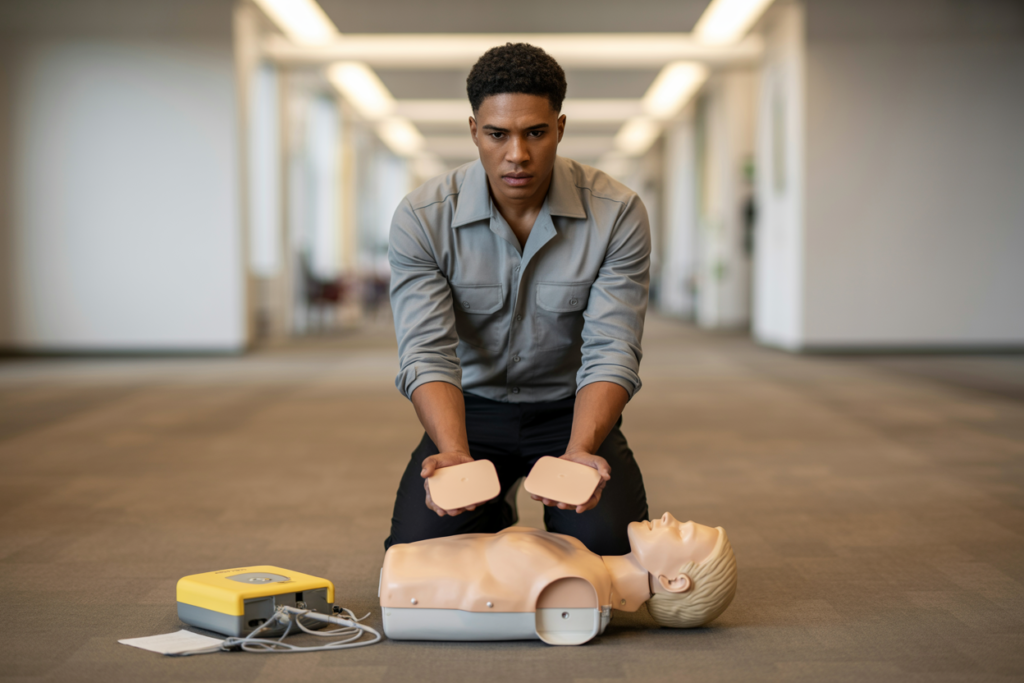
- They check the assessment method. A practical component must have been completed in person
Industries in Brisbane Where This Is Non-Negotiable
| Industry | Regulatory Body | Requirement |
|---|---|---|
| Childcare & early education | ACECQA | HLTAID012 (includes HLTAID009) |
| Construction & trades | WorkSafe Queensland | HLTAID009 minimum |
| NDIS support work | NDIS Commission | HLTAID009 or higher |
| Fitness & personal training | Fitness Australia | HLTAID011 (includes HLTAID009) |
| Hospitality & events | Employer / insurer driven | HLTAID009 |
💡 Quick Fact: A CPR certificate from an unregistered provider is not accepted by ACECQA, WorkSafe Queensland, or NDIS auditors, even if the course content was identical. Always check the RTO number before you book.
How to Tell If Your Current CPR Certificate Is Nationally Recognized
If you’ve got a certificate sitting in a drawer or saved as a PDF on your phone, here’s how to check whether it counts. This isn’t about catching you out. It’s about giving you the information you need before a compliance deadline does it for you.
The 4-Point Certificate Check
- 1. Find your RTO number. It must appear somewhere on the certificate. Cross-check it at training.gov.au/about/registers/rto to confirm the provider is legitimately registered with ASQA.
- 2. Check the unit code. HLTAID009 must be listed explicitly. “CPR course” or “CPR training” written in plain English isn’t enough. The unit code needs to be there.
- 3. Check the issue date. Certificates older than 12 months are expired under ARC guidelines, regardless of how the training felt at the time.
- 4. Review the assessment record. Confirm there was a face-to-face practical component and that you performed compressions on a manikin with a trainer present. Online-only training does not qualify.
⚠️ Certificate Expired? If your HLTAID009 is more than 12 months old, it is no longer current under ARC guidelines. Brisbane courses are available most weekends and you can be recertified within a week.
What If My Certificate Doesn’t Pass the Check?
It’s more common than you’d think, especially since the rise of online-only providers during the COVID years. A lot of people ended up with certificates that look legitimate but aren’t accepted by Australian regulators. The fix is straightforward. Book a nationally recognised HLTAID009 course with a registered Brisbane RTO and the new certificate supersedes the old one.
A quick example of how this plays out in real life:
Works as an educator at a childcare centre in Brisbane. When her centre went through a routine compliance check, the director flagged that her CPR certificate was issued by an online-only provider, one that wasn’t registered with ASQA. The certificate looked fine on the surface, but when the RTO number was checked against training.gov.au, it didn’t appear. Her certificate didn’t count.
She booked a weekend course, completed the practical assessment, and had her nationally recognised HLTAID009 certificate by Monday. Her director accepted it without question.
Once you’ve confirmed your certificate is valid, or sorted out a new one, the next question most people ask is: which course code do I actually need?
HLTAID009 vs Other CPR Certificates: What’s the Difference?
If you’ve been looking into CPR training for more than five minutes, you’ve probably already hit a wall of confusing certificate names. “Senior First Aid.” “Apply First Aid.” Course codes that don’t match what your employer asked for. It’s genuinely confusing, and it puts a lot of people off booking altogether.
Here’s how the current Australian CPR certificate framework actually works.
The Current Australian CPR Certificate Hierarchy
| Unit Code | Name | Who Needs It |
|---|---|---|
| HLTAID009 | Perform CPR | Most workers, parents, and community members |
| HLTAID011 | Provide First Aid | Workplace first aid officers, fitness professionals |
| HLTAID012 | Provide First Aid in an Education & Care Setting | Childcare educators, school staff |
| HLTAID015 | Provide Advanced Resuscitation | Healthcare professionals |
HLTAID009 is the foundation unit. It sits inside HLTAID011, HLTAID012, and HLTAID015. So if you’ve completed any of those higher units recently, your CPR component is already covered. The question is whether that certificate is still current under the 12-month ARC renewal cycle.
What About Old Certificate Codes?
HLTAID001 and HLTAID002 are the ones that trip people up most often. These were the predecessor units under an older training framework and they’ve been superseded. Most employers and regulators no longer accept them, and if your certificate shows one of these codes, you need to re-certify under HLTAID009 regardless of when the course was completed.
If you’re not sure which unit code your job or industry requires, the unit listings at training.gov.au show exactly what each qualification covers and which industries reference them.
Understanding the certificate hierarchy makes choosing the right course straightforward. Here’s exactly what to expect when you show up on the day.
What to Expect From a Nationally Recognized CPR Course in Brisbane
One of the most common reasons people put off booking is not knowing what they’re walking into. Will it be awkward? Will the trainer make you feel stupid if you get something wrong?
The short answer is no, and understanding what actually happens on the day tends to remove that hesitation pretty quickly.
Course Format
- No prior medical knowledge required. The course is designed for everyday people, not healthcare workers
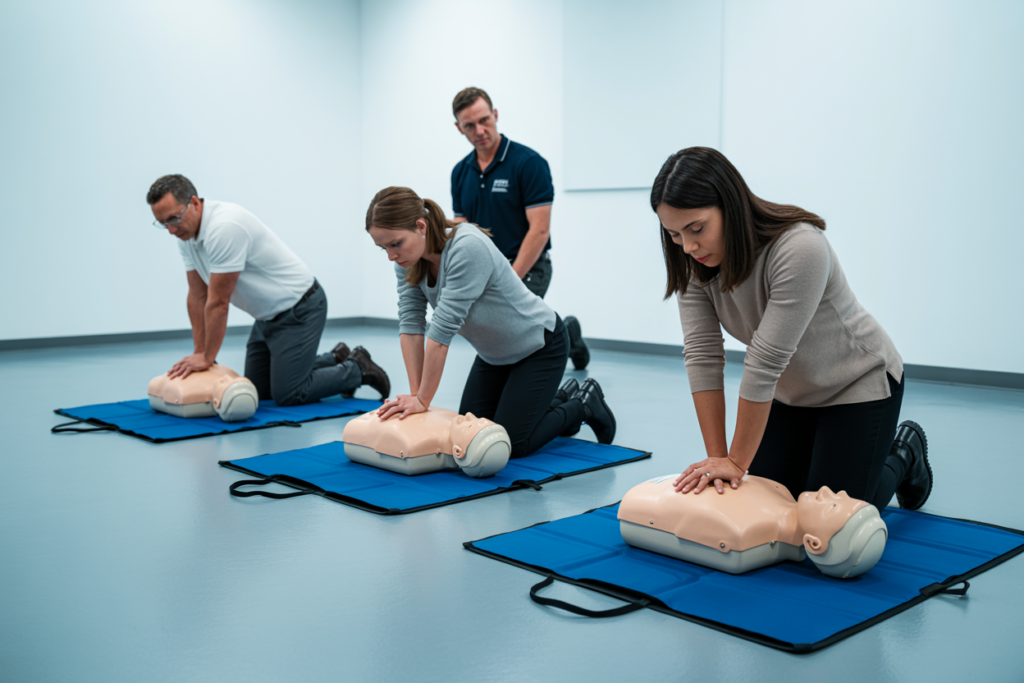
- Practical assessment on a manikin with a trainer guiding every step. Nobody is left to figure it out alone
- Certificate issued same day or within 24 hours of completing your assessment
Our trainers hold HLTAID015, the advanced resuscitation qualification, and come from paramedicine, nursing, and emergency services backgrounds. That experience shows in how they teach. They know what it’s like to use these skills under pressure, and they know how to get that across to someone who’s never done CPR before.
What the Practical Assessment Covers
The hands-on component is where the real learning happens. You’ll work through:
- Correct compression rate. 100 to 120 compressions per minute under current ARC guidelines
- Correct compression depth. 5 to 6 centimetres for adults
- Airway management and rescue breaths
- Use of an AED (automated external defibrillator)
- Recovery position
- The DRSABCD action plan: Danger, Response, Send for help, Airway, Breathing, CPR, Defibrillation
By the time you leave, you won’t just have a certificate. You’ll have actually done it, on a manikin, with a trainer watching and correcting your technique in real time. That’s the difference between a nationally recognised CPR course and an online quiz with a printable PDF at the end.
Knowing what to expect on the day is one thing. Knowing how long your certificate stays valid is another, and it catches more people off guard than almost anything else.
How Often Do You Need to Renew Your CPR Certificate?
This is where a lot of people get caught out, and it’s an honest mistake, because the renewal cycle for CPR is stricter than most people realise.
The ARC Renewal Recommendation Explained
The Australian Resuscitation Council recommends CPR recertification every 12 months. That’s annual, not every three years, not when your employer reminds you, not when it feels like it’s probably been a while.
Here’s where the confusion usually comes from:
- CPR (HLTAID009): recommended every 12 months by the ARC
- Full First Aid (HLTAID011): the full unit renews every 3 years, but the CPR component within it still needs to be refreshed annually
- Skill fade is real: research into CPR performance shows that compression technique, correct depth, and the right rate all degrade within months without practice, often faster than people expect
That last point is worth sitting with for a moment. It’s not just about the certificate expiring on paper. The actual physical skill, the muscle memory, the confidence to keep going when it feels like you’re pressing too hard, fades. Annual renewal isn’t a bureaucratic inconvenience. It’s the reason bystander CPR actually works when it’s needed.
Setting Up Your Renewal Reminder
The simplest thing you can do after completing your course is note your issue date and set a calendar reminder at the 11-month mark. That one-month buffer gives you time to find a session that fits your schedule before your certificate technically lapses.
First Aid Alive sends renewal reminders to past students at the 11-month mark, so if you book with us, you won’t need to track it yourself. One course, and we’ll make sure you don’t fall through the cracks.
🔁 Renewal Reminder: First Aid Alive sends a renewal reminder at the 11-month mark to every student. Book once and we'll make sure you never let your certificate lapse again.
Ready to Get Your Nationally Recognised CPR Certificate in Brisbane?
Most people don’t think about their CPR certificate until something forces them to: a job application, a compliance audit, a director asking for updated records. By that point, the pressure is already on. Getting ahead of it, even by a few weeks, makes the whole thing a lot less stressful.
The difference between a nationally recognised CPR certificate and one that isn’t comes down to three things: who delivered the training, what unit code appears on the certificate, and whether there was a real hands-on practical component. None of that is complicated once you know what to look for. And now you do.
If your current certificate passed the 4-point check, you’re in good shape. Just make sure that 11-month reminder is in your calendar before you close this tab. If it didn’t pass, or if it’s already expired, the fix is genuinely straightforward. A weekend morning is all it takes to go from uncertain to covered.
CPR is one of those skills that sits quietly in the background until the moment it isn’t quiet at all. The people who act in those moments aren’t special. They’re just the ones who showed up to a course at some point and did the work.
That can be you, and sooner than you think.
Book Your First Aid Training Now
Fast, affordable, and nationally accredited training delivered by professionals who care
Frequently Asked Questions
Q.What does nationally recognized CPR mean in Australia?
Nationally recognized CPR means the training was delivered by an RTO registered with ASQA, Australia's national vocational training regulator. The certificate carries the unit of competency code HLTAID009 and is accepted by employers, licensing bodies, and compliance regulators across every Australian state and territory. A certificate from an unregistered provider, regardless of how professional it looks, does not meet this standard.
Q.How do I know if my CPR certificate is nationally recognized?
Check four things on your certificate: the RTO number, the unit code (must show HLTAID009), the issue date, and whether a face-to-face practical component was completed. You can verify the RTO number at training.gov.au/about/registers/rto. If any of those four points can't be confirmed, the certificate may not be accepted by your employer or regulator.
Q.Is online CPR training nationally recognized in Australia?
No. HLTAID009 requires a hands-on practical assessment completed in person with a registered trainer. Online-only CPR certificates are not accepted by ACECQA, WorkSafe Queensland, NDIS providers, or most employers. The practical component isn't a formality — it's the part of the course where the actual skill is assessed and verified.
Q.How long does a nationally recognized CPR certificate last?
The Australian Resuscitation Council recommends CPR recertification every 12 months. Once your certificate is older than 12 months it is no longer considered current under ARC guidelines, and most employers and regulators will not accept it. This is a stricter renewal cycle than full first aid (HLTAID011), which renews every three years.
Making first aid training more affordable for
every classroom
We believe every student deserves access to life-saving first aid knowledge. That’s why we offer specially reduced pricing for schools and educational groups. Whether you’re booking for a single class, a year group, or your entire school, our flexible packages make training more accessible and cost-effective — without compromising quality.
