

Picture a 15-year-old at a school swimming carnival who knows exactly what to do when a teammate collapses who drops to their knees, starts compressions, and keeps going until the ambulance arrives. Now picture that same teenager being turned away from a CPR course the month before because nobody could give a straight answer about whether they were old enough to enrol.
That situation happens more than it should. The age rules around HLTAID009 in Australia are genuinely confusing. National guidelines say one thing, individual RTOs sometimes apply their own policies, and parents are left guessing.
If you’re researching HLTAID009 minimum age requirements in Australia whether you’re a parent booking on behalf of your teenager, an employer onboarding a young staff member, or a young person trying to figure out if you qualify, this article gives you clear, practical answers. We cover what the national framework says about CPR course age limits, how Queensland RTOs apply those rules, what parental consent looks like, and how to get an under-18 student booked in Brisbane.
Quick Answer: What Is the Minimum Age for HLTAID009 in Australia?
There is no single national minimum age set by ASQA or the Australian Resuscitation Council (ARC) for HLTAID009 Perform CPR. The unit of competency itself does not specify an age floor. In practice, most registered training organisations (RTOs) in Australia set their own minimum age policy, which is commonly 14 or 15 years, with parental or guardian consent required for anyone under 18.
What this means in practice:
- ●No federal law prohibits a teenager from completing HLTAID009: The national vocational education and training framework contains no age restrictions for this course.
- ●Individual RTOs set their own minimum age: Training providers independently determine their requirements, which is typically 14 to 15 years old.
- ●Students under 18 usually require written parental consent to enrol: This standard compliance policy ensures guardians approve of the minor's participation.
- ●Queensland RTOs follow the same national framework with no state-specific age override: Providers in QLD strictly mirror the broader Australian standards.
- ●Always confirm the age policy directly with your chosen RTO before booking: Verifying upfront prevents registration issues since rules can vary from provider to provider.
Is There a National Minimum Age for HLTAID009 in Australia?
Here’s where a lot of parents and employers get tripped up they assume there’s a single national rule they’ve somehow missed. There isn’t. The two bodies most people assume are setting the age rules are ASQA and the Australian Resuscitation Council and neither of them sets a minimum enrolment age for this course.
What ASQA Says About Age Requirements
ASQA the Australian Skills Quality Authority is the national regulator for vocational education and training. They oversee RTO registration and the integrity of the training package. If you look up HLTAID009 on training.gov.au, you’ll find the full unit descriptor, the official document that defines what the course covers, what skills are assessed, and what a student needs to demonstrate to achieve competency.
There is no age floor written into that unit descriptor. ASQA does not prohibit a 14-year-old from completing HLTAID009. RTOs are responsible for setting their own enrolment policies, including any age minimums they apply.
What the Australian Resuscitation Council (ARC) Guidelines State
The ARC sets the clinical standards for CPR in Australia compression depth, compression rate, rescue breath ratios, and the sequence of steps that define best-practice resuscitation. Their guidelines are the science behind the course content.
The ARC does not set enrollment eligibility rules. They’re a clinical body, not an education regulator. Their guidelines tell RTOs how to teach CPR not who can attend.
| National Body | What They Control | Do They Set a Minimum Age? |
|---|---|---|
| ASQA | RTO registration; training package standards | No |
| Australian Resuscitation Council (ARC) | Clinical CPR guidelines and standards | No |
Age policy falls entirely to individual RTOs. Which is why the answer to “how old do you need to be for HLTAID009?” depends on who you book with.
What Age Do Most RTOs Accept for HLTAID009 Enrolment?
So if there’s no national age floor, where does the 14 or 15 year threshold that most RTOs use actually come from? It’s not arbitrary and understanding the reasoning behind it helps explain why some providers set their minimum higher than others.
The Common 14-15 Year Threshold Where Does It Come From?
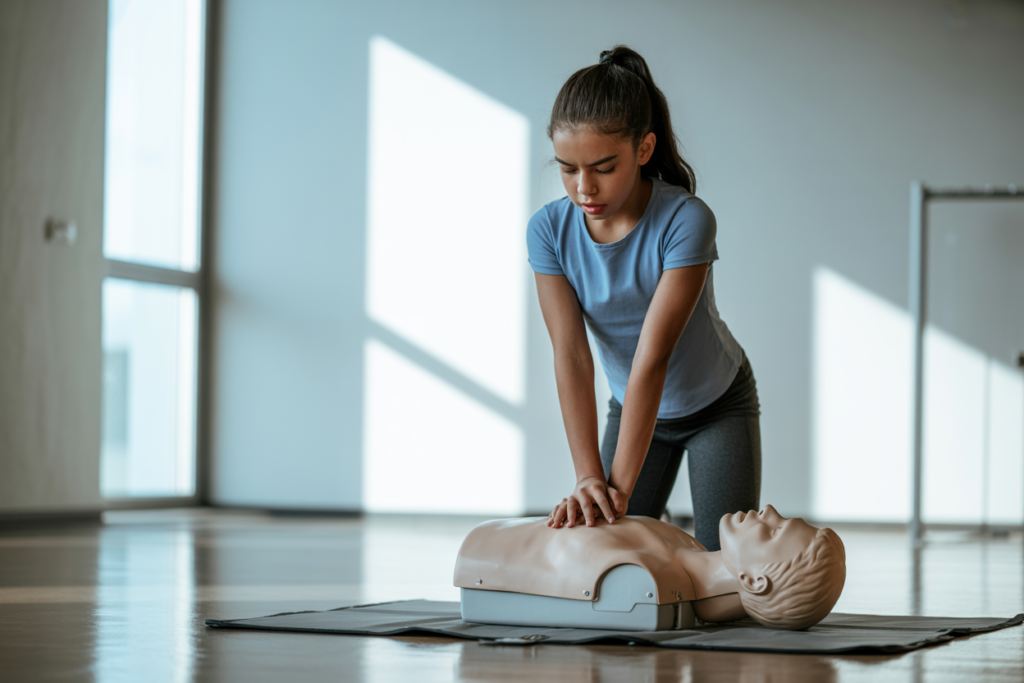
The physical demands of CPR are the main driver. ARC guidelines require chest compressions to reach a depth of 5-6 centimetres on an adult manikin consistently, at a rate of 100-120 compressions per minute. That takes real upper body strength and body weight behind each compression.
For most teenagers, that physical threshold is achievable somewhere around 14-15 years old. It’s not a hard rule. A tall, strong 13-year-old might manage it fine, while a slight 15-year-old might struggle. But as a general policy baseline, 14-15 years is where most RTOs have landed after delivering this training to thousands of students.
Why Different RTOs Have Different Policies
Some RTOs set their minimum age at 16. Some set it at 18. That’s usually a liability decision rather than a capability; smaller operations sometimes opt for a higher age threshold to simplify their consent and duty-of-care obligations. It’s not a regulatory requirement, and it doesn’t reflect anything in the training package itself.
What Brisbane RTOs Typically Require
Most Brisbane-based RTOs that run regular public HLTAID009 sessions accept students from age 14 or 15, with parental consent required for anyone under 18.
📋Course Requirements: First Aid Alive accepts students from the minimum age with parental consent. Here's what to bring on the day: a consent form signed by a parent or guardian, comfortable clothing you can move in, and any ID required by the RTO at check-in. Everything else—including manikins, masks, and training materials—is provided.
Can Someone Under 18 Enrol in HLTAID009 Without a Parent Present?
This is one of the most common questions that comes up when a parent is booking on behalf of their teenager and it’s also a source of a lot of unnecessary confusion. The short answer is: it depends on the student’s age and the RTO’s specific policy. But the general framework across Australia is pretty consistent.
What Parental Consent Actually Looks Like
Almost every RTO in Australia requires written parental or guardian consent for any student under 18 enrolling in HLTAID009. This is a legitimate duty-of-care requirement that protects both the student and the training provider.
In practice, consent takes the form of a signed consent form covering the nature of the training, any physical activity involved, and permission for the RTO to deliver the course to a minor. Most RTOs make this form available for download before the session.
Can a 16 or 17 Year Old Self-Enroll?
Generally, yes. A 16 or 17 year old can complete the online enrolment process themselves. What RTOs require is that a signed parental consent document is presented at the venue before training begins so a 17-year-old can book their own spot and complete the course independently, as long as they arrive with a signed form.
What Documentation Is Required on the Day
For students under 16, some RTOs require a parent or guardian to be physically present at the venue, not necessarily in the training room, but on-site. This varies by provider, so confirm directly when you book.
Enrolling an under-18 student what to expect:
- 1.Check the RTO's minimum age policy: Confirm the provider's policy at their phone number before booking.
- 2.Download and print the parental consent form: Access the required document from the training provider's portal.
- 3.Have a parent or guardian sign the form: Complete this step before the scheduled session date.
- 4.Arrive with the signed consent form and any required ID: Bring these directly to your practical session.
- 5.The RTO handles the rest: They will manage your training, assessment, and certificate issuance.
Now that the consent process is clear, it’s worth understanding why more teenagers than ever are actively seeking out this certification in the first place.
Why Would a Teenager Need HLTAID009?
The cohort of 15-17 year olds completing HLTAID009 has grown noticeably over the last few years. It’s not just parents pushing their kids through a compliance hoop. A lot of these young people have a genuine reason to be there, and in some cases they’re the ones asking to enroll. Here’s what’s actually driving it.
School-Based Motivations
Some Queensland schools have started incorporating HLTAID009 into senior health or physical education curricula particularly in years 10 through 12. For students in those programs, the course is either a formal part of their assessment or a strongly encouraged co-curricular activity. Word travels fast among teenagers, and peers take notice when a classmate completes their CPR cert.
Junior Sports Coaching and Lifesaving Programs
Queensland community sport increasingly expects coaches, team managers, and senior volunteers including junior volunteers to hold a current CPR certificate. For a 15 or 16-year-old stepping into an assistant coaching role or joining a surf lifesaving club, HLTAID009 is often a prerequisite. Between backyard pools, Moreton Bay, school carnivals, and club swimming programs, Queensland’s outdoor environment means young people are regularly in situations where these skills could matter.
Part-Time Work Requirements
This is probably the fastest-growing driver. A growing number of 15-17 year olds are pursuing HLTAID009 for part-time employment gyms, aquatic centres, childcare assistant roles, and hospitality venues increasingly list CPR certification as a condition of employment. For a teenager who wants a job at the local pool or leisure centre, having a current HLTAID009 is often the difference between getting the role and missing out.
Personal and Family Motivation
Some young people enroll because something happened: they witnessed a health emergency at school, heard about a drowning in their community, or noticed a family member’s cardiac risk and decided they wanted to be prepared. That personal motivation produces some of the most engaged students in any CPR class. A teenager who genuinely wants to learn will retain the skill far better than one who’s just ticking a box.
The four reasons teenagers complete HLTAID009:
Motivation | Common Scenario |
School | Senior health curriculum; co-curricular program; school sporting events |
Sport | Surf lifesaving; swim club; junior assistant coaching roles |
Work | Part-time roles at gyms, pools, childcare centres, and events |
Family | Personal motivation after a health event; parent-initiated enrolment |
Understanding why teenagers are enrolling puts the age question in context but the certificate itself is what most parents and employers actually want to know about next.

How to Book HLTAID009 for an Under-18 Student in Brisbane
At this point you’ve got the full picture on age rules, consent requirements, and certificate validity. Here’s how to get your teenager booked in without any unnecessary back-and-forth.
Step 1 Check the RTO’s Minimum Age Policy Before Booking
Before putting a date in the calendar, confirm the minimum age policy with your chosen RTO. Most Brisbane providers accept students from 14 or 15 years old, but policies vary. A quick phone call or website check sorts this before you commit.
Step 2 Complete the Parental Consent Form
Download the parental consent form and get it signed before the session date. Training cannot begin until it’s in hand, so don’t leave it until the morning of the course.
Step 3 Choose a Suitable Session
Weekend and school holiday sessions are the right fit for most school-age students. Weekday daytime courses don’t work around a school timetable, and most Brisbane RTOs offer Saturday and Sunday options for exactly that reason. Check current availability.
Step 4 What to Bring on the Day
- ●Signed parental consent form: This document is non-negotiable for students under 18 years old.
- ●Comfortable clothing you can move in: CPR practice involves getting on the floor and working on manikins.
- ●Any ID required by the RTO at check-in: Be sure to confirm exactly what identification you need to bring when you book.
- ●A water bottle and a light snack: Keep these handy to stay refreshed throughout the training session if needed.
WRAPPING UP
The age rules around HLTAID009 are genuinely less complicated than they first appear. There’s no federal law setting a minimum age, no state-specific Queensland override, and no clinical body drawing a line in the sand. What exists is a practical framework RTOs setting their own policies based on physical capability and duty-of-care, typically landing at 14 or 15 years, with parental consent covering the rest.
For parents researching this on behalf of a teenager, the most important thing to know is that the certificate your child earns carries exactly the same weight as one held by any adult in the same workplace or sporting club. There’s no asterisk, no junior version, no reduced recognition. They do the course, they demonstrate competency, they get the qualification. That’s the full story.
For teenagers pursuing this independently for a part-time job, a sporting role, or simply because they want to be prepared, the path is straightforward. Find a Brisbane RTO that accepts students at your age, get the consent form signed, pick a weekend session that fits your schedule, and show up ready to work. The practical component is hands-on and the skill transfer is real. Most young people leave feeling genuinely capable, not just certified.
What makes CPR training at any age valuable isn’t the laminated card or the PDF certificate, it’s the moment in a real emergency when the training kicks in and the panic doesn’t. That window between collapse and ambulance arrival is where bystander CPR makes the difference between a good outcome and a devastating one. Queensland’s outdoor lifestyle, its pools, its sporting culture, and its long warm season make that scenario more likely here than almost anywhere else in the country.
Whether you’re a parent booking for your teenager, a young person researching your own options, or an employer confirming whether a junior staff member’s certificate is valid the answer is almost always simpler than the question suggests. Get the training done, keep the certificate current, and know that when it matters most, you or the person you care about will be ready to act.
Book Your First Aid Training Now
Fast, affordable, and nationally accredited training delivered by professionals who care
Frequently Asked Questions: HLTAID009 Age Requirements
Q.What is the minimum age for HLTAID009 in Australia?
There is no federal minimum age for HLTAID009 set by ASQA or the Australian Resuscitation Council. The unit of competency on training.gov.au contains no age floor. In practice, individual RTOs set their own minimum age policies most commonly 14 or 15 years with written parental or guardian consent required for any student under 18. Always confirm the specific policy with your chosen RTO before booking.
Q.Can a 16 year old do a CPR course in Australia?
Yes. Most RTOs in Australia accept students from age 14 or 15 for HLTAID009 enrolment. A 16-year-old can typically complete the online booking process independently but must present a signed parental consent form at the venue before training begins. The certificate issued on completion carries full national recognition, identical to one issued to an adult student.
Q.Do you need parental consent for HLTAID009 if you are under 18?
Yes, almost universally. Written parental or guardian consent is required by virtually every Australian RTO for students under 18 enrolling in HLTAID009. For students under 15 or 16, some RTOs also require a parent or guardian to be physically present at the venue on the day of training. Confirm the specific consent requirements with your chosen RTO when you book.
Q.Is an HLTAID009 certificate valid if completed as a minor?
Yes, completely. A statement of attainment issued to an under-18 student carries full national recognition under the Australian Qualifications Framework. The certificate does not display the student's age or date of birth; an employer or institution reviewing it sees only the qualification, the issuing RTO's details, and the date of issue. There is no difference in standing between a certificate issued to a 16-year-old and one issued to a 40-year-old.
Q.How long does an HLTAID009 certificate last for a teenager?
The renewal cycle is the same regardless of age. The Australian Resuscitation Council recommends renewal every 12 months for HLTAID009. A teenager who completes their CPR cert in one calendar year will need to renew it 12 months later — the same timeline that applies to every other certificate holder in Australia.
Q.Can a teenager do HLTAID009 online?
No, not entirely. HLTAID009 requires a hands-on practical component that cannot be completed online. Some RTOs offer blended delivery where pre-reading or theory is completed online before the session, but the practical assessment including compression technique on an adult manikin must be done in person with a qualified assessor. Online-only CPR certificates are not nationally recognised under current ARC guidelines.
Making first aid training more affordable for
every classroom
We believe every student deserves access to life-saving first aid knowledge. That’s why we offer specially reduced pricing for schools and educational groups. Whether you’re booking for a single class, a year group, or your entire school, our flexible packages make training more accessible and cost-effective — without compromising quality.
