
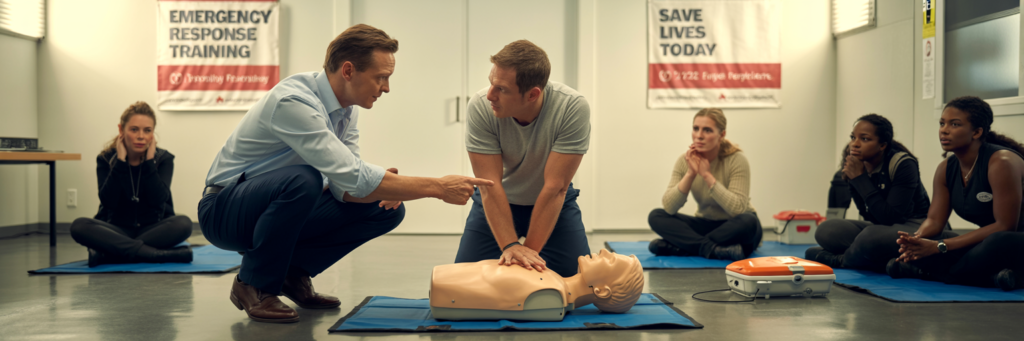
Someone collapses in front of you. Your heart rate spikes. People around you freeze, looking at each other, waiting for someone to move first. Do you know what to do, and in what order?
That single question is why DRSABCD training Brisbane exists. DRSABCD is a seven-step emergency action sequence used across all Australian first aid and CPR training, including the nationally recognised HLTAID009 CPR course. It gives you a clear, practised framework so that when the moment comes, your brain doesn’t have to figure out what comes next. It already knows.
If you’re ready to book, weekend sessions are available here. Otherwise, keep reading – by the end of this article you’ll know what DRSABCD means, why the sequence matters, and how to get your HLTAID009 certificate this week.
What Are the Steps of DRSABCD?
DRSABCD is the nationally recognised emergency action framework used in Australian first aid training. Here are the seven steps, in order:
Step | Letter | Action |
1 | D – Danger | Check for danger to yourself, bystanders, and the patient |
2 | R – Response | Check for patient response – tap shoulders, call their name |
3 | S – Send for help | Call 000 or direct a bystander to call immediately |
4 | A – Airway | Open and clear the airway – tilt head, lift chin |
5 | B – Breathing | Look, listen, and feel for normal breathing (10 seconds) |
6 | C – CPR | Begin 30 compressions to 2 breaths if not breathing normally |
7 | D – Defibrillation | Attach AED as soon as available and follow prompts |
Each step is practiced hands-on in Brisbane’s HLTAID009 CPR course, so the sequence becomes automatic under pressure.
🧠 Remember: sequence matters more than speed. Working through DRSABCD in order, even when your instinct is to rush straight to compressions, outperforms panicked action every time. The sequence is the point.
Why the Order of DRSABCD Matters More Than Most People Realize
Most people, when they think about CPR, think about chest compressions. But jumping straight to compressions without working through the steps before it is one of the most common mistakes untrained bystanders make. The sequence isn’t arbitrary – every step is there for a reason.
Your brain under stress works differently
When something goes wrong in front of you, your brain doesn’t respond the way it does when you’re calm. Stress narrows your focus. Adrenaline floods your system. Your working memory shrinks. A practiced sequence doesn’t require you to think through each decision under pressure – it runs almost automatically. The Australian Resuscitation Council (ARC) and ANZCOR guidelines are built around this reality. That’s the difference between reading about DRSABCD and actually practicing it on a manikin with a trainer watching.
The danger step that most people skip
The D in DRSABCD – Danger – is the most commonly skipped step in a real emergency. Someone collapses and the instinct is to run straight to them. Understandable. Also potentially dangerous.
A bystander who rushes in without checking for hazards can become a second casualty. Think about the environments Brisbane people move through every day: a poolside, a construction site where the original hazard is still active, a roadside where traffic is still moving. The Danger check takes about three seconds and protects everyone, including you.
Workplaces across Brisbane are legally required to have adequate first aid provisions under the Queensland WHS Act and Safe Work Australia guidelines. If you’re responsible for a team, group bookings for Brisbane workplaces are available here.

Breaking Down Each DRSABCD Step: What You Actually Do
Knowing the letters is one thing. Knowing what your hands, eyes, and voice are actually doing is another. Here’s what DRSABCD looks like in real life.
D: Danger – why your safety comes first
Before you touch anyone, stop. Scan the scene for anything that could hurt you or others – live electrical wires, moving traffic, water, unstable structures. Your instinct will be to act immediately. Override it for three seconds. A second casualty helps nobody.
If the scene is safe, move in. If it’s not, make it safe first, or keep others back and call 000 immediately.
R: Response – the two-step check
Tap both shoulders firmly and call their name or say loudly, “Can you hear me? Open your eyes.” You’re looking for a meaningful response: eyes opening, movement, a verbal reply. No response at all means you move to the next step.
An unresponsive person who is still breathing normally needs a different response to an unresponsive person who is not breathing. DRSABCD accounts for both.
S: Send for help – why 000 comes before CPR
Call 000 before you start CPR. Not after. Now.
If you’re alone, put the phone on speaker next to the patient – the Queensland Ambulance Service dispatcher can talk you through CPR while you work. If there are others around, point directly at one person: “You – call 000 now.” Direct instruction to a specific person is far more effective than a general call to the crowd.
A: Airway – the head-tilt chin-lift
Tilt the person’s head back gently by placing one hand on their forehead and lifting the chin with two fingers of your other hand. This opens the airway by moving the tongue away from the back of the throat the most common airway obstruction in an unconscious person.
If you have any reason to suspect a spinal injury a fall from height, a car accident, a diving incident modify this step. A jaw thrust rather than a head-tilt is the safer option, and your trainer will walk you through both in your HLTAID009 session.
B: Breathing – what “normal breathing” actually means
Look, listen, and feel for normal breathing for up to 10 seconds. Watch the chest for rise and fall. Listen for breath sounds. Feel for air movement against your cheek.
Here’s a point that saves lives and that most people don’t know: agonal breathing the occasional gasping or gurgling sound a person makes in the early stages of cardiac arrest – is frequently mistaken for normal breathing. It is not. If breathing is infrequent, irregular, or sounds like gasping, treat it as absent and move straight to CPR. Waiting to see if it improves is one of the most dangerous mistakes a bystander can make.
C: CPR – compression rate, depth, and the 30:2 ratio
If the person is not breathing normally, start CPR immediately. Place the heel of your hand on the centre of their chest, on the lower half of the breastbone, and interlock your fingers. Keep your arms straight and compress the chest firmly downward.
Under current ARC guidelines:
- ●Rate: 100-120 compressions per minute - roughly the beat of Stayin' Alive
- ●Depth: 5-6 centimeters - firm and deliberate, not a gentle press
- ●Ratio: 30 compressions to 2 rescue breaths
If you’re unwilling or unable to give rescue breaths for any reason, compression-only CPR is acceptable and still significantly better than no CPR at all. You don’t have to give breaths to make a difference.
This is also where skill fade becomes real. Most people who’ve done CPR training before privately doubt whether they’d get the rate and depth right under pressure. That doubt is well-founded, and it’s exactly why annual renewal with hands-on practice matters. Knowing the ratio is not the same as having it in your muscle memory.
D: Defibrillation – what to do when an AED is nearby
If an automated external defibrillator (AED) is available, attach it as soon as possible, ideally while CPR is continuing. AEDs are now common in Brisbane shopping centers, gyms, sporting facilities, and many workplaces.
The device will talk you through every single step. It analyses the heart rhythm itself, tells you whether a shock is needed, and instructs you to stand clear before delivering it. AEDs are specifically designed to be used by people with no medical training. You cannot accidentally shock someone who doesn’t need it – the device won’t allow it.
HLTAID009 includes AED familiarization so you know exactly how to use one and where to find them in your area.
Ready to practice this hands-on? Weekend sessions are available in Brisbane this week. View available dates
Knowing the steps on paper and being able to run them under pressure are two very different things. That’s what the next section is about – the real Brisbane environments where DRSABCD gets called on, and why hands-on training changes everything.
DRSABCD in Brisbane’s Real-World Environments
Understanding the sequence is one thing. But DRSABCD doesn’t get used in a classroom – it gets used at the pool on a Saturday morning, on a construction site in the middle of a Brisbane summer, or on the sideline of a junior rugby league game. The environments matter, and Brisbane has more than its share of situations where this sequence gets called on.
At the pool or beach: drowning and cardiac arrest
Queensland consistently records some of Australia’s highest drowning rates – and the combination of backyard pools, Moreton Bay, Gold Coast beaches, and a long warm season means Brisbane residents are near water more often than most Australians.
Drowning and cardiac arrest are closely linked. A person pulled from the water who isn’t breathing needs DRSABCD applied immediately – starting with that Danger check, because a poolside is a slip hazard and a panicked crowd creates its own risks.
One important note: if you’re not trained in water rescue, do not enter the water to retrieve someone. Reach, throw, or call – but don’t put yourself at risk of becoming a second casualty. DRSABCD begins once the person is out of the water and you can safely approach.
That’s what DRSABCD training Brisbane actually produces. Not just a certificate. A trained response.
At work: what Brisbane employers are required to provide
Under the Queensland Work Health and Safety Act and Safe Work Australia guidelines, employers are legally required to provide adequate first aid for their workers. For many Brisbane workplaces – construction sites, childcare centers, hospitality venues, aged care facilities – that means having staff with a current HLTAID009 certificate on-site at all times.
If your certificate has lapsed, or your workplace is heading into a compliance audit, the timeline matters. Brisbane sessions run every week with same-day certificate issues, so there’s no reason to be caught short.
📍 Need to Renew? HLTAID009 certificate expired or expiring? Brisbane sessions run every week. Same-day certificate. Find a session this week.
Training a team? Ask about Brisbane workplace group bookings for 5 or more staff. Enquire about group sessions
At weekend sport: the environment most people overlook
Brisbane’s outdoor sporting culture is part of daily life – AFL, rugby league, cricket, touch football, junior sport on Saturday mornings across every suburb in the city. Cardiac events at sporting events are not rare. The physical exertion, the heat, the age range of participants and spectators – it all adds up.
For community coaches, team managers, and parents on the sideline, DRSABCD training isn’t just a compliance tick. The person who steps forward when a coach goes down or a player collapses mid-game is the person who trained for it.
A single session this weekend changes all of this. Here’s exactly what that looks like.
How HLTAID009 Training Teaches DRSABCD – What to Expect in a Brisbane Course
A lot of people put off CPR training because they’re not sure what to expect. Here’s what actually happens in a First Aid Alive HLTAID009 session.
What happens in a CPR course in Brisbane
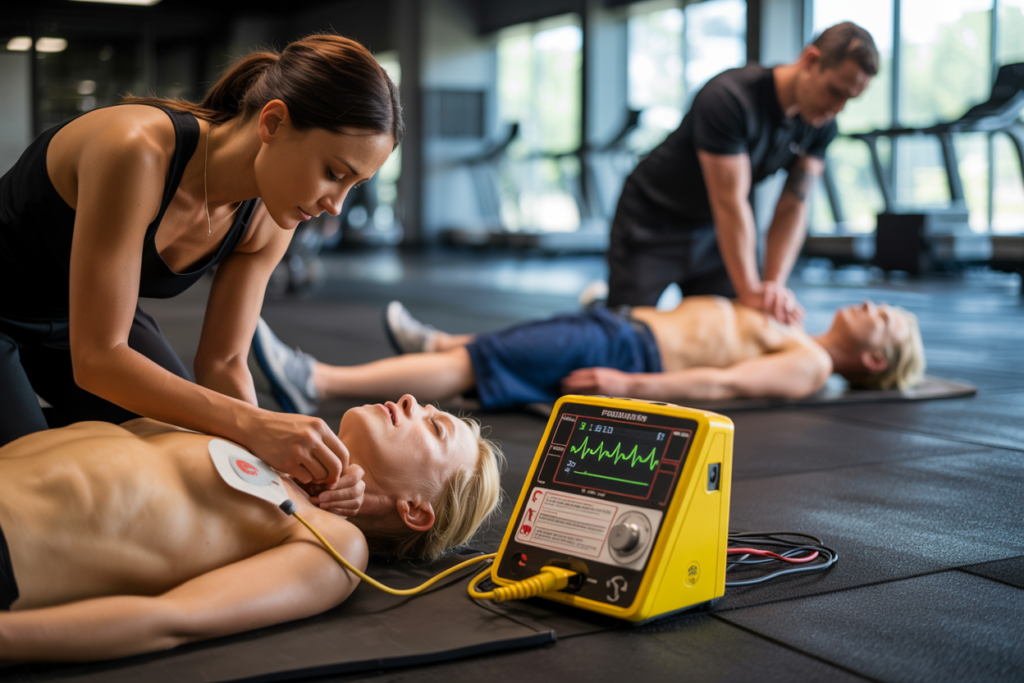
The session covers theory first – what cardiac arrest is, why DRSABCD works, how the steps connect. Then you get onto the manikins. You practise compressions until the rate and depth feel natural, run through the full DRSABCD sequence with your trainer giving feedback, and get time on the AED. Assessment is less intimidating than it sounds – by that point you’ve already done it several times. Most people leave feeling genuinely surprised by how capable they feel.
Online-only CPR is not nationally recognised
Under current ARC guidelines, HLTAID009 requires a hands-on practical assessment. A certificate issued without that component isn’t valid for workplace compliance, childcare registration, or any other formal requirement. If you’ve seen very cheap fully-online CPR options, that’s why.
How long does a CPR certificate last?
Your HLTAID009 certificate is valid for 12 months from the date of issue, in line with ARC guidelines. Annual renewal is recommended – not just for compliance, but because CPR skill fades faster than most people expect. First Aid Alive issues certificates the same day as your session.
Book Your DRSABCD Course in Brisbane
Most people know they should have CPR training. They just haven’t gotten around to it yet. There’s never going to be a perfect week – there’s just the week you decide to stop putting it off.
DRSABCD isn’t complicated. It’s a sequence – seven steps, in order, practised until they’re automatic. The people who act in an emergency aren’t braver than everyone else. They’re just trained. They’ve done it enough times on a manikin that their hands know what to do before their brain catches up.
Brisbane sessions run every week, including weekends. The certificate is issued the same day. If your certificate has lapsed, or you’ve never done this before, or you just want to know that you’d actually be able to help if something happened – this is the week to sort it.
Book Your First Aid Training Now
Fast, affordable, and nationally accredited training delivered by professionals who care
Frequently Asked Questions About DRSABCD Training in Brisbane
Q. What does DRSABCD stand for?
DRSABCD stands for Danger, Response, Send for help, Airway, Breathing, CPR, and Defibrillation. It's the nationally recognized emergency action sequence used in all Australian first aid and CPR training, including the HLTAID009 course. Each letter represents a specific step that should be followed in order during a medical emergency.
Q. Is DRSABCD the same as CPR?
DRSABCD and CPR are related but not the same thing. CPR, which stands for cardiopulmonary resuscitation, is just one step within the DRSABCD sequence - the C step. DRSABCD is the broader framework that tells you what to do before, during, and after CPR, including checking for danger, calling 000, and using a defibrillator if one is available.
Q. Do I need a course to learn DRSABCD, or can I just read about it?
Reading about DRSABCD gives you the theory, but it won't prepare you for a real emergency. Under pressure, your brain defaults to what's been practiced physically, not what's been read. The HLTAID009 course includes hands-on manikin practice specifically so that the sequence becomes automatic - the kind of automatic that holds up when adrenaline takes over.
Q. Is HLTAID009 the right course if I only want to learn DRSABCD and CPR?
Yes. HLTAID009 is the nationally recognized unit of competency for CPR in Australia and covers the full DRSABCD sequence, chest compressions, rescue breathing, and AED use. It's the appropriate course for most workplaces, childcare compliance, and general personal readiness - and it's the shortest first aid certification available at the national level.
Q. How often do I need to redo DRSABCD training?
The Australian Resuscitation Council recommends annual renewal for CPR skills. This isn't just a compliance requirement - research consistently shows that CPR technique degrades within months of training without practice. Annual renewal keeps your hands-on skills sharp and ensures you're up to date with any changes to ARC guidelines.
Q. Can I do compression-only CPR if I'm not comfortable giving rescue breaths?
Yes. If you're unwilling or unable to give rescue breaths, compression-only CPR is acceptable under current ARC guidelines and is still significantly more effective than doing nothing. The HLTAID009 course covers both full CPR and compression-only CPR so you know exactly what to do in either situation.
Making first aid training more affordable for
every classroom
We believe every student deserves access to life-saving first aid knowledge. That’s why we offer specially reduced pricing for schools and educational groups. Whether you’re booking for a single class, a year group, or your entire school, our flexible packages make training more accessible and cost-effective — without compromising quality.
