

It was a Saturday morning at a Brisbane swimming carnival. A dad in the stands went limp and slid off his seat. Three hundred people were there. Only one person moved toward him.
They froze because nobody had ever shown them a clear sequence to follow.
That sequence exists. It’s called the unconscious casualty response, and it’s been refined by the Australian Resuscitation Council (ARC) into a seven-step framework called DRSABCD. It works for everyday Australians – not just paramedics. Anyone can learn it.
In this guide, you’ll learn what each letter of DRSABCD means in plain English, when to call 000, and how to keep someone alive until help arrives.
What to Do If Someone Is Unconscious: Step-by-Step
If someone is unconscious, your response in the first two minutes determines whether they survive. Follow these steps in order, based on current ARC guidelines.
1. Check for Danger - Make sure the scene is safe before approaching.
2. Check for a Response - Tap the shoulders firmly and call out: "Can you hear me? Open your eyes?"
3. Call for Help - Shout for someone to call 000. If alone, call yourself first.
4. Open the Airway - Tilt the head back and lift the chin.
5. Check for Normal Breathing - Look, listen, and feel for no more than 10 seconds.
6. Begin CPR if Not Breathing Normally - Start compressions at 100–120 per minute.
7. Use a Defibrillator (AED) if Available - Turn it on and follow the voice prompts.
8. Continue Until Help Arrives - Do not stop until paramedics take over.
Not confident you could execute those steps under pressure? That’s completely normal – and fixable. A CPR course in Brisbane gives you hands-on practice that turns this knowledge into reflex.
What Does “Unconscious” Actually Mean?
Unconscious vs. Unresponsive – Is There a Difference?
You might hear both terms and wonder if they mean the same thing. Here’s the distinction that matters in practical first aid:
| Sign | Unconscious | Just Asleep or Unwell |
|---|---|---|
| Responds to loud voice | No | Usually yes |
| Responds to shoulder tap | No | Usually yes |
| Eyes open on command | No | Often yes |
| Normal breathing pattern | May be absent or abnormal | Yes |
| Body goes limp suddenly | Often | Unlikely |
An unresponsive person shows no reaction to verbal or physical stimuli. Unconsciousness is a broader clinical state that includes unresponsiveness. The practical rule: if they don’t respond to your checks, treat them as an unconscious casualty and follow DRSABCD.
If you can’t wake them with a firm shoulder tap and a loud call-out, you act. You don’t wait.
Why the First Two Minutes Matter
Bystander CPR can double or triple a cardiac arrest survivor’s odds, according to the Heart Foundation Australia. That’s the difference between someone going home and someone not.
Brisbane’s average ambulance response time is 8 to 12 minutes. The 4-minute threshold for brain damage means the window between collapse and paramedic arrival is not a waiting period – it’s an active one.
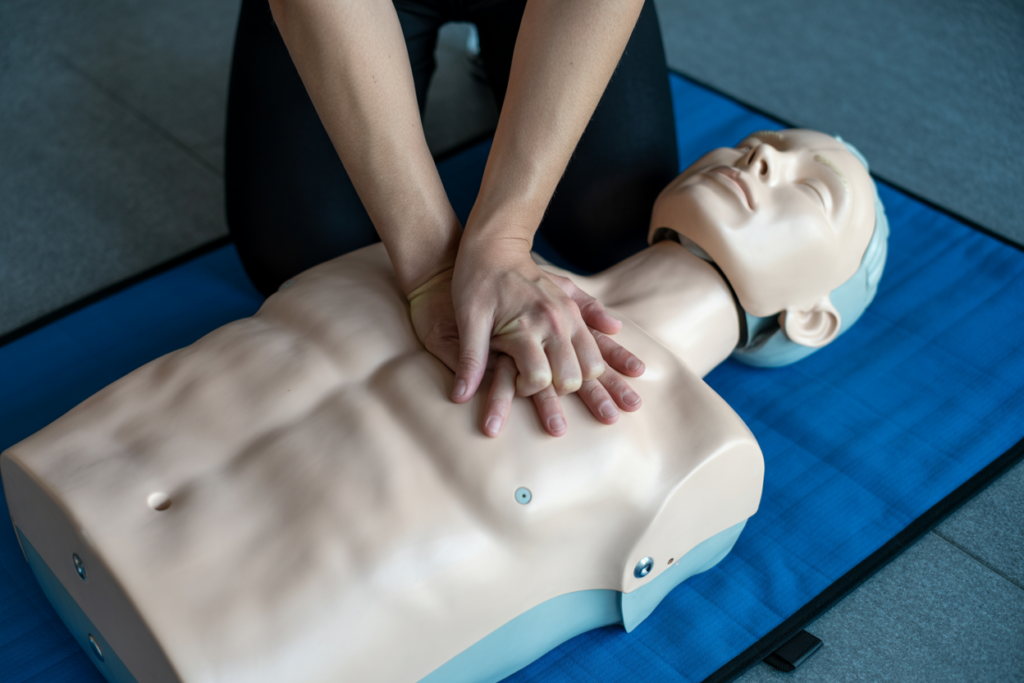
The DRSABCD Action Plan Explained
DRSABCD is the ARC-endorsed framework every Australian first aider learns – a sequence designed to keep you moving in the right order when your brain wants to panic.
D – Danger
Before you take a single step toward someone who’s collapsed, scan the scene. Traffic. Electricity. Water. Unstable ground.
If the scene isn’t safe, don’t enter it – call 000 and wait for emergency services. Your safety isn’t selfish. It’s tactical.
R – Response
Kneel beside the person, place both hands on their shoulders, and tap firmly. Call out clearly: “Can you hear me? Open your eyes. Squeeze my hand.”
It feels awkward. Do it anyway – loudly and clearly. No response to voice and touch means you move immediately to the next step.
S – Send for Help
Call 000 – or point directly at one person in the crowd and say: “You – call 000 right now.”
Don’t say “someone call an ambulance.” When you address a crowd rather than a specific person, bystander diffusion kicks in – everyone assumes someone else will act, and no one does. Point to one person. Make eye contact. Give a direct instruction.
If you’re alone, call 000 before starting CPR. Put the phone on speaker so the dispatcher can guide you through.
A – Airway
Place one hand on the casualty’s forehead and two fingers under their chin. Gently tilt the head back and lift the chin forward. This opens the airway.
In an unconscious person, the tongue can fall back and physically block the airway – meaning even someone with a heartbeat can stop getting oxygen. Head tilt, chin lift is the fix. It takes three seconds.
Don’t attempt to remove objects from the airway unless clearly visible at the front of the mouth.
B – Breathing
Look, listen, and feel for normal breathing – but no more than 10 seconds. Look at the chest for rise and fall. Listen for breath sounds. Feel for air on your cheek.
⚠️ Warning: Agonal breathing - irregular gasping, gurgling, or laboured breathing - is NOT normal breathing. It occurs in the minutes after cardiac arrest and is one of the most common reasons bystanders hesitate to start CPR. If breathing is not regular, quiet, and consistent, treat it as cardiac arrest and begin CPR immediately.
If you’re not sure – start CPR. You will not make things worse.
C – CPR
If the casualty is not breathing normally, start CPR without delay.
- ●Rate: 100–120 compressions per minute - roughly the beat of Stayin' Alive by the Bee Gees.
- ●Depth: At least 5cm for adults - deeper than most people expect.
- ●Ratio: 30 compressions to 2 rescue breaths - or compression-only if trained in a CPR-only protocol.
Push hard and push fast. Full chest recoil between compressions. Don’t stop to check for breathing between cycles. Ribs can crack – a cracked rib is survivable. A brain without oxygen for 6 minutes is not.
Practising CPR on a manikin in a [HLTAID009 course] is the only way to build the muscle memory that holds under pressure. Doing them with a trainer correcting your depth and rate is what prepares you for a real emergency.
D – Defibrillation
If an AED (automated external defibrillator) is available, use it – even if you’ve never touched one before. They talk you through every step with voice prompts and will not deliver a shock unless the casualty’s heart rhythm requires one.
AEDs are more common than most people realise – shopping centres, gyms, sports clubs, and airports all have them. Open the GoodSAM Responder app and find the nearest one to where you’re sitting right now.
Know the Steps. Now Practice Them.
Understanding DRSABCD is the foundation. Performing it under stress – on a real person, in a real emergency – is a different skill entirely. That’s what our qualified Brisbane trainers build with you.
Common Mistakes Bystanders Make and How to Avoid Them
Even people who have done CPR training before can freeze in a real emergency. Every mistake below is common and correctable with practice.
Mistake 1 – Waiting to See If They “Come Around”
It feels instinctive to watch and wait. Maybe they’ll stir. Maybe they just fainted.
Don’t wait. Brain damage can begin within 4 minutes of cardiac arrest. If someone is unresponsive, you act on what’s in front of you – not on what you hope might happen.
Mistake 2 – Assuming Someone Else Will Act
You’re in a shopping centre. Twenty people are standing around. Somebody should call 000. Somebody should start CPR.
That “somebody” logic is how people die. The bystander effect is real – the more people present, the less likely any individual is to act. The counter is simple: be the person who moves first. Point. Delegate. Act.
Mistake 3 – Stopping CPR Too Soon
CPR is physically hard. Two minutes in, your arms are burning. If there are people around, swap every 2 minutes. Tap them on the shoulder, show them where to place their hands, and step back. Imperfect CPR is always better than no CPR.
Mistake 4 – Confusing Agonal Breathing for Normal Breathing
This is the most clinically significant mistake on this list.
After cardiac arrest, some people display agonal breathing – irregular gasping, gurgling, or laboured infrequent breaths. It can look like breathing. It is not. What you’re seeing is a reflex, not recovery.
If the casualty is unconscious and the breathing is not regular, quiet, and consistent – start CPR. You will not make things worse.
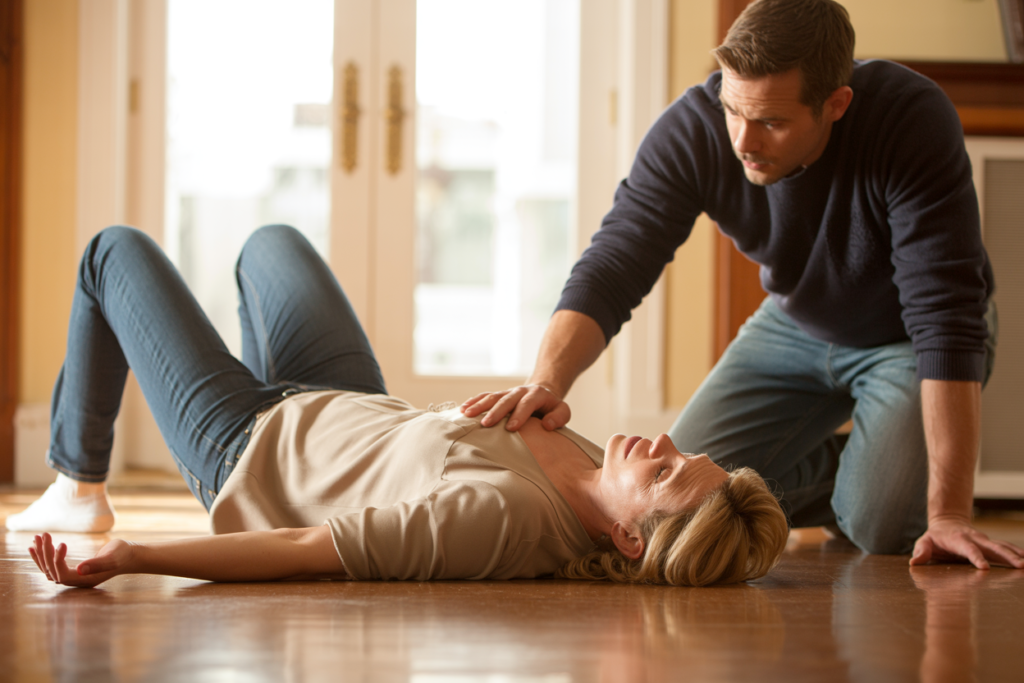
Special Situations – Unconscious Casualty Variations
The steps above apply to an adult in most settings. But emergencies don’t follow the standard script.
If the Casualty Is Breathing – Recovery Position
If the casualty is breathing normally, you don’t start CPR. Place them in the lateral recovery position and stay with them until the ambulance arrives.
Here’s how:
1. Kneel beside the casualty and straighten their legs.
2. Place the arm nearest to you at a right angle to their body, elbow bent, palm facing up.
3. Bring their far arm across their chest and hold the back of their hand against their near cheek.
4. Pull up their far knee so the foot is flat on the ground.
5. Pull on the bent knee to roll them toward you onto their side.
6. Tilt the head back slightly to keep the airway open.
7. Monitor their breathing continuously until paramedics arrive.
The recovery position keeps the airway open and prevents choking on vomit – common after loss of consciousness.
Unconscious Child or Infant
Responding to an unconscious child is one of the highest-stakes situations a parent or childcare worker can face – and the technique differs from the adult response.
Key differences for children and infants:
- ●Head tilt: Gentler than for adults; a child's airway is more easily kinked with over-extension.
- ●Compressions for infants: Use two fingers rather than the heel of the hand, on the centre of the chest just below the nipple line.
- ●Compression depth: Approximately one-third of the chest depth, not the 5cm adult standard.
- ●Rescue breaths: Smaller, gentler puffs for infants; enough to see the chest rise, nothing more.
If you have children at home or work in childcare, this is not a section to skim. Paediatric technique is covered in our [HLTAID012 Childcare First Aid] course, alongside anaphylaxis and asthma management.
Unconscious Person in Water
Queensland’s backyard pools, Moreton Bay beaches, and long warm season mean drowning emergencies are more common than most people expect. Royal Life Saving Queensland consistently records some of the country’s highest drowning rates involving children – and most happen in familiar settings.
If someone is unconscious in water:
- ●Do not enter the water unless trained in water rescue - an unconscious person can pull an untrained rescuer under.
- ●Get them to the edge using a rope, pool noodle, or by reaching from the side.
- ●Once out of the water, follow the standard DRSABCD sequence.
- ●Begin CPR immediately if not breathing normally.
- ●Call 000 or direct a bystander to call while you begin CPR.
Want to make sure you’re prepared for the full range of emergencies – not just cardiac arrest? Our [HLTAID011 First Aid course] covers unconscious casualty response, bleeding, choking, fractures, and more.
When the Ambulance Arrives: What to Tell Them
Once paramedics arrive, your job shifts from responder to communicator. A clear handover in the first 30 seconds helps them make faster decisions.
Tell them:
- ●What happened and when - "He collapsed about 6 minutes ago, no warning."
- ●Whether the casualty was conscious at any point - "She was unresponsive from the moment I arrived."
- ●What you did - CPR, recovery position, AED use, number of cycles completed.
- ●Any known medical history - heart conditions, diabetes, current medications.
- ●Your name and exact location - particularly in large venues with multiple entry points.
You don’t need perfect answers. Paramedics will ask follow-up questions. Just give them the clearest picture of what you found and what you did.
NEXT THING TO DO
The person who stayed calm at that Brisbane swimming carnival – the one who moved toward the collapsed dad while three hundred others stood frozen – wasn’t a paramedic or a doctor. They were someone who had learned a sequence and trusted it when everything felt chaotic. That’s all unconscious casualty response comes down to. A sequence. Followed in order. By someone who chose to act.
Most people freeze in emergencies not because they don’t care, but because the gap between knowing something in theory and doing it under pressure is wider than expected. Hands-on training closes that gap. Reading this puts the steps in your head. Practising on a manikin puts them in your hands – where they need to be when seconds are counting.
Getting certified in HLTAID009 gives you the reps – the physical memory of pushing hard enough, fast enough, long enough – that holds up when your hands are shaking and someone’s life is on the line. That’s the difference between knowing and being ready.
Book Your First Aid Training Now
Fast, affordable, and nationally accredited training delivered by professionals who care
Frequently Asked Questions
Q.What do you do if someone is unconscious?
Follow the DRSABCD action plan in order - check for Danger, check for Response, Send for help by calling 000, open the Airway, check for Breathing, commence CPR if not breathing normally, and use a Defibrillator if one is available. This framework is based on current Australian Resuscitation Council guidelines and applies to adults in most emergency settings.
Q.What is the difference between unconscious and unresponsive?
An unresponsive person shows no reaction to verbal or physical stimuli - no eye opening, no movement, no response to a shoulder tap or loud voice. Unconsciousness is a broader state that includes unresponsiveness. For practical first aid purposes, treat any person who doesn't respond to your checks as an unconscious casualty and follow DRSABCD without delay.
Q.Should you do CPR on an unconscious person who is breathing?
No. If an unconscious casualty is breathing normally - regularly, quietly, and consistently - place them in the lateral recovery position to keep the airway open and monitor their breathing until emergency services arrive. Only begin CPR if normal breathing is absent or you are not sure.
Q.What is agonal breathing and should I start CPR?
Agonal breathing is irregular, gasping, or gurgling breathing that can occur after cardiac arrest. It is not normal breathing. If a casualty is unconscious and displaying agonal breathing - even if it looks like they are trying to breathe - treat it as cardiac arrest and begin CPR immediately. When in doubt, start compressions.
Q.How long can someone be unconscious before brain damage occurs?
Brain damage can begin within 4 minutes of cardiac arrest if blood flow and oxygen delivery stop. Brisbane's average ambulance response time is 8-12 minutes, which means the gap between collapse and paramedic arrival is a window where bystander action makes a real difference to survival outcomes.
Q.Can you do CPR wrong and hurt someone?
Imperfect CPR is always better than no CPR. You may crack a rib - that is survivable. A brain without oxygen for 6 minutes is not. If the person is unconscious and not breathing normally, start compressions. You will not make things worse by trying, and hands-on training gives you the confidence and technique to do it well.
Making first aid training more affordable for
every classroom
We believe every student deserves access to life-saving first aid knowledge. That’s why we offer specially reduced pricing for schools and educational groups. Whether you’re booking for a single class, a year group, or your entire school, our flexible packages make training more accessible and cost-effective — without compromising quality.
