
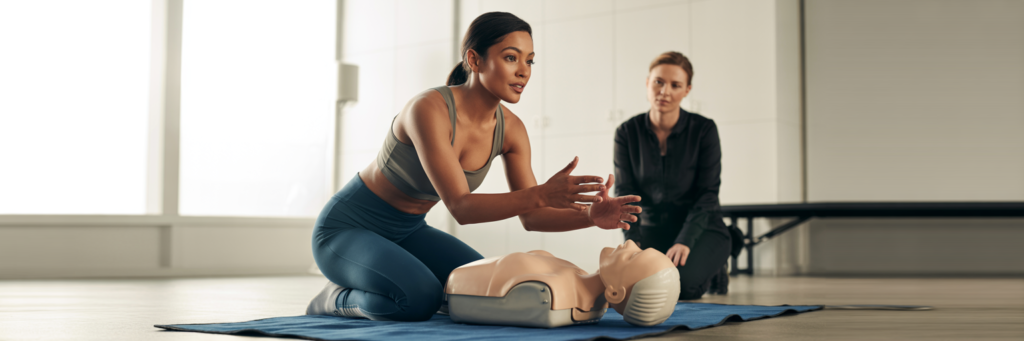
You keep meaning to do your CPR course. Life keeps getting in the way early starts, school pick-ups, weekend sport, a job that doesn’t exactly pause your to-do list. And meanwhile, the certificate you need sits somewhere between “this week” and “maybe next month” on a mental list that never quite reaches the top.
Here’s what most people don’t realise: a CPR course for busy people isn’t the all-day commitment most assume it is. HLTAID009 CPR certification takes just 4 hours. One Saturday morning. One weekday evening. That’s genuinely it.
And you don’t just walk out with a laminated card you walk out actually knowing what to do if someone collapses in front of you. That’s the part people don’t expect. Four hours is enough time to learn the skill properly, practise it on a manikin with a trainer watching, get assessed, and have your CPR certification Brisbane-ready before lunch.
Sessions run on weekends, weekday evenings, and selected daytime slots specifically designed around people who work, care for kids, or both.
In this guide, you’ll find out exactly how long CPR certification takes, which session times work around a full schedule, and what to look for in a Brisbane provider so you walk out actually confident, not just ticked off a list.
How Long Does a CPR Course Take?
A CPR course in Australia typically takes almost 2 hours to complete. This includes a theory component, hands-on practice with a manikin, and a practical assessment. Most Brisbane providers offer HLTAID009 in a single morning, afternoon, or evening session making it genuinely achievable around a full work and family schedule.
- ●Duration: Almost 2 hours from start to finish
- ●Format: In-person practical session (online-only CPR is not nationally recognised)
- ●Assessment: Observed practical demonstration, no written exam
- ●Certificate: Issued same day or within 24 hours of completion
- ●Validity: 12 months from date of issue (ARC guidelines)
Why Busy People Keep Putting Off CPR Training (And Why That’s About to Change)
If you’ve been putting off your CPR training, you’re not alone and you’re closer to sorted than you think.
Most people assume a CPR course takes a full day. A whole Saturday gone. Childcare to organize, commitments to rearrange, lunch to pack. That assumption is wrong, and it’s probably the single biggest reason people keep pushing the booking to next week.
The reality? HLTAID009 is a four-hour course. Not a full day. Not even close.
The other thing that catches people out is certificate expiry. Life gets busy, and a renewal date has a way of creeping up unnoticed until a job application asks for it, an ACECQA audit is scheduled, or an employer onboarding checklist flags it. That moment of “oh no” is familiar to a lot of Brisbane people. It doesn’t mean you’ve been irresponsible. It means you’re human.
📊 Stat: Bystander CPR more than doubles survival rates from cardiac arrest. Australian Resuscitation Council
The gap between meaning to do it and actually doing it usually comes down to one thing: finding a session time that fits. Not motivation. Just scheduling. And that’s the most solvable problem on the list.
Whether you need a CPR renewal Brisbane session before a deadline, or you’re booking for the first time, the session times exist. Weekend mornings, weekday evenings, even same-week availability if things are urgent. The course fits around real life because it was designed that way.
What HLTAID009 Actually Covers In Plain English
HLTAID009 is the national course code for “Perform CPR.” That’s the official name on the certificate, and it’s what employers, ACECQA auditors, and professional registration bodies are looking for when they ask for a current CPR qualification.
If you’ve never done it before, or it’s been a few years, here’s exactly what you’ll cover in your session in plain English, no jargon.
What You’ll Learn in Your Session
- ●Chain of survival: How to recognise a cardiac emergency, call 000, start CPR, and use a defibrillator in the right sequence
- ●Correct compression rate and depth: Updated under current Australian Resuscitation Council guidelines, which means even people who've done CPR before often learn something new here
- ●CPR-only vs rescue breathing: When to do compressions only and when rescue breaths apply
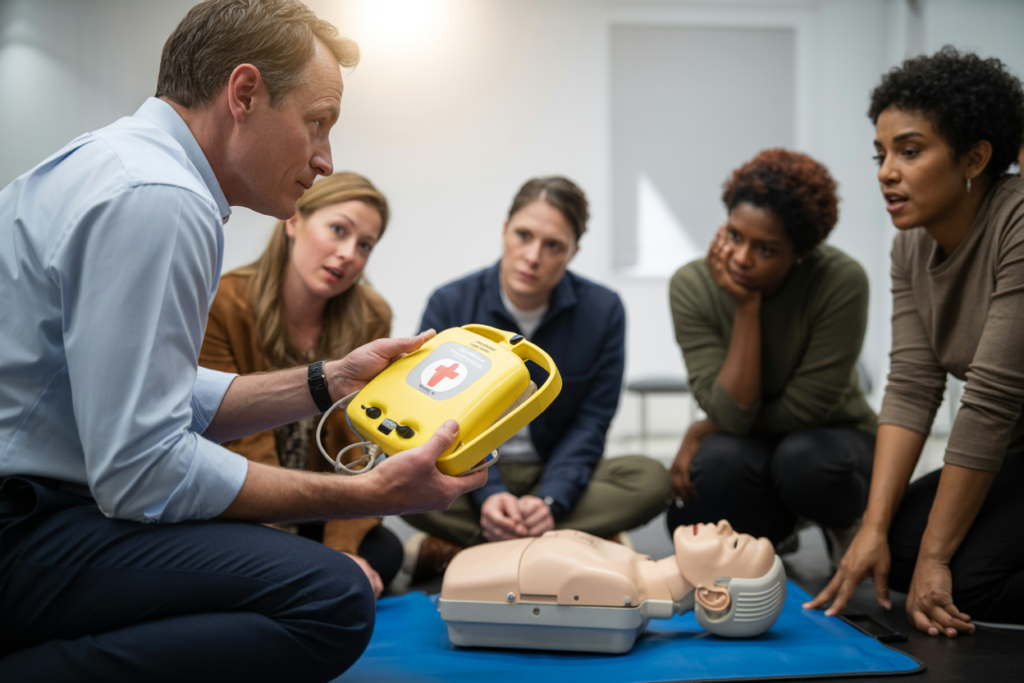
- ●How to use an AED: Automated external defibrillators are in shopping centres, schools, gyms, and workplaces across Brisbane; you'll know exactly what to do with one
- ●Infant and child CPR: The technique is different for babies and children, and you'll practise both
No prior medical knowledge needed. Trainers explain everything from scratch, so whether you’re a gym instructor, a new parent, or someone who’s never thought much about first aid before, you’ll follow along fine.
One thing people worry about is looking incompetent in front of a group. It’s worth saying directly: trainers are there to guide you, not grade you, and pretty much everyone feels a little unsure at the start. That’s normal. It passes quickly once your hands are on the manikin.
What the Assessment Looks Like
- ●Observed practical only, no written exam, no trick questions
- ●Your trainer watches and guides you through the sequence
- ●Most people pass on their first attempt
- ●Certificate issued the same day
The assessment isn’t something to stress about. It’s a demonstration, not an exam. Your trainer has seen every level of experience walk through the door, and their job is to help you get it right, not catch you out.
Flexible CPR Sessions That Fit Around Real Life
This is usually the section that makes people actually book.
Knowing the course is only 145 hours is one thing. Knowing there’s a session that fits your specific week around your roster, your kids, your Tuesday night commitments is what turns a good intention into a confirmed booking.
Here’s how the session types break down.
Weekend Sessions
Weekend mornings are the most popular option for a reason. If you work Monday to Friday, have school-age kids, or just can’t disappear from work mid-week, a Saturday or Sunday morning session is the obvious fit.
A few practical things worth knowing:
- ●Wear comfortable clothes you can move in, you'll be kneeling on a mat doing compressions
- ●Bring a water bottle and a light snack if you need one
- ●Check the venue address when you book and allow a few minutes for parking
Weekday Evening Sessions
Evening sessions are ideal for shift workers, hospitality staff, and anyone with daytime caring responsibilities that make a morning slot impossible.
It’s a surprisingly easy session to fit into a weeknight once you stop assuming it’ll eat the whole evening.
Same-Week Availability
For the person who just discovered their certificate expired and has a deadline in five days, same-week sessions exist for exactly this reason.
Real-time availability is visible online. Booking takes under 5 minutes. No phone calls, no forms to print, no back-and-forth emails.
💡 Brisbane tip: If you're booking between October and March, don't leave it too long. Swimming season brings a genuine spike in enrolments of parents of young kids, surf lifesavers, anyone who spends time near Moreton Bay or backyard pools. Weekend sessions fill faster than people expect during those months.
Is Online CPR Training Good Enough? (The Answer Might Surprise You)
It’s a fair question. If you can do a tax return online, renew your licence online, and complete workplace inductions online, it’s reasonable to wonder why CPR training would be any different.
Here’s the thing: it’s not about convenience. It’s about what the certificate actually covers.
Online-only CPR is not nationally recognised under current ARC guidelines. That’s not a preference or a policy quirk of one particular employer. It’s the standard that ACECQA auditors, workplace compliance managers, and professional registration bodies apply when they check your certificate. An online-only certificate can fail that check which means time spent on a course that doesn’t count when it matters.
⚠️ Important: Online-only CPR certificates are not nationally recognised under ARC guidelines. Your employer, ACECQA, or professional registration body may reject them. Always verify your provider's RTO number before booking at training.gov.au.
Why the Hands-On Component Actually Matters
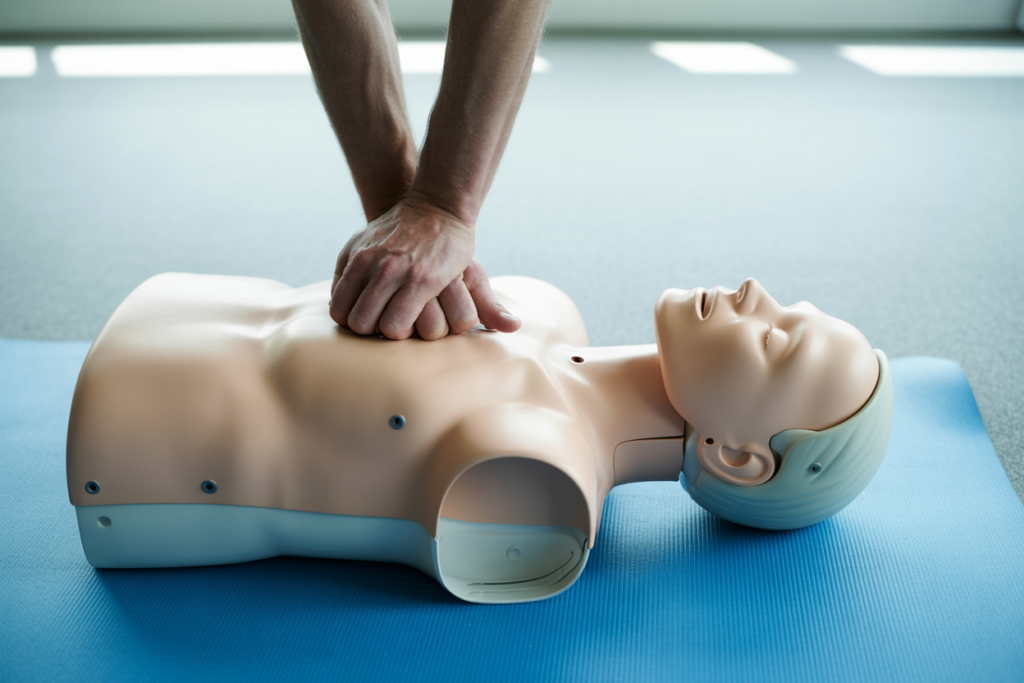
CPR is a physical skill. Correct compression depth on an adult is around 5-6cm, deeper than most people imagine when they watch a demonstration on a screen. Getting that depth right, finding the correct hand position, and maintaining a rate of 100-120 compressions per minute takes muscle memory that only comes from doing it on a real manikin with someone watching and correcting your technique in real time.
A video can show you what CPR looks like. A practical session teaches you what it feels like, which is the only version that’s useful in an actual emergency.
The distinction worth understanding is between blended learning where some pre-reading or theory is done online before a face-to-face practical and online-only delivery, where there’s no hands-on component at all. Blended is acceptable. Online-only is not recognised for compliance purposes.
If you’re ever unsure about a provider, you can check their registration directly at training.gov.au. A legitimate RTO will have a current registration and a scope of registration that includes HLTAID009.
How to Choose the Right CPR Provider in Brisbane
There are a lot of options out there national chains, community organisations, independent RTOs, and everything in between. The national providers win on brand recognition. The smaller, local Brisbane providers often win on everything else: flexibility, personal attention, warm training environments, and faster certificate turnaround.
Reading Google reviews carefully before booking is exactly the right instinct. Reviews tell you things a website never will.
Book Your CPR Course in Brisbane Today
Getting your CPR certification doesn’t have to be the thing you keep meaning to do. It can be the thing you did last Saturday morning, before the rest of the weekend even started. Four hours. One session. A skill that stays with you long after the certificate expires.
The barriers that feel real the packed schedule, the assumption it’ll take all day, the “I’ll do it next month” thinking turn out to be a lot smaller than they look. Most people who finally book wonder why they waited. The course fits around real life because the session times were designed for people who actually have one.
And it’s worth being honest about what you’re really getting. Not just a laminated card that satisfies a compliance requirement. A genuine capability the kind that means if someone collapses at a school carnival, a backyard barbecue, or a worksite in Brisbane’s summer heat, you’re the person who knows what to do. That’s not a small thing.
Brisbane’s outdoor lifestyle, the swimming season, the pools, the parks, Moreton Bay on a hot weekend these aren’t abstract risks. They’re the actual environment you live in. A four-hour investment lines up pretty well against that reality.
Weekend sessions fill faster than most people expect, particularly from October through March. The best time to book was probably six months ago. The next best time is this week.
Book Your First Aid Training Now
Fast, affordable, and nationally accredited training delivered by professionals who care
Frequently Asked Questions
Q.Do I need any experience or medical background to do a CPR course?
No experience is needed at all. HLTAID009 is designed for everyday people with no medical background including parents, office workers, gym instructors, and community volunteers. Trainers explain every step from scratch, and the practical session gives you enough hands-on time to feel genuinely confident before you leave.
Q.How often do I need to renew my CPR certificate?
CPR certificates issued under HLTAID009 are valid for 12 months from the date of issue, as per Australian Resuscitation Council guidelines. Most people set a renewal reminder at the 11-month mark so the expiry doesn't sneak up during a busy period. Renewal sessions follow the same format as the initial course.
Q.Is online CPR training recognised in Australia?
Online-only CPR is not nationally recognised under current ARC guidelines. HLTAID009 requires a face-to-face practical component to be valid for workplace compliance, ACECQA audits, and professional registration purposes. Blended learning, where theory is completed online and the practical is done in person, is acceptable but online-only delivery is not.
Q.What should I bring to my CPR course?
You don't need to bring much. Comfortable clothing you can move in is the main thing, as you'll be kneeling on a mat during the practical component. A water bottle and a light snack are handy for the session. Your booking confirmation is worth having on your phone, and that's genuinely about it.
Q.When will I receive my certificate?
Most Brisbane providers issue your HLTAID009 certificate on the same day you complete the course. Some providers issue within 24 hours. It's worth confirming the turnaround with your provider at the time of booking, particularly if you have an upcoming compliance deadline.
Q.Can I book a CPR course for the same week?
Yes. Same-week availability exists specifically for people with urgent renewal deadlines or upcoming compliance requirements. Real-time session availability is visible online and booking takes under 5 minutes. If you're not sure what's available this week, check the booking page directly rather than calling.
Q.What's the difference between HLTAID009 and HLTAID011?
HLTAID009 covers CPR only, which is what most workplaces and compliance requirements ask for as a standalone qualification. HLTAID011 is the full first aid certificate and includes CPR alongside a broader range of emergency response skills. If your employer or registration body specifically requires first aid rather than CPR, HLTAID011 is the course to book.
Making first aid training more affordable for
every classroom
We believe every student deserves access to life-saving first aid knowledge. That’s why we offer specially reduced pricing for schools and educational groups. Whether you’re booking for a single class, a year group, or your entire school, our flexible packages make training more accessible and cost-effective — without compromising quality.
