

Have you ever searched for a first aid course, found three different providers, and genuinely had no idea which one actually counts?
It happens more than you’d think. In Australia, the term “nationally recognised” carries a specific legal and regulatory meaning and not every course that uses it actually qualifies. For Queensland workers, childcare educators, healthcare professionals, and everyday Australians, choosing the wrong provider can mean a certificate your employer won’t accept, a compliance gap that puts your ACECQA or WorkSafe Queensland audit at risk, or training that simply doesn’t meet the standard your industry requires.
This article explains exactly what a nationally recognised first aid course is, how the Australian national training system works, what to look for when choosing a provider, and why the difference between a registered and unregistered course matters more than most people realise. By the end of this, you’ll know precisely what to look for, and what to avoid.
What Is a Nationally Recognised First Aid Course?
A nationally recognised first aid course is a training program delivered by a Registered Training Organisation (RTO) that is officially registered with the Australian Skills Quality Authority (ASQA). RTOs must meet strict standards set under the Australian Quality Training Framework (AQTF) and the Standards for Registered Training Organisations 2015.
Nationally recognised first aid courses in Australia:
- Are listed on the national register at training.gov.au
- Lead to a qualification or Statement of Attainment that is valid across all Australian states and territories
- Are delivered and assessed against nationally consistent unit standards within the Health Training Package (HLT)
- Are the only type of first aid certificate accepted by regulators including ACECQA, AHPRA, Safe Work Australia, and WorkSafe Queensland
- Cannot be completed entirely online — hands-on practical assessment is a mandatory component
🎓 Why this matters: The VET system is what gives your first aid certificate its legal weight. Without ASQA registration behind the provider, the qualification simply doesn't exist in the eyes of any Queensland regulator.
How the Australian National Training System Works
Most people searching for a first aid course don’t realise there’s an entire national framework sitting behind it. It’s a qualification that fits inside a regulated system designed to make your certificate mean the same thing whether you’re in Brisbane, Sydney, or Perth. That system is called the VET system, Vocational Education and Training, and understanding how it works is what separates people who book confidently from people who end up with a certificate their employer won’t accept.
What Is ASQA and Why Does It Matter?
ASQA, the Australian Skills Quality Authority, is the national regulator for vocational education and training. It registers and audits RTOs against the Standards for Registered Training Organisations 2015.
ASQA registration is what makes a course nationally recognized. Not a logo. Not a professional-looking website. Not a certificate with a fancy border. If the provider isn’t registered with ASQA, the training they deliver isn’t nationally recognized, full stop. You can verify any RTO’s registration status at any time through training.gov.au, the authoritative public register for all registered providers in Australia.
Why Unit Codes Like HLTAID011 Exist
Unit codes exist so that a qualification means the same thing everywhere. HLTAID011 Provide First Aid describes a specific, nationally consistent set of skills and knowledge. It doesn’t matter which registered RTO delivered your training. If the unit code is on your Statement of Attainment and the RTO is active on training.gov.au, the qualification is portable across every state and territory.
That portability is the whole point of the system. And it’s exactly why training.gov.au is the first place any employer, auditor, or regulator goes when they want to verify your credentials.
What Makes a First Aid Course “Nationally Recognized”?
Knowing the system exists is one thing. Knowing what it actually requires a provider to do, and what it requires your certificate to show, is where it gets practical. There are three things that have to be in place for a first aid course to genuinely qualify as nationally recognized. Miss any one of them, and the certificate you walk away with isn’t worth the paper it’s printed on, at least not in the eyes of WorkSafe Queensland, ACECQA, or AHPRA.
The RTO Registration Requirement
Only ASQA-registered RTOs can issue nationally recognized Statements of Attainment. That’s not a guideline. It’s a hard line.
When you complete a nationally recognized first aid course, the document you receive has to display the RTO’s name and their registration number. That RTO number is how a regulator, employer, or auditor can verify in about 30 seconds on training.gov.au that the organisation who trained you was actually authorized to do so.
If a provider can’t give you an RTO number, or their number doesn’t appear on your certificate, that’s not a minor admin issue. That’s the whole qualification being invalid.
Hands-On Assessment: Why It Can’t Be Skipped
This is the one that catches people out the most, especially with the explosion of online-only providers in recent years.
Practical assessment is mandatory under the Health Training Package. There is no version of a nationally recognized first aid course that can be completed entirely online. A fully online course, regardless of how polished the platform looks or how many modules it contains, cannot satisfy this requirement and cannot produce a valid Statement of Attainment.
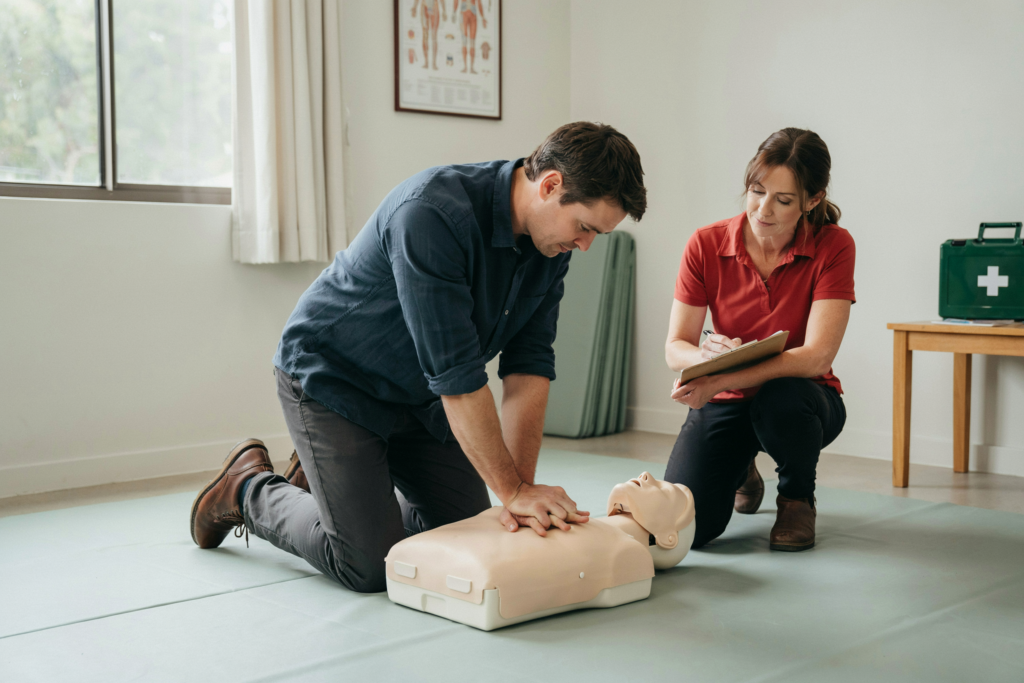
What is permitted, and what most quality providers use, is blended delivery. That means completing the theory component online at your own pace, then attending a face-to-face practical session where your skills are assessed in person. It’s a genuinely good format. It respects your time while making sure you can actually perform CPR on a manikin before you’re certified to do it on a person.
But the face-to-face practical component isn’t optional. It’s the assessment. Without it, there’s no nationally recognized qualification.
The Statement of Attainment Explained
When you complete a nationally recognized first aid course, you don’t receive a “certificate” in the loose, everyday sense of the word. The correct document is called a Statement of Attainment and that distinction matters when an auditor, employer, or regulator is reviewing your records.
A valid Statement of Attainment must display:
- The RTO's name
- The RTO's registration number
- The unit code (e.g. HLTAID011)
- The unit title (e.g. Provide First Aid)
- The student's name
- The date of issue
If any of those elements are missing, the document isn’t compliant. And a document that isn’t compliant won’t satisfy a WorkSafe Queensland audit, an ACECQA inspection, or an AHPRA credentialing review, regardless of how professional it looks.
🔍 Not sure which unit you need? HLTAID011 covers most Queensland workplaces. HLTAID012 is specific to childcare. HLTAID009 is CPR only. The table below maps each unit to who needs it.

Which Nationally Recognized First Aid Units Do You Actually Need?
This is where most people get stuck. Knowing which specific unit your role, your industry, or your regulator actually requires is a different question from knowing the system exists. It depends on who you are and what you do.
HLTAID009: Provide Cardiopulmonary Resuscitation (CPR)
HLTAID009 is the standalone CPR unit. It covers cardiopulmonary resuscitation using current Australian Resuscitation Council (ARC) guidelines, and annual renewal is recommended because resuscitation guidelines do get updated, and because the skill degrades faster than most people realise without regular practice.
HLTAID009 is already embedded within HLTAID011. So if you complete HLTAID011 Provide First Aid, you’ve also satisfied the CPR requirement. You don’t need to book both separately.
HLTAID011: Provide First Aid
HLTAID011 is Australia’s standard first aid qualification and the most broadly required unit across Queensland workplaces, trades, community organizations, and regulated industries.
It covers CPR and AED use, choking, bleeding, burns, shock, fractures, and basic awareness of asthma and anaphylaxis response. For most Queensland workers, from construction sites to corporate offices to retail floors, this is the unit their employer, their industry, or their regulator requires.
HLTAID012: Provide First Aid in an Education and Care Setting
HLTAID012 is designed specifically for childcare educators and OSHC staff. It incorporates pediatric-specific content that the standard HLTAID011 doesn’t go into at the same depth, because the emergencies you’re most likely to face in a childcare environment aren’t always the same ones you’d encounter in a warehouse or an office. There’s genuine confusion in the sector about whether HLTAID011 or HLTAID012 satisfies ACECQA obligations, so confirm with your director which unit applies before you book.
HLTAID014: Provide Advanced First Aid
HLTAID014 is for designated first aid officers and workers in high-risk environments where the scope of response goes beyond the standard HLTAID011 qualification. If your workplace has nominated you as a first aid officer, or you work in a high-risk setting, this is the unit to look at.
Which Unit Does Your Regulator Require?
Unit Code | Unit Title | Who Needs It | Validity |
HLTAID009 | Provide CPR | All workplaces, annual renewal recommended | 1 year |
HLTAID011 | Provide First Aid | Most workplaces, trades, community organizations | 3 years |
HLTAID012 | Provide First Aid in Education & Care | Childcare educators, OSHC staff | 3 years |
HLTAID014 | Provide Advanced First Aid | First aid officers, high-risk workplaces | 3 years |
⚠️ Before you book: Check the provider on training.gov.au first. Confirm their registration is Active, and that your specific unit code is on their scope. It takes two minutes. Could save you a lot of grief.
How to Verify a First Aid Provider Is Legitimately Registered
Here’s something most people never think to do before they book a first aid course: check whether the provider is actually registered.
Most people search, find a professional-looking website, assume it’s legitimate, and book. Most of the time that works out fine. The problem is the times it doesn’t, because by the time you realise your certificate isn’t going to be accepted, you’ve already sat through the training and quite possibly missed a site start, an ACECQA inspection, or an AHPRA credentialing deadline. Verification takes about two minutes. Here’s exactly how to do it.
Step-by-Step: How to Check an RTO on training.gov.au
- 1 Go to training.gov.au and search for the provider by name or RTO number
- 2 Confirm the RTO's registration status shows as "Active" — not expired, not suspended
- 3 Confirm the specific unit code you're enrolling in (e.g. HLTAID011) is listed on the RTO's scope of registration
- 4 Check that the RTO number appears on all of the provider's marketing material and course pages
- 5 Confirm the course includes a face-to-face practical assessment component, not just an online module
That’s it. Five steps, two minutes, and you’ll know with certainty whether the provider you’re looking at is legitimately registered to deliver the training you need.
What to Look for on a Statement of Attainment
Once you’ve completed your training, the document you receive should display all of the following:
- The RTO's name and RTO number
- The unit code and unit title (e.g. HLTAID011 Provide First Aid)
- Your full name as the student
- The date the Statement of Attainment was issued
If any of those elements are missing when your certificate arrives, go back to the provider and ask for a corrected document. A compliant Statement of Attainment isn’t a nice-to-have. It’s what stands up when an auditor or employer looks at your records.
Red Flags: What Illegitimate Providers Look Like
Most dodgy providers aren’t obvious about it. But there are patterns that show up consistently. Watch out for any provider that:
- Has no RTO number displayed on their website or course materials
- Claims a course can be completed entirely online with no face-to-face component
- Issues a certificate that doesn't display a unit code
- Can't or won't confirm their training.gov.au listing when you ask directly
Any one of those is worth a second look. More than one, and you should walk away.

Why Nationally Recognised Training Matters for Queensland Workplaces and Regulators
In Queensland, the requirement to hold a nationally recognised first aid qualification isn’t just best practice. It’s written into the regulatory frameworks that govern workplaces, childcare services, healthcare professionals, and schools. The consistent thread across every one of those frameworks: a certificate from an unregistered provider won’t satisfy the requirement. It doesn’t matter how professional it looks or how much you paid for it.
WorkSafe Queensland and Safe Work Australia Requirements
Safe Work Australia’s First Aid in the Workplace Code of Practice is the national benchmark for workplace first aid obligations. It requires designated workplace first aiders to hold a nationally recognised qualification, and in Queensland, WorkSafe enforces that standard.
For HR managers and business owners, the exposure here is real. A WorkSafe audit that finds lapsed certificates, or certificates from unregistered providers, creates genuine liability. Not just a fine, though those exist, but civil exposure if an incident occurs and your designated first aider’s credentials don’t hold up to scrutiny.
ACECQA First Aid Ratios for Childcare Services
ACECQA requires at least one educator with a current, approved first aid qualification to be present on the floor at all times during operating hours. That’s not one per service per day. It’s one qualified educator physically present whenever children are in care.
For childcare directors and educators, that requirement creates a constant pressure point. One lapsed certificate, one educator on leave, one new staff member still waiting to be trained, and the service is technically non-compliant. ACECQA audits don’t give grace periods for good intentions. The certificate either meets the standard or it doesn’t.
AHPRA and Healthcare Worker Credentialing
AHPRA-registered practitioners, nurses, allied health professionals, and others, are required to maintain current CPR certification as part of their continuing professional development obligations. For most, that means annual HLTAID009 renewal at a minimum. The certificate still has to come from an ASQA-registered RTO. An employer credentialing process won’t accept anything less.
Queensland DET Requirements for Schools
Queensland DET requires schools to maintain a specified ratio of trained first aid staff relative to student enrolment, across the full school year, not just at the start of Term 1. Staff turnover, long-term leave, and mid-year enrolment growth all create compliance gaps that need to be actively managed, and the certificates held by staff need to come from a registered RTO delivering nationally recognised training.
A non-nationally recognised certificate will not satisfy any of these regulatory frameworks. Regardless of how professional it looks.
Regulator | Industry | Minimum Requirement | Accepted Units |
WorkSafe Queensland / Safe Work Australia | All Queensland workplaces | Designated first aider per Code of Practice ratios | HLTAID011, HLTAID014 |
ACECQA | Childcare / OSHC | At least 1 qualified educator on floor at all times | HLTAID011, HLTAID012 |
AHPRA | Healthcare professionals | Current CPR, annual renewal | HLTAID009 (minimum) |
Queensland DET | State schools | First aid staff per student enrolment ratio | HLTAID011 |
Getting this wrong is more expensive than most people realise, not just financially, but professionally. A certificate from an unregistered provider doesn’t just fail a compliance check. It means the person holding it isn’t actually qualified in the eyes of the law, regardless of how much they learned on the day. And in a genuine emergency, that distinction matters in ways that go well beyond paperwork.
Checking whether a provider is legitimately registered takes two minutes on training.gov.au. Confirming that the unit code on your Statement of Attainment matches what your employer or regulator requires takes one conversation. These aren’t complicated steps. They’re just steps most people don’t know they need to take until they’ve already been caught out.
First aid training is one of those things most people put off until something forces their hand, a new contract, a compliance deadline, a near-miss that makes the risk feel real. Whatever the trigger, the thing that matters most once you decide to act is making sure the training you complete actually counts. Nationally recognised means something specific in Australia. Now you know exactly what that is.
Book Your First Aid Training Now
Fast, affordable, and nationally accredited training delivered by professionals who care
Frequently Asked Questions
Q. Is an online-only first aid course nationally recognised in Australia?
No. Nationally recognized first aid courses require a mandatory hands-on practical assessment component, and a course completed entirely online cannot produce a valid Statement of Attainment. Blended delivery, which combines online theory with a face-to-face practical session, is permitted and widely used by quality providers, but skipping the in-person assessment means the qualification simply doesn't exist in any regulatory sense.
Q. How long is a nationally recognized first aid certificate valid in Queensland?
HLTAID011 Provide First Aid is valid for 3 years, and the embedded HLTAID009 CPR component should be renewed annually because resuscitation guidelines are updated regularly and the skill degrades without practice. HLTAID012 Provide First Aid in an Education and Care Setting carries the same 3-year validity, and HLTAID009 as a standalone unit is also renewed on a 1-year cycle.
Q. Can I use my interstate first aid certificate in Queensland?
Yes. A nationally recognized Statement of Attainment issued by any ASQA-registered RTO is valid across all Australian states and territories, including Queensland, because the unit code and the standard behind it are nationally consistent regardless of where the training was delivered.
Q. What is the difference between HLTAID011 and HLTAID012?
HLTAID011 Provide First Aid is the standard workplace first aid qualification required across most Queensland industries, while HLTAID012 Provide First Aid in an Education and Care Setting is a more specialized unit designed for childcare educators and OSHC staff that incorporates pediatric-specific content and ACECQA compliance requirements. Childcare workers should confirm with their director which unit satisfies their specific regulatory obligation before booking.
Q. What happens if my first aid certificate lapses?
A lapsed certificate means non-compliance with your workplace, regulatory, or professional obligations, and Queensland regulators don't recognize a grace period. Employers risk WorkSafe Queensland penalties, childcare services risk ACECQA non-compliance findings, and healthcare workers may face AHPRA credentialing issues, so renewal training needs to happen before the expiry date, not after it.
Making first aid training more affordable for
every classroom
We believe every student deserves access to life-saving first aid knowledge. That’s why we offer specially reduced pricing for schools and educational groups. Whether you’re booking for a single class, a year group, or your entire school, our flexible packages make training more accessible and cost-effective — without compromising quality.
