
Your coordinator calls on Monday morning. Your HLTAID010 has lapsed. You can’t start your shift until it’s renewed.
Sound familiar?
For aged care workers, disability support workers, and NDIS providers across Brisbane and South East Queensland, basic emergency life support training isn’t optional. It’s a condition of employment. But beyond the compliance requirement, there’s a more important question: do you actually know what basic emergency life support covers, and whether HLTAID010 is the right qualification for your role?
This guide breaks down exactly what basic emergency life support means in Australia, what HLTAID010 covers, who needs it, how long it’s valid, and how it differs from HLTAID011. Whether you’re completing it for the first time or renewing before a deadline, you’ll have a clear answer by the end.
What Is Basic Emergency Life Support?
Basic emergency life support (BELS) is a nationally recognized first aid skill set that equips a person to recognize and respond to life-threatening emergencies until professional help arrives. In Australia, it’s delivered as the unit of competency HLTAID010 Provide Basic Emergency Life Support, issued by an ASQA-registered Registered Training Organisation (RTO).
HLTAID010 covers:
- Cardiopulmonary resuscitation (CPR) chest compressions and rescue breathing following guidelines set by the Australian and New Zealand Committee on Resuscitation (ANZCOR)
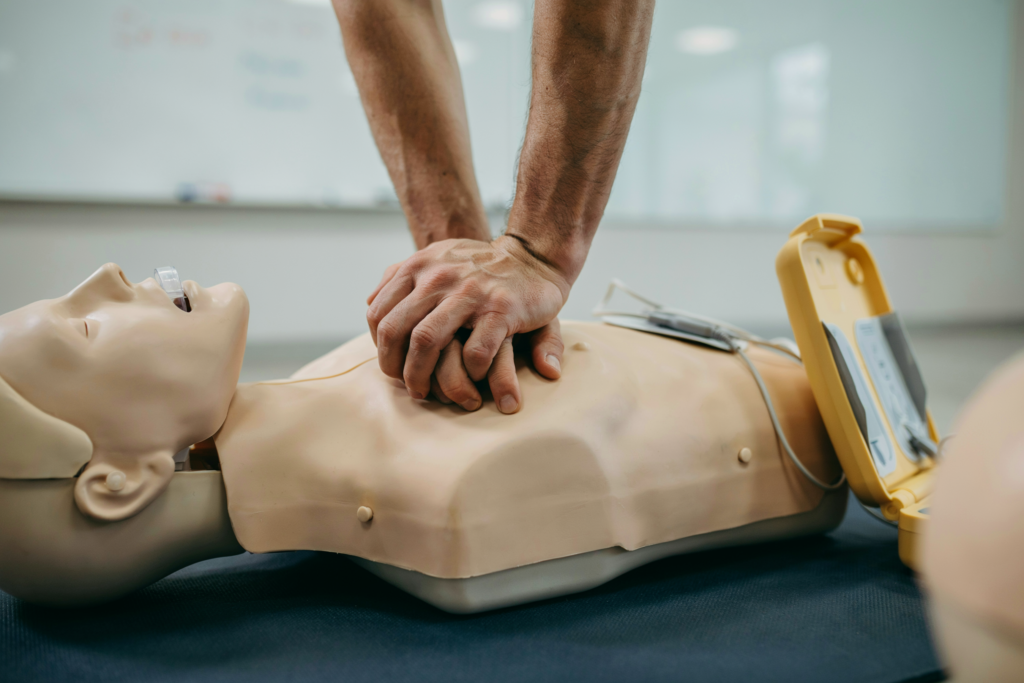
- Automated External Defibrillator (AED) use recognising when to apply one and how to operate it safely
- Airway management positioning and clearing the airway in an unresponsive patient
- Recognition of life-threatening emergencies cardiac arrest, severe breathing difficulties, unconsciousness
- Calling for emergency assistance activating Triple Zero (000) and coordinating with Queensland Ambulance Service (QAS)
HLTAID010 is valid for 3 years, with CPR renewal recommended annually. It’s required by most aged care employers, NDIS registered providers, and community services organisations across Australia.
What Does Basic Emergency Life Support Training Actually Cover?
If you’ve been told by your employer that you need basic emergency life support training, it’s worth knowing exactly what you’re signing up for and what skills you’ll walk away with.
The Core Skills Taught in HLTAID010
- Cardiopulmonary resuscitation (CPR) performing chest compressions and rescue breaths on adult, child, and infant manikins following current ANZCOR guidelines
- Automated External Defibrillator (AED) operation recognising when one is needed, locating it, and operating it safely
- Airway management positioning an unresponsive patient, clearing and maintaining an open airway, placing a casualty in the recovery position
- Recognition of cardiac arrest and severe emergencies identifying signs of cardiac arrest, breathing difficulty, and loss of consciousness
- Emergency response activation calling Triple Zero (000), communicating with QAS dispatchers, and managing the scene until paramedics arrive
- Safe work practices standard precautions including infection control during resuscitation
Is the Training Hands-On or Online?
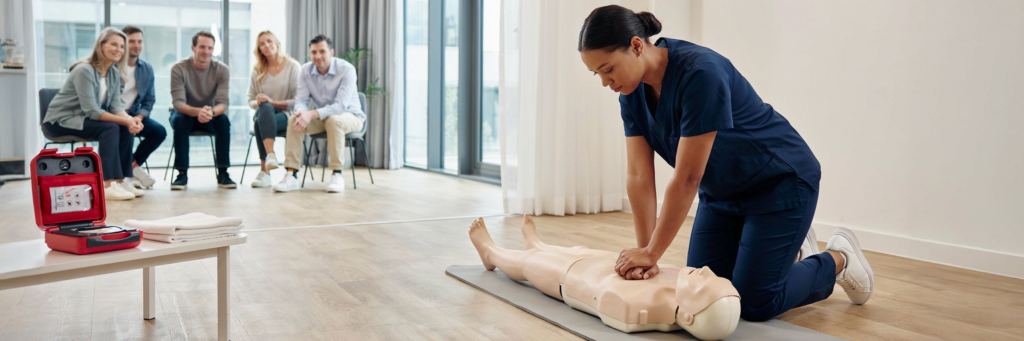
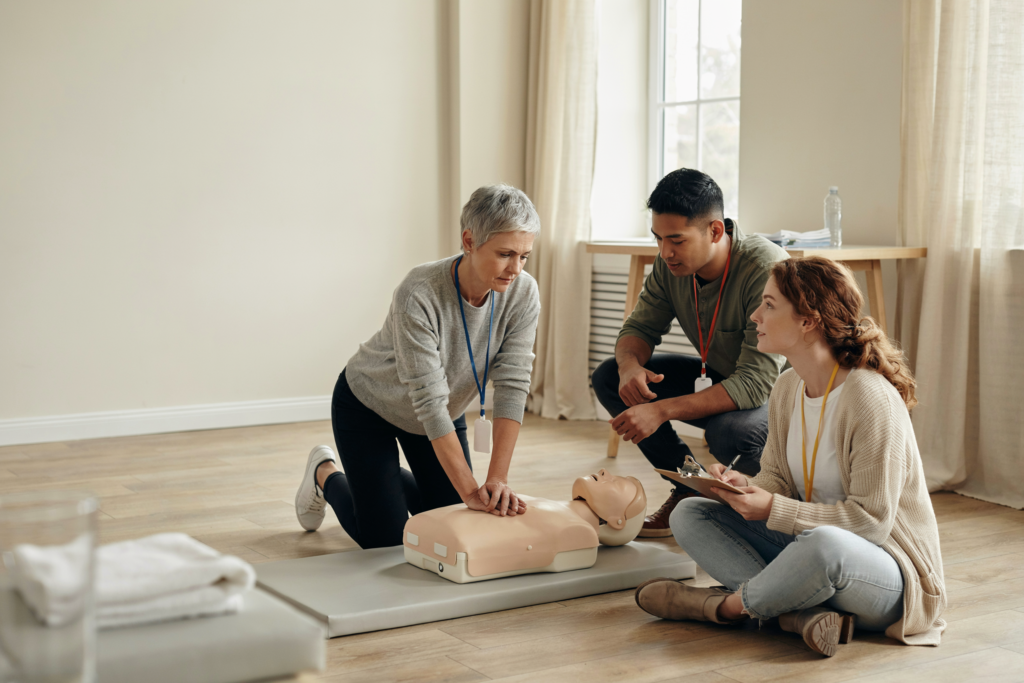
HLTAID010 cannot be completed entirely online. Under ASQA requirements, the practical components, including CPR performance on a manikin and scenario-based assessment, must be completed face-to-face with a qualified trainer and assessor.
Be cautious of any provider offering a fully online HLTAID010 certificate. A certificate issued without a verified face-to-face practical component may not be accepted by your employer’s compliance team or an NDIS auditor. Good providers are upfront about this requirement. It’s a trust signal that they’re running a legitimate course.
What to expect in a legitimate HLTAID010 course:
- A short theory component (in-person or online pre-learning)
- Hands-on CPR practice on adult, child, and infant manikins
- AED scenario practice
- Practical assessment by a qualified trainer
Who Needs Basic Emergency Life Support Training in Australia?
Basic emergency life support training is required across a wide range of care and community service roles in Australia. If you work directly with vulnerable people, elderly clients, people living with disability, or individuals with complex health needs, there’s a strong chance your employer, registration body, or industry regulator requires you to hold a current HLTAID010 certificate.
Aged Care and Residential Facility Workers
Under the Aged Care Quality and Safety Standards, approved providers are required to make sure their workforce is equipped to respond to health emergencies. Most aged care employers, including large providers such as Bupa, Regis, and Anglicare, specify HLTAID010 as the minimum acceptable qualification for personal care workers and support staff.
Roles that commonly require HLTAID010 in aged care:
- Personal Care Workers (PCWs)
- Home Care Workers
- Residential Care Assistants
- Community Care Aides
- Care Coordinators and Scheduling Staff with client-facing duties
NDIS Support Workers and Community Care Aides
For workers registered under the NDIS Practice Standards, first aid training is a documented workforce requirement. Registered NDIS providers are required to maintain evidence that direct support workers hold current first aid qualifications, and HLTAID010 is the most widely accepted baseline qualification for this purpose.
This requirement applies whether you are:
- Employed by a registered NDIS provider
- Operating as a sole trader or self-managed support worker
- Working through a support coordination arrangement
📄 Audit Compliance Tip: Important for sole traders and self-managed workers: Your certificate must display the correct unit code (HLTAID010) and your provider's RTO number to be accepted during an NDIS audit or quality review.
Other Roles That Require HLTAID010
Role / Sector | Typical Requirement |
Community health workers | HLTAID010 minimum |
Cert III Individual Support students | Placement prerequisite |
Early childhood education staff | HLTAID010 or higher (see note below) |
School support officers | HLTAID010 minimum |
Fitness and recreation staff | HLTAID010 or HLTAID011 depending on employer |
👶 Childcare Worker Note: HLTAID010 may not be sufficient for all regulated childcare roles. HLTAID011 or HLTAID012 (which includes paediatric components) may be required. Check with ACECQA to confirm what applies to your role before booking.
HLTAID010 vs HLTAID011 What’s the Difference?
This is the question that stops more care workers from booking than almost anything else. Your employer said you need “first aid training” but does that mean the basic course or the full course? Getting this wrong means completing a qualification your employer won’t accept, or sitting through more training than your role actually requires.
When HLTAID010 Is Enough
HLTAID010 is the right qualification if:
- Your employer's training policy or onboarding checklist specifically lists HLTAID010
- You work as a personal care worker, support worker, or community care aide in a supervised care environment
- You are completing Cert III in Individual Support and need to meet placement requirements
- Your role is not designated as a first aid officer or emergency warden
- You are renewing an existing HLTAID010 certificate before it lapses
When Your Employer Will Require HLTAID011
Your employer is likely to require HLTAID011 if:
- You are designated as a first aid officer for your workplace or facility
- You work in a higher-acuity care environment where a broader range of medical emergencies is likely
- You are applying for a team leader, senior carer, or coordinator role
- Your employment contract or position description specifies HLTAID011 by name
- You work in a setting that requires a designated first aider under the Work Health and Safety Act 2011 (Qld)
If you’re still not sure which one applies to you, ask your coordinator or People and Culture team directly. Quote both unit codes, HLTAID010 and HLTAID011, so there’s no ambiguity in the answer you get back.
Quick Comparison: HLTAID010 vs HLTAID011
Feature | HLTAID010 | HLTAID011 |
Full title | Provide Basic Emergency Life Support | Provide First Aid |
CPR included | ✓ | ✓ |
AED use included | ✓ | ✓ |
Airway management | ✓ | ✓ |
Wound care, burns, fractures | ✗ | ✓ |
Allergic reactions / anaphylaxis | ✗ | ✓ |
Diabetic emergencies, seizures | ✗ | ✓ |
Suitable for first aid officer role | ✗ | ✓ |
Validity period | 3 years (CPR annually) | 3 years (CPR annually) |
Typical aged care / NDIS requirement | Personal care and support workers | Team leaders, first aid officers |
How Long Is Basic Emergency Life Support Valid in Australia?
One of the most common reasons care workers find themselves urgently searching for a course on a Sunday night is simple: they didn’t realise their certificate had lapsed or was about to.
The 3-Year Rule Explained
Your HLTAID010 Statement of Attainment is valid for 3 years from the date of issue.
- If you completed HLTAID010 in June 2023, your certificate expires in June 2026
- You'll need to complete a full HLTAID010 renewal course before that date to remain compliant
- Your new Statement of Attainment is issued on the day of training and resets your 3-year validity period from that date
Note your certificate expiry date in your phone calendar with a reminder set 6 weeks out. That gives you enough time to find a session that fits your roster without the panic of a Monday morning phone call from your coordinator.
Why CPR Renewal Is Recommended Every 12 Months
While HLTAID010 itself is valid for 3 years, the Australian Resuscitation Council (ARC) recommends that the CPR component be refreshed every 12 months. Research shows CPR skill retention, particularly compression depth, rate, and rescue breathing technique, declines significantly within 6 to 12 months of initial training.
What this means in practice:
- The qualification (Statement of Attainment) remains valid for 3 years
- The skill (CPR performance) is recommended to be refreshed annually
- Your employer may enforce the annual CPR refresher as a condition of employment
Most workers complete HLTAID009 Provide Cardiopulmonary Resuscitation annually, with the full HLTAID010 renewal every 3 years. Check your employer’s specific training policy directly, as this is one of the most common sources of confusion in the aged care and NDIS sectors.
What Happens If Your Certificate Lapses?
If your HLTAID010 certificate expires before you renew it, there is no grace period under ASQA’s framework. An expired certificate is a non-compliant certificate.
Practical consequences:
- Immediate stand-down from client-facing duties most aged care and NDIS employers will remove you from the roster if your HLTAID010 certification has expired or is no longer current.
- Delayed onboarding an expired or missing HLTAID010 qualification can hold up your start date when commencing a new aged care, disability support, or community care role.
- NDIS audit risk non-compliant worker credentials are a direct compliance risk against the NDIS Practice Standards and may negatively affect provider audit outcomes.
There’s no catch-up pathway for a lapsed certificate. You simply complete the full HLTAID010 course again.
What to Look for When Booking an HLTAID010 Course
ASQA-Registered RTOs Why It Matters
The single most important thing to verify before booking any first aid course is whether the provider is a Registered Training Organisation (RTO) registered with ASQA, the Australian Skills Quality Authority.
How to verify a provider’s RTO status:
- 1. Look for their RTO number on their website and ensure it is clearly displayed on the homepage, course pages, and all certificates they issue.
- 2. Search the provider's name or RTO number on training.gov.au, Australia's official national register of registered training organisations.
- 3. Confirm that HLTAID010 appears on their scope of registration on training.gov.au before booking or attending the course.
If a provider can’t tell you their RTO number, or it doesn’t appear on training.gov.au, don’t book with them. A certificate issued by an unregistered provider is not a nationally recognised Statement of Attainment and won’t be accepted by your employer’s compliance team or an NDIS auditor.
Same-Day Certificate Delivery
For care workers managing an employer deadline or an urgent compliance gap, same-day certificate delivery is essential. A reputable HLTAID010 provider should:
- Issue your Statement of Attainment digitally by email on the day of training so you can immediately demonstrate compliance to employers.
- Provide a certificate displaying your full name, unit code (HLTAID010), RTO number, and issue date to meet employer and regulatory verification requirements.
- Make it easy to forward the certificate directly to your employer's HR team or upload it to a compliance portal straight from your phone.
Basic emergency life support isn’t a background credential you tick off once and forget about. It’s the difference between knowing what to do when a client collapses in front of you and standing there hoping someone else steps in. The skills you build in HLTAID010, CPR, AED use, airway management, emergency response, are the ones that matter most.
The renewal timeline is the part that catches most care workers off guard. Three years sounds like a long time until it isn’t, and an expired certificate in the aged care and NDIS sectors doesn’t come with a grace period. It comes with a phone call telling you that you can’t start your shift. Staying ahead of your expiry date is one of the simplest things you can do to protect your income. Set a reminder, book early, and don’t leave it to the last minute.
Knowing the difference between HLTAID010 and HLTAID011 matters more than most people realise before they go looking for a course. If your role is a personal care worker or support worker in a supervised environment, HLTAID010 is almost certainly what you need. If you’re a first aid officer or team leader, HLTAID011 is the one to check. When in doubt, ask your coordinator directly and quote both unit codes.
Choosing the right provider matters just as much as choosing the right course. An ASQA-registered RTO, transparent availability, and same-day certificate delivery are the baseline of what a legitimate HLTAID010 provider should offer. The care sector moves fast, compliance deadlines are real, and you deserve a training experience that gets you back to work with a certificate your employer will accept without question.
Book Your First Aid Training Now
Fast, affordable, and nationally accredited training delivered by professionals who care
Frequently Asked Questions About Basic Emergency Life Support in Australia
Q. What is the difference between basic emergency life support and first aid?
Basic emergency life support (HLTAID010) focuses specifically on life-threatening emergencies, cardiac arrest, severe breathing difficulty, and unconsciousness, and equips you to respond until professional help arrives. First aid (HLTAID011) covers a broader range of injuries and medical conditions including wounds, burns, fractures, allergic reactions, and diabetic emergencies. For most personal care and support worker roles, HLTAID010 is the minimum requirement; HLTAID011 is required for designated first aid officers and higher-acuity workplace settings.
Q. How long does an HLTAID010 certificate last in Australia?
An HLTAID010 Statement of Attainment is valid for 3 years from the date of issue. The Australian Resuscitation Council (ARC) recommends refreshing the CPR component every 12 months, and many aged care employers and NDIS providers enforce this annual refresher as a workplace policy. Check your employer's specific training requirements to confirm which schedule applies to your role.
Q. Can I complete HLTAID010 entirely online?
No. HLTAID010 cannot be completed entirely online. ASQA requires that the practical components, including CPR performance on a manikin and scenario-based assessment, be completed face-to-face with a qualified trainer and assessor. A fully online HLTAID010 certificate is not a nationally recognized qualification and won't be accepted by aged care employers or NDIS auditors.
Q. Does HLTAID010 meet aged care and NDIS first aid requirements?
Yes, for most personal care workers and support worker roles. HLTAID010 is the nationally recognized baseline first aid qualification accepted by the majority of aged care providers and NDIS registered organizations across Australia. Always confirm the specific unit code required with your employer's compliance or People and Culture team before booking.
Q. How quickly will I receive my certificate after completing HLTAID010?
With a reputable ASQA-registered RTO, you should receive your Statement of Attainment by email on the same day as your training. Your certificate will display your full name, unit code (HLTAID010), RTO number, and date of issue, all four elements required for employer and NDIS compliance verification.
Q. What should I bring to an HLTAID010 course?
Most providers require a valid photo ID such as a driver's licence or passport, comfortable clothing suitable for kneeling and floor-based practical work, and any relevant medical information if you have physical limitations that may affect participation. No prior first aid knowledge or experience is required to enrol in HLTAID010.
Making first aid training more affordable for
every classroom
We believe every student deserves access to life-saving first aid knowledge. That’s why we offer specially reduced pricing for schools and educational groups. Whether you’re booking for a single class, a year group, or your entire school, our flexible packages make training more accessible and cost-effective — without compromising quality.
