

It’s Sunday night. Your coordinator sends you a message that your HLTAID010 has lapsed and you can’t go back to client visits until it’s renewed. You open Google and start searching, but what you actually want to know before you book anything is: what does this course actually cover, and will it prepare me for a real emergency with a real client?
That’s a fair question. And it deserves a straight answer.
HLTAID010 Provide Basic Emergency Life Support is the nationally recognised qualification most care sector employers require as a minimum. It’s shorter than a full first aid course, focused on the most life-threatening emergencies, and designed to be completed in a single session. But what actually happens in the room, and will those skills hold up when it matters?
In this article you’ll find out what a basic first aid knowledge course covers, what the assessment looks like, whether HLTAID010 or HLTAID011 is the right qualification for your role, and what to look for in a provider to make sure your certificate is accepted by your employer.
What Does a Basic First Aid Knowledge Course Cover?
A basic first aid knowledge course covers the essential skills needed to recognize and respond to life-threatening emergencies until professional help arrives. In Australia, this course is delivered as HLTAID010 Provide Basic Emergency Life Support and is a nationally recognized qualification listed on training.gov.au.
A standard HLTAID010 course covers:
- Cardiopulmonary resuscitation (CPR) adult, child, and infant techniques using ANZCOR guidelines
- Automated External Defibrillator (AED) use how to locate, apply, and operate a defibrillator
- Airway management recognising and clearing a blocked airway
- Recovery position placing an unresponsive but breathing casualty safely
- Emergency response procedures calling 000, managing bystanders, and communicating with Queensland Ambulance Service (QAS)
- Recognition of life-threatening conditions cardiac arrest, choking, unconsciousness
The course does not cover wound care, fractures, burns, or allergic reactions. Those are included in HLTAID011 Provide First Aid which is a separate, longer qualification. If your employer has asked for “first aid” without specifying a unit code, it’s worth checking whether they mean HLTAID010 or HLTAID011 before you book. More on that in the comparison section below.
What Happens During the Course? A Step-by-Step Breakdown
A lot of care workers come into HLTAID010 with some version of the same anxiety. They’ve heard stories about demanding trainers, floor exercises that wreck your back, and being put on the spot in front of strangers. So before you walk through the door, here’s exactly what to expect no surprises.
The Theory Component: What You Need to Know Before You Touch a Manikin
The theory side of the course covers three core areas: recognising emergencies, understanding the DRSABCD action plan, and knowing how the chain of survival works.
DRSABCD stands for Danger, Response, Send for help, Airway, Breathing, CPR, and Defibrillation. It’s the step-by-step framework you’ll follow in any life-threatening emergency, and it’s the backbone of everything you do in the practical component. By the time you get to the manikin, this sequence should feel instinctive.
The theory isn’t a lecture. It’s a conversation working through real scenarios that are directly relevant to the kind of clients you’re supporting.
The Practical Component: CPR, AED, and Scenario Training
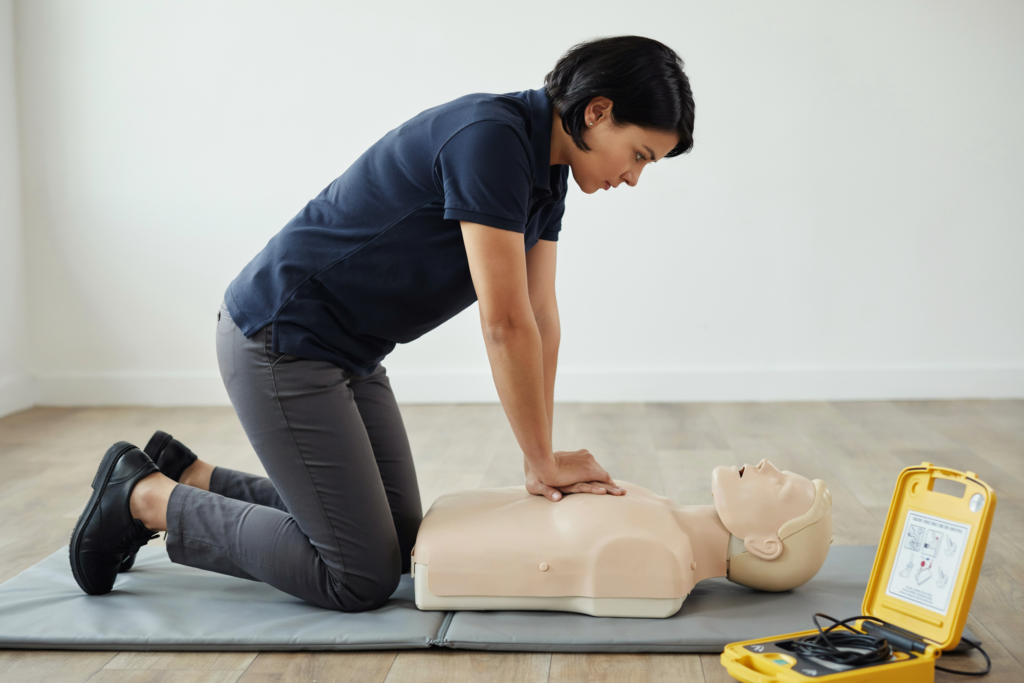
This is the hands-on part, and it’s where the real learning happens. You’ll practice:
- CPR compressions on a manikin adult, child, and infant techniques
- AED pad placement and how to operate the device
- Recovery position demonstrating on an unresponsive but breathing casualty
According to ANZCOR, bystander CPR can double a cardiac arrest patient’s chance of survival. That’s not a stat to take lightly when you’re working one-on-one with elderly or high-needs clients in their home.
Good trainers know that not everyone in the room is 35 and physically fit. If you’ve got a bad knee, a sore back, or any physical limitation that might affect floor-based exercises, let your provider know when you book. A good provider will make sure you’re supported, not pushed through something that causes you pain or embarrassment.
The Assessment: What Does Pass/Fail Look Like?
HLTAID010 uses a competency-based assessment. That means there’s no percentage score, no exam mark, and no traditional pass/fail grade. You’re assessed as either Competent or Not Yet Competent.
Your trainer is watching for correct technique and the ability to follow the DRSABCD sequence under a simulated scenario. If something isn’t quite right, a good trainer will work with you in the moment. The goal is to make sure you genuinely know what to do, not to catch you out.
What to Wear and Bring on the Day
Comfortable clothing you can move in, closed-toe shoes, any relevant medical information if you have physical limitations, and your pre-learning completion if your provider uses a blended model. That’s it.
🏥 Real scenario: A support worker is on a home visit when her elderly client becomes unresponsive. She checks for danger, calls 000, and begins CPR while staying on the line with QAS. She uses the AED her employer installed in the facility last year a device she'd never touched before her HLTAID010 training. The ambulance arrives within eight minutes. Her quick response makes the difference.

Is HLTAID010 the Right Course for Aged Care and Disability Support Workers?
This is the question that causes the most confusion and it’s the one that costs care workers the most time when they get it wrong. Booking the wrong qualification means starting over. So let’s sort it out properly.
What Most Aged Care Employers Require
For personal care workers, support workers, home care aides, and residential care workers, HLTAID010 is the minimum qualification most employers require. It covers basic life support and the skills you need to manage a life-threatening emergency until QAS arrives. It doesn’t cover wound care, fractures, burns, or anaphylaxis. Those skills live in a different qualification.
The Aged Care Quality Standards specifically Standard 3 require that staff are competent in emergency response. For direct care workers in most facility and community care policies, HLTAID010 satisfies that requirement.
What NDIS Providers Expect Under the Practice Standards
The NDIS Practice Standards don’t prescribe a specific unit code. What they require is that workers can respond appropriately in an emergency. For most support worker roles, HLTAID010 is what providers accept. Having a current, valid, nationally recognised Statement of Attainment from an ASQA-registered RTO is what keeps you and your employer on the right side of a compliance audit.
HLTAID010 vs HLTAID011: A Plain-English Comparison
HLTAID010 | HLTAID011 | |
Skills included | CPR, AED, airway management, recovery position, 000 response | All HLTAID010 skills plus wound care, fractures, burns, anaphylaxis, asthma |
Who it’s for | Personal care workers, support workers, home care aides | First aid officers, team leaders, higher-risk workplaces |
Valid for | 3 years (CPR annually recommended) | 3 years (CPR annually recommended) |
Typical employer requirement | Aged care direct workers, NDIS support workers | Senior staff, first aid officers, clinic and facility roles |
When You Might Need HLTAID011 Instead
If your employer has asked for a “first aid certificate” not “basic life support” or “BLS” there’s a chance they mean HLTAID011. Same goes if you’re stepping into a team leader role, working in a higher-risk environment, or your facility designates you as the first aid officer on shift.
💡 Rule of thumb: If your employer calls it "basic life support" or "BLS", that's HLTAID010. If they call it "first aid" or ask for a "first aid certificate", confirm whether they mean HLTAID010 or HLTAID011 before you book.
When in doubt, ask your coordinator or HR team to confirm the unit code they need, not just the course name. Unit codes don’t lie. Course names do.
How to Make Sure Your Certificate Will Be Accepted by Your Employer
Booking the wrong provider is the other way care workers get burned and it’s more common than it should be. A colleague books a cheap online course, submits the certificate to her employer’s compliance team, and gets a call back telling her it can’t be accepted. She’s out the time, and still not cleared for client visits. Don’t let that be you.
What Makes a First Aid Certificate Nationally Recognized?
A nationally recognized qualification in Australia is one that’s been delivered by a Registered Training Organisation an RTO registered with ASQA, the Australian Skills Quality Authority. When an RTO delivers HLTAID010 under ASQA standards, the resulting Statement of Attainment is accepted by employers across Queensland and Australia. The training has to actually happen assessed by a qualified trainer, in a real training environment. You can’t get a valid Statement of Attainment by watching videos online and ticking boxes.
What Is an ASQA-Registered RTO and Why Does It Matter?
ASQA is the federal body that regulates vocational education and training in Australia. When a training provider is registered with ASQA, they’re audited against strict standards covering trainer qualifications, assessment practices, and record keeping.
If a provider isn’t ASQA-registered, their certificate isn’t worth the paper it’s printed on or the email it arrives in. Your employer’s compliance team knows this. Your NDIS auditor knows this. And if a provider can’t show you their RTO number on their website, that’s your answer right there.
Red Flags: Courses That May Not Be Accepted
Watch out for these:
- Online-only courses with no face-to-face component CPR cannot be assessed online under current standards. If there's no manikin involved, there's no valid HLTAID010.
- No visible RTO number on the provider's website every legitimate RTO displays their registration number. If you can't find it, ask. If they can't provide it, walk away.
- Certificates that don't state the unit code a certificate that says "CPR Training" or "Basic Life Support" without the unit code HLTAID010 printed on it will not satisfy your employer's compliance requirements.
What Your Certificate Should Show
When you complete HLTAID010 with a legitimate provider, your Statement of Attainment must include:
- Full unit code HLTAID010
- Unit name Provide Basic Emergency Life Support
- RTO name and RTO number
- Your full name
- Date of issue
If any of those five elements are missing, the certificate is incomplete. A reputable provider won’t let that happen but it’s worth knowing what to check when it lands in your inbox.
Where to Do a Basic First Aid Knowledge Course in Brisbane
You know what the course covers. You’ve confirmed HLTAID010 is the right qualification for your role and you know what a legitimate certificate looks like. The last step is finding a provider who can actually deliver all of that without making you jump through hoops to book.
What to Look for in a Brisbane First Aid Training Provider
Not all providers are equal, and in the aged care and disability support sector, the wrong choice has real consequences. When you’re comparing options, here’s what actually matters:
- ASQA-registered RTO number visible on their website no exceptions
- Weekend availability Saturday and Sunday sessions, not just weekday 9-to-5
- Same-day digital certificate emailed on completion so you can forward it to your employer before you drive home
- Sector-relevant trainers people who understand aged care and NDIS contexts, not generic workplace trainers
If a provider ticks all of those boxes, you’re in good hands.
How to Book and What Happens After
The booking process is done entirely online, no phone call required. Select your session, complete any pre-learning, attend on the day, get assessed, and receive your digital certificate the same day. Forward your Statement of Attainment to your employer’s HR or compliance team and you’re done.
Conclusion
If you work in aged care or disability support, HLTAID010 isn’t optional, it’s the baseline. It’s the qualification that keeps you on the roster, keeps your employer’s compliance team happy, and more than anything, keeps the people you care for safer when something goes wrong. A basic first aid knowledge course might only take a few hours of your weekend, but what you walk away with is the ability to act when it counts most. That’s not nothing. That’s everything.
The course itself is more straightforward than most people expect. A competency-based assessment, hands-on CPR practice, AED training, and a clear framework for responding to life-threatening emergencies. No exam score to stress over, no mystery about what happens in the room. Just practical skills delivered by qualified trainers who understand the environment you work in and the clients you’re responsible for.
Getting the qualification right matters just as much as doing the training. HLTAID010 and HLTAID011 are different qualifications, and booking the wrong one or booking with a provider who isn’t ASQA-registered can mean your certificate gets rejected before your next shift. Know what unit code your employer needs, check the RTO number, and make sure your Statement of Attainment includes every required element before you forward it to HR.
So if your certificate has lapsed, or renewal is coming up, or you’re starting a new role and the onboarding checklist is sitting in front of you, don’t put it off. Find a provider you trust, confirm the session fits your roster, and get it done. The people you care for are counting on you to know what to do. HLTAID010 makes sure you do.
Book Your First Aid Training Now
Fast, affordable, and nationally accredited training delivered by professionals who care
Frequently Asked Questions
Q. What does a basic first aid knowledge course cover?
A basic first aid knowledge course covers CPR for adults, children and infants, AED operation, airway management, the recovery position, and emergency response procedures including calling 000. In Australia this is delivered as HLTAID010 Provide Basic Emergency Life Support and is a nationally recognised qualification listed on training.gov.au.
Q. What is the difference between HLTAID010 and HLTAID011?
HLTAID010 covers basic life support skills including CPR and AED use, while HLTAID011 includes everything in HLTAID010 plus wound management, fractures, burns, anaphylaxis, and asthma response. Most aged care and disability support worker roles require HLTAID010 as a minimum, but if your employer has asked for a "first aid certificate" without specifying a unit code, confirm the exact unit before booking.
Q. How long is HLTAID010 valid?
HLTAID010 is valid for 3 years, but ANZCOR recommends annual renewal of the CPR component because CPR is a perishable skill that degrades without regular practice. Many aged care and NDIS employers require annual CPR refreshers regardless of certificate validity.
Q. Will my employer accept my HLTAID010 certificate?
Your certificate will be accepted if it is issued by an ASQA-registered RTO and clearly states the unit code HLTAID010, unit name Provide Basic Emergency Life Support, RTO details, your name, and date of issue. Avoid providers who cannot demonstrate proper registration or assessment standards.
Making first aid training more affordable for
every classroom
We believe every student deserves access to life-saving first aid knowledge. That’s why we offer specially reduced pricing for schools and educational groups. Whether you’re booking for a single class, a year group, or your entire school, our flexible packages make training more accessible and cost-effective — without compromising quality.
