
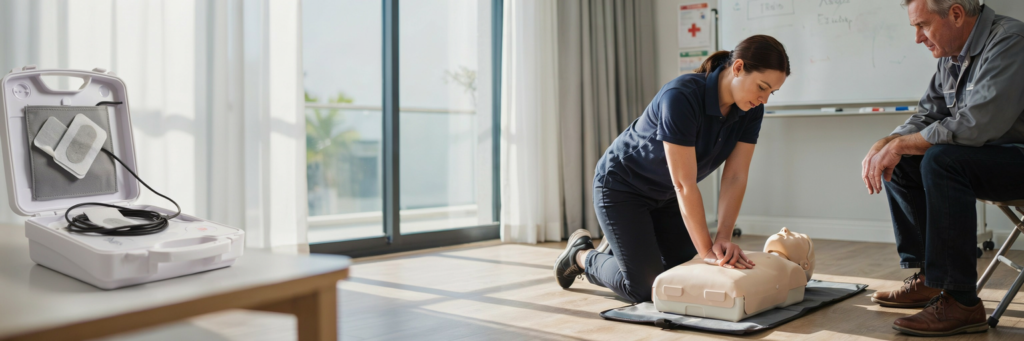
Your employer said you need BELS but what exactly does that mean, and does HLTAID010 cover it?
If you work in aged care, disability support, or as an NDIS provider, you’ve probably heard the term BELS thrown around at work. It stands for Basic Emergency Life Support, and in 2026 it remains one of the most commonly required qualifications for care sector workers across Queensland.
The confusion starts because BELS isn’t always listed on job ads or compliance checklists by its full name. Sometimes it appears as HLTAID010. Sometimes your coordinator just says “make sure your first aid is current.” And sometimes you’re not sure whether what you already have actually counts.
This guide cuts through all of that. You’ll find out exactly what the BELS minimum qualification is, which unit of competency it maps to, who needs it, how long it’s valid, and whether your current certificate will satisfy your employer’s compliance requirements in 2026.
If you’re a support worker, personal care aide, or community care worker in Queensland, this is the definitive answer to the question you’ve been searching for.
What Is the Minimum Qualification for BELS in Australia?
The minimum qualification for Basic Emergency Life Support (BELS) in Australia is HLTAID010 Provide Basic Emergency Life Support. This is a nationally recognized unit of competency on the Australian Qualifications Framework, delivered by ASQA-registered RTOs and listed on training.gov.au.
To meet the BELS minimum qualification, you must complete:
- HLTAID010 core BELS unit covering emergency response, CPR, AED use, and casualty management
- In-person practical assessment online-only courses do not satisfy the competency requirements
- Training delivered by a registered RTO certificates from unregistered providers are not nationally recognised and will not be accepted by aged care or NDIS employers
HLTAID010 is valid for 3 years from the date of issue. The CPR component is recommended for annual renewal by the Australian Resuscitation Council (ARC).
What Does BELS Cover? Inside the HLTAID010 Course
HLTAID010 Provide Basic Emergency Life Support is a hands-on, practical course. It is not an online click-through. The competency standard requires face-to-face assessment.
Core Skills Covered in HLTAID010
- CPR adult, child, and infant techniques using current ANZCOR guidelines
- AED operation how to locate, activate, and apply a defibrillator in a workplace or community setting
- Unconscious casualty management recovery position, airway management, and monitoring
- Recognition of a life-threatening emergency when to call Triple Zero (000) and what to tell QAS dispatchers
- Safe approach and scene assessment managing your own safety before you go near a casualty
What HLTAID010 Does NOT Cover
HLTAID010 is a focused qualification covering life support, not the full first aid toolkit.
What HLTAID010 Covers | What It Doesn’t Cover |
CPR adult, child, and infant | Wound care and bleeding management |
AED operation | Anaphylaxis and asthma management |
Unconscious casualty management | Burns, poisoning, or fracture treatment |
Emergency recognition and Triple Zero | Diabetes-related or cardiac event management |
Scene assessment and safe approach | Broader medical emergency response |
Anaphylaxis and asthma management fall under HLTAID011 the full Provide First Aid qualification. If your clients have complex health needs, it’s worth asking your employer whether HLTAID011 is a better fit for your role.
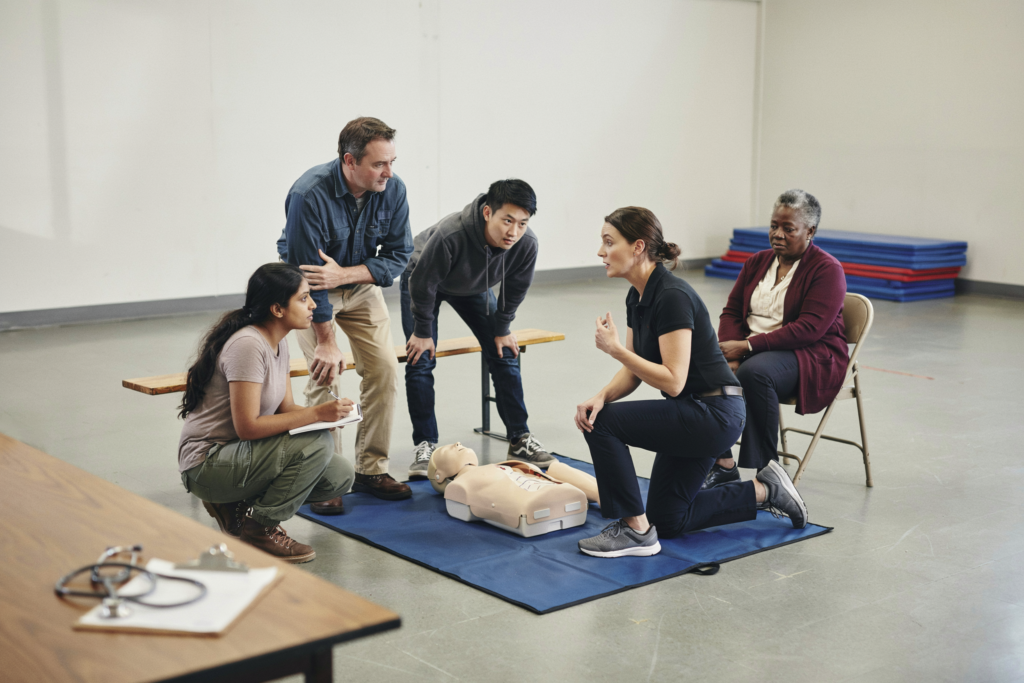
Who Needs the BELS Qualification in Queensland?
The short answer for most people reading this is: yes, you need it. But the care sector covers a wide range of roles and not every employer words their compliance requirements the same way. Knowing exactly where HLTAID010 sits in your industry’s expectations means you can walk into any booking with confidence.
Aged care workers – in residential or home care under the Aged Care Act will find HLTAID010 is the minimum standard at most large operators like Bupa, Regis, and Anglicare.
NDIS support workers and registered providers – are required under the NDIS Practice Standards to ensure workers can respond to health and safety incidents. Most providers interpret that as HLTAID010 minimum, and NDIS auditors look for a current Statement of Attainment from an ASQA-registered RTO. If you’re a sole trader, that compliance responsibility sits entirely with you.
Community services and disability support workers – in day programs, SIL, SLES, or community access roles routinely require HLTAID010 as a condition of employment.
Students completing Cert III or IV in Individual Support – will often find HLTAID010 is a placement prerequisite. Get it done before your placement start date.
Role | Typical Requirement |
Personal Care Worker (residential aged care) | HLTAID010 minimum |
Home Care Worker (community aged care) | HLTAID010 minimum |
NDIS Support Worker (registered provider) | HLTAID010 minimum |
Disability Support Worker (day programs, SIL) | HLTAID010 minimum |
Community Care Aide | HLTAID010 minimum |
Cert III Individual Support student (placement) | HLTAID010 prerequisite |
Senior Care Worker / Team Leader | HLTAID011 often required |
BELS vs First Aid: HLTAID010 vs HLTAID011
If your employer mentioned “first aid” without specifying a unit code, this is the section that will save you from booking the wrong course.
It happens more than you’d think. A coordinator tells a worker to “get their first aid sorted” and the worker books HLTAID011 the full Provide First Aid course when all they actually needed was HLTAID010. The reverse happens too. Neither outcome is good, and both are completely avoidable.
HLTAID010 and HLTAID011 are both nationally recognized but they are not interchangeable.
HLTAID010 – is a focused, single-skill qualification covering CPR, AED use, and basic casualty management. It is the BELS qualification and the minimum standard for most aged care and NDIS support worker roles.
HLTAID011 – includes everything in HLTAID010, plus wound care, burns, fractures, anaphylaxis, asthma, poisoning, diabetes emergencies, and stroke recognition.
Feature | HLTAID010 (BELS) | HLTAID011 (First Aid) |
CPR and AED | Yes | Yes |
Unconscious casualty management | Yes | Yes |
Wound and bleeding care | No | Yes |
Anaphylaxis and asthma | No | Yes |
Burns, fractures, medical emergencies | No | Yes |
Validity period | 3 years | 3 years |
Typical requirement | Support workers, care aides | First aid officers, team leaders |
To confirm which one you need: check your employment contract, ask your coordinator directly, or look back at the original job advertisement. Unit codes are usually listed in at least one of those places. Many providers also offer a pathway from HLTAID010 to HLTAID011 later, recognising previously completed components, so starting with HLTAID010 now doesn’t lock you out of anything.
How Long Is the BELS Qualification Valid?
The 3-Year Rule
HLTAID010 is valid for 3 years from the date of issue. After that, the full qualification must be renewed. There is no partial renewal, no top-up option, and no grace period. If it’s lapsed, you redo it in full.
The 12-Month CPR Recommendation
The Australian Resuscitation Council (ARC) recommends CPR skills be refreshed every 12 months. Many aged care employers and NDIS providers have adopted that as a mandatory requirement separate from the 3-year certificate validity. Which means you could have a current HLTAID010 and still be flagged as non-compliant if your CPR hasn’t been refreshed in the last year.
📌 Important: These are two separate obligations. Check your employer's training policy before assuming your certificate is accepted.
To check your current status: find your Statement of Attainment and count forward from the issue date, confirm the unit code reads HLTAID010 (not HLTAID003 or HLTAID001), and verify the issuing RTO at training.gov.au/search.
Renewal Type | Frequency | Required By |
Full HLTAID010 renewal | Every 3 years | ASQA / nationally recognised standard |
CPR component refresh | Annually (recommended) | Australian Resuscitation Council (ARC) |
Employer compliance check | Varies check your policy | Your employer or NDIS provider |
Set two reminders when you complete your HLTAID010 one at 11 months for the CPR refresh, and one at 2 years and 9 months for the full renewal.

Will My Employer Accept My BELS Certificate?
This is the question that keeps care workers up at night more than any other. The real fear isn’t failing the course most people pass. The fear is spending time on a course, walking out with a certificate, and then having it rejected by your employer’s compliance team. It happens. The way to avoid it is to know what a valid BELS certificate must show.
What a Valid BELS Certificate Must Show
- Issued by an ASQA-registered RTO RTO number must appear on the certificate; verify at training.gov.au/search
- Unit code HLTAID010 predecessor codes like HLTAID003 or HLTAID001 may not be accepted
- Face-to-face practical component completed purely online certificates will not hold up to NDIS audit or aged care accreditation review
- Issue date within the valid period 3 years from issue, or 12 months if your employer requires annual renewal
- Statement of Attainment format official RTO letterhead; a digital badge alone is not sufficient
⚠️ Warning: If a provider cannot show you their RTO number, do not book. A certificate from an unregistered provider will not be accepted by your employer, your NDIS auditor, or any aged care accreditation reviewer in Queensland.
What Your Employer’s Compliance Team Is Actually Checking
Pre-Booking Checklist
- Provider displays a current RTO number on their website
- Course listing shows HLTAID010 as the unit of competency
- Course includes face-to-face practical assessment
- Training venue confirmed at booking
- Same-day or next-business-day Statement of Attainment delivery confirmed
- Provider asks for your USI at enrolment
- You've confirmed with your employer whether HLTAID010 or HLTAID011 is required
How to Get Your BELS Qualification
A lot of care workers put this off longer than they should not because they don’t want to do it, but because they assume it’s going to be complicated. It’s not.
What to Expect on the Day
The course is hands-on from start to finish. You’ll work through CPR, AED operation, recovery position, and scenario roleplay with a qualified trainer. The scenarios are designed to be relevant to care work an elderly client who’s become unresponsive, a participant who’s collapsed during a day program. Assessment is practical observation. There’s no written exam. Wear comfortable clothing you can move in.
If you have knee pain, back pain, or any physical limitation, contact the provider before you book. Reputable providers will discuss reasonable adjustments and qualified trainers understand the difference between a paramedic standard and a competent emergency response from a care worker. Don’t let the physical side of the assessment be the reason your certificate lapses.
In Closing
The BELS minimum qualification isn’t complicated. It’s HLTAID010, delivered face-to-face, by an ASQA-registered RTO, with a Statement of Attainment issued on the day. That’s the standard your employer is looking for, that’s what NDIS auditors check for, and that’s what keeps you compliant and on the roster. The confusion tends to come from the language, not the training itself but when you focus on what actually matters: the unit code, the RTO number, the face-to-face requirement, the decision becomes a lot simpler.
What’s also worth saying is that HLTAID010 isn’t just a compliance checkbox. You work with vulnerable people who depend on you to be the most capable person in the room when something goes wrong. The skills you walk out of that training room with knowing how to start CPR, how to use an AED, how to manage an unconscious person while QAS is on the way those matter in a way that goes well beyond keeping your employer happy.
So if your certificate has lapsed, or it’s coming up for renewal, or you’re starting a new role and need to get compliant before your first shift don’t put it off. Book a weekend session, get it done in the morning, and have your Statement of Attainment in your inbox before the afternoon. It takes far less time than the stress of leaving it any longer.
Book Your First Aid Training Now
Fast, affordable, and nationally accredited training delivered by professionals who care
Frequently Asked Questions
Q. What is the minimum qualification for BELS in Australia?
The minimum qualification for Basic Emergency Life Support (BELS) is HLTAID010 Provide Basic Emergency Life Support. It must be delivered by an ASQA-registered RTO and include a face-to-face practical assessment. Online-only courses do not meet the competency standard and will not be accepted by aged care or NDIS employers.
Q. Is HLTAID010 the same as BELS?
Yes. HLTAID010 Provide Basic Emergency Life Support is the unit of competency that satisfies the BELS requirement. When your employer or onboarding checklist refers to BELS, HLTAID010 is the qualification they're asking for.
Q. How long is HLTAID010 valid?
HLTAID010 is valid for 3 years from the date of issue. The Australian Resuscitation Council (ARC) also recommends refreshing the CPR component annually, and many aged care and NDIS employers enforce that recommendation as a mandatory compliance requirement separate from the 3-year certificate validity.
Q. Does HLTAID010 cover aged care and NDIS requirements?
Yes, for most care sector roles. HLTAID010 is the accepted minimum standard for personal care workers, support workers, home care aides, and disability support workers under both the Aged Care Act and NDIS Practice Standards. Senior roles or first aid officer designations may require HLTAID011 instead, so confirm the unit code with your employer before booking.
Q. What is the difference between HLTAID010 and HLTAID011?
HLTAID010 covers CPR, AED use, unconscious casualty management, and emergency recognition. HLTAID011 includes all of that plus a significantly broader scope covering wound care, burns, fractures, anaphylaxis, asthma, poisoning, diabetes emergencies, and stroke recognition. HLTAID010 is the BELS qualification; HLTAID011 is the full Provide First Aid qualification typically required for team leaders and first aid officers.
Making first aid training more affordable for
every classroom
We believe every student deserves access to life-saving first aid knowledge. That’s why we offer specially reduced pricing for schools and educational groups. Whether you’re booking for a single class, a year group, or your entire school, our flexible packages make training more accessible and cost-effective — without compromising quality.
