
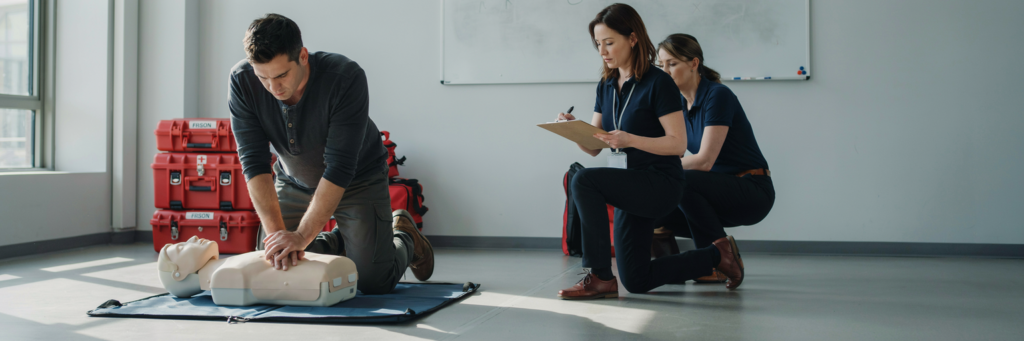
You’ve booked your HLTAID014 course. The classroom content makes sense, you’ve read the unit outline, you know roughly what’s coming. But there’s one part of the day actually keeping you up at night, and it’s not the theory.
It’s a practical assessment. The bit where an assessor watches you manage a simulated crush injury, a chest wound, or an unconscious worker, and decides whether you’re ready to be the most senior first aider on your site.
Failing isn’t really the issue most candidates should worry about. Most people pass. The real risk is walking in underprepared, freezing up halfway through a scenario, and burning half a day re-sitting something you could’ve nailed first go if you’d known what was coming.
So that’s what this guide is for. We’re going to break down what Brisbane HLTAID014 assessors are actually looking for, the most common reasons candidates lose marks (and they’re pretty predictable once you’ve seen a few hundred of them), how to prepare without overdoing it, and what happens if a skill doesn’t click first time. By the end you’ll know how to walk in ready, pass first time, and get back to site with your Statement of Attainment in hand instead of a re-booking headache.
What Happens in an Advanced First Aid Practical Assessment?
If you only read one section before your course, make it this one. Here’s the short version of what happens on the day.
An advanced first aid (HLTAID014) practical assessment typically involves:
- Scenario-based simulations covering realistic injuries like severe bleeding, fractures, chest trauma, and unconscious patients
- CPR and resuscitation demonstrations performed to current ANZCOR guidelines, often under realistic time pressure
- Casualty management decisions, including prioritising treatment when facing multiple injuries or multiple casualties
- Communication and teamwork assessments, including directing bystanders, calling for help, and handing over information to paramedics
- Equipment use training, including correct handling of AEDs, slings, and trauma dressings
Assessors watch each candidate one at a time and score you against the HLTAID014 unit of competency, not against the bloke who went before you.
That’s the whole shape of it. Nothing in there should surprise you by the time you’re walking in the door, not after reading the rest of this.
What Assessors Are Actually Looking For in Your HLTAID014 Practical
Think about the assessment less like a test and more like a structured observation. There’s no examiner hoping to catch you out. You’re measured against the HLTAID014 unit of competency, an ASQA-regulated framework that’s the same no matter which Brisbane provider you train with. That should take the pressure off straight away.
There’s two parts to it. Some knowledge-based questioning, making sure you understand the why behind the what. And a scenario-based practical demonstration, the bit everyone actually worries about, where you have to act it out.
Worth knowing before you walk in: hesitation and freezing get marked more harshly than a small technical slip-up. We’ll come back to that.
The HLTAID014 unit of competency, explained simply
In plain English, “advanced” first aid sits above your basic HLTAID009 and HLTAID011. It covers spinal management, fractures, chest injuries, and triaging multiple casualties at once, the stuff that comes up when a workplace incident is genuinely serious, not just a cut finger.
It’s nationally recognized and ASQA-registered, which matters more than it sounds. The standard you’re assessed against isn’t made up by whoever’s running your course that day. It’s the same criteria everywhere, so a pass is a pass.
🔗 Training Resource: You can read the actual unit of competency yourself at training.gov.au: HLTAID014 if you want to see exactly what you're being measured against before you turn up.
Scenario-based vs. skills-checklist assessment styles
A proper HLTAID014 assessment isn’t a multiple-choice quiz where you tick boxes and walk out. It’s realistic, simulated scenarios, the kind of thing that actually maps to what you’d face on site. First Aid Alive builds scenarios around site-relevant risks, falls, plant injuries, remote-location trauma, rather than generic clinical textbook examples that don’t mean much to a bloke who works in civil construction. Not every course runs this way, so it’s worth knowing the difference exists.
Why “freezing” costs more marks than getting a step wrong
This is the one most people don’t expect. An assessor would rather see you talk through DRSABCD slowly and correctly than rush through it and skip a step trying to look quick. Composed and methodical beats fast and flustered, every time.
So if your biggest fear is “what if I freeze up”, here’s your answer. Slowing down isn’t a weakness here. It’s actually what gets rewarded.
HLTAID009, HLTAID011, HLTAID014: how the scope builds
Unit | Scope |
HLTAID009 | Basic first aid, CPR, common workplace injuries |
HLTAID011 | CPR-focused, foundational resuscitation skills |
HLTAID014 | Advanced, spinal management, fractures, chest injuries, multiple casualty triage |
So what exactly are assessors watching for? Understanding the standard is one thing, knowing where candidates actually lose marks is what turns preparation into a pass.
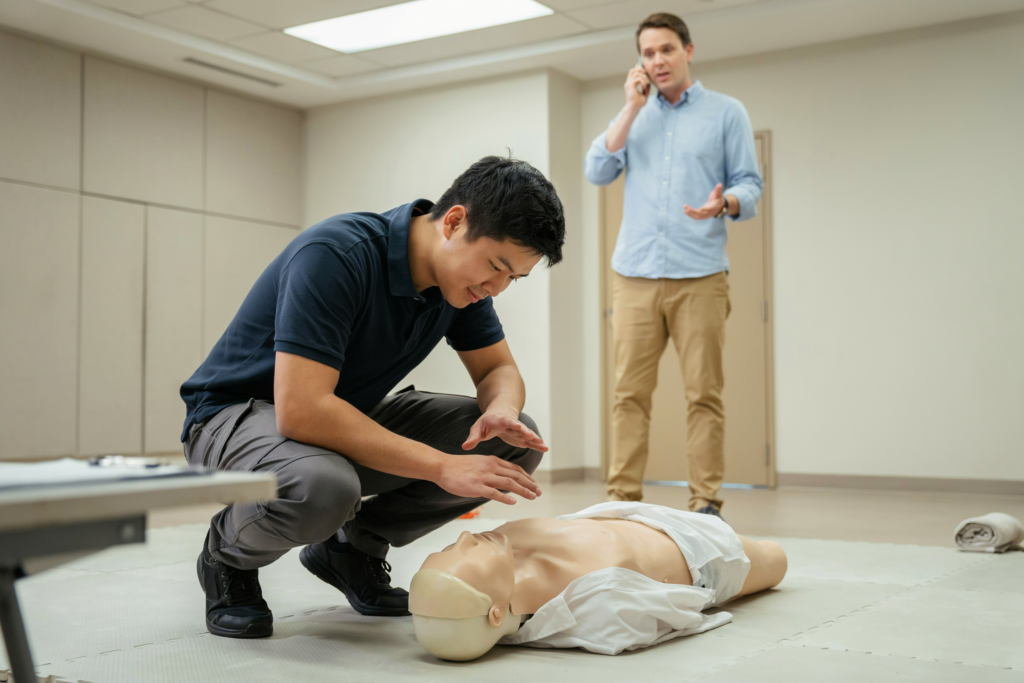
The Most Common Reasons Candidates Lose Marks
Having seen a few hundred of these run, the same handful of mistakes show up again and again, and almost none are about not knowing the content. They’re about what happens to that knowledge under simulated pressure.
Rushing patient assessment (DRSABCD) under pressure
The mistake: skipping or rushing through Danger–Response–Send for help, usually because the scenario feels urgent and skipping straight to “fixing” the injury feels right.
The fix: verbalise it, follow the sequence in order, even if it feels slow under pressure. Say it out loud as you go.
Skipping “Danger” first is exactly how a second casualty happens on a plant site or a fall site. You don’t want to be the first aider who runs in and becomes patient number two.
Poor communication with bystanders and “patients”
The mistake: going heads-down into hands-on treatment and forgetting to actually talk to anyone.
The fix: assessors explicitly score your communication and delegation. Something as simple as “you, call triple zero and confirm it’s done” is exactly what they want to hear.
On a real multi-worker site, this is the difference between help arriving fast and help arriving late. Directing bystanders properly often determines how quickly things move.
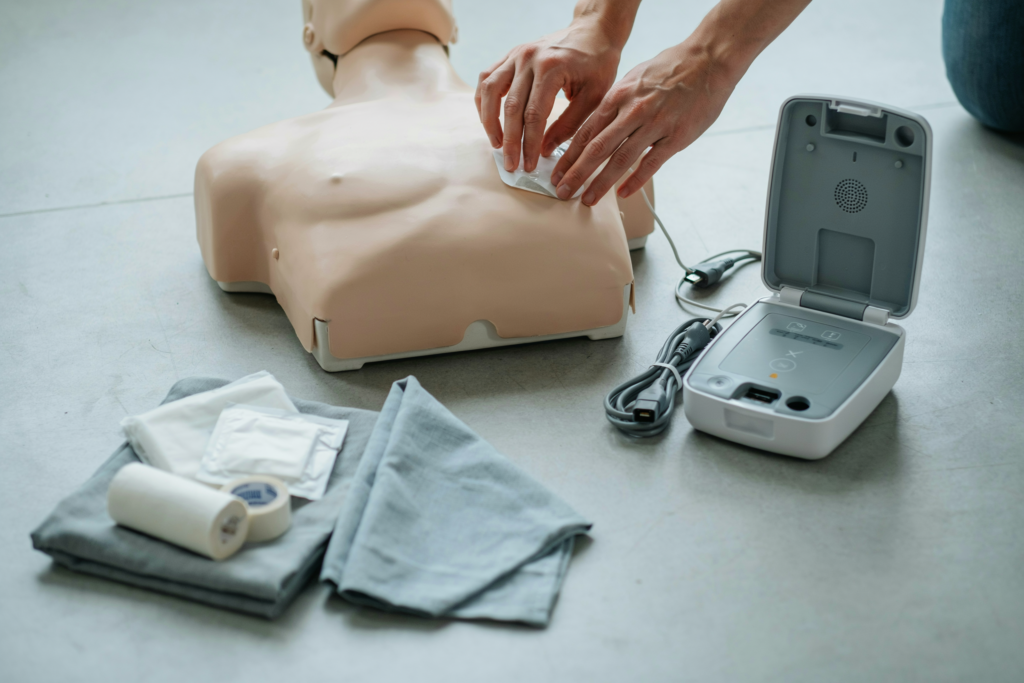
Incorrect or hesitant use of equipment (AED, slings, dressings)
The mistake: fumbling AED pad placement, improvising a sling that doesn’t hold, dressings too loose or too tight.
The fix: get hands-on with the equipment beforehand if you can. Even a few minutes handling a demo AED builds a surprising amount of confidence. It’s not complicated gear, just unfamiliar if you’ve never touched one.
🔗 Guideline Reference: Current AED use and defibrillation sequence is set out in the ANZCOR guidelines if you want to look over it before your course.
Forgetting to reassess or hand over properly to paramedics
The mistake: treating the scenario as “done” once initial first aid’s been applied, then just standing there.
The fix: keep monitoring, consciousness, breathing, bleeding, and deliver a structured handover when paramedics arrive.
This maps straight onto real site conditions too. On a remote site, well away from the nearest ambulance, “finished” isn’t a real state. You’re managing that patient the whole time help is on its way, not just for the first couple of minutes.
Mistake and Fix at a glance
Mistake | Fix |
Rushing DRSABCD under pressure | Verbalise and follow the sequence in order, even slowly |
Poor communication with bystanders | Direct bystanders clearly, confirm help is on the way |
Hesitant equipment use (AED, slings, dressings) | Get hands-on with demo equipment before assessment day |
Skipping reassessment / handover | Keep monitoring and deliver a structured paramedic handover |
📌 Course Selection Tip: Not sure which course your role actually requires? See our HLTAID009 vs HLTAID011 vs HLTAID014 comparison.
None of these fail points require weeks of study to fix. If you’ve got a job keeping you flat out already, here’s what’s worth your limited time before your course.
How to Prepare Before Your Course
Mentally rehearsing site-specific scenarios
Run through two or three realistic scenarios in your head. If a worker came off the scaffold right now, what’s step one? If someone’s pinned by plant, what’s step one? You don’t need a textbook, it’s just a quick walkthrough.
This is doable in the ute on the way to the course. It builds exactly the composure that gets rewarded in the assessment, the kind we talked about earlier with the freezing point.
Going over DRSABCD and the CPR sequence from memory
Recite DRSABCD once or twice from memory. That’s it. It’s probably the single highest-value bit of prep you can do.
Compression rate, depth, and ratio for CPR is the other one people tend to second-guess under pressure, even when they actually know it fine. A quick refresh removes that hesitation before it creeps in. You’re not trying to become an expert here, the full technique gets properly taught in the course itself, this is just enough to walk in without a blank moment.
What to bring and wear on assessment day
Closed shoes, clothing you can move around in, water, and whatever ID or paperwork’s required.
If you’re coming straight from site or heading back after, workwear is completely fine. No need to overthink the outfit, it’s a practical assessment, not an interview.
Turning up a bit early takes the edge off too. Walking in rushed right before your first scenario is its own way of starting on the back foot.
🗒️ Night Before / Morning Of Checklist
- Recite DRSABCD from memory once or twice before attending
- Mentally run through 2–3 site-specific emergency scenarios
- Pack closed shoes, comfortable clothing, and water for the practical session
- Bring any required identification or paperwork
- Aim to arrive a little early to allow time for registration and preparation
Even with solid prep, not every skill clicks on the first attempt, and that’s not the disaster it might feel like.
What Happens If You Don’t Pass First Time
This one’s probably been sitting at the back of your mind through this article, so let’s deal with it head-on.
Re-assessment process at First Aid Alive
Not passing one particular skill or scenario on your first go is common. It’s built into how the course structure works, not some rare disaster that only happens to unlucky candidates. Most providers, including First Aid Alive, allow supervised same-day re-attempts when it’s an isolated gap, one skill not yet demonstrated, not the whole assessment.
There’s a real difference between “you haven’t quite nailed this one skill yet” and “you need a full re-assessment.” The first is minor and gets sorted on the spot, with a bit of extra coaching and another go. The second is rare, and gets scheduled separately rather than rushed through there and then.
⚠️ Writer Note: Confirm re-assessment policy (same-day re-attempts, fees) with operations before publishing.
Contractor management system uploads and site access deadlines
Worth being upfront about this part too. If a full re-assessment is genuinely needed, that can mean a short delay before your Statement of Attainment actually issues, and for a lot of you, that document needs uploading into a contractor management platform before you’re even allowed back on site.
Book your course with a bit of buffer before whatever the hard deadline actually is, a tender close, an audit date, a mobilisation date, whatever it is for you. A few days of breathing room on either side turns a possible delay into a non-event instead of a crisis.
Once competency’s demonstrated, fast digital certificate turnaround does a lot of the heavy lifting too, minimising any delay. Booking with a bit of a buffer is the easiest way to take this fear off the table.
This is also why the provider you choose for this training matters more than most people realise.
Why Realistic, Industry-Relevant Training Matters for Site Supervisors
The gap between “classroom-only” providers and practical, WorkSafe-aligned training
Let’s name the risk plainly. A certificate without genuine competence isn’t a compliance win, it’s a liability sitting on your qualifications register waiting to become a problem. It looks fine on paper right up until something happens on site and the person holding that certificate doesn’t actually know what to do.
This connects back to composure under pressure and proper preparation, the kind we’ve already covered. None of that means much if the training was never built to test it properly in the first place.
WorkSafe Queensland alignment and ASQA registration matter, don’t get me wrong, they’re the baseline. But every legitimate provider has to meet that bar anyway. What separates a genuinely useful course from a box-ticking one is scenario realism, whether the training reflects situations you’ll actually face, not generic textbook scenarios that could apply to anyone.
How First Aid Alive scenarios reflect construction/civil/industrial risks
This is where it gets specific. Falls from height. Mobile plant injuries. Crush injuries. Remote-site trauma, the kind where help genuinely takes a while to arrive, not the kind where a hospital’s just down the road.
⚠️ Writer Note: Confirm with First Aid Alive which scenario types are used in HLTAID014 delivery. If generic rather than industry-customized, reframe to focus on trainer experience instead.
Training built around what you’ll actually face on a civil or construction site closes the loop on everything this article opened with. Walking in genuinely ready isn’t the same thing as walking in paper-ready. One of those holds up when it actually matters. The other just holds up in an audit.
For more on which industries and roles WorkSafe Queensland expects to hold advanced-level first aid, see WorkSafe Queensland first aid and WHS obligations.
Conclusion
Walking into your HLTAID014 practical assessment doesn’t need to feel like the unknown anymore. Assessors aren’t out to catch you, they’re watching for composure, communication, and whether you actually follow the sequence when it counts, not perfection.
Most candidates pass. The ones who walk out feeling good about it slowed down on DRSABCD, talked to the people around them, and treated the equipment like something familiar instead of something foreign.
A few minutes of mental rehearsal beforehand, the right clothes, and a bit of buffer time on the day, that’s genuinely most of what separates a confident candidate from a nervous one. And if a skill doesn’t click first time, that’s not the disaster it might feel like, it’s a normal part of how the day’s built.
What matters most, though, is whether the training behind that Statement of Attainment reflects the world you actually work in. Falls, plant injuries, remote sites where help genuinely takes a while to get there. That’s the difference between a piece of paper and genuine readiness, and it’s the whole point of getting this right.
Book Your First Aid Training Now
Fast, affordable, and nationally accredited training delivered by professionals who care
Frequently Asked Questions About HLTAID014 Advanced First Aid Practical Assessment
Q.What happens in an advanced first aid practical assessment?
A HLTAID014 practical assessment typically involves scenario-based simulations of injuries like severe bleeding, fractures, chest trauma, or an unconscious patient, a CPR and resuscitation demonstration to current ANZCOR guidelines, casualty management decisions, communication and teamwork checks, and correct use of equipment like AEDs, slings, and dressings. Assessors watch each candidate individually and score against the HLTAID014 unit of competency.
Q.What's the biggest reason candidates lose marks?
Rushing or skipping steps in the DRSABCD sequence under pressure is the most common one. Assessors would rather see you talk through the sequence slowly and correctly than rush through it and miss a step, so slowing down and verbalising each step as you go is genuinely the safest approach.
Q.What if I freeze up during a scenario?
Hesitation gets marked less harshly than most candidates expect, and freezing briefly isn't the disaster it feels like in the moment. What matters more is whether you compose yourself and work through the sequence methodically rather than rushing to look confident.
Q.Do I need to study before my course?
Not in any heavy sense. A quick mental walkthrough of two or three realistic scenarios and reciting DRSABCD once or twice from memory covers most of what helps on the day. The full technique gets properly taught during the course itself.
Q.What happens if I don't pass a skill on the first attempt?
Not passing one particular skill or scenario on the first attempt is common and built into how the course is structured. Most providers, including First Aid Alive, allow supervised re-attempts for an isolated gap, while a full re-assessment is rare and would be scheduled separately.
Making first aid training more affordable for
every classroom
We believe every student deserves access to life-saving first aid knowledge. That’s why we offer specially reduced pricing for schools and educational groups. Whether you’re booking for a single class, a year group, or your entire school, our flexible packages make training more accessible and cost-effective — without compromising quality.
