

If your job puts you in the room when someone’s crashing, ICU, ED, retrieval, wherever deterioration can happen in minutes not hours, you already know a standard first aid certificate doesn’t cut it. You’ve probably known that for a while. Regulators, credentialing committees, your unit manager, they all expect you to hold resuscitation currency that actually reflects what you do on shift, not a generic “call triple zero and wait” version of first aid. Airway management. Rhythm recognition. Defibrillation. Running a resuscitation as part of a team, under pressure, when there’s no time to think it through slowly.
That’s exactly what a resuscitation course for high-risk roles is built to cover, and it’s exactly what First Aid Alive’s version of this course does. It’s taught by instructors who’ve actually worked frontline in these settings, it’s aligned to current ANZCOR guidelines, and it’s built around the scenarios you’re likely to face rather than ones a textbook thinks you might face.
Below we’ll get into what the course actually covers, who it’s meant for, and how you can book it in around a roster that probably doesn’t leave you much room to move.
What Does a Resuscitation Course for High-Risk Roles Cover?
So what’s actually in a resuscitation course for high-risk roles? Good question, and it’s the one most people want answered before they even pick up the phone.
A resuscitation course for high-risk roles covers the advanced clinical skills that sit above standard first aid, the stuff you need when someone’s deteriorating fast and there’s no room for hesitation. Here’s what’s actually in it:
- ● Airway management: advanced techniques, including bag-valve-mask ventilation and airway adjuncts, not just "tilt the head back."
- ● Rhythm recognition: being able to tell a shockable rhythm from a non-shockable one, quickly, under pressure.
- ● Defibrillation: manual defibrillation and AED-based protocols, both.
- ● Team-based resuscitation: crisis resource management (CRM) and running coordinated, multi-responder scenarios, because a real resuscitation is almost never a solo job.
- ● ANZCOR-aligned protocols: the current Australian Resuscitation Council guidelines and algorithms, kept up to date.
- ● Oxygen therapy: supplemental oxygen administration in an emergency setting.
This course is built for people in ICU, ED, paramedicine, and other high-risk settings, the places where resuscitation events aren’t rare and a slow response actually costs something.
🏥 Who It's For: This course is for the people who arrive when something goes wrong: ICU, ED, paramedic and retrieval staff, not those calling for backup.
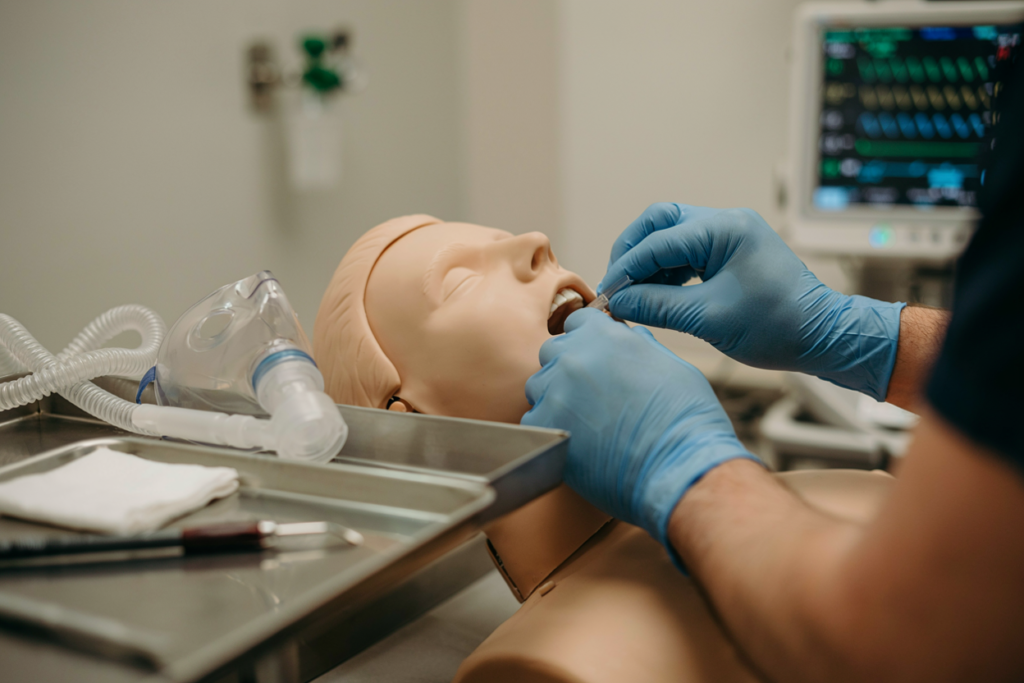
Who Needs a Resuscitation Course for High-Risk Roles?
Not everyone doing a first aid refresher needs this level of course, and that’s fine, that’s actually the point. A resuscitation course for high-risk roles isn’t for someone who wants a certificate for their retail job. It’s for people who are actually in the room when a patient’s heart stops, or their airway closes over, or their oxygen sats fall off a cliff, and someone has to do something about it right then, not wait for someone else to arrive.
Clinical and Emergency Response Roles
This means ICU nurses, ED nurses, theatre recovery staff, paramedics, retrieval and aeromedical crews, nurse educators who are training the next round of clinicians. If deterioration and resuscitation are just part of a normal shift for you, this is the course built with your actual job in mind, not a simplified version of it.
How This Differs From Standard First Aid Certification
Here’s the plain difference: a standard first aid certificate, something like HLTAID011, teaches people to recognise an emergency and call for help until someone qualified arrives. That’s a good and necessary skill for most workplaces.
But you’re not the person calling for help. You’re the person who arrives. This course is built around that gap, actually performing resuscitation, running the algorithm, managing the airway, working the defib, coordinating a team response, not standing by until a more senior clinician shows up. If your registration or your unit expects you to be that person, a basic certificate was never going to cover it properly.
What’s Covered in the Course
The featured snippet gave you the short version. Here’s the real one, because a resuscitation course for high-risk roles should go a lot deeper than a bullet list and if it doesn’t, you should be asking questions about why.
Clinical Skills Covered
This isn’t a course where you sit and watch someone talk for two hours about theory. You’re actually doing the work, hands on, over and over until it’s not something you have to think about anymore.
Airway management gets proper time here, not a five minute mention. You’ll work through bag-valve-mask ventilation and airway adjuncts, the actual mechanics of keeping an airway open when a patient can’t do it themselves. Rhythm recognition is drilled until picking a shockable rhythm from a non-shockable one isn’t a guessing game under pressure. Defibrillation is covered both manually and through AED protocols, because you might be working with either depending on where you’re rostered that day.
Then there’s team-based resuscitation, which is honestly the part a lot of courses skip or rush. Crisis resource management, or CRM, is about how a team actually functions during a resuscitation event: who’s leading, who’s doing compressions, who’s managing the airway, who’s calling out timing. A resuscitation rarely goes wrong because one person forgot a step. It goes wrong because the team around them didn’t communicate. Oxygen therapy rounds things out, covering supplemental oxygen administration in an emergency setting.
ANZCOR Guideline Alignment
Everything taught in this course is aligned to current ANZCOR (Australian Resuscitation Council) guidelines, not an older version someone forgot to update. Guidelines shift as evidence changes, and a course that’s still teaching last decade’s algorithm isn’t doing you any favours, no matter how confident the instructor sounds.
Skill Area | Standard First Aid | High-Risk Role Course |
Airway | Basic positioning | Bag-valve-mask, adjuncts |
Defibrillation | AED only | Manual + AED |
Response | Call for help | Lead and perform resuscitation |
📅 Booking Tip: Roster-locked availability is real, so dates are filterable and group bookings come with stated instructor-to-participant ratios.
Course Dates, Format & Booking for Rostered Staff
Roster-locked availability is a real constraint, not something to work around with a generic “book any Saturday” calendar. If you’ve only got one weekday off in a three-week stretch, or a single weekend before your unit’s credentialing deadline, you need to see actual available dates fast, not send an enquiry and wait for a reply.
Course dates are listed with a filterable search, so you can check what’s running on the specific day you’ve actually got free, rather than scrolling through a generic calendar hoping something lines up.
Group & Team Bookings for ICU/ED Units
If you’re booking as a unit rather than an individual, whether that’s a full ICU team, an ED cohort, or a group of nurse educators, group bookings can be arranged on-site or at a dedicated venue. Instructor-to-participant ratios are stated clearly upfront, along with equipment availability, so a group session doesn’t end up under-resourced with one instructor and a shortage of manikins for the number of people in the room. That’s a fair thing to want confirmed before you commit a whole unit’s rostered time to it.

CPD, Credentialing & Certification
Once the course is complete, you’ll receive a Statement of Attainment that maps to the actual unit(s) covered. This documentation is built to support hospital credentialing requirements and professional development portfolios, so it can go straight into your unit’s records or your own CPD file without extra admin back-and-forth chasing a different format or missing detail.
It’s worth being clear about what this documentation does and doesn’t do: it supports the credentialing process your hospital or professional body runs, rather than being a substitute for that process itself. If your unit or credentialing committee has a specific format or additional evidence they require alongside the certificate, it’s worth checking that against what’s provided here before your renewal date gets close.
Certification reflects current ANZCOR-aligned content, so it’s dated and structured in a way that should hold up against a credentialing review without raising questions about currency.
Conclusion
Resuscitation skills fade faster than most people expect, not because anyone stops caring, but because the gap between real events and practised skills tends to widen quietly over months of a normal roster. A course built for high-risk roles exists precisely to close that gap before it matters, rather than after.
The difference between a standard first aid certificate and genuine resuscitation training isn’t really about content volume. It’s about what happens when someone is actually deteriorating in front of you and there’s no one more senior in the room yet. That moment doesn’t wait for confidence to catch up, which is exactly why the practice needs to happen well before it’s needed for real.
Team-based resuscitation deserves more attention than it usually gets. Most failures in a real event trace back to coordination, not individual technique, someone unclear on their role, timing that slips, communication that breaks down under pressure. Training that treats the team as the unit of performance, rather than each person in isolation, reflects how resuscitation actually works in practice.
Documentation matters too, but it shouldn’t be mistaken for the point of the exercise. A Statement of Attainment supports a credentialing process, it doesn’t replace the reason that process exists in the first place. The underlying goal is still competence that holds up when it’s tested, not paperwork that satisfies a file.
None of this needs to be complicated to be right. Clear content, taught by someone who has actually done the work, practised in a way that resembles the real thing, is most of what separates a course that helps from one that just fills a compliance requirement.
Book Your First Aid Training Now
Fast, affordable, and nationally accredited training delivered by professionals who care
Frequently Asked Questions
Q. How often do I need to renew resuscitation training?
Renewal timing depends on your employer or credentialing body, but most hospital units and professional registration requirements expect resuscitation currency to be renewed annually, given how quickly guidelines and skills can lapse without regular practice. Check your specific credentialing requirements, since some settings require more frequent renewal than others.
Q. Is this course accepted by my hospital network?
The Statement of Attainment maps to nationally recognized training and is built to support hospital credentialing requirements, but individual hospital networks and credentialing committees may have their own specific documentation or format requirements. It's worth checking your unit's exact requirements ahead of your renewal date to confirm this course covers what's needed.
Q. What's the difference between HLTAID014 and advanced resuscitation training?
HLTAID014 (Provide Advanced First Aid) covers a broader first-responder skill set for workplace and community settings, while this course goes further into the specific clinical skills used by ICU, ED, and paramedic staff, including manual defibrillation, advanced airway management, and team-based resuscitation scenarios. If your role involves leading or performing resuscitation rather than initiating first response and waiting for backup, this course is the better fit.
Q. Can I book this course as a group for my unit?
Group and team bookings are available for ICU, ED, and similar units, either on-site or at a dedicated venue, with instructor-to-participant ratios and equipment availability confirmed upfront so the session is properly resourced for your group size.
Q. Does this course cover pediatric resuscitation?
This depends on the specific unit or course variant booked, since pediatric resuscitation involves different algorithms and equipment considerations to adult resuscitation. Confirm scope directly before booking if pediatric-specific content is a requirement for your role.
Making first aid training more affordable for
every classroom
We believe every student deserves access to life-saving first aid knowledge. That’s why we offer specially reduced pricing for schools and educational groups. Whether you’re booking for a single class, a year group, or your entire school, our flexible packages make training more accessible and cost-effective — without compromising quality.
