

You’ve got a diploma-qualified educator on your floor who still needs her HLTAID012 renewed, and you’re staring at your roster trying to work out how you pull her off the floor for a full day without breaching ratios. Maybe you’ve got three staff in the same boat. A full day off site, times three, during a term where you’re already short-staffed and covering two rooms with one spare educator, isn’t really a plan. It’s a problem waiting to happen.
Anyone who’s run a centre for more than a year knows this exact feeling. You open the compliance register, you see a certificate expiring soon, and your stomach drops a little because you already know what’s coming: the juggling act of finding cover, rearranging shifts, and hoping nothing falls through the cracks while someone’s off doing a full day of training. It’s not that anyone doubts the value of the training itself. It’s that the old model of delivery, one long day, everyone in a room together, was never really designed with a ratio-bound, staff-shortage-era childcare centre in mind.
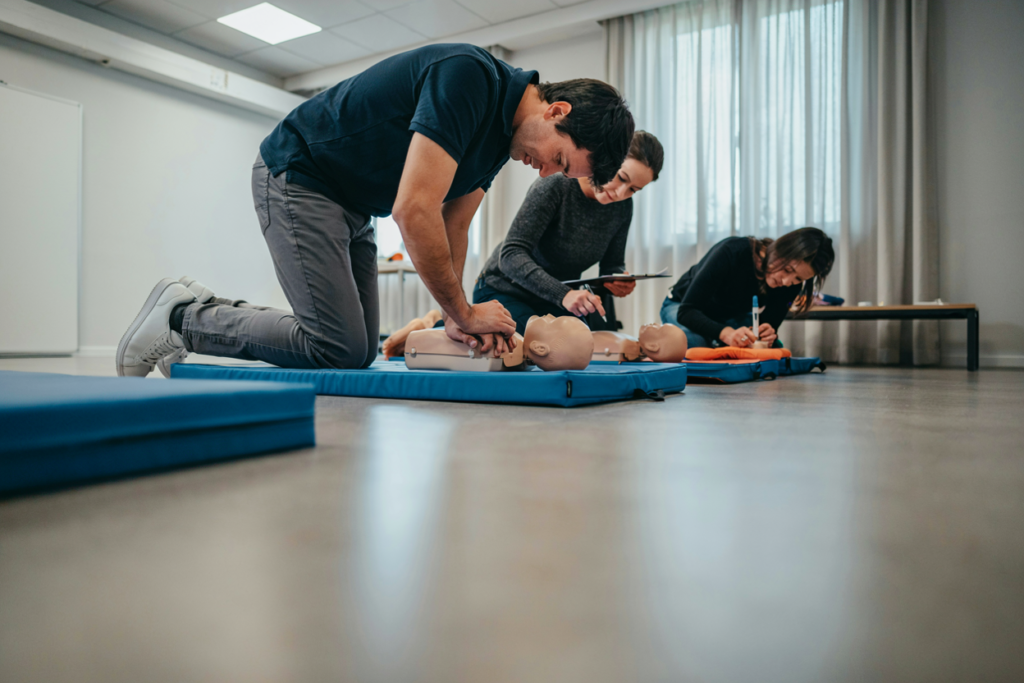
This is where blended learning changes the equation. Instead of one long day away from the centre, your staff complete the theory component online, in their own time, then come in for a shorter, hands-on practical session to lock in the skills that actually matter in an emergency. CPR on infant and child manikins. Choking response. Using an EpiPen or an asthma device under pressure, not just reading about it in a slide deck. Nothing about the format cuts corners on competence. It just moves the reading and the theory testing out of your rostered hours and into a shorter, sharper practical day.
Below, we’ll walk through exactly what’s covered online versus in person, how the scheduling works for a whole team rather than one person, what your staff need to get through the online component, and what happens if someone doesn’t finish their theory before the practical date rolls around. If you’re the one holding the compliance register for your centre, this is the version of the process written for you, not for a generic first aid buyer.
How Does HLTAID012 Blended Learning Work?
Here’s the short version, if you just need the process laid out before you commit anyone’s time to it:
- Complete the theory online at your own pace
- Attend the required face-to-face practical session
- Receive your Statement of Attainment after successful completion
That’s it. Because the theory’s already done before anyone walks in the door, the in-person session is a lot shorter than a traditional full-day face-to-face course. Your staff aren’t sitting through hours of slides they could’ve read at home. They’re in, they’re practicing, they’re assessed, they’re out.
What Is HLTAID012 Blended Learning, Exactly?
Blended learning just means the course is split into two parts instead of delivered as one block. You do the theory yourself, online, wherever and whenever suits you. Then you show up for a practical session where a trainer runs you through the physical skills and assesses whether you can actually do them.
That’s different to a course that’s fully online, and it’s different to a traditional face-to-face day where you’re doing theory and practical back to back in the one sitting. Some providers use the word “blended” loosely, so it’s worth understanding exactly what it means before you assume every course labelled that way is doing the same thing.
One thing worth being upfront about: a fully online-only first aid course isn’t accepted for HLTAID012. ASQA requires an assessed practical component, full stop. If a provider is telling you your whole team can get certified without ever attending in person, that’s not a compliant HLTAID012 course, and it won’t hold up if your regulatory authority comes asking questions during an assessment and rating visit. We’d rather tell you that plainly now than have you discovered it the hard way during an audit, with a staff member’s certificate suddenly in question.
What blended learning does give you is the same nationally recognised HLTAID012 Statement of Attainment you’d get from a full face-to-face course. Same qualification, same unit code, same standing with ACECQA. The only thing that’s different is how you get there. Nobody looking at the certificate afterwards, an assessor, a regulator, a parent asking questions, will be able to tell which pathway a staff member took to earn it.
Fully Online vs. Blended vs. Face-to-Face: What’s the Difference
Format | Accepted for HLTAID012? | Practical Component |
Fully online | No | None, doesn’t meet ASQA requirements |
Blended | Yes | Yes, assessed |
Face-to-face | Yes | Yes, assessed |
Worth a quick look before you book anything with any provider, honestly. If a course only shows up in the “fully online” row, keep your money in your pocket. It might be cheaper, it might look convenient on paper, but it will not satisfy the requirement your service is actually held to, and you’ll end up paying for the correct course anyway once the gap is discovered.
Compare the qualifications yourself: HLTAID012 vs HLTAID011 comparison.
🩹 Skills stay hands-on: CPR, choking response, and EpiPen/asthma device use are all still practised and assessed in person, not just talked through.

What’s Covered Online vs. In-Person
This is probably the bit you actually want to know before you sign your staff up. What are they doing on their laptop at home, and what are they doing in the room with a trainer?
Covered online:
- First aid principles and legal responsibilities, including duty of care and appropriate first aid actions
- Recognising emergencies early and identifying signs before they escalate
- Asthma and anaphylaxis theory, including what happens in the body and why it matters
- Incident documentation, including what needs to be recorded and why accurate records matter
Covered in-person:
- CPR practice on infant and child manikins
- Hands-on choking response techniques
- Practical EpiPen and asthma device use
- Scenario-based assessment, with trainers observing staff responses under simulated pressure
The idea is that your staff walk into the practical day already knowing the “why,” so the trainer can spend the whole session on the “how”: actually doing CPR, actually using an EpiPen trainer, and actually being assessed on it. Not sitting through another round of theory they’ve already covered. This is really the whole logic behind why blended learning can be shorter in person without being lighter in substance. The theory isn’t skipped, it’s just relocated to where it can be absorbed properly, at a staff member’s own pace, rather than crammed into the front half of a long day where people are already thinking about the roster gap they’re leaving behind.
Yes, and this is a question we get asked more than almost any other by centre directors: as long as the course is delivered by a registered training organisation and includes an assessed practical component, which HLTAID012 blended learning does, it satisfies the same regulatory requirements as a full face-to-face course under Regulation 136 and 137. The certificate that comes out the other end doesn’t look “lesser” to an assessor. It’s the same qualification, issued against the same national unit, held to the same standard.
If you’re still working out whether your team needs HLTAID012 specifically, or whether a generic first aid certificate someone did at a previous job actually counts, it’s worth reading our HLTAID012 vs HLTAID011 comparison before you book anyone in. Getting this distinction wrong is one of the most common and costly mistakes centres make, and it’s an easy one to avoid with a bit of upfront checking.
📋 For directors: Staff can complete theory on staggered timelines and still land on the same practical session date as a group.
Why Childcare Centres Choose Blended Learning Over Full Face-to-Face
Once directors understand blended learning is genuinely just as compliant, the appeal becomes pretty obvious. It comes down to time, and time is the one thing centres don’t have spare.
- Less time off the floor, with a shorter practical session reducing disruption and the need to arrange staff cover
- Easier shift-roster scheduling, with educators completing the online theory around their own schedules and only the practical session needing to fit the roster
- Less ratio disruption, by reducing the amount of time educators need to be away from the centre and helping make staffing requirements easier to manage
Whether the online theory happens in paid hours or staff complete it in their own time varies from centre to centre, and it’s worth having that conversation internally before you roll this out to your team, so nobody’s caught off guard. Some directors set clear expectations upfront that theory is expected to be completed within a certain window, others leave it more open. Either approach can work, as long as your staff know what’s expected of them before they start.
There’s also a real advantage for new hires. If someone starts without current HLTAID012, they can begin the online theory that same day rather than waiting weeks for the next full-day course to come up on the calendar. It doesn’t solve the compliance gap instantly, but it starts closing it immediately instead of sitting on a waitlist, which matters enormously when you’re trying to get a new educator counted toward ratio as soon as possible.
Ready to get your team booked in? Book your team’s HLTAID012 blended course.
Is Blended Learning Suitable for a Whole Staff Team, Not Just One Person?
Yes, and honestly this is where blended learning really earns its keep for a centre director managing a whole roster rather than a single booking. Your staff don’t all need to complete their online theory at the same pace or on the same day. One person might knock it out in an evening, another might spread it across a week between shifts. What matters is that everyone’s ready by the same practical session date, where the whole group comes together for the hands-on component.
If you’re coordinating certification for more than one or two staff, our group and on-site booking page is built for exactly this: one point of contact, one invoice, one practical date, staff completing theory on their own time in the lead-up. It’s designed around how centres actually operate, not around how an individual buyer books a single course.
Check upcoming practical session dates.
💻 Before you start: All staff need a USI to be issued a Statement of Attainment. Sort it before the course starts, not on the day it's due.
What You’ll Need to Complete the Online Component
Nothing complicated here, but worth setting your staff up properly so nobody hits a wall halfway through.
- A device with internet access, such as a laptop, tablet, or smartphone
- A Unique Student Identifier (USI), which is required before a Statement of Attainment can be issued to staff completing nationally recognised training. Staff completing nationally recognised training for the first time should create their USI before the course starts to avoid delays with certification
Some staff will want to sit down and knock the whole thing out in one go, others will do it in chunks between shifts or after the kids are in bed. Either way works. The online platform is built to be paused and resumed, so nobody needs to block out a single long stretch of uninterrupted time to get through it. That flexibility is honestly one of the more underrated parts of the whole model, because it means the theory component fits around a staff member’s actual life rather than demanding they carve out a chunk of it specifically for study.
There’s also a short LLND self-assessment (language, literacy and numeracy) built into the online enrolment. It’s not a test anyone fails, it’s just there to flag early if someone might need extra support working through the material, so nobody gets stuck without anyone noticing. If English isn’t a staff member’s first language, or if reading dense material has always been a struggle for them, this step means that gets picked up early and support gets offered, rather than someone quietly falling behind and only being noticed when they turn up to the practical session underprepared.
Worth knowing upfront what happens if a staff member doesn’t finish the online theory before their practical session, rather than finding out on the morning of, especially if you’ve got a staff member who’s been putting the theory off between shifts. Build in a buffer if you can, and don’t book the practical date for the exact day the theory’s due. A few days of breathing room between the theory deadline and the practical session gives everyone a chance to catch up if they’ve fallen behind, without you needing to reschedule the whole group around one person.
What your staff need before their practical day: we’ve put together a one-page checklist covering everything above, ready to hand straight to your team.
Conclusion
Getting your team certified in HLTAID012 doesn’t have to mean losing a full day of rostered staff every time someone’s certificate is due. Blended learning takes the theory off your floor entirely and puts it back where it actually belongs, in your staff’s own time, at their own pace, without anyone needing to be pulled off ratio to sit through a slideshow they could’ve read at home. What’s left is a shorter, sharper practical day where the trainer’s full attention goes on the skills that matter when something actually goes wrong.
And that’s really the point worth sitting with here. Nobody’s cutting corners to make this easier on your roster. The CPR, the choking response, the EpiPen and asthma device practice, the scenario-based assessment, all of it still happens in person, still gets watched and signed off by a trainer, still leads to the same nationally recognised Statement of Attainment as a full face-to-face day. The format changed. The competence didn’t.
If you’re the one holding the compliance register for your centre, you already know the real cost isn’t the course fee, it’s the disruption. Every hour an educator’s off site is an hour you’re managing thin, and every staff member who needs recertifying at a different time is another gap to plan around. Blended learning gives you back some control over that. Staff move through the theory on their own schedule, and only the practical session needs to line up with your roster, which for a director juggling more than one certificate expiry at a time is often the difference between chasing your tail and actually staying ahead of it.
So if you’ve got staff whose HLTAID012 is coming due, or a new educator who started without it, don’t let the idea of a full day away from the centre be the thing that delays getting it sorted. Get the theory started now, lock in a practical date that suits your team, and let the certificate catch up to where your roster already needs to be.
Book Your First Aid Training Now
Fast, affordable, and nationally accredited training delivered by professionals who care
Frequently Asked Questions
Q.Does HLTAID012 blended learning meet ACECQA and childcare regulation requirements?
Yes. As long as the course is delivered by a registered training organisation and includes an assessed practical component, blended learning satisfies the same regulatory requirements as a full face-to-face course and results in the same nationally recognised Statement of Attainment.
Q.Is a fully online HLTAID012 course accepted?
No. HLTAID012 requires an assessed practical component, so a course delivered entirely online with no in-person practical session does not meet the practical assessment requirement and may not be accepted by the relevant regulatory authority.
Q.What happens if a staff member doesn't finish the online theory before their practical session?
This depends on the provider's policy, so it's worth checking before you book. As a general rule, building in a few days of buffer between the theory deadline and the practical date gives staff room to catch up without needing the whole group's session rescheduled.
Q.Do all staff need to complete the online theory at the same time?
No. Staff can work through the theory on their own schedule and at their own pace. The only date that needs to line up for the whole group is the practical session itself.
Q.What does a staff member need to complete the online component?
A device with internet access and a Unique Student Identifier (USI). Staff who have never completed nationally recognised training before will need to set up a USI before they can be issued a Statement of Attainment.
Making first aid training more affordable for
every classroom
We believe every student deserves access to life-saving first aid knowledge. That’s why we offer specially reduced pricing for schools and educational groups. Whether you’re booking for a single class, a year group, or your entire school, our flexible packages make training more accessible and cost-effective — without compromising quality.
Contact Us
Have questions or ready to enrol in a course? Reach out to our friendly team for bookings, group sessions, or general enquiries. We’re here to help you choose the right first aid training for your needs.
