

A staff member collapses near the coffee machine, wheezing and clutching their throat. Someone shouts for the first aid kit. But before anyone even reaches for it, there’s a harder question hanging in the air: is this asthma, or is this anaphylaxis?
They can look scarily similar in the first few seconds, and the right response isn’t always the same for both. For a hospitality manager, a venue owner, or a sporting club coordinator, that moment of hesitation is exactly why this scenario stays stuck on the risk register, unresolved.
This isn’t about turning your team into paramedics. It’s about closing one specific, practical gap: knowing the signs that separate a moderate asthma episode from a severe one, and the signs that mean it’s anaphylaxis, where every second counts differently.
By the end of this guide, you’ll have a clear framework for telling the two apart under pressure, what to do the moment you’re sure, and how to make sure your team, whether that’s staff, volunteers or committee members, isn’t the one caught not knowing.
What’s the Difference Between Asthma and Anaphylaxis?
Asthma is a chronic lung condition that narrows the airways, causing wheezing, coughing and shortness of breath. Symptoms can build up slowly over minutes or hours, or flare suddenly when a known trigger like dust, cold air or exercise sets things off.
Anaphylaxis is different. It’s a severe, whole-body allergic reaction that can hit breathing, skin, heart and blood pressure all at once, usually within minutes of exposure to an allergen.
Here’s the tricky part. In the first moments, the two can look almost identical. Someone struggling to breathe, gasping, panicking. So what’s the tell? Context and spread. If breathing trouble follows eating, a sting, or taking a medication, or if it comes with hives, swelling or dizziness, treat it as anaphylaxis first. When in doubt, use an adrenaline autoinjector before you go anywhere near standard asthma first aid. That’s the ASCIA-backed rule, and it’s the one thing worth remembering above everything else in this guide.
Why the Difference Matters in a Workplace Setting
It’s Not Just a Childcare or Clinical Issue
Most content on this topic gets written for daycare centres or clinical settings, nurses, paramedics, people who already have the training. That’s not you. You’re running a café floor, a retail counter, or standing on the sideline at Saturday sport, and the stakes don’t change one bit.
A staff member on your team could have a known allergy. A customer could be about to eat something with a hidden ingredient. A junior club member could have a nut allergy nobody’s thought about since the season started. This stuff doesn’t stay inside a childcare centre. It walks into your workplace on an ordinary Tuesday.
What Your WHS Duty of Care Actually Requires Here
Under work health and safety law, you’ve got a duty to manage foreseeable risks to staff, customers or members. Nobody’s expecting you to run a hospital ward. But if a risk is known, or reasonably foreseeable, doing nothing about it isn’t really an option anymore.
And here’s the tension that sits underneath all of this: asthma and anaphylaxis can look almost identical in the first thirty seconds. Treat one as the other and you’re not just wasting time, you’re wasting the exact minutes that matter most.
So what does an asthma attack actually look like when it’s happening in front of you?
🫁 Watch for: Persistent coughing, wheeze, and shortened sentences are your early cue to act, not wait.

Recognizing an Asthma Attack
Early and Moderate Signs
An asthma attack rarely comes out of nowhere fully formed, there’s usually a build-up, even if it’s a fast one. Here’s what to watch for:
- Coughing that won't settle, especially a dry, persistent one
- A wheeze or whistling sound on the breath out
- Tightness in the chest, or the person saying it "feels tight"
- Shortness of breath, breathing faster than normal
- Talking in shorter sentences than usual, breaking up their words to breathe
None of these on their own mean panic stations. But together, or getting worse quickly, they’re your cue to act, not wait and see.
Severe Asthma Attack: When It’s an Emergency
This is where it turns serious, and where a bystander needs to know the red flags cold:
- Can't finish a sentence without gasping for air
- Lips or fingertips turning blue or grey
- Visibly exhausted from the effort of breathing
- No relief at all after using a reliever inhaler
- Looking distressed, confused, or starting to lose consciousness
Any one of these is a call-000 moment. Don’t wait to see if the inhaler “kicks in eventually.” It won’t, and that hesitation is exactly the gap that turns a manageable episode into an emergency.
Anaphylaxis often starts the same way, but it rarely stays contained to the airway.
Recognizing Anaphylaxis
The Whole-Body Warning Signs
Anaphylaxis doesn’t politely stay in one place. This is the single most useful thing to remember when you’re trying to tell it apart from asthma: it’s a whole-body reaction, not just a breathing one. Watch for signs across more than one system at the same time:
- Skin: hives, welts, itching, sudden flushing or swelling of the lips, face or eyes
- Breathing: difficulty breathing, wheeze, a tight throat, or a hoarse voice
- Gut: nausea, vomiting, stomach pain that comes on fast
- Cardiovascular: dizziness, fainting, or collapse
If you’re seeing symptoms popping up in two or more of these areas at once, that’s your strongest clue this isn’t a straightforward asthma attack.
Why the Trigger Context Matters
Anaphylaxis usually shows up fast, often within minutes, and it’s usually tied to a trigger. Something eaten, a sting, a new medication. If someone’s just had lunch, been stung, or taken a tablet and now they’re struggling, that context matters as much as the symptoms themselves.
Here’s the part that catches workplaces off guard, though. Someone doesn’t need a known allergy to have anaphylaxis. A first-ever reaction can happen on your premises, to someone who’s never had a problem with that food or sting before. There’s no history to warn you. It just happens, right there on your floor.
Here’s the side-by-side most workplaces wish they’d seen before it mattered.
Asthma or Anaphylaxis? How to Tell Them Apart Fast
Side-by-Side Comparison
When someone’s struggling to breathe in front of you, you don’t have time to run through a mental checklist. A quick side-by-side helps make the call faster:
Feature | Asthma | Anaphylaxis |
Trigger context | Known trigger (dust, cold, exercise) or none at all | Food, sting, or medication, usually within minutes |
Body systems involved | Lungs and airway only | Skin, airway, gut, heart, often more than one at once |
Onset speed | Gradual, or sudden with a trigger | Usually sudden |
Skin involvement | Not typical | Hives, swelling, flushing common |
First response | Reliever inhaler, sit upright | Adrenaline autoinjector first |
The One Rule to Remember When You’re Not Sure
If you’ve read through that table and you’re still not certain which one you’re looking at, here’s the rule that matters more than any of it: treat it as anaphylaxis first. Use the adrenaline autoinjector, then move into asthma first aid if needed. That’s the sequencing ASCIA recommends, and it exists for a simple reason. The downside of treating asthma as anaphylaxis by mistake is small. The downside of doing the reverse can be fatal.
Not sure which course level your team actually needs? Get in touch and we’ll talk it through.
Recognizing it is step one. Knowing what to do next is what actually protects someone.
☎️ Remember: Call 000 for anaphylaxis and severe asthma attacks every time, regardless of how the person responds to treatment.
What To Do in the Moment
Asthma First Aid Steps
- Sit the person upright: Don't lay them down, as it can make breathing harder
- Stay calm and keep them calm too: Panic can make breathing difficulties feel worse
- Help them use their reliever inhaler: Give four puffs, one at a time
- Wait four minutes
- If there's no improvement: Give four more puffs
- If there's still no improvement: Call 000. Don't keep cycling through inhaler doses hoping it turns around
Anaphylaxis First Aid Steps
- Lie the person flat: Don't let them stand or walk, even if they insist they're fine
- If breathing is difficult: They can sit up slightly, but never stand
- Give the adrenaline autoinjector: Administer it without delay
- Call 000 immediately
- If there's no improvement after five minutes: Give a second dose if one is available
- Stay with them until help arrives: Don't leave them alone, even for a minute
When to Call 000, Every Time
This is the bit worth repeating until it sticks: call 000 for anaphylaxis, and for a severe asthma attack, no matter how the person responds to treatment. Even if the autoinjector works and they seem fine within a minute or two, anaphylaxis can come back in a second wave later on. Even if the inhaler brings relief, a severe attack can still deteriorate. Treatment buys time. It doesn’t replace the ambulance.
Which raises a fair question for your own workplace: if this happened on your shift today, is your team ready?
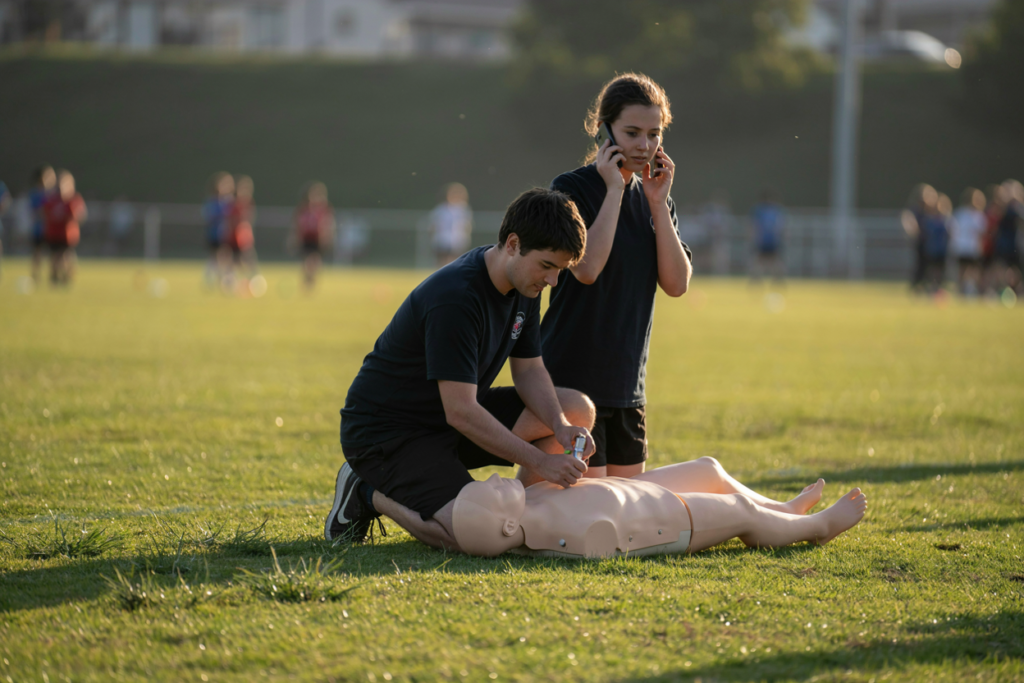
Is Your Team Actually Ready? A Reality Check for Your Workplace
Awareness vs. Formal Training, What’s Actually Enough?
This is usually where the hesitation kicks in. Does your team need a full, formal course, or is a shorter awareness session enough? Honest answer, it depends on your setting, but the honest starting point is this: knowing the difference between asthma and anaphylaxis, and knowing what to do in the first minute, isn’t something most people pick up by accident. It has to be taught, and it has to be practiced, at least once, somewhere other than in the middle of an actual emergency.
If your team includes someone with a known allergy or asthma diagnosis, or you’re serving food, running a bar, or managing a club canteen, that tips things toward something more formal. If the risk is lower and more general, an awareness session might genuinely be enough for now. Either way, guessing isn’t a strategy.
Questions Worth Asking Your Team This Week
A few honest questions, asked out loud this week, tell you more than any risk assessment document sitting in a drawer:
- Does everyone on shift know exactly where the first aid kit and any autoinjectors are kept?
- Has anyone on your team actually been trained in this, or are you assuming "someone" has?
- Could your staff, right now, tell asthma and anaphylaxis apart under pressure?
- If someone collapsed on the floor tomorrow, who would step forward, and would they know what to do?
If any of those answers make you wince a little, that’s useful information, not a failure. It just means you know exactly where to start.
👥 Good news: Training doesn't have to mean a full day off shift. Onsite, evening and weekend sessions exist for exactly this reason.
Building Real Confidence Into Your Team
Group and Onsite Options for Busy Teams
Real readiness isn’t a one-off panic booking after a scare. It’s a normal part of how your team gets trained, the same as anything else on the roster. The good news is training doesn’t have to mean pulling your whole floor off shift for a full day or asking volunteers to give up a weekend they don’t have.
First Aid Alive runs sessions onsite, around your roster, with evening and weekend options for volunteer and committee groups who can’t take a weekday off. Group bookings mean your whole team learns the same thing, the same way, at the same time, not a patchwork of whoever happened to be on shift when someone else got trained.
What Happens After You Book
Once booked in, it’s straightforward. A trainer comes to you, or your team comes to a session, and everyone leaves knowing what this guide covers: how to spot the difference, how to respond, and when to call 000 without hesitating.
That’s the real goal here. Not a certificate filed away and forgotten, but a team that doesn’t freeze the next time someone’s struggling to breathe near the coffee machine.
Bringing It All Together
The gap between an asthma attack and anaphylaxis is measured in seconds, not minutes, and that’s what makes it so easy to underestimate until you’re standing in the middle of it. A wheeze near the coffee machine, a customer gone quiet and pale after lunch, a junior member clutching their throat on the sideline. None of these moments come with a label telling you which one you’re looking at.
What separates a workplace that handles this well from one that doesn’t isn’t luck. It’s whether someone on shift, at the club, or behind the counter that day actually knows what they’re looking at and what to do about it. The whole-body signs of anaphylaxis, the red flags of a severe asthma attack, the one rule about treating uncertainty as anaphylaxis first. None of it is complicated once laid out, but almost nobody works it out on the spot without having learned it first.
This isn’t about becoming an expert or turning a café floor into an emergency ward. It’s about closing one specific gap so that if the moment comes, somebody in the room doesn’t freeze. That’s a low bar in some ways, and a genuinely high one in others, because freezing is exactly what happens when the only preparation someone’s had is a vague sense that “someone probably knows this stuff.”
A duty of care isn’t really about paperwork sitting in a folder somewhere. It’s about the actual people standing in your venue, on your shop floor, or on your sideline on any given Saturday, and whether you’ve done something real to protect them before something happens, not after. That’s a different standard than most workplaces hold themselves to, and it’s a fair one.
None of this needs to be a big production. A short, practical session, run around your roster, gets your team from guessing to knowing. The people who work for you, volunteer with you, or sit on your committee deserve better than hoping nobody ever needs to find out whether they were ready.
Book Your First Aid Training Now
Fast, affordable, and nationally accredited training delivered by professionals who care
Frequently Asked Questions
Q.What's the main difference between asthma and anaphylaxis?
Asthma is a chronic lung condition that narrows the airways, so symptoms stay focused on breathing, wheeze, cough and chest tightness. Anaphylaxis is a whole-body allergic reaction that can affect the skin, breathing, gut and heart all at once, usually within minutes of exposure to a trigger like food, a sting or a medication. The two can look almost identical in the first moments, which is why trigger context and spread of symptoms matter as much as the symptoms themselves.
Q.Can someone have anaphylaxis without a known allergy?
Yes. A first-ever anaphylactic reaction can happen to someone who's never had a problem with that particular food or sting before, with no history to warn you it was coming. That's exactly why workplaces can't rely on a mental list of "who's allergic to what" as a safety plan.
Q.What should I do if I'm not sure whether it's asthma or anaphylaxis?
Treat it as anaphylaxis first. Use the adrenaline autoinjector before moving into standard asthma first aid, since this is the sequencing recommended by ASCIA. The downside of mistakenly treating asthma as anaphylaxis is small, but the downside of doing the reverse can be fatal.
Q.Do I still need to call 000 if the inhaler or autoinjector helps?
Yes, every time. Anaphylaxis can return in a second wave even after the autoinjector works, and a severe asthma attack can still deteriorate after the inhaler brings temporary relief. Treatment buys time, it doesn't replace an ambulance.
Making first aid training more affordable for
every classroom
We believe every student deserves access to life-saving first aid knowledge. That’s why we offer specially reduced pricing for schools and educational groups. Whether you’re booking for a single class, a year group, or your entire school, our flexible packages make training more accessible and cost-effective — without compromising quality.
