

If you’re an aged care or disability support worker in Brisbane, you’ve probably asked yourself: “Is $145 actually enough to get a real, nationally recognised HLTAID010 or am I going to end up with a certificate my employer won’t accept?”
It’s a fair question. With so many training providers out there some legitimate, some decidedly not price alone isn’t enough to make a confident decision. You need to know exactly what you’re paying for before you book.
This guide breaks down everything included in an HLTAID010 Basic Emergency Life Support course: the skills you’ll learn, what your certificate covers, and why it’s accepted by aged care providers, NDIS organisations, and disability support employers across South East Queensland.
Whether you’re renewing before a deadline or completing HLTAID010 for the first time, you’ll leave this page knowing precisely what to expect and whether this course is the right fit for your role.
What Is Included in HLTAID010 Basic Emergency Life Support?
HLTAID010 Basic Emergency Life Support is a nationally recognised qualification that trains participants to recognise and respond to life-threatening emergencies. A standard HLTAID010 course includes:
- Cardiopulmonary resuscitation (CPR) correct technique for adults, children, and infants following current ANZCOR guidelines, including chest compressions and rescue breaths
- Automated External Defibrillator (AED) operation how to safely use an AED, follow voice prompts, and ensure safe shock delivery when required
- Airway management recognising and responding to airway obstruction, including appropriate techniques to clear and maintain an open airway
- Unconscious casualty management including assessment, monitoring, and placing the person in the recovery position when appropriate
- Emergency response principles applying the DRSABCD action plan, calling 000, and effectively managing bystanders during an emergency
- Legal and duty of care considerations understanding responsibilities as a care worker in Queensland, including duty of care, consent, and reporting obligations
The course is delivered face-to-face and results in a nationally recognised Statement of Attainment issued by an ASQA-registered RTO. The qualification is valid for 3 years, with an annual CPR refresher recommended.
What Does HLTAID010 Actually Teach You? The Skills Breakdown
A lot of people show up to HLTAID010 not really knowing what to expect. They’ve been told by their employer to get it done, they’ve booked the course, and they’re hoping it’s not going to be a full day of death by PowerPoint. It’s not. Here’s exactly what you’re going to learn.
The DRSABCD Action Plan Your Framework for Every Emergency
DRSABCD is the action plan you’ll follow in any life-threatening emergency. It gives you a clear sequence to work through when everything around you feels chaotic, and it’s the foundation of everything else you’ll learn in HLTAID010.
Here’s what each step means in plain English:
- Danger check that the scene is safe for you, bystanders, and the casualty before you do anything
- Response check if the person is conscious by talking to them and gently tapping their shoulders
- Send for help call 000 immediately or direct someone nearby to call while you remain with the casualty
- Airway open and check the airway by tilting the head back and lifting the chin
- Breathing look, listen, and feel for normal breathing for no more than 10 seconds
- CPR start chest compressions if the person is not breathing normally
- Defibrillation attach an AED as soon as it is available and follow the device prompts immediately
CPR for Adults, Children, and Infants What You’ll Practise on the Day
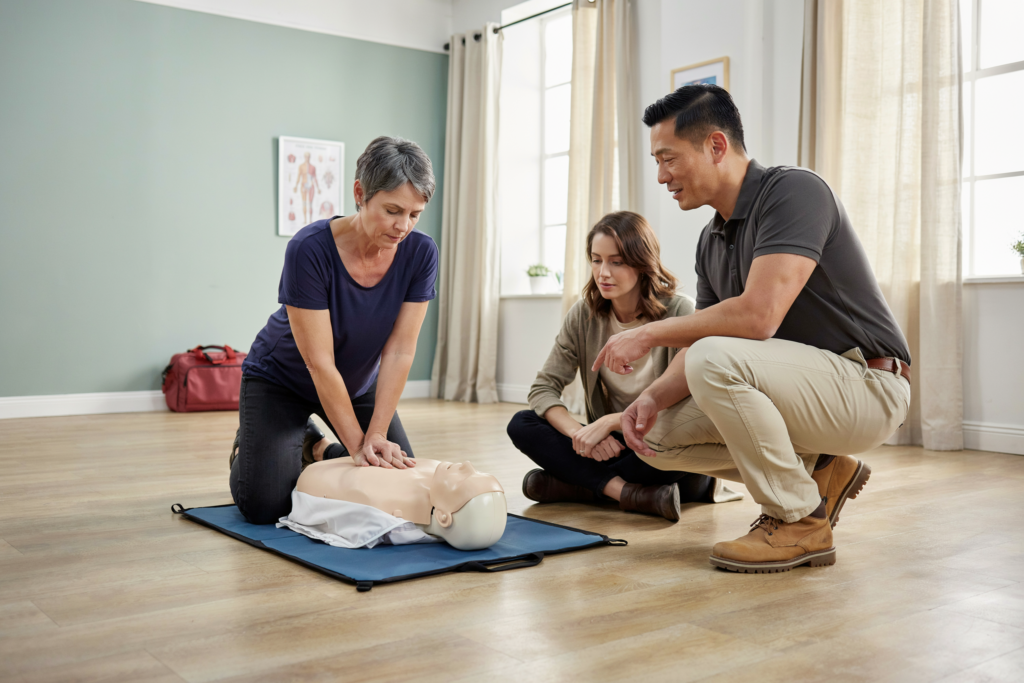
This is the hands-on part, and it’s the part that matters most. You’ll be on the floor with a manikin, practicing chest compressions and rescue breaths until the technique feels natural not just correct on paper.
The compression-to-breath ratio you’ll be working with is 30:2 30 chest compressions followed by 2 rescue breaths. You’ll repeat this cycle until the person starts breathing, an AED is ready to use, or paramedics take over. All training at First Aid Alive is based on current ANZCOR 2024 resuscitation guidelines, so what you learn reflects the latest clinical evidence, not outdated protocols.
If you’ve got a dodgy knee, a bad back, or any physical limitations you’re worried about, say so when you book. Trainers work with students of all fitness levels and will make sure you can participate fully and comfortably. Nobody’s going to make you feel embarrassed for asking.
AED Training Why This Is Now a Core Component, Not an Add-On
AED operation is now fully integrated into HLTAID010 because access to a defibrillator in the critical minutes after a cardiac arrest can be the difference between life and death. If you work in a residential aged care facility or community centre, there’s a reasonable chance there’s an AED on the wall somewhere. HLTAID010 means you’ll know exactly how to use it when it counts, no hesitation, no guessing.
Airway Management and the Recovery Position
An unconscious person left lying on their back can choke on their own tongue or fluids. The lateral recovery position keeps the airway open while you wait for QAS. You’ll practise this on the day and leave knowing exactly how to position an unconscious client safely, which is directly relevant to the people you care for every single day.
Calling 000 and Managing the Scene Until QAS Arrives
Knowing what to say when you call 000 and how to keep things under control while you wait is just as important as the physical skills. You’ll learn what information the QAS dispatcher needs, how to manage bystanders, and how to keep doing CPR until paramedics take over. You don’t stop until someone qualified tells you to. The course builds the confidence to actually do that, not just know it in theory.
Will Your Employer Accept the HLTAID010 Certificate?
This is the question that keeps a lot of care workers up at night. You can do everything right find a course, pay for it, show up, pass and still end up in a nightmare situation if the certificate your employer receives doesn’t meet their compliance requirements. Here’s what you need to know before you book anything.
What Aged Care Employers and NDIS Providers Actually Require
Both the Aged Care Quality Standards and the NDIS Practice Standards require workers in client-facing roles to hold a Statement of Attainment not a certificate of completion issued by an ASQA-registered RTO for the specific unit of competency HLTAID010. Compliance teams check for the RTO number, the qualification code, and confirmation the provider appears on training.gov.au. If any of those things are missing, the certificate gets rejected.
How to Check Your Certificate Will Be Accepted Before You Book
You don’t have to take any provider’s word for it. There are three checks you can do in under five minutes before you hand over your money:
1. Search for the qualification code HLTAID010 on training.gov.au to confirm the unit is a nationally recognised qualification.
2. Look up the provider on the ASQA RTO Register to confirm they are a registered training organisation authorised to deliver nationally recognised training.
3. Check the qualification code on your certificate to ensure it displays HLTAID010 and not an internal course code that does not appear on any national register.
What “Nationally Recognised” Really Means (And Why It Matters)
Australia’s national training framework governs which qualifications are recognized across all states and territories. When a course is delivered by an ASQA-registered RTO and issues a Statement of Attainment for HLTAID010, that qualification is recognized by employers, licensing bodies, and regulators everywhere in Australia. A “certificate of completion” from an unregistered provider isn’t part of that framework. It might look similar, but to your employer’s compliance team, the difference is immediate and non-negotiable.
💡 Real-World Example: A support worker completed an online-only first aid course at a low price point. When she submitted her certificate to her employer's compliance team, it was rejected because the provider wasn't an ASQA-registered RTO and the qualification code didn't appear on training.gov.au. She had to rebook and complete the course again, paying twice.
When Will You Receive Your HLTAID010 Certificate?
If you’re booking HLTAID010 because your employer has flagged an expiry or you’ve got a compliance deadline coming up, “when do I get my certificate” isn’t a minor detail. It’s probably the first thing you want to know. Here’s exactly how it works.
Same-Day Digital Certificate How It Works
Your Statement of Attainment is issued on the day of training not two days later, not “within 5 business days.” If you train on a Saturday morning, your certificate is in your inbox by the time you’re driving home. No waiting around over the weekend wondering if your employer’s Monday morning compliance check is going to go sideways.
What Format Is the Certificate Sent In?
Your Statement of Attainment is delivered as a digital PDF by email. It’s the full, nationally recognised document not a summary, not a placeholder issued by First Aid Alive as an ASQA-registered RTO.
The PDF format means you can do exactly what you need to do with it straight away:
- Forward it directly to your employer's HR team or compliance coordinator
- Upload it to your employer's compliance portal
- Save it to your phone for your own records
- Print it if your workplace requires a physical copy
You don’t need to wait for anything to arrive in the mail. By the time you get home, your employer can have the certificate in their system.
How to Forward Your Certificate to Your Employer or Upload to a Compliance Portal
When the certificate lands in your inbox, open the email, download the PDF, and forward it directly to your employer’s HR or compliance team or upload it to whatever portal they use. Most support workers have it sorted before they’ve even had lunch.

HLTAID010 vs HLTAID011 Which One Does Your Employer Actually Require?
This is one of the most common sources of confusion for care workers in Brisbane and across SEQ. Your employer said “first aid.” Your coordinator said “make sure it’s current.” But nobody told you which one. And the last thing you want is to complete the wrong course and have to start again.
Here’s how to tell them apart.
What Is the Difference Between HLTAID010 and HLTAID011?
Criteria | HLTAID010 | HLTAID011 |
Full name | Basic Emergency Life Support | Provide First Aid |
CPR included | Yes | Yes |
AED included | Yes | Yes |
Wound/injury management | No | Yes |
Who needs it | Aged care, disability support, NDIS support workers | First aid officers, senior carers, higher-risk roles |
Validity | 3 years (CPR: annual) | 3 years (CPR: annual) |
Wrapping It All Up
HLTAID010 Basic Emergency Life Support is one of those qualifications that sits quietly in the background of a care worker’s professional life right up until the moment it matters. And when it matters, it really matters. The difference between knowing what to do in the first few minutes of a cardiac emergency and not knowing can be the difference between a client surviving and not. That’s not dramatic. That’s just the reality of the work.
The skills you learn in HLTAID010 aren’t abstract. They’re not theory you’ll forget on the drive home. DRSABCD, CPR technique, AED operation, airway management, the recovery position these are practical, physical skills that you practise on the day until they feel automatic. The whole point of the course is to make sure that if you’re ever standing in a room where someone collapses, your body knows what to do before your brain has finished processing what’s happening.
Certification matters as much as the training itself. The most important thing isn’t just what you learn it’s whether the certificate you walk away with will be accepted by your employer, your NDIS provider, or the next facility you work at. A nationally recognised Statement of Attainment from an ASQA-registered RTO is the difference between your training counting and it not counting at all.
For aged care workers, disability support workers, and NDIS support staff, HLTAID010 is the qualification that keeps you on the floor, keeps you employable, and keeps the people you care for safer. It’s not a box to tick. It’s a skill set worth having.
If your certificate is expired, expiring soon, or you’ve never completed HLTAID010 before now’s the time to get it done. The booking process is simple and entirely online. Get in, get trained, get your certificate, and get back to doing the work you’re good at.
Book Your First Aid Training Now
Fast, affordable, and nationally accredited training delivered by professionals who care
Frequently Asked Questions About HLTAID010
Q.What is HLTAID010?
HLTAID010 Basic Emergency Life Support is a nationally recognised unit of competency that trains workers to respond to life-threatening emergencies. It covers CPR for adults, children, and infants, AED operation, airway management, the recovery position, and the DRSABCD emergency response framework. It's the standard first aid qualification required by most aged care employers and NDIS registered providers for frontline support workers in Queensland.
Q.Is HLTAID010 the same as a CPR certificate?
No, but CPR is included. HLTAID010 covers a broader scope than a standalone CPR refresher, including AED operation, airway management, unconscious casualty management, and legal duty of care considerations. A CPR-only refresher doesn't meet the full requirements of most aged care or NDIS employers who specify HLTAID010 on their compliance checklists.
Q.How long is HLTAID010 valid for?
The qualification is valid for 3 years from the date of issue. However, most aged care employers and NDIS providers recommend an annual CPR component refresher to keep your skills and your employer's compliance current. When you complete HLTAID010 with First Aid Alive, you can sign up for a renewal reminder so you never get caught out by an expiring certificate.
Q.Will my HLTAID010 certificate be accepted by my aged care or NDIS employer?
Yes, provided the course is delivered by an ASQA-registered RTO and issues a nationally recognised Statement of Attainment for the unit code HLTAID010. First Aid Alive is RTO [RTO_NUMBER], registered on training.gov.au, and every course issues a Statement of Attainment that meets the requirements of the Aged Care Quality Standards and NDIS Practice Standards.
Q.Can I do HLTAID010 if I have physical limitations?
Yes. HLTAID010 includes hands-on CPR practice which involves kneeling and chest compressions, but First Aid Alive trainers work with students of all fitness levels and physical abilities. If you have a bad knee, back pain, or any other concern, note it when you book and the trainer will make appropriate adjustments so you can complete the course fully and comfortably.
Q.Do I need HLTAID010 or HLTAID011?
Most aged care support workers, personal care workers, and NDIS direct support workers need HLTAID010. HLTAID011 is required for designated first aid officers, team leaders in higher-risk settings, or workers whose employer specifically lists HLTAID011 as a requirement. If you're not sure, check your position description or ask your coordinator before you book.
Making first aid training more affordable for
every classroom
We believe every student deserves access to life-saving first aid knowledge. That’s why we offer specially reduced pricing for schools and educational groups. Whether you’re booking for a single class, a year group, or your entire school, our flexible packages make training more accessible and cost-effective — without compromising quality.
